Japan Cloud ERP Market Size & Growth Rate (2026-2032)
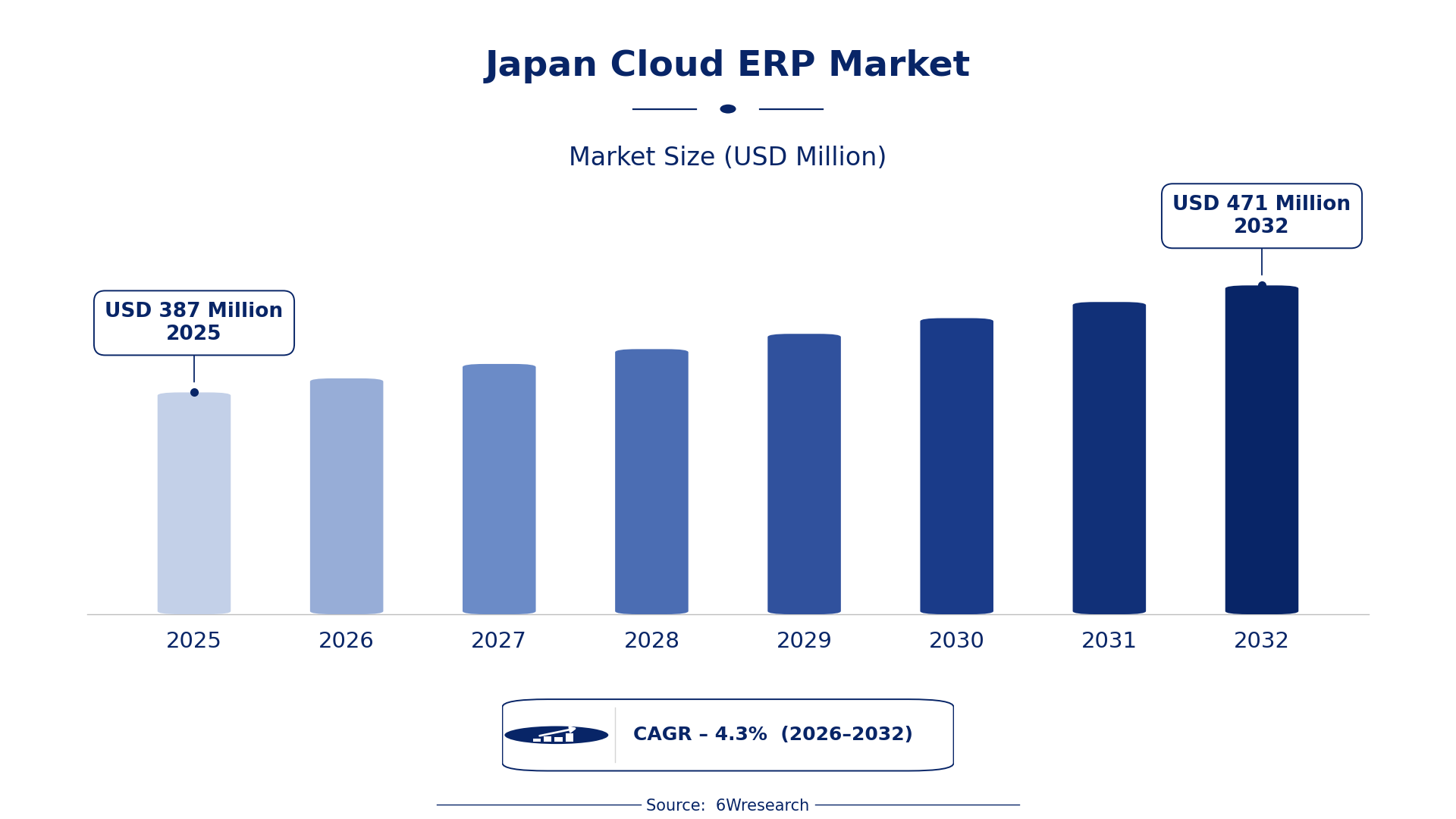
The Japan Cloud ERP Market was estimated at USD 387 Million in 2025 and is projected to reach USD 471 Million by 2032, growing at a CAGR of 4.3% from 2026 to 2032.
Japan Cloud ERP Market Synopsis
The primary force driving the Japan Cloud ERP market is the rapid shift towards digital transformation among enterprises. Businesses are increasingly recognizing the need for scalable and efficient solutions that cloud ERP systems offer, enabling them to enhance their operational efficiency.
As organizations prioritize real-time data access and integration with existing applications, they are gravitating towards cloud ERP solutions. This trend is further fueled by the demand for industry-specific functionalities, allowing businesses to tailor their systems according to unique operational needs.
Japan Cloud ERP Market Year-wise Growth Rate and Key Drivers
This graph illustrates the annual growth rates of the Japan Cloud ERP Market from 2021 to 2032, highlighting a steady upward trajectory and projected expansion over the forecast period.
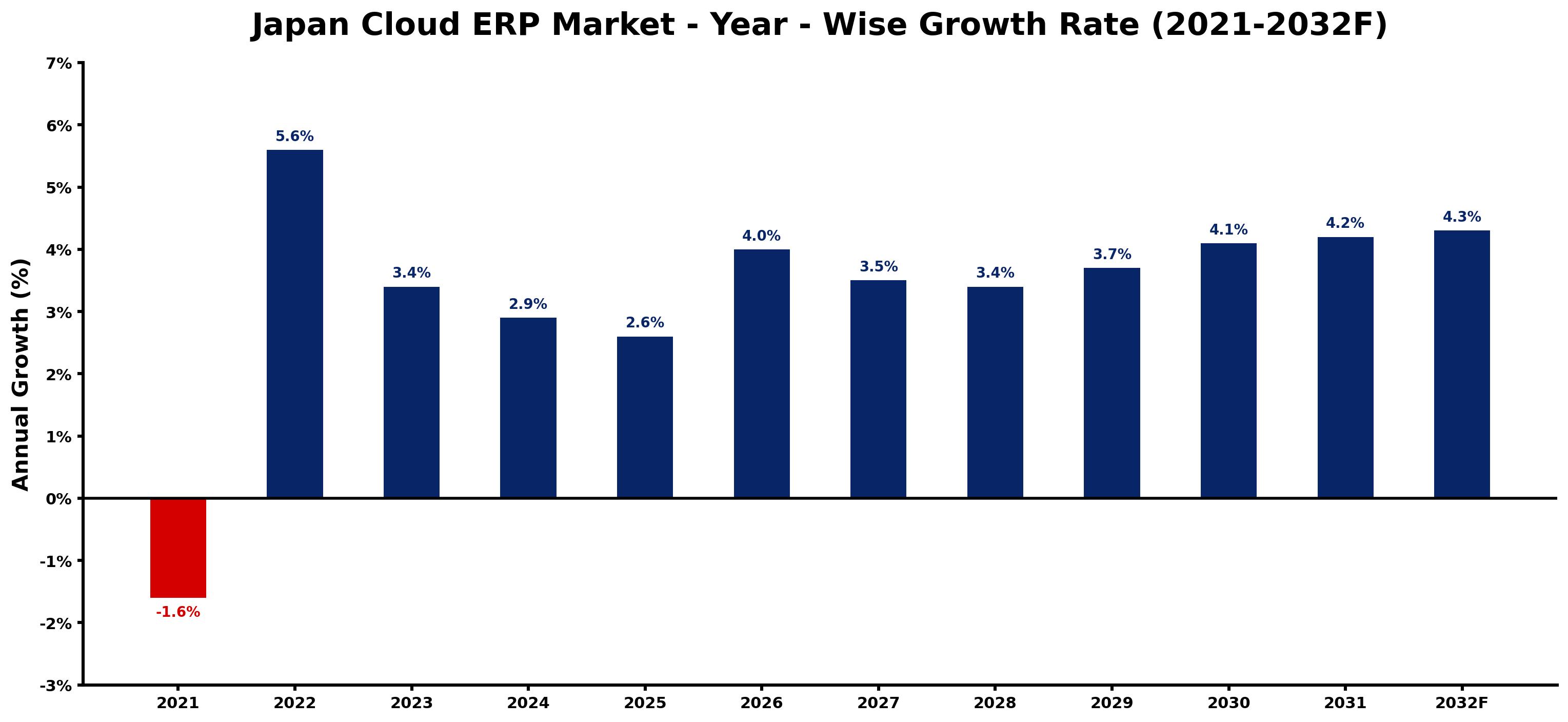
The table below presents the year‑wise growth rates along with the key drivers influencing the market
| Year | Growth Rate | Major Drivers |
| 2021 | -1.6% | Japan's strict data localization laws hindered cloud adoption. |
| 2022 | 5.6% | Japan's aging population driving automation in enterprises. |
| 2023 | 3.4% | Local companies adopting AI for enhanced ERP functionalities. |
| 2024 | 2.9% | Regulatory push for better data management practices. |
| 2025 | 2.6% | Increased focus on sustainability in business operations. |
| 2026 | 4.0% | Rising cybersecurity threats prompting ERP updates. |
| 2027 | 3.5% | Growing interest in integrated supply chain solutions. |
| 2028 | 3.4% | Tax incentives for cloud migration initiatives announced. |
| 2029 | 3.7% | Demand for customized solutions from SMEs increasing. |
| 2030 | 4.1% | Partnerships with tech firms boosting system integration. |
| 2031 | 4.2% | Supportive government framework for tech startups emerging. |
| 2032 | 4.3% | Proliferation of IoT devices enhancing data analytics capabilities. |
Note: Market size estimations and growth projections presented in this report are based on 6Wresearch's proprietary forecasting methodology, utilizing the latest available industry data, government publications, and primary research inputs.
Japan Cloud ERP Market Key Takeaways
Below are some of the specific key takeaways from the market, including:
- The demand for mobile ERP solutions is surging as companies seek flexibility in accessing data.
- AI-driven ERP systems are gaining traction, offering predictive analytics to optimize decision-making.
- Integrated ERP suites are becoming increasingly popular, consolidating multiple business functions into one platform.
- Local customization options are essential for meeting the regulatory and operational needs of Japanese businesses.
- Security measures remain a top priority, as companies navigate data privacy concerns in cloud adoption.
Evaluation of Restraints in Japan Cloud ERP Market
Despite the promising growth trajectory, the Japan Cloud ERP market faces notable hurdles. A cultural inclination towards on-premise solutions continues to slow the adoption of cloud systems. Many businesses remain hesitant, prioritizing familiar infrastructures over the perceived risks associated with cloud technologies.
Concerns surrounding data security and privacy remain prevalent, complicating the decision-making process for many organizations. Additionally, the complexities of integrating cloud ERP solutions with existing legacy systems create further barriers, necessitating substantial investments in both time and resources. The skills gap in cloud technology expertise also poses a challenge, necessitating focused training initiatives to ensure successful implementation.
Japan Cloud ERP Market Trends
Several key trends are shaping the Japan Cloud ERP market. Firstly, there is a marked increase in the demand for integrated suites that offer comprehensive functionalities encompassing finance, HR, and supply chain management. This demand reflects a shift towards more unified systems that facilitate seamless operations.
Secondly, mobile accessibility is becoming critical as remote work arrangements persist. Companies are increasingly looking for ERP systems that allow employees to access essential data from anywhere. Lastly, the incorporation of artificial intelligence and machine learning in ERP systems is on the rise, as businesses seek to harness advanced analytics for enhanced operational insights.
Japan Cloud ERP Market Opportunities
Investment opportunities within the Japan Cloud ERP market are expanding rapidly. The ongoing digital transformation initiatives present a fertile ground for software providers and consulting services that can address the specific needs of Japanese enterprises. Businesses are eager for solutions that offer scalability and real-time data capabilities, highlighting a demand for innovative technologies.
Investors should also consider focusing on companies that specialize in industry-specific solutions, as these can cater effectively to the diverse requirements across sectors. on top of that, there is potential in supporting firms that prioritize compliance with local regulations and data security, as these factors are critical for successful cloud ERP adoption.
Government Initiatives in the Japan Cloud ERP Market
The Japanese government is actively fostering the growth of cloud ERP systems, recognizing their importance in enhancing business efficiency and global competitiveness. Recent policies have focused on supporting SMEs through financial incentives and initiatives aimed at simplifying cloud adoption processes. This proactive stance is essential as businesses increasingly embrace digital solutions.
- A recently launched initiative provides funding and resources to assist SMEs in implementing cloud ERP systems, enhancing their operational capabilities.
- Currently, the government is collaborating with industry leaders to establish guidelines for secure cloud ERP implementation, ensuring safety and compliance.
- Future plans include a nationwide digital infrastructure upgrade program expected to roll out by 2026, aimed at improving accessibility to cloud technologies.
- Ongoing efforts focus on developing a regulatory framework that mandates data transparency, enhancing trust in cloud solutions.
- A planned public-private initiative aims to increase training programs for professionals in cloud technologies, addressing the skills gap in the workforce.
Future Insights of the Japan Cloud ERP Market
Looking ahead to 2026-2032, the Japan Cloud ERP market is set to flourish. The push for digital transformation will continue to accelerate, with organizations increasingly prioritizing agility and real-time insights in their operations. As remote work solidifies its place in the business culture, demand for mobile and accessible ERP solutions will likely grow.
Tailored industry solutions are anticipated to gain prominence, as businesses seek systems that align closely with their specific operational challenges. Vendors that can integrate advanced technologies such as AI and machine learning will likely carve out competitive advantages, driving innovation in the market.
Japan Cloud ERP Market Latest Developments
Recent activity in the Japan Cloud ERP market reflects a dynamic push towards innovation and enhanced service offerings. Over the past year, numerous initiatives have emerged, aimed at addressing the evolving demands of businesses in the region. The focus has been on providing more integrated and user-friendly solutions to meet the needs of diverse sectors.
- A major technology vendor launched a new cloud ERP solution designed specifically for the manufacturing sector in late 2022, focusing on real-time data integration.
- An initiative began in early 2023 to develop a cloud-based ERP platform that incorporates AI-driven analytics for improved decision-making.
- A partnership between regional software providers was announced in early 2023, aiming to enhance ERP functionalities through shared expertise and resources.
- A rollout of a new mobile ERP application is planned for mid-2023, targeting businesses seeking on-the-go access to critical data.
- By the end of 2023, a consortium of companies is expected to launch a comprehensive training program focused on cloud technologies to address the skills gap.
Japan Cloud ERP Market - Key Attractiveness of the Report
- 10 Years of Market Numbers
- Historical Data Starting from 2022 to 2025
- Base Year: 2025
- Forecast Data until 2032
- Key Performance Indicators Impacting the Market
- Major Upcoming Developments and Projects
Key Highlights of the Report:
- Japan Cloud ERP Market Outlook
- Market Size of Japan Cloud ERP Market, 2025
- Forecast of Japan Cloud ERP Market, 2032
- Historical Data and Forecast of Japan Cloud ERP Revenues & Volume for the Period 2022-2032F
- Japan Cloud ERP Market Trend Evolution
- Japan Cloud ERP Market Drivers and Challenges
- Japan Cloud ERP Price Trends
- Japan Cloud ERP Porter's Five Forces
- Japan Cloud ERP Industry Life Cycle
- Historical Data and Forecast of Japan Cloud ERP Market Revenues & Volume By Component for the Period 2022-2032F
- Historical Data and Forecast of Japan Cloud ERP Market Revenues & Volume By Solution for the Period 2022-2032F
- Historical Data and Forecast of Japan Cloud ERP Market Revenues & Volume By Services for the Period 2022-2032F
- Historical Data and Forecast of Japan Cloud ERP Market Revenues & Volume By Vertical for the Period 2022-2032F
- Historical Data and Forecast of Japan Cloud ERP Market Revenues & Volume By BFSI for the Period 2022-2032F
- Historical Data and Forecast of Japan Cloud ERP Market Revenues & Volume By Manufacturing for the Period 2022-2032F
- Historical Data and Forecast of Japan Cloud ERP Market Revenues & Volume By IT and Telecom for the Period 2022-2032F
- Historical Data and Forecast of Japan Cloud ERP Market Revenues & Volume By Business Function for the Period 2022-2032F
- Historical Data and Forecast of Japan Cloud ERP Market Revenues & Volume By Accounting and Finance for the Period 2022-2032F
- Historical Data and Forecast of Japan Cloud ERP Market Revenues & Volume By Sales and Marketing for the Period 2022-2032F
- Historical Data and Forecast of Japan Cloud ERP Market Revenues & Volume By Inventory and Order Management for the Period 2022-2032F
- Historical Data and Forecast of Japan Cloud ERP Market Revenues & Volume By Organization Size for the Period 2022-2032F
- Historical Data and Forecast of Japan Cloud ERP Market Revenues & Volume By SMEs for the Period 2022-2032F
- Historical Data and Forecast of Japan Cloud ERP Market Revenues & Volume By Large Enterprises for the Period 2022-2032F
- Japan Cloud ERP Import Export Trade Statistics
- Market Opportunity Assessment By Component
- Market Opportunity Assessment By Vertical
- Market Opportunity Assessment By Business Function
- Market Opportunity Assessment By Organization Size
- Japan Cloud ERP Top Companies Market Share
- Japan Cloud ERP Competitive Benchmarking By Technical and Operational Parameters
- Japan Cloud ERP Company Profiles
- Japan Cloud ERP Key Strategic Recommendations






































