Japan Cloud POS Market Size & Growth Rate (2026-2032)
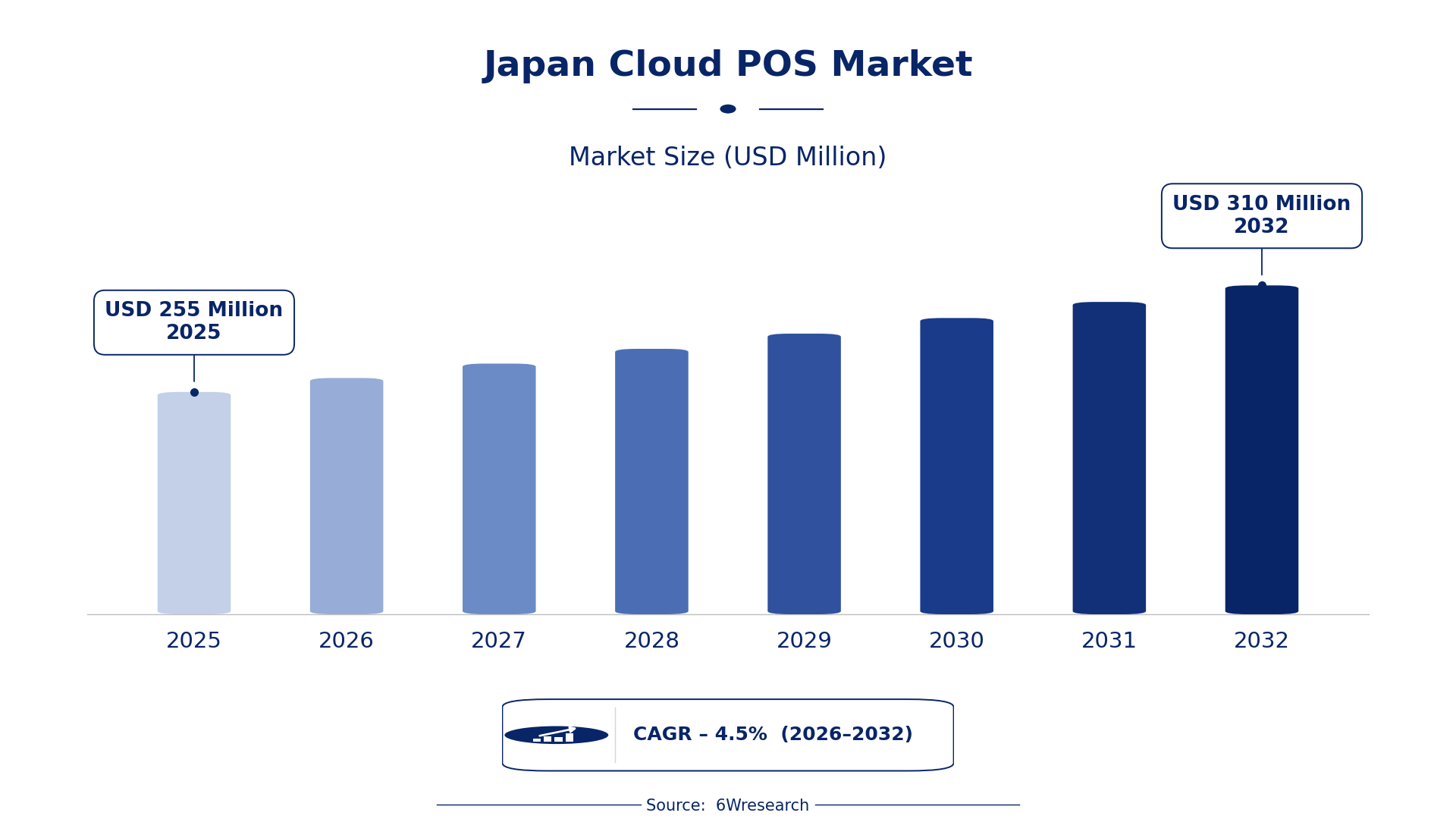
The Japan Cloud POS Market was estimated at USD 255 Million in 2025 and is projected to reach USD 310 Million by 2032, growing at a CAGR of 4.5% from 2026 to 2032.
Japan Cloud POS Market Synopsis
The surge in cloud technology adoption is the most compelling force shaping the Japan Cloud POS Market. Businesses are increasingly seeking solutions that enhance operational efficiency, particularly in the retail and hospitality sectors, where customer experience is paramount.
As retailers pivot towards digital transformation, the demand for Cloud POS systems is escalating. These systems not only support real-time data access but also facilitate remote management, aligning perfectly with the needs of modern businesses looking for agility and competitiveness.
Japan Cloud POS Market Year-wise Growth Rate and Key Drivers
This graph illustrates the annual growth rates of the Japan Cloud POS Market from 2021 to 2032, highlighting a steady upward trajectory and projected expansion over the forecast period.
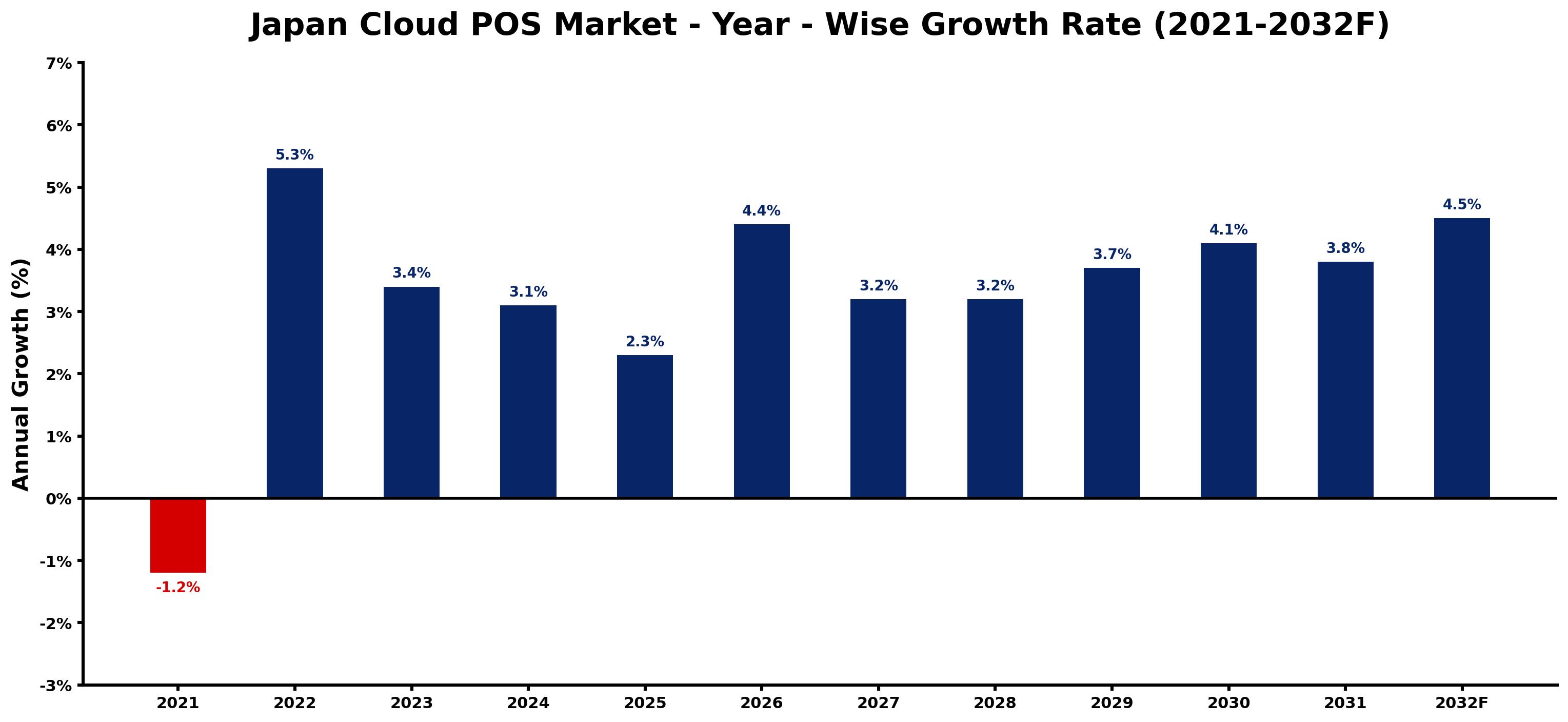
The table below presents the year‑wise growth rates along with the key drivers influencing the market
| Year | Growth Rate | Major Drivers |
| 2021 | -1.2% | Delayed adoption due to Japan's aging retail infrastructure. |
| 2022 | 5.3% | Integration of cashless payment systems in retail. |
| 2023 | 3.4% | Implementation of Japan's Digital Agency's e-commerce initiative. |
| 2024 | 3.1% | Increase in contactless payment adoption post-COVID-19. |
| 2025 | 2.3% | Supportive regulatory environment for cloud technology advancements. |
| 2026 | 4.4% | Growth in mobile commerce fueling POS cloud solutions. |
| 2027 | 3.2% | Rising consumer preference for seamless shopping experiences. |
| 2028 | 3.2% | Enhanced data analytics capabilities driving retail efficiency. |
| 2029 | 3.7% | Government incentives for small businesses adopting digital solutions. |
| 2030 | 4.1% | Adoption of AI-driven inventory management systems. |
| 2031 | 3.8% | Growing importance of cybersecurity measures in retail. |
| 2032 | 4.5% | Increased investment in retail tech startups fostering innovation. |
Note: Market size estimations and growth projections presented in this report are based on 6Wresearch's proprietary forecasting methodology, utilizing the latest available industry data, government publications, and primary research inputs.
Japan Cloud POS Market Key Takeaways
Below are some of the specific key takeaways from the market, including:
- The demand for Cloud POS solutions is driven by the rise of omnichannel retailing and e-commerce.
- Companies are prioritizing features like inventory management and customer relationship tools.
- Mobile POS systems are gaining traction due to the increase in contactless transactions.
- Data security and compliance with local regulations remain top concerns for businesses.
- Government initiatives are promoting the adoption of cloud technologies among small and medium-sized retailers.
Evaluation of Restraints in Japan Cloud POS Market
The Japan Cloud POS Market faces several real limitations that could impede its growth trajectory. A primary concern is the apprehension surrounding data security, as businesses must handle sensitive customer information in compliance with stringent regulations like the Personal Information Protection Law. This creates a reluctance to shift from traditional POS systems to cloud-based solutions.
on top of that, Japan's cultural inclination towards established, on-premise systems may hinder faster adoption of cloud technologies. Businesses also grapple with the necessity of reliable internet connectivity, which is crucial for the effective performance of Cloud POS systems. Addressing these challenges will be essential for encouraging wider market acceptance.
Japan Cloud POS Market Trends
Currently, the market is witnessing trends that reflect a shift towards more integrated and advanced Cloud POS systems. Retailers are increasingly focused on leveraging data analytics to enhance decision-making processes, prompting a demand for systems that provide real-time insights.
The popularity of mobile payments is driving the growth of mobile POS solutions, which are becoming essential for businesses looking to provide a frictionless customer experience. As consumer preferences continue to evolve, so will the functionality and capabilities of Cloud POS systems.
Japan Cloud POS Market Opportunities
There are substantial opportunities for growth in the Japan Cloud POS Market. With the ongoing rise of e-commerce, businesses are increasingly in need of integrated systems that can manage multiple sales channels effectively. This opens avenues for providers to enhance their offerings with advanced features such as analytics and customer engagement tools.
Additionally, as mobile payments continue to gain acceptance, the demand for mobile POS solutions that facilitate contactless transactions is expected to surge. Companies that can innovate and adapt their solutions to meet these changing demands are likely to succeed in this growing market.
Government Initiatives in the Japan Cloud POS Market
The Japanese government is actively fostering the adoption of cloud-based POS systems to stimulate the retail sector's digital transformation. Through various initiatives, the government aims to enhance operational efficiency and customer service in small and medium-sized enterprises.
- A program launched in 2018 by the Ministry of Economy, Trade and Industry (METI) aimed to subsidize small retailers for implementing cloud POS systems, enhancing their operational capabilities.
- Currently, ongoing efforts focus on establishing data security regulations to ensure the safe handling of customer information within cloud environments.
- A planned initiative is expected to expand access to cloud technologies for rural retailers, set to launch by 2026.
- Future regulatory frameworks are being developed to encourage transparency in billing practices for cloud services, anticipated to be introduced in 2025.
Future Insights of the Japan Cloud POS Market
The Japan Cloud POS Market is set to evolve significantly between 2026 and 2032. With the growing emphasis on digitalization, businesses will increasingly turn to cloud-based solutions that offer flexibility and scalability. The integration of advanced features such as AI-driven analytics and enhanced security measures will become commonplace, catering to the rising expectations of both businesses and consumers.
As competition intensifies, the focus will shift towards providing superior customer experiences. The need for effective inventory management and real-time data access will drive further innovations in Cloud POS systems, ensuring that businesses remain agile and responsive to market changes.
Japan Cloud POS Market Latest Developments
In the last year, the Japan Cloud POS Market has seen a flurry of activity as companies adapt to new consumer demands and technological advancements. The push towards digital solutions has prompted numerous enhancements in Cloud POS systems, signaling a commitment to improving customer engagement and operational efficiency.
- A major technology vendor launched a new Cloud POS solution in early 2025, featuring enhanced inventory management capabilities tailored for the retail sector.
- An ongoing partnership between regional operators aims to create a unified mobile POS platform, expected to improve transaction speed and customer experience by mid-2026.
- A recently completed initiative focused on upgrading existing POS systems to integrate cloud functionalities, which was finalized in late 2025.
- Upcoming in 2026, a national campaign will promote the adoption of cloud technologies among small and medium-sized enterprises, aiming to boost digital transformation.
Japan Cloud POS Market - Key Attractiveness of the Report
- 10 Years of Market Numbers
- Historical Data Starting from 2022 to 2025
- Base Year: 2025
- Forecast Data until 2032
- Key Performance Indicators Impacting the Market
- Major Upcoming Developments and Projects
Key Highlights of the Report:
- Japan Cloud POS Market Outlook
- Market Size of Japan Cloud POS Market, 2025
- Forecast of Japan Cloud POS Market, 2032
- Historical Data and Forecast of Japan Cloud POS Revenues & Volume for the Period 2022-2032F
- Japan Cloud POS Market Trend Evolution
- Japan Cloud POS Market Drivers and Challenges
- Japan Cloud POS Price Trends
- Japan Cloud POS Porter's Five Forces
- Japan Cloud POS Industry Life Cycle
- Historical Data and Forecast of Japan Cloud POS Market Revenues & Volume By Application Areas for the Period 2022-2032F
- Historical Data and Forecast of Japan Cloud POS Market Revenues & Volume By Retail and Consumer Goods for the Period 2022-2032F
- Historical Data and Forecast of Japan Cloud POS Market Revenues & Volume By Travel and Hospitality for the Period 2022-2032F
- Historical Data and Forecast of Japan Cloud POS Market Revenues & Volume By Media and Entertainment for the Period 2022-2032F
- Historical Data and Forecast of Japan Cloud POS Market Revenues & Volume By Transport and Logistics for the Period 2022-2032F
- Historical Data and Forecast of Japan Cloud POS Market Revenues & Volume By Healthcare for the Period 2022-2032F
- Historical Data and Forecast of Japan Cloud POS Market Revenues & Volume By Component for the Period 2022-2032F
- Historical Data and Forecast of Japan Cloud POS Market Revenues & Volume By Solution for the Period 2022-2032F
- Historical Data and Forecast of Japan Cloud POS Market Revenues & Volume By Services for the Period 2022-2032F
- Historical Data and Forecast of Japan Cloud POS Market Revenues & Volume By Service for the Period 2022-2032F
- Historical Data and Forecast of Japan Cloud POS Market Revenues & Volume By Training, Consulting, and Integration for the Period 2022-2032F
- Historical Data and Forecast of Japan Cloud POS Market Revenues & Volume By Support and Maintenance for the Period 2022-2032F
- Historical Data and Forecast of Japan Cloud POS Market Revenues & Volume By Organization Size for the Period 2022-2032F
- Historical Data and Forecast of Japan Cloud POS Market Revenues & Volume By SMEs for the Period 2022-2032F
- Historical Data and Forecast of Japan Cloud POS Market Revenues & Volume By Large Enterprises for the Period 2022-2032F
- Japan Cloud POS Import Export Trade Statistics
- Market Opportunity Assessment By Application Areas
- Market Opportunity Assessment By Component
- Market Opportunity Assessment By Service
- Market Opportunity Assessment By Organization Size
- Japan Cloud POS Top Companies Market Share
- Japan Cloud POS Competitive Benchmarking By Technical and Operational Parameters
- Japan Cloud POS Company Profiles
- Japan Cloud POS Key Strategic Recommendations






































