Japan Cloud Professional Services Market Size & Growth Rate (2026-2032)
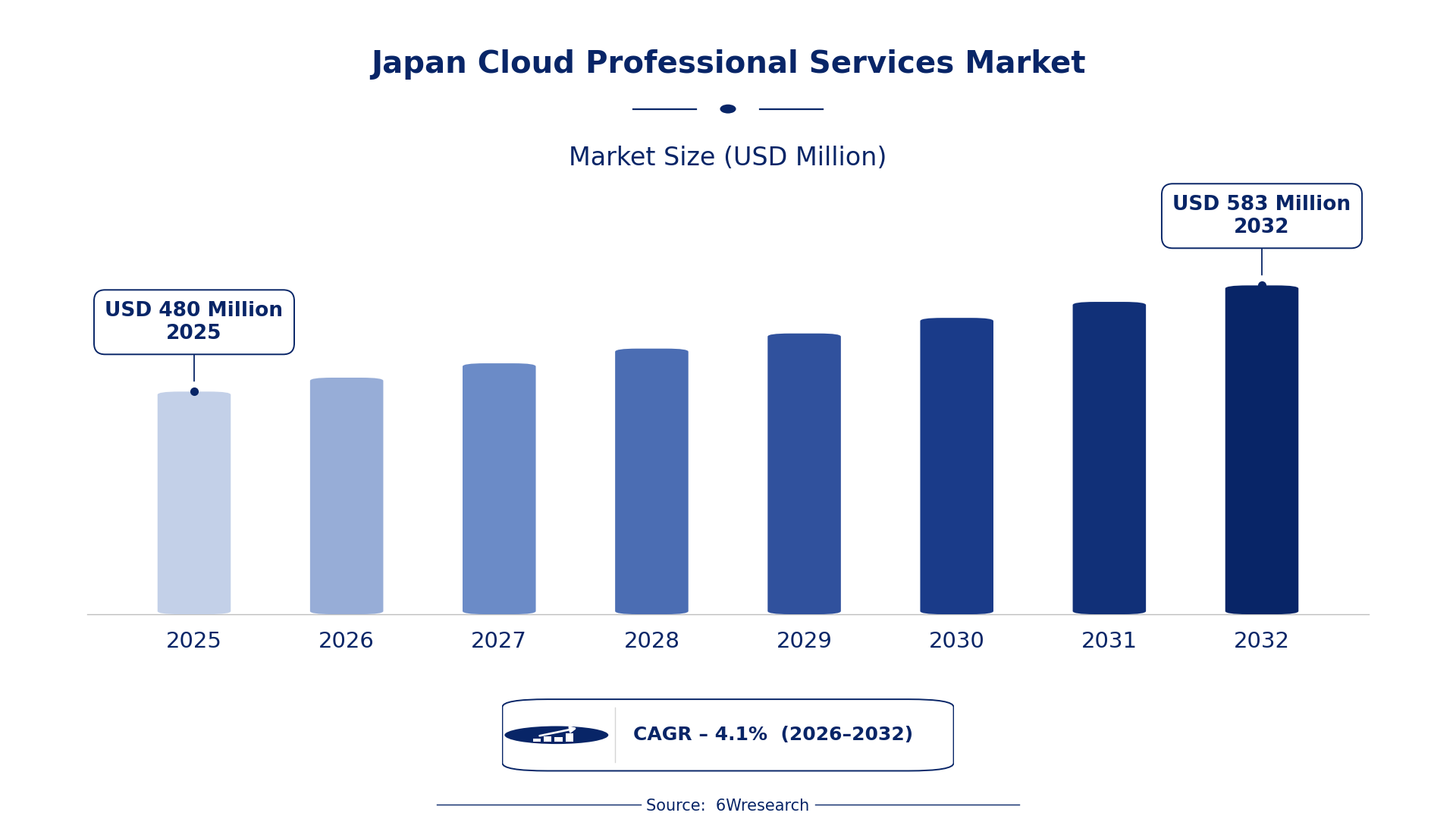
The Japan Cloud Professional Services Market was estimated at USD 480 Million in 2025 and is projected to reach USD 583 Million by 2032, growing at a CAGR of 4.1% from 2026 to 2032.
Japan Cloud Professional Services Market Synopsis
At the forefront of the Japan Cloud Professional Services Market is the increasing adoption of cloud technology across various sectors. Businesses are not just migrating to the cloud; they are embracing it as a cornerstone for operational efficiency and innovation.
The demand for specialized services such as cloud consulting and managed services is surging as companies seek tailored solutions to meet their unique needs. This shift is driven by a commitment to digital transformation, necessitating professional guidance to navigate the complexities of cloud integration and optimization.
Japan Cloud Professional Services Market Year-wise Growth Rate and Key Drivers
This graph illustrates the annual growth rates of the Japan Cloud Professional Services Market from 2021 to 2032, highlighting a steady upward trajectory and projected expansion over the forecast period.
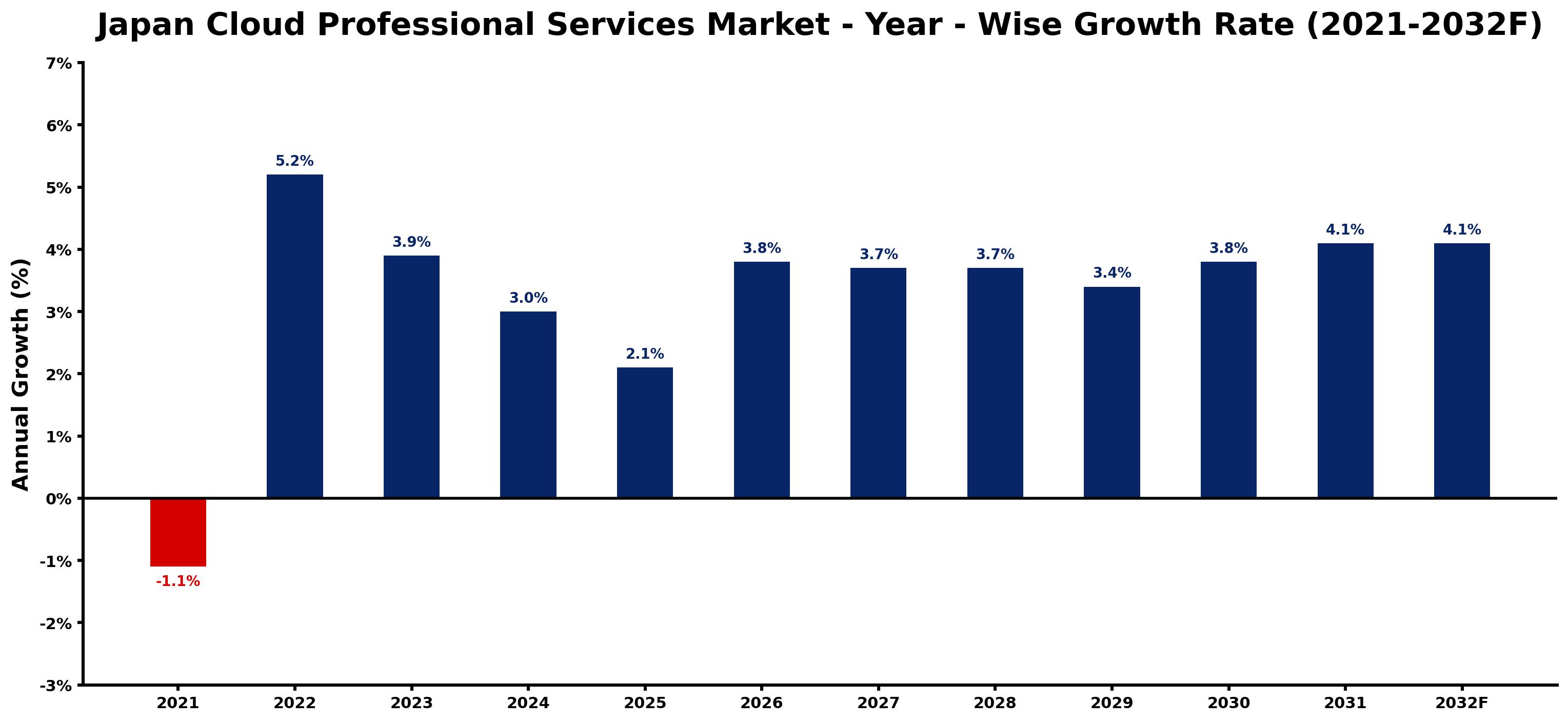
The table below presents the year‑wise growth rates along with the key drivers influencing the market
| Year | Growth Rate | Major Drivers |
| 2021 | -1.1% | Japan's strict data localization laws hindered cloud adoption. |
| 2022 | 5.2% | Government's Digital Agency promoting cloud adoption nationwide. |
| 2023 | 3.9% | Increased investment in smart city projects driving cloud needs. |
| 2024 | 3.0% | Growing remote work culture accelerating demand for cloud solutions. |
| 2025 | 2.1% | Sector-specific regulations stimulating cloud security service demand. |
| 2026 | 3.8% | Rise in e-commerce usage enhancing cloud service integration. |
| 2027 | 3.7% | Cloud optimization projects initiated by major retailers expanding. |
| 2028 | 3.7% | Increased competition among tech firms improving service offerings. |
| 2029 | 3.4% | Strong focus on disaster recovery solutions boosting cloud investments. |
| 2030 | 3.8% | Diverse start-up ecosystem driving innovative cloud applications. |
| 2031 | 4.1% | Government incentives for cloud-based health tech investments. |
| 2032 | 4.1% | Higher demand for edge computing enhancing cloud service uptake. |
Note: Market size estimations and growth projections presented in this report are based on 6Wresearch's proprietary forecasting methodology, utilizing the latest available industry data, government publications, and primary research inputs.
Japan Cloud Professional Services Market Key Takeaways
Below are some of the specific key takeaways from the market, including:
- The market is seeing a notable shift towards multi-cloud and hybrid cloud environments.
- Cloud professional services are increasingly vital for sectors like finance, healthcare, and manufacturing.
- Regulatory changes are fostering a climate conducive to cloud adoption.
- There is a pressing need for skilled professionals to meet rising service demands.
- Companies are prioritizing partnerships with cloud providers to enhance service delivery.
Evaluation of Restraints in Japan Cloud Professional Services Market
Despite its growth trajectory, the Japan Cloud Professional Services Market faces significant restraints. The high level of competition among service providers means companies must continuously innovate and differentiate their offerings. Additionally, the cultural preference for face-to-face business interactions complicates the shift towards digital services. Concerns around data privacy and security are paramount, as companies navigate the regulatory landscape that demands compliance. The shortage of skilled professionals in cloud technologies further hampers market potential, creating a talent gap that service providers must address to sustain growth.
Japan Cloud Professional Services Market Trends
Current trends indicate a strong move towards integrating artificial intelligence and machine learning capabilities within cloud services. Companies are looking to enhance their operational efficiency and data analytics capabilities through these advanced technologies. on top of that, businesses are increasingly adopting multi-cloud strategies to avoid vendor lock-in and improve resilience. The rise of remote work is also driving demand for cloud solutions that support collaboration and productivity, solidifying cloud technology's role in modern business operations.
Japan Cloud Professional Services Market Opportunities
Opportunities abound in the Japan Cloud Professional Services Market, particularly for service providers that can offer comprehensive cloud migration and integration solutions. Industries such as healthcare and finance, which prioritize data security and regulatory compliance, are seeking specialized services to aid their transitions. The growing focus on cost optimization and operational scalability presents a fertile ground for innovative service offerings. Additionally, strategic partnerships with cloud providers can yield significant competitive advantages for service firms looking to capitalize on this market's growth potential.
Government Initiatives in the Japan Cloud Professional Services Market
The Japanese government is actively shaping the Cloud Professional Services Market through various supportive policies and initiatives. These efforts aim to promote cloud adoption, enhance cybersecurity, and ensure compliance with data privacy regulations. The government's focus on fostering digital transformation is critical for the continued growth of cloud services in the region.
- A national digital infrastructure upgrade program launched in 2023 aims to enhance cloud service accessibility for businesses.
- The Japan Cloud Computing Promotion Council is currently working on initiatives to improve cybersecurity measures across cloud platforms.
- A regulatory framework introduced in 2024 mandates enhanced data protection protocols for cloud service providers.
- A planned public-private initiative expected to roll out by 2026 will focus on developing a skilled workforce in cloud technologies.
Future Insights of the Japan Cloud Professional Services Market
Looking ahead to 2026-2032, the Japan Cloud Professional Services Market is set to expand significantly. As companies increasingly prioritize agility and scalability, the demand for cloud consulting, implementation, and managed services will continue to rise. The ongoing digital transformation across various sectors will necessitate a deeper integration of cloud solutions, paving the way for innovative service delivery models. on top of that, as cybersecurity threats evolve, the need for specialized cloud security services will become even more critical, shaping the future direction of the market.
Japan Cloud Professional Services Market Latest Developments
In the last 12-14 months, the Japan Cloud Professional Services Market has witnessed dynamic developments, reflecting the rapid pace of technological advancement and increasing demand for cloud solutions. Providers are adapting to the evolving needs of businesses, focusing on enhancing service offerings and expanding capabilities.
- A major technology vendor announced a partnership in early 2024 to develop hybrid cloud solutions tailored for the healthcare sector.
- In mid-2024, a leading regional operator launched a cloud migration service aimed at small and medium-sized enterprises.
- A rollout of a new managed services platform is expected to begin in late 2025, enhancing operational efficiency for clients.
- Currently ongoing, an initiative focused on integrating AI capabilities into cloud services aims to improve data analytics for businesses.
Japan Cloud Professional Services Market - Key Attractiveness of the Report
- 10 Years of Market Numbers
- Historical Data Starting from 2022 to 2025
- Base Year: 2025
- Forecast Data until 2032
- Key Performance Indicators Impacting the Market
- Major Upcoming Developments and Projects
Key Highlights of the Report:
- Japan Cloud Professional Services Market Outlook
- Market Size of Japan Cloud Professional Services Market, 2025
- Forecast of Japan Cloud Professional Services Market, 2032
- Historical Data and Forecast of Japan Cloud Professional Services Revenues & Volume for the Period 2022-2032F
- Japan Cloud Professional Services Market Trend Evolution
- Japan Cloud Professional Services Market Drivers and Challenges
- Japan Cloud Professional Services Price Trends
- Japan Cloud Professional Services Porter's Five Forces
- Japan Cloud Professional Services Industry Life Cycle
- Historical Data and Forecast of Japan Cloud Professional Services Market Revenues & Volume By Service Type for the Period 2022-2032F
- Historical Data and Forecast of Japan Cloud Professional Services Market Revenues & Volume By Consulting for the Period 2022-2032F
- Historical Data and Forecast of Japan Cloud Professional Services Market Revenues & Volume By Integration & Optimization for the Period 2022-2032F
- Historical Data and Forecast of Japan Cloud Professional Services Market Revenues & Volume By Implementation & Migration for the Period 2022-2032F
- Historical Data and Forecast of Japan Cloud Professional Services Market Revenues & Volume By Application Development & Modernization for the Period 2022-2032F
- Historical Data and Forecast of Japan Cloud Professional Services Market Revenues & Volume By Service Model for the Period 2022-2032F
- Historical Data and Forecast of Japan Cloud Professional Services Market Revenues & Volume By Platform as a Service (PaaS) for the Period 2022-2032F
- Historical Data and Forecast of Japan Cloud Professional Services Market Revenues & Volume By Software as a Service (SaaS) for the Period 2022-2032F
- Historical Data and Forecast of Japan Cloud Professional Services Market Revenues & Volume By Infrastructure as a Service (IaaS) for the Period 2022-2032F
- Historical Data and Forecast of Japan Cloud Professional Services Market Revenues & Volume By Deployment Model for the Period 2022-2032F
- Historical Data and Forecast of Japan Cloud Professional Services Market Revenues & Volume By Public Cloud for the Period 2022-2032F
- Historical Data and Forecast of Japan Cloud Professional Services Market Revenues & Volume By Private Cloud for the Period 2022-2032F
- Historical Data and Forecast of Japan Cloud Professional Services Market Revenues & Volume By Organization Size for the Period 2022-2032F
- Historical Data and Forecast of Japan Cloud Professional Services Market Revenues & Volume By Small and Medium-Sized Enterprises (SMEs) for the Period 2022-2032F
- Historical Data and Forecast of Japan Cloud Professional Services Market Revenues & Volume By Large Enterprises for the Period 2022-2032F
- Historical Data and Forecast of Japan Cloud Professional Services Market Revenues & Volume By Vertical for the Period 2022-2032F
- Historical Data and Forecast of Japan Cloud Professional Services Market Revenues & Volume By Baanking, Financial Services, and insurance (BFSI) for the Period 2022-2032F
- Historical Data and Forecast of Japan Cloud Professional Services Market Revenues & Volume By Retail & Consumer Goods for the Period 2022-2032F
- Historical Data and Forecast of Japan Cloud Professional Services Market Revenues & Volume By IT & ITeS for the Period 2022-2032F
- Historical Data and Forecast of Japan Cloud Professional Services Market Revenues & Volume By Telecommunications for the Period 2022-2032F
- Historical Data and Forecast of Japan Cloud Professional Services Market Revenues & Volume By Healthcare & Life Sciences for the Period 2022-2032F
- Historical Data and Forecast of Japan Cloud Professional Services Market Revenues & Volume By Manufacturing for the Period 2022-2032F
- Historical Data and Forecast of Japan Cloud Professional Services Market Revenues & Volume By Energy & Utilities for the Period 2022-2032F
- Historical Data and Forecast of Japan Cloud Professional Services Market Revenues & Volume By Government & Defense for the Period 2022-2032F
- Japan Cloud Professional Services Import Export Trade Statistics
- Market Opportunity Assessment By Service Type
- Market Opportunity Assessment By Service Model
- Market Opportunity Assessment By Deployment Model
- Market Opportunity Assessment By Organization Size
- Market Opportunity Assessment By Vertical
- Japan Cloud Professional Services Top Companies Market Share
- Japan Cloud Professional Services Competitive Benchmarking By Technical and Operational Parameters
- Japan Cloud Professional Services Company Profiles
- Japan Cloud Professional Services Key Strategic Recommendations






































