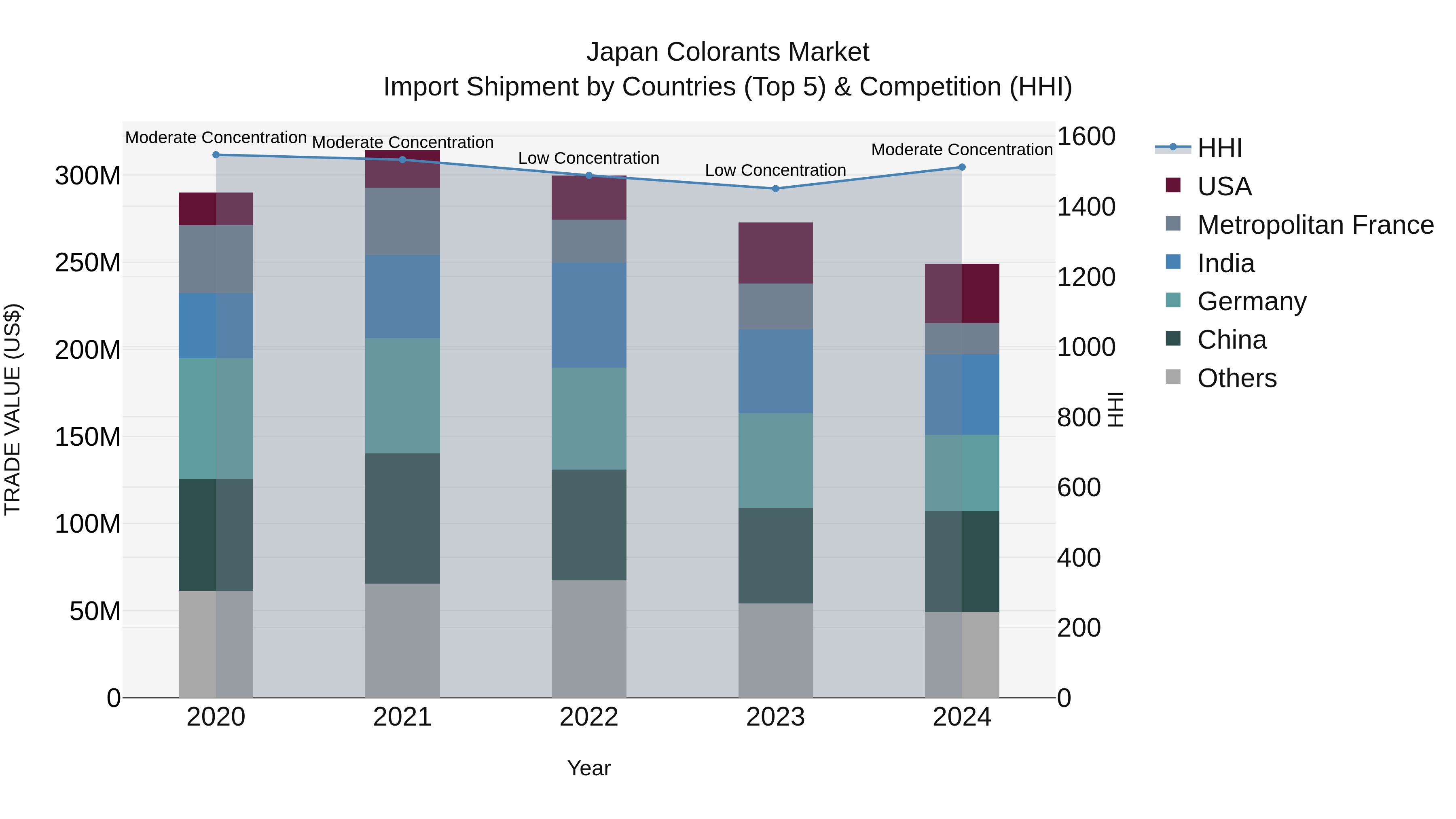
Japan Colorants Market Import Shipment by Countries (Top 5) & Competition (HHI)
In 2024, Japan saw an increase in the concentration of colorants import shipments, moving from low to moderate concentration compared to the previous year. The top countries exporting colorants to Japan were China, India, Germany, USA, and Metropolitan France. Despite a negative Compound Annual Growth Rate (CAGR) of -3.73% from 2020 to 2024, the growth rate in 2024 showed a further decline of -8.66% compared to 2023. This data suggests a challenging market environment for colorants importers in Japan, highlighting the importance of strategic planning and adaptation to the changing trends in the industry.
Japan Colorants Market Overview
The Japan Colorants Market is a thriving industry driven by strong demand from various sectors such as automotive, packaging, construction, and consumer goods. With a focus on innovation and sustainability, the market offers a wide range of colorant products including dyes, pigments, and specialty chemicals. The market is characterized by intense competition among key players such as DIC Corporation, Toyo Ink Group, and Clariant AG, who continuously strive to develop advanced and eco-friendly colorant solutions. Growing consumer awareness regarding product quality and safety further fuels the market growth, with a shift towards organic and natural colorants becoming prominent. Moreover, the stringent regulations in Japan regarding the use of colorants in different applications drive the market towards developing compliant and high-quality products to meet industry standards and regulations.
Japan Colorants Market Trends and Opportunities
The Japan Colorants Market is witnessing a shift towards environmentally friendly and sustainable products, driven by increasing awareness and regulations regarding environmental conservation. Natural and organic colorants derived from sources such as plants, minerals, and insects are gaining popularity among consumers seeking safer and more eco-friendly options. Additionally, the demand for high-performance colorants in industries like automotive, cosmetics, and textiles is creating opportunities for innovative product developments and technological advancements. Companies focusing on research and development to create new colorant solutions with improved properties, such as enhanced durability and color vibrancy, are likely to thrive in the market. Collaboration with manufacturers in different industries to customize colorants according to specific requirements also presents a promising opportunity for growth in the Japan Colorants Market.
Japan Colorants Market Challenges
In the Japan colorants market, some challenges include the increasing regulatory restrictions on certain types of colorants, particularly synthetic ones, due to environmental and health concerns. This has led to a shift towards natural and eco-friendly colorants, which may be more expensive and harder to source in large quantities. Additionally, the market faces competition from imported colorants, which may offer lower prices and wider variety, posing a challenge to domestic colorant manufacturers. Furthermore, consumer preferences for sustainable and non-toxic products are influencing the demand for colorants that are safe for both human health and the environment, requiring companies to invest in research and development to meet these evolving expectations. Overall, navigating these regulatory, competitive, and consumer-driven challenges is crucial for success in the Japan colorants market.
Japan Colorants Market Drivers
The Japan Colorants Market is primarily driven by the growing demand from end-use industries such as automotive, packaging, and construction. The increasing focus on aesthetics, product differentiation, and brand identity is fueling the demand for colorants in these sectors. Additionally, the rising adoption of eco-friendly and sustainable colorant solutions is a key driver in the market. The stringent environmental regulations and growing awareness regarding the harmful effects of conventional colorants have led to a shift towards more environmentally friendly options. Furthermore, technological advancements in colorant manufacturing processes, such as the development of high-performance pigments and dyes, are also driving market growth by offering improved color quality, durability, and versatility to meet diverse customer requirements.
Japan Colorants Market Government Policies
The Japan Colorants Market is influenced by government regulations aimed at ensuring product safety and environmental protection. The Japanese government has implemented strict regulations on the use of colorants in various industries, including food, cosmetics, and textiles, to safeguard consumer health and the environment. These regulations require colorants to meet specific safety standards and undergo rigorous testing before being approved for use. Additionally, there are guidelines in place to monitor the disposal of colorants to prevent pollution and minimize environmental impact. Companies operating in the Japan Colorants Market must comply with these regulations to maintain market access and consumer trust, driving the demand for safer and more sustainable colorant products in the market.
Japan Colorants Market Future Outlook
The Japan Colorants Market is expected to show steady growth in the coming years, driven by increasing demand from various end-use industries such as automotive, packaging, and construction. With a growing focus on sustainable and eco-friendly products, there is a rising demand for natural and organic colorants in the market. Additionally, technological advancements in the colorants industry, such as the development of high-performance pigments and dyes, are expected to further propel market growth. The market is also likely to benefit from the increasing adoption of colorants in the cosmetics and personal care sector. However, challenges such as stringent regulations on the use of certain chemicals in colorants and fluctuating raw material prices may impact the market growth to some extent.
Key Highlights of the Report:
- Japan Colorants Market Outlook
- Market Size of Japan Colorants Market, 2024
- Forecast of Japan Colorants Market, 2031
- Historical Data and Forecast of Japan Colorants Revenues & Volume for the Period 2021-2031
- Japan Colorants Market Trend Evolution
- Japan Colorants Market Drivers and Challenges
- Japan Colorants Price Trends
- Japan Colorants Porter's Five Forces
- Japan Colorants Industry Life Cycle
- Historical Data and Forecast of Japan Colorants Market Revenues & Volume By Type for the Period 2021-2031
- Historical Data and Forecast of Japan Colorants Market Revenues & Volume By Dyes for the Period 2021-2031
- Historical Data and Forecast of Japan Colorants Market Revenues & Volume By Pigments for the Period 2021-2031
- Historical Data and Forecast of Japan Colorants Market Revenues & Volume By Masterbatches for the Period 2021-2031
- Historical Data and Forecast of Japan Colorants Market Revenues & Volume By Color Concentrates for the Period 2021-2031
- Historical Data and Forecast of Japan Colorants Market Revenues & Volume By End Use Industry for the Period 2021-2031
- Historical Data and Forecast of Japan Colorants Market Revenues & Volume By Packaging for the Period 2021-2031
- Historical Data and Forecast of Japan Colorants Market Revenues & Volume By Building & Construction for the Period 2021-2031
- Historical Data and Forecast of Japan Colorants Market Revenues & Volume By Automotive for the Period 2021-2031
- Historical Data and Forecast of Japan Colorants Market Revenues & Volume By Textiles for the Period 2021-2031
- Historical Data and Forecast of Japan Colorants Market Revenues & Volume By Paper & Printing for the Period 2021-2031
- Japan Colorants Import Export Trade Statistics
- Market Opportunity Assessment By Type
- Market Opportunity Assessment By End Use Industry
- Japan Colorants Top Companies Market Share
- Japan Colorants Competitive Benchmarking By Technical and Operational Parameters
- Japan Colorants Company Profiles
- Japan Colorants Key Strategic Recommendations






































