Japan Commercial Banking Market Size & Growth Rate
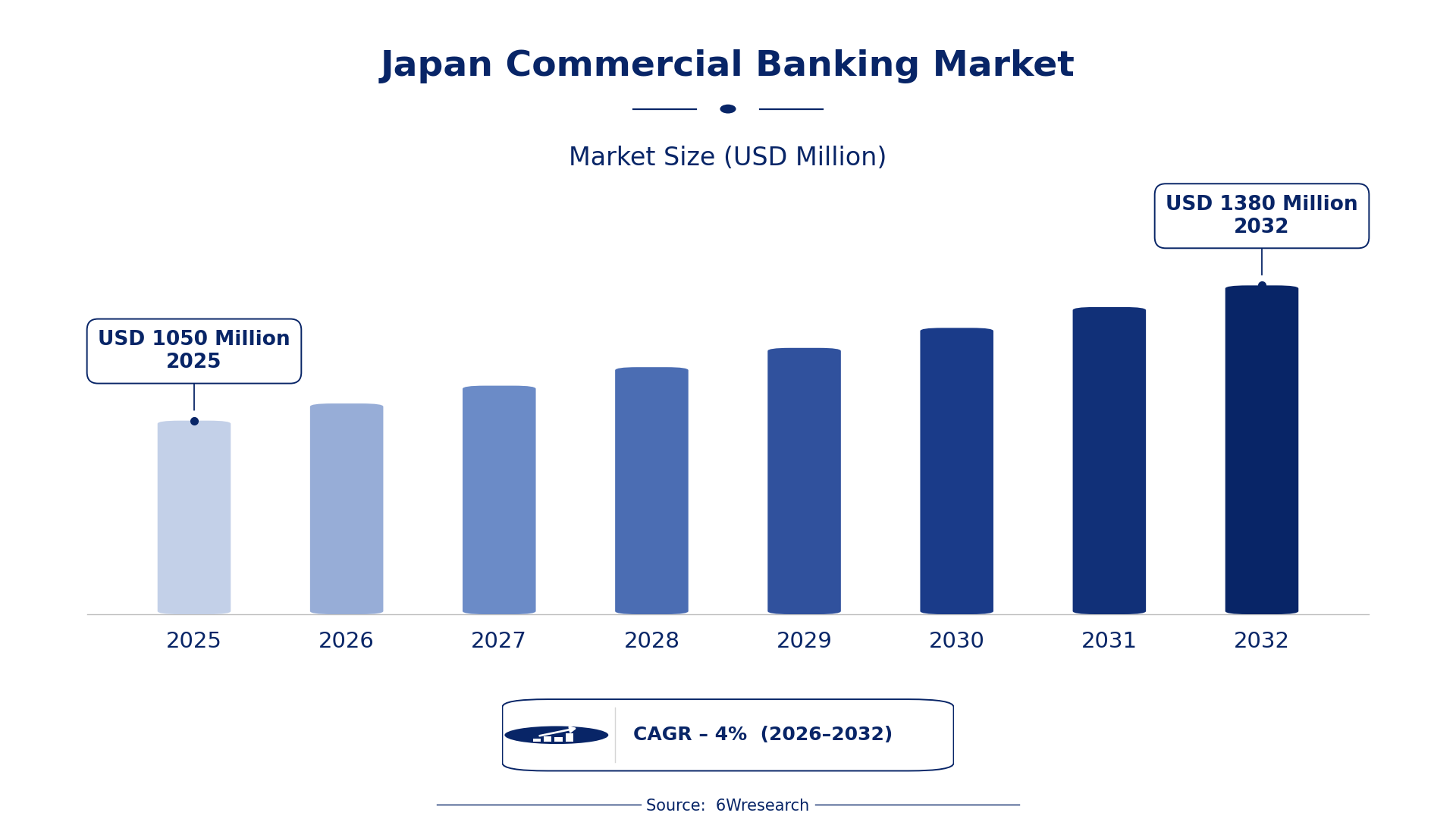
According to 6Wresearch internal database and industry insights, the Japan Commercial Banking Market was valued at USD 1,050 Million in 2025 and is projected to reach USD 1,380 Million by 2032, growing at a CAGR of approximately 4% during 2026–2032.
Japan Commercial Banking Market Highlights
| Report Metric | Details |
| Report Name | Japan Commercial Banking Market (2026-2032) |
| Market Size 2025 | USD 1,050 Million |
| Market Size 2032 | USD 1,380 Million |
| Absolute Growth 2025–2032 | USD 330 Million |
| CAGR 2026–2032 | 4% |
| Peak Annual Growth | 4.5% in 2026 |
| Forecast Period | 2026–2032 |
| Historical Data | 2022–2025 |
| Base Year | 2025 |
| Leading Products, 2025 | Syndicated Loans (39% share) |
| Leading Application, 2025 | Healthcare (43% share) |
| Fastest-Growing Products | Capital Market (5.8% CAGR) |
| Fastest-Growing Application | Construction (5.4% CAGR) |
| Growing Sector | Construction |
| Key End Users | local businesses, government projects, healthcare providers, construction firms |
Japan Commercial Banking Market Year-wise Growth Rate and Key Drivers (2022–2032)
This graph illustrates the annual growth rates of the market from 2022 to 2032, highlighting a steady upward trajectory and projected market expansion over the forecast period.
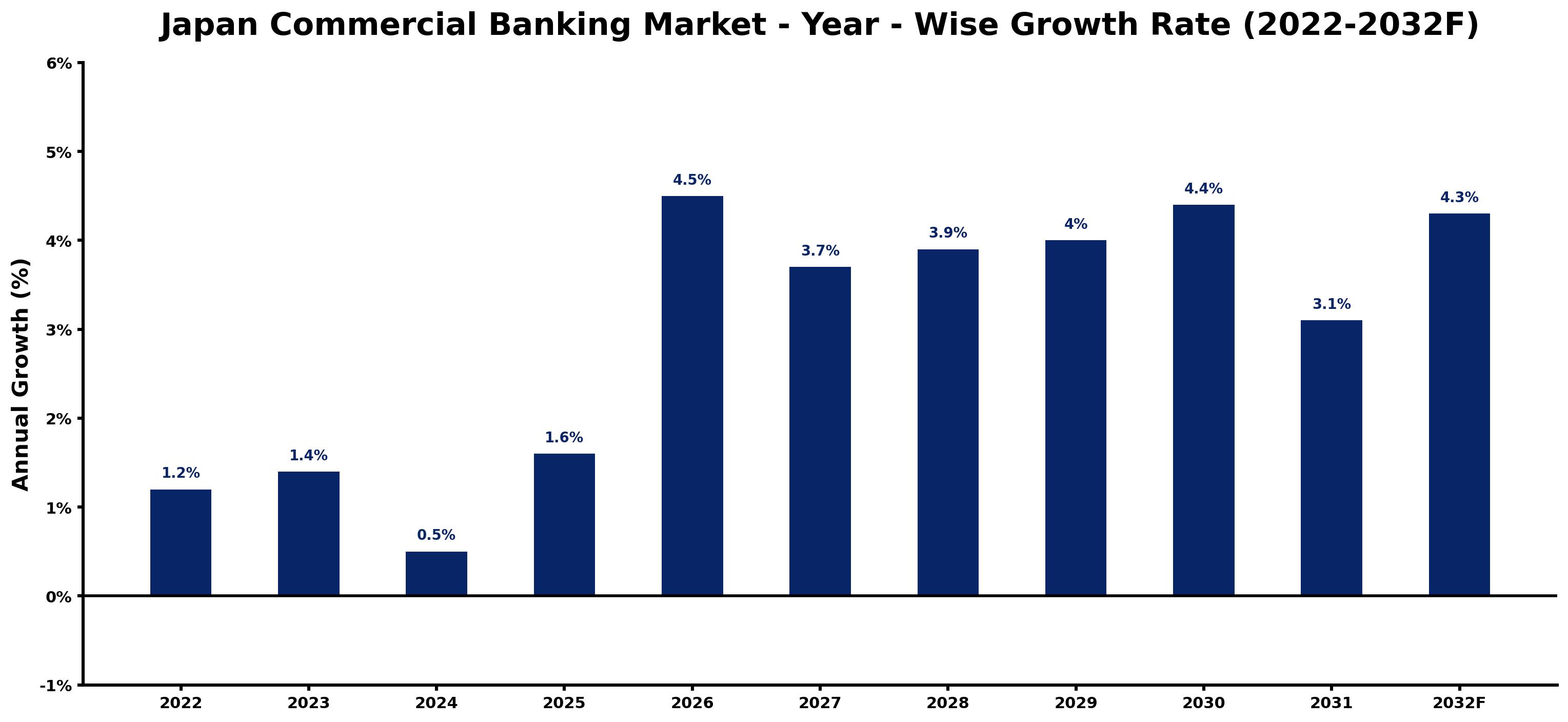
The yearly estimates that follow link every growth rate to its principal driver, so readers can see why the pace changed in each period.
| Year | Estimated Annual Growth (%) | Market Rationale |
| 2022 | 1.2 | The market showed steady growth driven by stable demand from local businesses. |
| 2023 | 1.4 | Growth accelerated due to increased lending activities in various sectors. |
| 2024 | 0.5 | The market experienced slower growth as demand stabilised after previous increases. |
| 2025 | 1.6 | Demand surged as businesses sought financing for expansion projects. |
| 2026 | 4.5 | The peak growth year is expected to be driven by infrastructure investments. |
| 2027 | 3.7 | Growth is projected to slow as the market adjusts to the previous year's peak. |
| 2028 | 3.9 | Demand is expected to increase again as businesses resume expansion plans. |
| 2029 | 4.0 | The market will continue to grow as lending activities remain strong. |
| 2030 | 4.4 | Growth is projected to remain steady, supported by ongoing infrastructure financing. |
| 2031 | 3.1 | The market will experience a slowdown as growth rates normalise. |
| 2032 | 4.3 | Demand is expected to rise as commercial activities expand further. |
Note: Market size estimations and growth projections presented in this report are based on 6Wresearch's proprietary forecasting methodology, utilizing the latest available industry data, government publications, and primary research inputs.
Japan Commercial Banking Market Synopsis
Commercial banking in Japan provides a range of financial services, including loans, deposits, and payment processing, primarily through established institutions under strict regulations. The Japan Commercial Banking Market is growing due to rising capital requirements from local businesses and government projects, with commercial lending accounting for over 40% of total bank assets. Funding directed towards sectors such as construction, projected to require ¥20 trillion by 2025, is driving further demand for banking services.
Market Dynamics Impact Analysis (2026–2032)
| Factor | Type | Impact | Primary Segment Affected |
| Increased capital requirements from local businesses | Driver | High | Commercial Lending |
| Growing demand for project financing in infrastructure | Driver | High | Project Finance |
| Expansion of fintech services enhancing customer experience | Opportunity | High | Capital Market |
| Rising construction financing needs due to urban development | Opportunity | High | Construction |
| Regulatory compliance costs impacting profitability | Restraint | Medium | Commercial Lending |
| Market saturation limiting growth potential | Restraint | Medium | Capital Market |
| Competition from emerging fintech disrupting traditional banking | Challenge | High | Others |
| Technological integration challenges for legacy systems | Challenge | Medium | Treasury Management |
Evaluation of Drivers in Japan Commercial Banking Market (2026–2032)
Key forces behind demand, with the segment each one moves most, are listed below.
| Drivers | Primary Segment Affected | Why It Matters (Evidence) |
| Increased lending for business expansion | Commercial Lending | The construction sector is projected to require ¥20 trillion in financing by 2025, prompting banks to increase lending. |
| Growing infrastructure projects driving demand | Project Finance | Infrastructure projects in Japan require substantial funding, increasing demand for project finance. |
| Expansion of fintech solutions improving service delivery | Capital Market | The new fintech framework established by the Financial Services Agency in 2023 improves banking services. |
| Rising demand for healthcare financing | Healthcare | The healthcare sector received substantial funding through commercial loans, increasing banks' involvement in this area. |
| Increased focus on treasury management services | Treasury Management | As businesses manage cash flow, demand for treasury management services rises, attracting more bank offerings. |
Buyers are adding capacity as commercial lending expands to meet the needs of local businesses, particularly in construction, which is projected to require ¥20 trillion in financing by 2025. Major infrastructure projects are increasingly sought after, driving banks to improve their offerings. The healthcare sector has also seen substantial funding through commercial loans, reflecting banks' growing involvement in this area. The fintech framework introduced in 2023 is improving service delivery, prompting banks to adopt new technologies and enhance customer interactions.
Evaluation of Restraints in Japan Commercial Banking Market
These are the pressures that could keep growth below its potential.
| Market Restraint | Primary Segment Affected | Why It Matters (Evidence) |
| High regulatory compliance costs | Commercial Lending | Compliance with Basel III standards increases operational costs for banks, affecting profitability. |
| Market saturation limiting new client acquisition | Capital Market | With over 100 banks in Japan, competition restricts growth opportunities for new entrants. |
| Technological integration challenges | Treasury Management | Legacy systems hinder the adoption of new technologies, affecting service efficiency. |
| Slow adaptation to fintech innovations | Others | Traditional banks face challenges in integrating fintech solutions, limiting their competitiveness. |
| Increased competition from non-bank financial institutions | Project Finance | Emerging fintech firms are capturing market share, creating pressure on traditional banks. |
Japan Commercial Banking Market Challenges
Over 40% of total bank assets are tied to commercial lending, limiting financing options for buyers seeking diverse funding sources. Skills shortages in fintech development hinder banks from adopting new technologies, delaying service upgrades for clients. Increased competition from digital banking initiatives forces traditional banks to lower fees, which reduces profitability for suppliers. Regulatory costs related to Basel III compliance strain resources, resulting in higher loan costs for borrowers needing capital, impacting their ability to invest in growth.
Trends in the Japan Commercial Banking Market
The shifts below are changing how Japan Commercial Banking Market products are bought and supplied.
- Shift towards Digital Banking Solutions: The trend towards digital banking solutions began in 2023 with the launch of a digital banking initiative by the Japan Financial Services Agency. This shift is improving customer engagement and operational efficiency, resulting in increased adoption of online banking services.
- Growing Focus on Sustainable Financing: Since 2022, there has been a notable increase in sustainable financing initiatives, particularly in the construction sector. This trend is driven by the need for environmentally friendly projects, with banks increasingly funding green building initiatives.
- Expansion of Fintech Integration in Banking: The integration of fintech solutions in banking has accelerated since the Financial Services Agency's 2023 framework introduction. This change is reshaping customer interactions and service delivery, compelling banks to adapt quickly.
- Increase in Project Financing for Infrastructure: The demand for project financing has surged since 2023, particularly for infrastructure projects. This trend is evidenced by the significant funding allocated to major infrastructure developments across Japan.
Investment Opportunities in the Japan Commercial Banking Market
Where to invest in the Japan Commercial Banking Market: the main openings are set out below.
- Partner with Fintech Firms for Improved Services: Banks can collaborate with fintech firms to improve service offerings, especially in urban areas like Tokyo, where digital banking is gaining traction. This partnership can enhance customer engagement and operational efficiency.
- Invest in Construction Financing Solutions: With the construction sector projected to require ¥20 trillion by 2025, banks should focus on tailored financing solutions for construction projects. Engaging with construction firms can facilitate entry into this attractive market.
- Expand Healthcare Financing Services: The healthcare sector's growing need for financing presents an opportunity for banks to develop specialised loan products. Targeting hospitals and clinics can broaden their service portfolio and increase market share.
- Enhance Treasury Management Offerings: Banks should invest in advanced treasury management solutions to meet the rising demand from businesses managing cash flow. Providing tailored services can attract more corporate clients.
Government Initiatives in the Japan Commercial Banking Market
The Building Energy Efficiency Act, amended in 2022, mandates that all new buildings meet energy standards starting April 2025. This law impacts commercial banks by necessitating financing options for compliant projects, encouraging banks to develop relevant financial products. Additionally, the Long-Term Care Insurance Act, established in 1997, continues to fund nursing care services, influencing banks to provide tailored financial products for healthcare facilities.
The Financial Services Agency oversees the banking sector, approving new fintech initiatives that improve service delivery. In 2023, the agency launched a digital banking initiative aimed at improving access to banking services, which encourages banks to innovate in their service offerings.
Future Insight of the Japan Commercial Banking Market
A shift towards digitalisation will reshape Japan's banking environment, prompting financial institutions to modernise their service offerings. The establishment of new fintech frameworks will enhance operational efficiency and customer engagement. By 2025, the construction industry is expected to require ¥20 trillion in financing, leading banks to create tailored financial products for this sector. Enhanced capital adequacy standards will encourage better risk management practices, benefiting both buyers and suppliers.
Market Segmentation Analysis
Japan Commercial Banking Market report covers a detailed analysis of the following market segments:
By Products – Syndicated Loans Lead, Capital Market Expected to Grow Fastest
According to Sumit Sagar, AM at 6Wresearch, Syndicated Loans took 39% of products revenue in 2025, more than any other category. Syndicated loans hold the largest share in Japan's commercial banking market due to their critical role in financing large-scale corporate projects. These loans are particularly vital for sectors like infrastructure, where substantial capital is required for development. Over 2026–2032, Capital Market is expected to post the fastest growth, at a CAGR of 5.8%. The capital market segment is expanding rapidly as it facilitates the trading of securities, attracting a diverse range of investors. With the Tokyo Stock Exchange being one of the largest globally, this growth is anticipated to continue. Suppliers must focus on enhancing capital market services to capitalise on emerging opportunities.
By Application – Healthcare Leads, Construction Expected to Grow Fastest
The largest application category in 2025 was Healthcare, at 43% of revenue. The healthcare sector leads in commercial banking applications as financial services are essential for supporting healthcare operations, ensuring hospitals and clinics have access to necessary funds. This support is crucial for maintaining healthcare standards and expanding service capabilities. The quickest growth will come from Construction, forecast to expand at a CAGR of 5.4% between 2026 and 2032. The construction industry is growing swiftly due to its pressing need for funding construction projects, with an estimated ¥20 trillion required by 2025. This demand is expected to rise as urban development intensifies. Buyers in the construction sector should secure financing options early to align with their project timelines and financial requirements.
Key Attractiveness of the Report
- 10 Years of Market Numbers
- Historical Data Starting from 2022 to 2025
- Base Year 2025
- Forecast Data until 2032
- Key Performance Indicators Impacting the Market
- Major Upcoming Developments and Projects
Key Highlights of the Report:
- Japan Commercial Banking Market Outlook
- Market Size of Japan Commercial Banking Market, 2025
- Forecast of Japan Commercial Banking Market, 2032
- Historical Data and Forecast of Japan Commercial Banking Revenues & Volume for the Period 2022-2032
- Japan Commercial Banking Market Trend Evolution
- Japan Commercial Banking Market Drivers and Challenges
- Japan Commercial Banking Price Trends
- Japan Commercial Banking Porter's Five Forces
- Japan Commercial Banking Industry Life Cycle
- Historical Data and Forecast of Japan Commercial Banking Market Revenues & Volume By Products for the Period 2022-2032
- Historical Data and Forecast of Japan Commercial Banking Market Revenues & Volume By Syndicated Loans for the Period 2022-2032
- Historical Data and Forecast of Japan Commercial Banking Market Revenues & Volume By Capital Market for the Period 2022-2032
- Historical Data and Forecast of Japan Commercial Banking Market Revenues & Volume By Others for the Period 2022-2032
- Historical Data and Forecast of Japan Commercial Banking Market Revenues & Volume By Commercial Lending for the Period 2022-2032
- Historical Data and Forecast of Japan Commercial Banking Market Revenues & Volume By Treasury Management for the Period 2022-2032
- Historical Data and Forecast of Japan Commercial Banking Market Revenues & Volume By Project Finance for the Period 2022-2032
- Historical Data and Forecast of Japan Commercial Banking Market Revenues & Volume By Application for the Period 2022-2032
- Historical Data and Forecast of Japan Commercial Banking Market Revenues & Volume By Healthcare for the Period 2022-2032
- Historical Data and Forecast of Japan Commercial Banking Market Revenues & Volume By Construction for the Period 2022-2032
- Historical Data and Forecast of Japan Commercial Banking Market Revenues & Volume By Transportation And Logistics for the Period 2022-2032
- Historical Data and Forecast of Japan Commercial Banking Market Revenues & Volume By Media And Entertainment for the Period 2022-2032
- Historical Data and Forecast of Japan Commercial Banking Market Revenues & Volume By Others for the Period 2022-2032
- Japan Commercial Banking Import Export Trade Statistics
- Market Opportunity Assessment By Products
- Market Opportunity Assessment By Application
- Japan Commercial Banking Top Companies Market Share
- Japan Commercial Banking Competitive Benchmarking By Technical and Operational Parameters
- Japan Commercial Banking Company Profiles
- Japan Commercial Banking Key Strategic Recommendations
Market Covered
This report examines the market across the segments below.
By Products
- Syndicated Loans
- Capital Market
- Others
- Commercial Lending
- Treasury Management
- Project Finance
By Application
- Healthcare
- Construction
- Transportation And Logistics
- Media And Entertainment
- Others































