Japan Communication Test and Measurement Market Size, Share & Growth Rate
The Japan Communication Test and Measurement Market was estimated at USD 199 Million in 2025 and is projected to reach USD 215 Million by 2032, growing at a CAGR of 1.1% from 2026 to 2032. This growth is being propelled by the rapid deployment of 5G technologies and the increasing integration of IoT devices across various sectors. As Japanese industries demand more sophisticated solutions for network performance and quality assurance, the test and measurement market is evolving to meet these stringent requirements.
Japan Communication Test and Measurement Market Year-wise Growth Rate and Key Drivers
This graph highlights how the Japan Communication Test and Measurement Market has steadily grown over the years, supported by major growth factors.
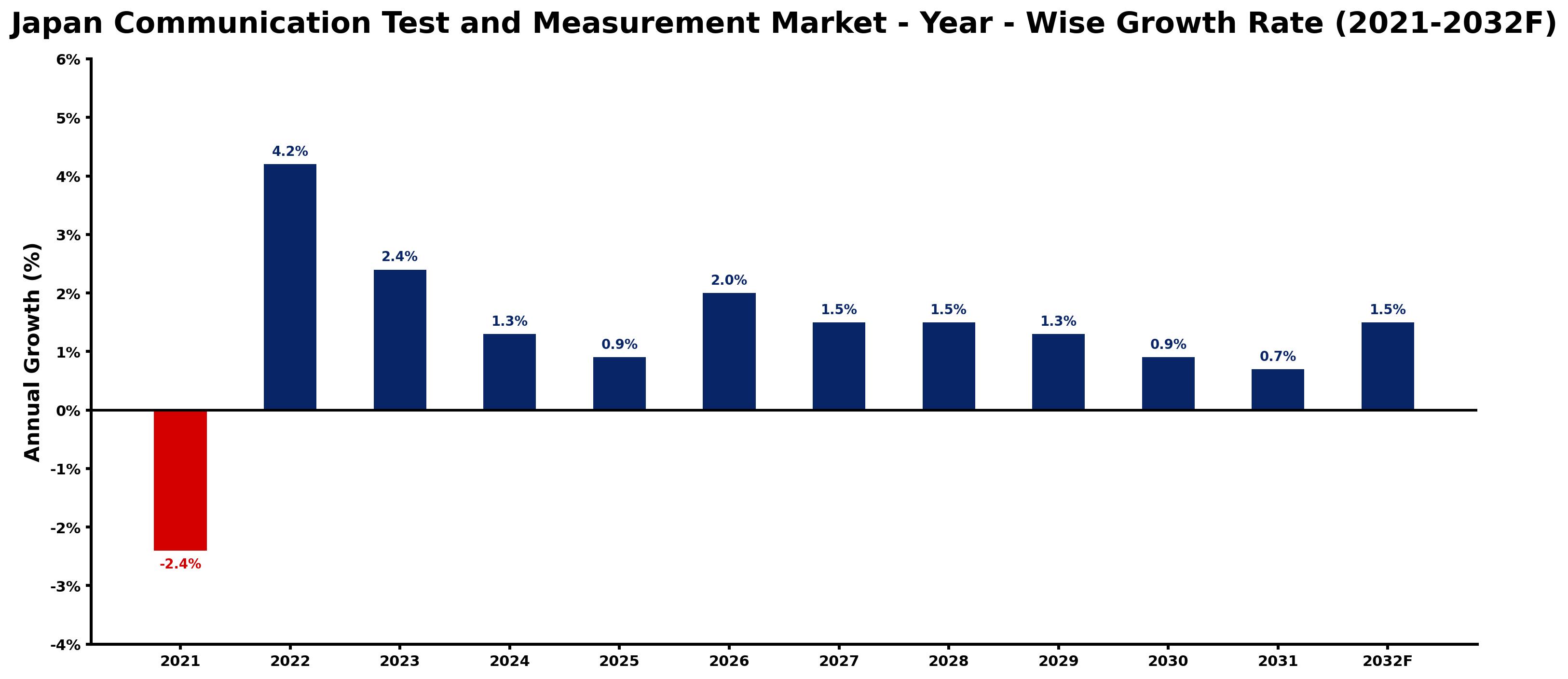
The table below presents the year‑wise growth rates along with the key drivers influencing the market
| Year | Growth Rate | Major Drivers |
| 2021 | -2.4% | Expansion of manufacturing activities |
| 2022 | 4.2% | Growing urbanization and commercial development |
| 2023 | 2.4% | Growing urbanization and commercial development |
| 2024 | 1.3% | Increasing adoption of advanced technologies |
| 2025 | 0.9% | Increasing smart city development projects |
| 2026 | 2.0% | Rising electricity demand across industries |
| 2027 | 1.5% | Increasing adoption of advanced technologies |
| 2028 | 1.5% | Expansion of commercial construction activities |
| 2029 | 1.3% | Rapid growth in telecom and data center sectors |
| 2030 | 0.9% | Rising electricity demand across industries |
| 2031 | 0.7% | Growing renewable energy integration projects |
| 2032 | 1.5% | Expansion of manufacturing activities |
Note - Market size estimations and growth projections presented in this report are based on 6Wresearch’s advanced forecasting approach, validated with industry datasets as of June 2026.
Japan Communication Test and Measurement Market Synopsis
One of the primary drivers for the Japan Communication Test and Measurement Market is the push for enhanced network reliability amid growing consumer demands for high-speed data services. This has led to an intensified focus on advanced testing solutions capable of ensuring optimal performance across various communication technologies.
Furthermore, the rise of cloud-based applications and virtualization technologies is reshaping the competitive landscape. As companies seek to streamline operations while improving the efficiency of their communication systems, the market for innovative testing tools is expanding rapidly, reflecting the fast-paced evolution of the telecommunications sector.
Japan Communication Test and Measurement Market Key Takeaways
- The market is driven by significant advancements in 5G technology and the IoT sector.
- Cloud computing and virtualization are crucial factors influencing testing methodologies.
- There is a rising demand for automated and integrated testing solutions.
- Cybersecurity concerns are prompting a focus on robust network security testing.
- Intense competition necessitates continuous innovation among market players.
Evaluation of Restraints in Japan Communication Test and Measurement Market
While the market is on a growth trajectory, several key restraints are evident. The increasing competition among established companies exerts significant pressure on pricing, which can potentially impact profit margins. Additionally, the rapid pace of technological innovation requires companies to continuously evolve their test and measurement solutions, leading to substantial R&D investments. Furthermore, the complexity of testing diverse technologies can challenge organizations lacking skilled personnel adept in utilizing sophisticated testing equipment. Addressing these limitations is critical for sustaining growth in this dynamic market.
Japan Communication Test and Measurement Market Trends
The current trend in the Japan Communication Test and Measurement Market showcases a shift toward leveraging artificial intelligence and machine learning to enhance testing processes. These technologies are enabling more precise measurements and reducing the time required for testing. Moreover, there is an increasing emphasis on end-to-end network performance testing, especially in the context of 5G deployments, ensuring that devices and networks can handle the forthcoming demands of consumers and industries alike.
Japan Communication Test and Measurement Market Opportunities
Investment opportunities in the Japan Communication Test and Measurement Market are robust. Companies focused on developing innovative testing methodologies will find fertile ground as the market seeks efficient solutions tailored to evolving communication technologies. Additionally, businesses that can effectively address the integration of advanced technologies like 5G and IoT into existing infrastructure are poised for success. There's also a rising need for solutions addressing network security, creating avenues for investment in testing tools specifically designed to combat emerging cybersecurity threats.
Government Initiatives in the Japan Communication Test and Measurement Market
The Japanese government actively promotes policies that foster competition and innovation within the communication sector. By establishing regulations that ensure compliance with industry standards, the government plays a crucial role in enhancing the credibility of testing and measurement practices. Support for research and development initiatives, along with incentives for companies adopting advanced technologies, underscores the government's commitment to strengthening Japan's position in the global telecommunications landscape.
Future Insights of the Japan Communication Test and Measurement Market
Looking ahead to the period from 2026 to 2032, the Japan Communication Test and Measurement Market is anticipated to continue its upward trajectory, primarily driven by the expanding 5G network and the proliferation of IoT devices. As companies seek to leverage virtualization and software-defined networking technologies, the demand for specialized testing capabilities will grow. Consequently, firms that are agile and responsive to technological shifts will thrive, maintaining a competitive edge in this rapidly evolving market.
Japan Communication Test and Measurement Market Latest Developments (May 2025 - June 2026)
In recent months, the Japan Communication Test and Measurement Market has observed a significant increase in partnerships among technology providers aimed at creating comprehensive solutions that address the complex needs of modern telecommunications. This collaborative effort is anticipated to enhance service delivery and improve user experience across various platforms. Furthermore, there has been a noted increase in investment towards cybersecurity solutions, reflecting a heightened awareness of the vulnerabilities present within communication networks.
Japan Communication Test and Measurement Market - Key Attractiveness of the Report
- 10 Years of Market Numbers
- Historical Data Starting from 2022 to 2025
- Base Year: 2025
- Forecast Data until 2032
- Key Performance Indicators Impacting the Market
- Major Upcoming Developments and Projects
Key Highlights of the Report:
- Japan Communication Test and Measurement Market Outlook
- Market Size of Japan Communication Test and Measurement Market, 2025
- Forecast of Japan Communication Test and Measurement Market, 2032
- Historical Data and Forecast of Japan Communication Test and Measurement Revenues & Volume for the Period 2022-2032F
- Japan Communication Test and Measurement Market Trend Evolution
- Japan Communication Test and Measurement Market Drivers and Challenges
- Japan Communication Test and Measurement Price Trends
- Japan Communication Test and Measurement Porter's Five Forces
- Japan Communication Test and Measurement Industry Life Cycle
- Historical Data and Forecast of Japan Communication Test and Measurement Market Revenues & Volume By Test Solutions for the Period 2022-2032F
- Historical Data and Forecast of Japan Communication Test and Measurement Market Revenues & Volume By Wireless for the Period 2022-2032F
- Historical Data and Forecast of Japan Communication Test and Measurement Market Revenues & Volume By Wireline for the Period 2022-2032F
- Historical Data and Forecast of Japan Communication Test and Measurement Market Revenues & Volume By Type of Test for the Period 2022-2032F
- Historical Data and Forecast of Japan Communication Test and Measurement Market Revenues & Volume By Enterprise Test for the Period 2022-2032F
- Historical Data and Forecast of Japan Communication Test and Measurement Market Revenues & Volume By Field Network Test for the Period 2022-2032F
- Historical Data and Forecast of Japan Communication Test and Measurement Market Revenues & Volume By Lab and Manufacturing Test for the Period 2022-2032F
- Historical Data and Forecast of Japan Communication Test and Measurement Market Revenues & Volume By Network Assurance Test for the Period 2022-2032F
- Historical Data and Forecast of Japan Communication Test and Measurement Market Revenues & Volume By Service for the Period 2022-2032F
- Historical Data and Forecast of Japan Communication Test and Measurement Market Revenues & Volume By Product Support Service for the Period 2022-2032F
- Historical Data and Forecast of Japan Communication Test and Measurement Market Revenues & Volume By Professional Service for the Period 2022-2032F
- Historical Data and Forecast of Japan Communication Test and Measurement Market Revenues & Volume By Managed Service for the Period 2022-2032F
- Historical Data and Forecast of Japan Communication Test and Measurement Market Revenues & Volume By Organization Size for the Period 2022-2032F
- Historical Data and Forecast of Japan Communication Test and Measurement Market Revenues & Volume By ?Small and Medium Enterprises for the Period 2022-2032F
- Historical Data and Forecast of Japan Communication Test and Measurement Market Revenues & Volume By Large Enterprises for the Period 2022-2032F
- Historical Data and Forecast of Japan Communication Test and Measurement Market Revenues & Volume By End-User for the Period 2022-2032F
- Historical Data and Forecast of Japan Communication Test and Measurement Market Revenues & Volume By Network Equipment Manufacturer for the Period 2022-2032F
- Historical Data and Forecast of Japan Communication Test and Measurement Market Revenues & Volume By Mobile Device Manufacturer for the Period 2022-2032F
- Historical Data and Forecast of Japan Communication Test and Measurement Market Revenues & Volume By Telecommunication Service Provider for the Period 2022-2032F
- Japan Communication Test and Measurement Import Export Trade Statistics
- Market Opportunity Assessment By Test Solutions
- Market Opportunity Assessment By Type of Test
- Market Opportunity Assessment By Service
- Market Opportunity Assessment By Organization Size
- Market Opportunity Assessment By End-User
- Japan Communication Test and Measurement Top Companies Market Share
- Japan Communication Test and Measurement Competitive Benchmarking By Technical and Operational Parameters
- Japan Communication Test and Measurement Company Profiles
- Japan Communication Test and Measurement Key Strategic Recommendations






































