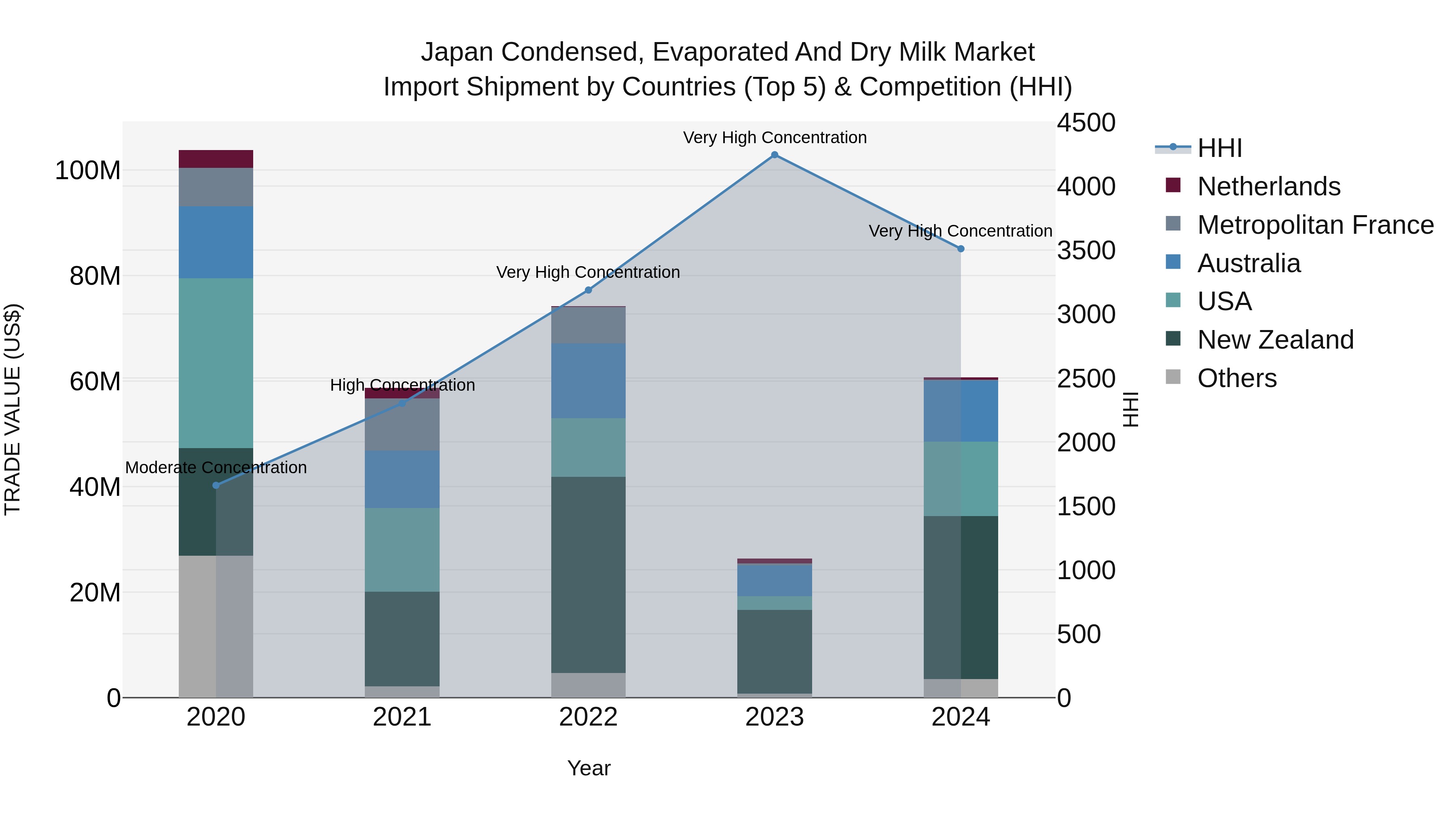
Japan Condensed, Evaporated And Dry Milk Market Import Shipment by Countries (Top 5) & Competition (HHI)
Japan's import shipments of condensed, evaporated, and dry milk in 2024 saw continued dominance from top exporters New Zealand, USA, Australia, Belarus, and Ukraine. Despite a challenging CAGR of -12.55% from 2020 to 2024, the growth rate surged by 130.42% in 2024 alone. The High Herfindahl-Hirschman Index (HHI) indicates a very concentrated market, highlighting the significance of these key exporting countries in meeting Japan's demand for milk products. This data suggests a dynamic market landscape with potential opportunities for strategic partnerships and market expansion.
Key Highlights of the Report:
- Japan Condensed, Evaporated and Dry Milk Market Outlook
- Market Size of Japan Condensed, Evaporated and Dry Milk Market, 2024
- Forecast of Japan Condensed, Evaporated and Dry Milk Market, 2026
- Historical Data and Forecast of Japan Condensed, Evaporated and Dry Milk Revenues & Volume for the Period 2021 - 2031
- Japan Condensed, Evaporated and Dry Milk Market Trend Evolution
- Japan Condensed, Evaporated and Dry Milk Market Drivers and Challenges
- Japan Condensed, Evaporated and Dry Milk Price Trends
- Japan Condensed, Evaporated and Dry Milk Porter's Five Forces
- Japan Condensed, Evaporated and Dry Milk Industry Life Cycle
- Historical Data and Forecast of Japan Condensed, Evaporated and Dry Milk Market Revenues & Volume By Product Type for the Period 2021 - 2031
- Historical Data and Forecast of Japan Condensed, Evaporated and Dry Milk Market Revenues & Volume By Dry Milk Product for the Period 2021 - 2031
- Historical Data and Forecast of Japan Condensed, Evaporated and Dry Milk Market Revenues & Volume By Condensed Milk Product for the Period 2021 - 2031
- Historical Data and Forecast of Japan Condensed, Evaporated and Dry Milk Market Revenues & Volume By Evaporated Milk Product for the Period 2021 - 2031
- Historical Data and Forecast of Japan Condensed, Evaporated and Dry Milk Market Revenues & Volume By Applications for the Period 2021 - 2031
- Historical Data and Forecast of Japan Condensed, Evaporated and Dry Milk Market Revenues & Volume By Food for the Period 2021 - 2031
- Historical Data and Forecast of Japan Condensed, Evaporated and Dry Milk Market Revenues & Volume By Beverages for the Period 2021 - 2031
- Historical Data and Forecast of Japan Condensed, Evaporated and Dry Milk Market Revenues & Volume By Intermediate Products for the Period 2021 - 2031
- Historical Data and Forecast of Japan Condensed, Evaporated and Dry Milk Market Revenues & Volume By Condiments for the Period 2021 - 2031
- Historical Data and Forecast of Japan Condensed, Evaporated and Dry Milk Market Revenues & Volume By Other for the Period 2021 - 2031
- Japan Condensed, Evaporated and Dry Milk Import Export Trade Statistics
- Market Opportunity Assessment By Product Type
- Market Opportunity Assessment By Applications
- Japan Condensed, Evaporated and Dry Milk Top Companies Market Share
- Japan Condensed, Evaporated and Dry Milk Competitive Benchmarking By Technical and Operational Parameters
- Japan Condensed, Evaporated and Dry Milk Company Profiles
- Japan Condensed, Evaporated and Dry Milk Key Strategic Recommendations






































