Japan Cosmetic Antioxidants Market Size & Growth Rate
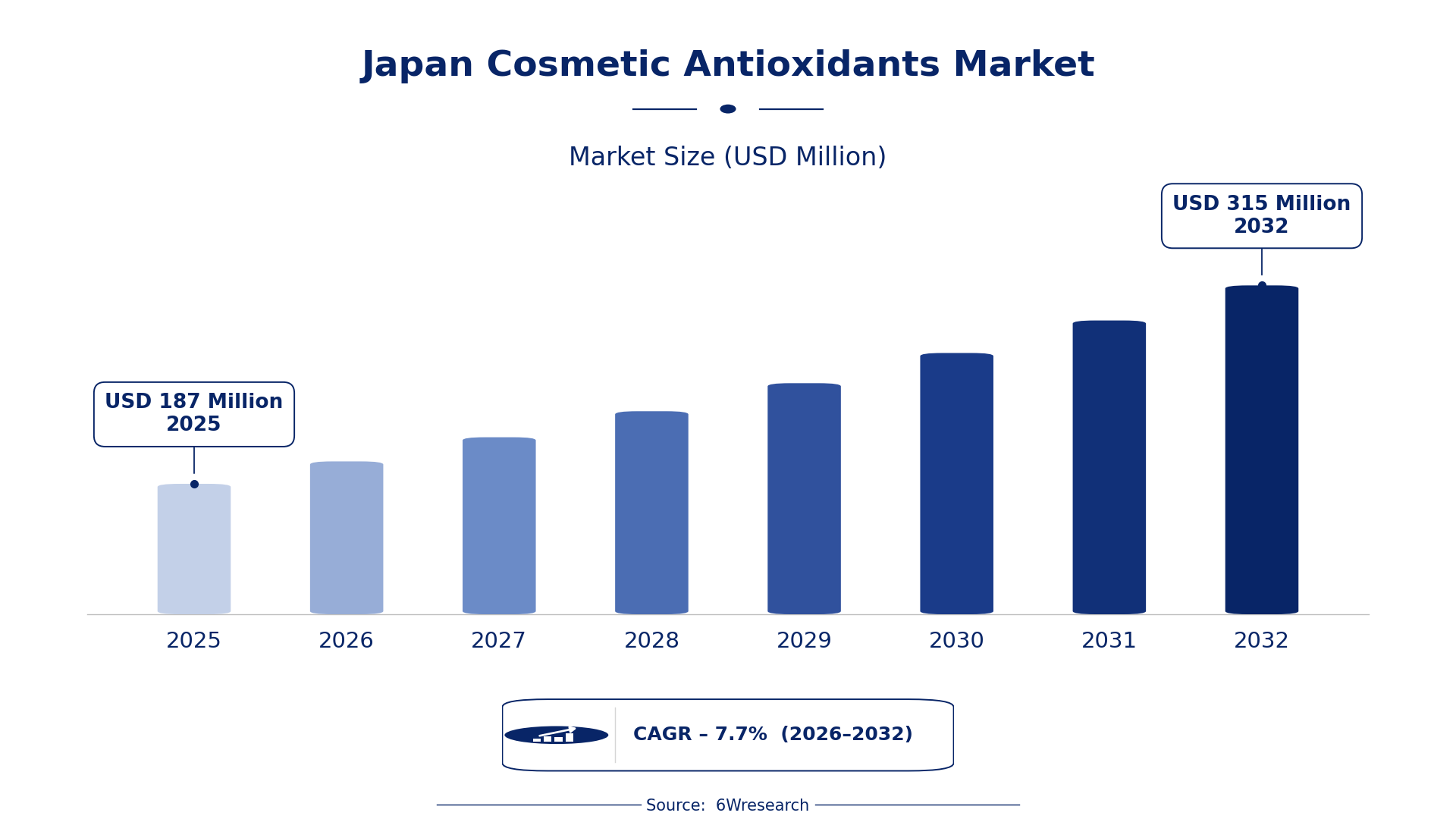
According to 6Wresearch internal database and industry insights, the Japan Cosmetic Antioxidants Market was valued at USD 187 Million in 2025 and is projected to reach USD 315 Million by 2032, growing at a CAGR of approximately 7.7% during 2026–2032.
Japan Cosmetic Antioxidants Market Highlights
| Report Metric | Details |
| Report Name | Japan Cosmetic Antioxidants Market (2026-2032) |
| Market Size 2025 | USD 187 Million |
| Market Size 2032 | USD 315 Million |
| Absolute Growth 2025–2032 | USD 128 Million |
| CAGR 2026–2032 | 7.7% |
| Peak Annual Growth | 9.2% in 2032 |
| Forecast Period | 2026–2032 |
| Historical Data | 2022–2025 |
| Base Year | 2025 |
| Leading Source, 2025 | Natural (58% share) |
| Leading Function, 2025 | Hair Conditioning (40% share) |
| Leading Type, 2025 | Vitamin (46% share) |
| Leading Application, 2025 | Skin Care (46% share) |
| Fastest-Growing Source | Chemically Derived (10.4% CAGR) |
| Fastest-Growing Function | Anti-aging (10.7% CAGR) |
| Fastest-Growing Type | Carotenoids (10.8% CAGR) |
| Fastest-Growing Application | Hair Care (10.2% CAGR) |
| Growing Sector | Skin Care |
| Key End Users | Cosmetic manufacturers, skin care brands, hair care producers, beauty retailers |
Japan Cosmetic Antioxidants Market Year-wise Growth Rate and Key Drivers (2022–2032)
This graph illustrates the annual growth rates of the market from 2022 to 2032, highlighting a steady upward trajectory and projected market expansion over the forecast period.
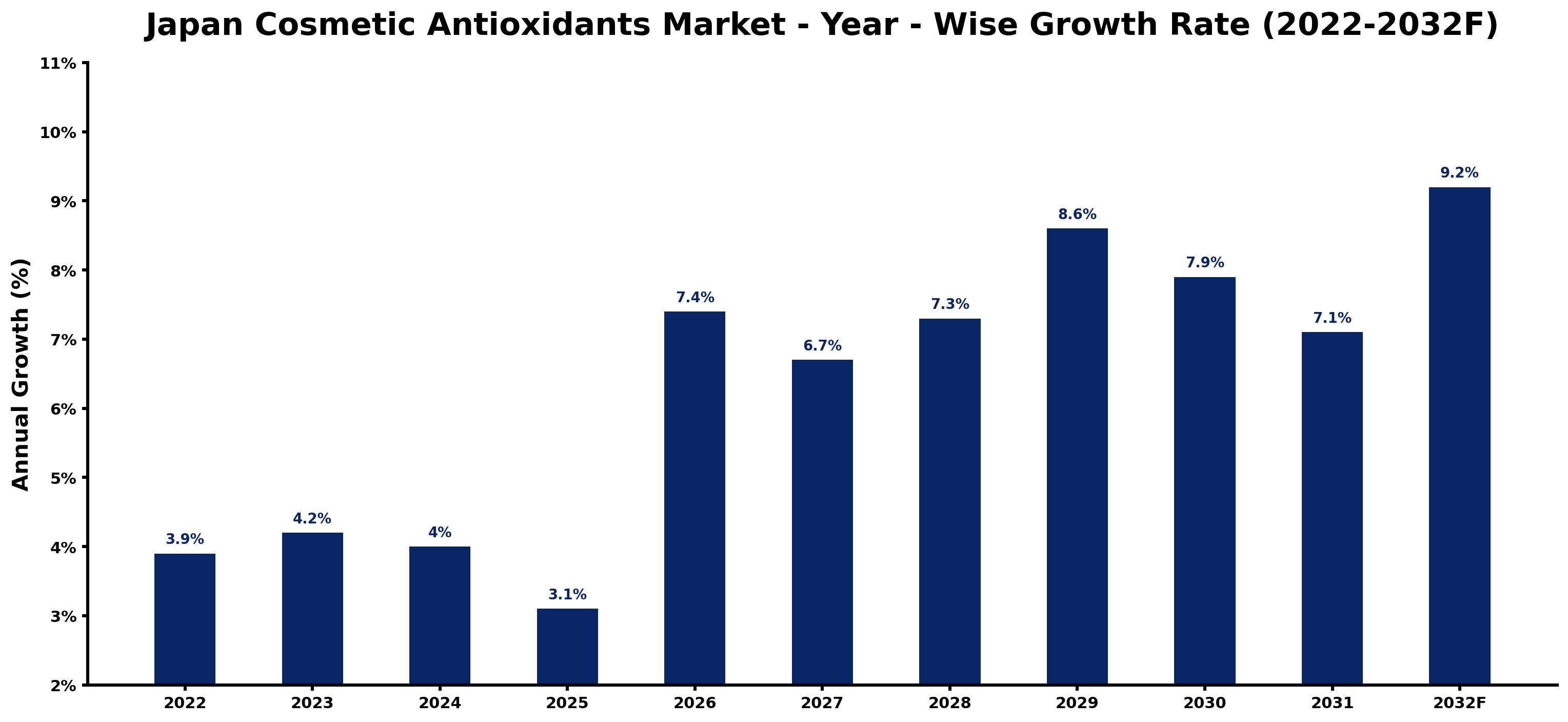
Year by year, the estimates below pair each growth rate with the development that shaped it.
| Year | Estimated Annual Growth (%) | Market Rationale |
| 2022 | 3.9 | The market experienced steady growth driven by increasing consumer awareness of skin health. |
| 2023 | 4.2 | Consumer interest in anti-aging products surged, contributing to faster growth than the previous year. |
| 2024 | 4.0 | Growth slowed slightly as market saturation began to affect new product introductions. |
| 2025 | 3.1 | The market continued to grow, but at a slower pace due to increased competition among brands. |
| 2026 | 7.4 | A resurgence in demand for natural ingredients is expected to lead to a faster growth rate. |
| 2027 | 6.7 | Growth is projected to slow again as established players dominate the market. |
| 2028 | 7.3 | Rising interest in new formulations is expected to spark renewed consumer engagement and spending. |
| 2029 | 8.6 | Demand is anticipated to accelerate further as consumers seek products with proven antioxidant benefits. |
| 2030 | 7.9 | Growth is projected to slow as market maturity sets in, with established brands holding significant shares. |
| 2031 | 7.1 | The market will continue to grow, albeit at a slower pace due to increased competition. |
| 2032 | 9.2 | The peak growth year is driven by heightened consumer focus on health and wellness. |
Note: Market size estimations and growth projections presented in this report are based on 6Wresearch's proprietary forecasting methodology, utilizing the latest available industry data, government publications, and primary research inputs.
Japan Cosmetic Antioxidants Market Synopsis
Cosmetic antioxidants protect the skin from oxidative stress and are derived from natural or synthetic sources. These compounds are widely used in skin care and hair care products to improve health and appearance. The Japan Cosmetic Antioxidants Market is expanding due to rising consumer interest in anti-aging products, with a notable increase in demand for natural ingredients, which account for over 60% of the market.
Market Dynamics Impact Analysis (2026–2032)
| Factor | Type | Impact | Primary Segment Affected |
| Increasing consumer awareness of skin health benefits | Driver | High | Skin Care |
| Growing demand for natural ingredients in cosmetics | Driver | High | Natural |
| Rising interest in anti-aging products among older consumers | Opportunity | High | Anti-aging |
| Expansion of product lines featuring antioxidants | Opportunity | Medium | Hair Care |
| Market saturation affecting new product introductions | Restraint | High | Hair Conditioning |
| Intense competition among established brands | Restraint | Medium | Skin Care |
| Supply chain disruptions impacting ingredient availability | Challenge | High | Chemically Derived |
| Regulatory compliance costs for new formulations | Challenge | Medium | Anti-inflammatory |
Evaluation of Drivers in Japan Cosmetic Antioxidants Market (2026–2032)
The factors lifting demand, and the evidence behind each, are summarised below.
| Drivers | Primary Segment Affected | Why It Matters (Evidence) |
| Rising consumer spending on skin care products | Skin Care | The average Japanese consumer spends around 10,000 yen annually on skin care, driving demand for effective antioxidants. |
| Increased focus on natural ingredients | Natural | Government initiatives promote natural ingredient sourcing, leading to over 60% market share for natural antioxidants. |
| Growing popularity of carotenoids in formulations | Carotenoids | Carotenoids are increasingly used in skin care due to their protective properties, boosting product appeal as demand rises. |
| Surge in anti-aging product demand | Anti-aging | The aging population, with over 28% aged 65 and older, fuels interest in effective anti-aging solutions. |
| Consumer awareness of UV protection benefits | UV Protection | UV protection is critical in 85% of Japanese skin care products, driving antioxidant demand. |
The strongest pull on demand comes from rising consumer spending on skin care products, with the average Japanese consumer spending around 10,000 yen annually. The growing popularity of carotenoids in formulations enhances product appeal, while the aging population drives demand for anti-aging solutions. Awareness of UV protection benefits fuels the need for antioxidants, which are critical in 85% of skin care products.
Evaluation of Restraints in Japan Cosmetic Antioxidants Market
The main factors holding the market back are set out below.
| Market Restraint | Primary Segment Affected | Why It Matters (Evidence) |
| Market saturation affecting new product introductions | Hair Conditioning | Increased competition has led to a crowded market, making it difficult for new products to gain traction. |
| Intense competition among established brands | Skin Care | Established brands dominate the market, limiting opportunities for new entrants to capture consumer attention. |
| Supply chain disruptions impacting ingredient availability | Chemically Derived | Ongoing global supply chain issues have made sourcing certain chemical antioxidants more challenging. |
| Regulatory compliance costs for new formulations | Anti-inflammatory | Compliance with stringent regulations increases costs for producers, affecting pricing strategies. |
| Consumer preference for natural over synthetic ingredients | Chemically Derived | Shifting consumer preferences towards natural ingredients reduce demand for chemically derived antioxidants. |
Japan Cosmetic Antioxidants Market Challenges
Buyers face delays in product availability due to stringent regulations imposed by the Ministry of Health, Labour and Welfare, which can extend launch timelines by up to six months. Compliance with JIS standards increases costs for producers, leading to higher prices that affect buyers' purchasing decisions. A lack of skilled formulators hampers innovation, causing producers to lag behind market trends, which frustrates buyers seeking the latest products. With the average Japanese consumer spending around 10,000 yen annually on skin care, any increase in product prices could lead to reduced sales volumes for producers.
Trends in the Japan Cosmetic Antioxidants Market
The trends below show where the Japan Cosmetic Antioxidants Market is heading.
- Shift Towards Natural Ingredients in Cosmetics: Since 2022, there has been a notable shift towards natural ingredients in cosmetic formulations, particularly in skin care. The Tokyo Beauty Week in 2023 highlighted advancements in antioxidant formulations, with over 60% of the market now comprising natural antioxidants.
- Increasing Demand for Anti-aging Products: The trend towards anti-aging products has intensified, especially among older consumers. In 2023, anti-aging products saw a 15% increase in consumer interest, reflecting the aging population's focus on maintaining youthful skin.
- Growing Popularity of Carotenoids: Carotenoids have gained traction in skin care formulations due to their protective properties. Their increasing use aligns with consumer demand for effective antioxidants, contributing to a notable rise in product offerings.
- Emphasis on UV Protection in Skin Care: The focus on UV protection has become critical, with 85% of Japanese skin care products incorporating this feature. This trend is driven by heightened consumer awareness of skin damage caused by UV exposure.
Investment Opportunities in the Japan Cosmetic Antioxidants Market
The openings below show where demand in the Japan Cosmetic Antioxidants Market is visible and how suppliers can enter.
- Rising Demand for Natural Antioxidants: With over 60% of the market comprising natural antioxidants, now is the time for suppliers to invest in sourcing and formulation. The Tokyo region is a major hub for cosmetic product development, providing opportunities for local partnerships.
- Expansion of Anti-aging Product Lines: The increasing interest in anti-aging products presents an opportunity for brands to expand their offerings. Collaborating with skin care manufacturers in Japan can facilitate entry into this growing market segment.
- Development of Hair Care Products with Antioxidants: Investing in hair care products featuring antioxidants is timely, as this segment is growing rapidly. Engaging with local distributors in the Tokyo region can enhance market penetration.
- Focus on UV Protection Formulations: The critical demand for UV protection in skin care products creates opportunities for suppliers of antioxidant ingredients. Establishing partnerships with manufacturers focusing on UV protection can yield significant market benefits.
Government Initiatives in the Japan Cosmetic Antioxidants Market
The Standards for Cosmetics established by the Ministry of Health, Labour and Welfare in 2000 set guidelines for prohibited and restricted ingredients in cosmetics. This regulation ensures consumer safety and mandates that products meet specific quality standards, impacting how producers formulate their products. The regulation also includes provisions for monitoring compliance, which affects the overall integrity of the cosmetic market. Additionally, the Chemical Substances Control Law requires evaluation and control of new and existing chemical substances in manufacture and import, further ensuring safety in product formulations.
The Ministry of Health, Labour and Welfare oversees the approval of cosmetic products, ensuring compliance with safety regulations. They also fund initiatives that promote the use of safe and effective ingredients, contributing to the overall integrity of the cosmetic market. Their actions help ensure that products containing antioxidants meet safety and quality standards, benefiting both producers and consumers. The PRTR Law mandates businesses to report releases of chemical substances, ensuring transparency in the cosmetic industry.
Future Insight of the Japan Cosmetic Antioxidants Market
Investment in research facilities will drive advancements in antioxidant formulations by 2032, meeting the rising demand for effective skin care solutions. The Tokyo region is expected to become a hub for innovative product development, enhancing choices for buyers. Anti-aging products will continue to thrive, addressing the needs of an aging population. Increased consumer awareness of antioxidant benefits will create new opportunities for suppliers to expand their offerings.
Market Segmentation Analysis
Japan Cosmetic Antioxidants Market report covers a detailed analysis of the following market segments:
By Source – Natural Leads, Chemically Derived Expected to Grow Fastest
According to Shubham Padhi, Research Analyst at 6Wresearch, the largest source category in 2025 was Natural, at 58% of revenue. Natural antioxidants dominate the market due to their widespread use in cosmetic formulations, appealing to consumers seeking skin benefits. For instance, over 60% of the antioxidant market in cosmetics is attributed to natural sources, reflecting strong consumer preference. Over 2026–2032, Chemically Derived is expected to post the fastest growth, at a CAGR of 10.4%. Chemically derived antioxidants are gaining traction as specific formulations highlight their effectiveness, particularly in targeted products. The Tokyo Beauty Week in 2023 showcased innovations that are likely to drive this segment's growth further. Suppliers should focus on developing and promoting natural and chemically derived antioxidants to meet evolving consumer preferences.
By Function – Hair Conditioning Leads, Anti-aging Expected to Grow Fastest
Hair Conditioning accounted for 40% of the market by function in 2025. Hair conditioning antioxidants lead the market as they are crucial for improving hair texture and health, making them integral to many hair care products. The strong consumer preference for products that enhance hair quality underscores their dominance in this segment. Anti-aging is projected to grow fastest, at a CAGR of 10.7% during 2026–2032. Anti-aging antioxidants are witnessing rapid growth, with a notable 15% increase in consumer interest in 2023, primarily driven by the ageing population seeking effective skin care solutions. This trend suggests that the gap between this segment and others will likely widen further. Suppliers should prioritise the development of hair conditioning and anti-aging products to align with consumer preferences.
By Type – Vitamin Leads, Carotenoids Expected to Grow Fastest
Vitamin held 46% of the Japan Cosmetic Antioxidants Market by type in 2025. Vitamin antioxidants are fundamental for maintaining skin health and are extensively used across various cosmetic products, establishing them as the leading type in the market. Their importance is underscored by the average annual spending of 10,000 yen on skin care by Japanese consumers. Carotenoids are set to record the highest CAGR in this split, 10.8% over 2026–2032. Carotenoids are increasingly favoured in skin care formulations for their beneficial antioxidant properties, reflecting a growing consumer awareness regarding skin health. This suggests a trend towards the incorporation of more specialised ingredients in cosmetic products. Suppliers should prioritise the development of vitamin and carotenoid-based products to align with the increasing consumer demand.
By Application – Skin Care Leads, Hair Care Expected to Grow Fastest
With 46% of application revenue in 2025, Skin Care was the largest category. Skin care is the foremost application for antioxidants, constituting around 40% of Japan's total cosmetic sales. The focus on skin health and anti-aging effects fuels robust demand for these products among consumers. The quickest growth will come from Hair Care, forecast to expand at a CAGR of 10.2% between 2026 and 2032. Hair care is seeing a significant rise in antioxidant use as consumers increasingly look for effective ways to improve hair health, reflecting broader trends in personal care. This momentum indicates a promising outlook for hair care products featuring antioxidants. Suppliers must adjust their product lines to take advantage of the growing market for hair care antioxidants.
Key Attractiveness of the Report
- 10 Years of Market Numbers
- Historical Data Starting from 2022 to 2025
- Base Year 2025
- Forecast Data until 2032
- Key Performance Indicators Impacting the Market
- Major Upcoming Developments and Projects
Key Highlights of the Report:
- Japan Cosmetic Antioxidants Market Outlook
- Market Size of Japan Cosmetic Antioxidants Market, 2025
- Forecast of Japan Cosmetic Antioxidants Market, 2032
- Historical Data and Forecast of Japan Cosmetic Antioxidants Revenues & Volume for the Period 2022-2032
- Japan Cosmetic Antioxidants Market Trend Evolution
- Japan Cosmetic Antioxidants Market Drivers and Challenges
- Japan Cosmetic Antioxidants Price Trends
- Japan Cosmetic Antioxidants Porter's Five Forces
- Japan Cosmetic Antioxidants Industry Life Cycle
- Historical Data and Forecast of Japan Cosmetic Antioxidants Market Revenues & Volume By Source for the Period 2022-2032
- Historical Data and Forecast of Japan Cosmetic Antioxidants Market Revenues & Volume By Natural for the Period 2022-2032
- Historical Data and Forecast of Japan Cosmetic Antioxidants Market Revenues & Volume By Chemically Derived for the Period 2022-2032
- Historical Data and Forecast of Japan Cosmetic Antioxidants Market Revenues & Volume By Function for the Period 2022-2032
- Historical Data and Forecast of Japan Cosmetic Antioxidants Market Revenues & Volume By Hair Conditioning for the Period 2022-2032
- Historical Data and Forecast of Japan Cosmetic Antioxidants Market Revenues & Volume By Anti-aging for the Period 2022-2032
- Historical Data and Forecast of Japan Cosmetic Antioxidants Market Revenues & Volume By Anti-inflammatory for the Period 2022-2032
- Historical Data and Forecast of Japan Cosmetic Antioxidants Market Revenues & Volume By UV Protection for the Period 2022-2032
- Historical Data and Forecast of Japan Cosmetic Antioxidants Market Revenues & Volume By Moisturizing for the Period 2022-2032
- Historical Data and Forecast of Japan Cosmetic Antioxidants Market Revenues & Volume By Hair Cleansing for the Period 2022-2032
- Historical Data and Forecast of Japan Cosmetic Antioxidants Market Revenues & Volume By Others for the Period 2022-2032
- Historical Data and Forecast of Japan Cosmetic Antioxidants Market Revenues & Volume By Type for the Period 2022-2032
- Historical Data and Forecast of Japan Cosmetic Antioxidants Market Revenues & Volume By Vitamin for the Period 2022-2032
- Historical Data and Forecast of Japan Cosmetic Antioxidants Market Revenues & Volume By Carotenoids for the Period 2022-2032
- Historical Data and Forecast of Japan Cosmetic Antioxidants Market Revenues & Volume By Enzymes for the Period 2022-2032
- Historical Data and Forecast of Japan Cosmetic Antioxidants Market Revenues & Volume By Polyphenols for the Period 2022-2032
- Historical Data and Forecast of Japan Cosmetic Antioxidants Market Revenues & Volume By Others for the Period 2022-2032
- Historical Data and Forecast of Japan Cosmetic Antioxidants Market Revenues & Volume By Application for the Period 2022-2032
- Historical Data and Forecast of Japan Cosmetic Antioxidants Market Revenues & Volume By Skin Care for the Period 2022-2032
- Historical Data and Forecast of Japan Cosmetic Antioxidants Market Revenues & Volume By Hair Care for the Period 2022-2032
- Historical Data and Forecast of Japan Cosmetic Antioxidants Market Revenues & Volume By Make-up for the Period 2022-2032
- Japan Cosmetic Antioxidants Import Export Trade Statistics
- Market Opportunity Assessment By Source
- Market Opportunity Assessment By Function
- Market Opportunity Assessment By Type
- Market Opportunity Assessment By Application
- Japan Cosmetic Antioxidants Top Companies Market Share
- Japan Cosmetic Antioxidants Competitive Benchmarking By Technical and Operational Parameters
- Japan Cosmetic Antioxidants Company Profiles
- Japan Cosmetic Antioxidants Key Strategic Recommendations
Market Covered
Coverage by segment is as follows.
By Source
- Natural
- Chemically Derived
By Function
- Hair Conditioning
- Anti-aging
- Anti-inflammatory
- UV Protection
- Moisturizing
- Hair Cleansing
- Others
By Type
- Vitamin
- Carotenoids
- Enzymes
- Polyphenols
- Others
By Application
- Skin Care
- Hair Care
- Make-up































