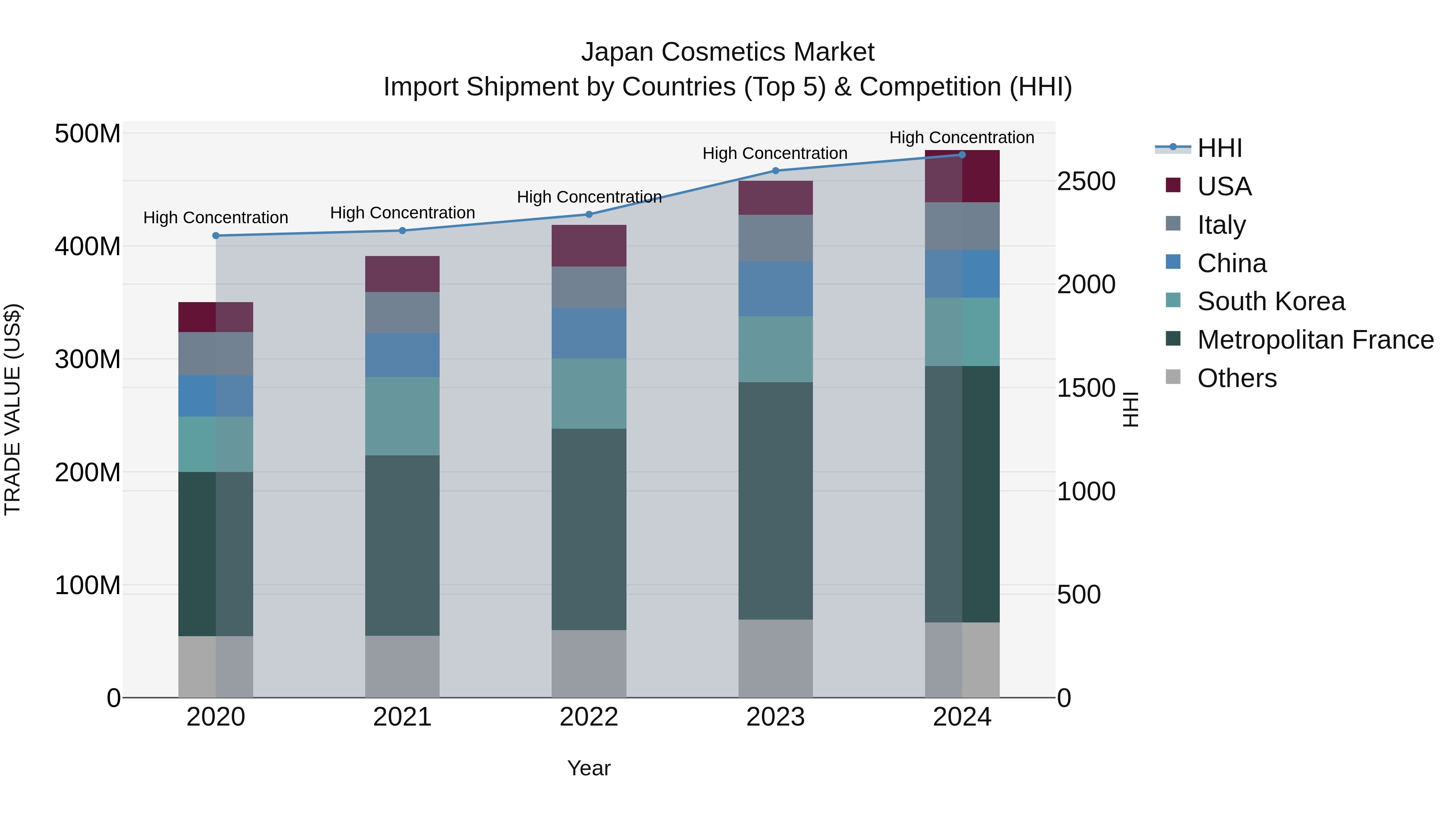
Japan Cosmetics Market Import Shipment by Countries (Top 5) & Competition (HHI)
The Japan cosmetics import market continued to thrive in 2024, with significant contributions from top exporting countries including Metropolitan France, South Korea, USA, Italy, and China. The high Herfindahl-Hirschman Index (HHI) indicates a concentrated market structure. The compound annual growth rate (CAGR) for 2020-24 stood at an impressive 8.48%, showcasing sustained growth momentum. Moreover, the growth rate from 2023-24 at 5.93% highlights the resilience and attractiveness of the Japanese cosmetics market for international suppliers.
Japan Cosmetics Market Growth Rate
According to 6Wresearch internal database and industry insights, the Japan Cosmetics Market is projected to grow at a compound annual growth rate (CAGR) of 6.6% during the forecast period 2026–2032.
Topics Covered in the Japan Cosmetics Market Report
The Japan Cosmetics Market report thoroughly covers the market by product type and category. The report provides a detailed analysis of ongoing market trends, opportunities/high-growth areas, and market drivers, helping stakeholders devise and align their market strategies according to current and future market dynamics.
Japan Cosmetics Market Highlights
| Report Name | Japan Cosmetics Market |
| Forecast Period | 2026–2032 |
| CAGR | 6.6% |
| Growing Sector | Personal Care and Beauty |
Japan Cosmetics Market Synopsis
The customer awareness about the importance of skincare regimes and product quality is rising, giving Japan cosmetics industry a boost. The market has hugely benefitted from the improvements in technology in formulations. The demand for anti-aging and functional beauty products is also helping to proliferate market growth. The product accessibility is further improving due to expanding e-commerce channels and specialty beauty stores. The safety of the product and quality standard are ensured by government regulations, bolstering consumer confidence and industry credibility.
Evaluation of Growth Drivers in the Japan Cosmetics Market
Below are some prominent drivers and their influence on the market dynamics:
| Drivers | Primary Segments Affected | Why It Matters |
| Aging Population | By Product Type (Face Care) | Increases demand for anti-aging and functional skincare products |
| Premiumization Trend | By Product Type (Face Care, Color Cosmetics) | Consumers prefer high-quality, innovative formulations |
| Growth of Online Retail | By Product Type (All) | E-commerce improves accessibility and brand reach |
| Demand for Clean Beauty | By Category (Organic/Natural) | Rising awareness about ingredient transparency supports growth |
| Technological Innovation | By Product Type (Face Care, Hair Care) | Advanced formulations enhance product performance and differentiation |
The Japan Cosmetics Market Size is projected to grow at a CAGR of 6.6% during the forecast period of 2026–2032. Growing consumer focus on skincare quality and preventive beauty solutions is a major growth contributor. Anti-aging products which include creams and serums together with dermatologically tested items have become essential due to their high demand. The brand's visibility along with consumer engagement is rising due to its growing online sales channels and digital marketing methods. Government-led programs create market stability via their dual function of protecting product safety and offering complete details about the ingredients. The biotechnology-based ingredients and sustainable packaging are improving in technology, further propelling Japan cosmetics market growth.
Evaluation of Restraints in the Japan Cosmetics Market
Below are some prominent restraints and their influence on the market dynamics:
| Restraints | Primary Segments Affected | What This Means |
| High Cost of Premium Products | By Product Type (Face Care, Color Cosmetics) | Luxury pricing may limit affordability for certain consumers |
| Strict Regulatory Standards | By Category (Organic/Natural, Synthetic) | Compliance requirements increase product development timelines |
| Market Saturation | By Product Type (Hair Care, Color Cosmetics) | Strong competition restricts new entrant growth |
| Changing Consumer Preferences | By Product Type (All) | Rapid shifts in trends may impact inventory cycles |
Japan Cosmetics Market Challenges
The market comes across challenges such as the high cost of premium cosmetics and skin sensitivity issues. The high cost of premium products may restrict their reach, with the growth of non-invasive treatments. For organic and natural products, the cost of production is raised, and introduction of new products is delayed due to the compliance with stringent regulatory requirements. Intense competition from both local and international brands further makes it difficult for smaller companies to gain market share.
Japan Cosmetics Market Trends
Some major trends contributing to the Japan Cosmetics Market growth are:
- Rise in Anti-Aging Solutions: Demand for anti-aging products which include collagen boosters, retinol-based solutions and advanced serums has increased, driven by the aging population.
- Clean and Sustainable Beauty: Consumers expect brands to practice sustainable methods which they achieve through their use of eco-friendly packaging and their creation of products that do not contain harmful chemicals.
- Growth in Direct-to-Consumer Brands: Digital avenues allow niche brands to build direct customer connections which helps them build better brand loyalty and engagement with their audience.
- Incorporation of Beauty Technology: There is a growing use of intelligent skincare gadgets and AI-driven skin diagnostics that deliver tailored beauty recommendations.
Investment Opportunities in the Japan Cosmetics Market
Some investment opportunities that will shape the dynamics of the Japan Cosmetics Market include:
- Premium Skincare Development: Investment is essential for creating premium anti-aging skincare products that meet strict dermatological standards.
- Sustainable Packaging Solutions: Sustainable Packaging Solutions require development of eco-friendly packaging that will help organizations achieve their environmental objectives.
- Expansion of Online Retail Channels: The Expansion of Online Retail Channels enables brands to use digital platforms to reach more customers.
- Biotechnology-Based Ingredients: Development of novel, science-supported components to strengthen brand uniqueness.
Top 5 Leading Players in the Japan Cosmetics Market
Below is the list of prominent companies leading the Japan Cosmetics Market:
1. Shiseido Company, Limited
| Company Name | Shiseido Company, Limited |
|---|---|
| Established Year | 1872 |
| Headquarters | Tokyo, Japan |
| Official Website | Click Here |
Shiseido is a leading Japanese cosmetics company offering premium skincare, makeup, and fragrance products with strong global and domestic presence.
2. Kao Corporation
| Company Name | Kao Corporation |
|---|---|
| Established Year | 1887 |
| Headquarters | Tokyo, Japan |
| Official Website | Click Here |
Kao Corporation provides skincare, haircare, and personal care products, known for innovation and high-quality formulations.
3. Kosé Corporation
| Company Name | Kosé Corporation |
|---|---|
| Established Year | 1946 |
| Headquarters | Tokyo, Japan |
| Official Website | Click Here |
Kosé specializes in skincare and color cosmetics, offering premium and mass-market beauty brands in Japan.
4. POLA Orbis Holdings Inc.
| Company Name | POLA Orbis Holdings Inc. |
|---|---|
| Established Year | 1929 |
| Headquarters | Tokyo, Japan |
| Official Website | Click Here |
POLA Orbis delivers high-performance skincare solutions and luxury cosmetic products focused on anti-aging research.
5. L'Oréal Group
| Company Name | L'Oréal Group |
|---|---|
| Established Year | 1909 |
| Headquarters | Clichy, France |
| Official Website | Click Here |
L'Oréal operates extensively in Japan, offering a wide range of skincare and beauty products across multiple price segments.
Government Regulations in the Japan Cosmetics Market
According to Japanese Government Data, the Pharmaceuticals and Medical Devices Agency, which operates under the Japanese Government, together with the Ministry of Health Labour and Welfare, establishes the safety requirements, labeling regulations and ingredient standards for cosmetic products. The Act on Securing Quality Efficacy and Safety of Products mandates strict safety standards which businesses must follow to achieve compliance. The government programs which support sustainable manufacturing and waste reduction initiatives create a framework which promotes environmentally friendly methods of producing cosmetics.
Future Insights of the Japan Cosmetics Market
The Japan Cosmetics Market Share will witness stable growth driven by innovation in anti-aging products and sustainable beauty solutions. Increased digital interactions together with customized skincare products will result in higher customer retention. The market position will receive another boost from ongoing research into biotechnology-based products and environmentally sustainable packaging solutions. The market will continue to grow as consumers want cosmetics that provide both skincare and makeup functions.
Market Segmentation Analysis
The report offers a comprehensive study of the following market segments and their leading categories:
By Product Type – Face Care to Lead the Market
According to Rashika, Senior Research Analyst, 6Wresearch, face care products will dominate the market due to high consumer awareness regarding skincare routines and strong demand for anti-aging solutions among Japan’s aging population.
By Category – Organic/Natural to Lead the Market
Due to consumers increasingly prefer eco-friendly and chemical-free cosmetics, propelled by health and environmental issues, the organic and natural products will dominate the market. This shift is further compelled by the rise of sustainability-led beauty brands.
Key Attractiveness of the Report
- 10 Years of Market Numbers
- Historical Data Starting from 2022 to 2025
- Base Year: 2025
- Forecast Data until 2032
- Key Performance Indicators Impacting the Market
- Major Upcoming Developments and Projects
Key Highlights of the Report:
- · Japan Cosmetics Market Outlook
- Market Size of Japan Cosmetics Market, 2025
- Forecast of Japan Cosmetics Market, 2032
- Historical Data and Forecast of Japan Cosmetics Revenues & Volume for the Period 2022-2032
- Japan Cosmetics Market Trend Evolution
- Japan Cosmetics Market Drivers and Challenges
- Japan Cosmetics Price Trends
- Japan Cosmetics Porter's Five Forces
- Japan Cosmetics Industry Life Cycle
- Historical Data and Forecast of Japan Cosmetics Market Revenues & Volume By Product Type for the Period 2022-2032
- Historical Data and Forecast of Japan Cosmetics Market Revenues & Volume By Face Care for the Period 2022-2032
- Historical Data and Forecast of Japan Cosmetics Market Revenues & Volume By Body Care for the Period 2022-2032
- Historical Data and Forecast of Japan Cosmetics Market Revenues & Volume By Hair Care for the Period 2022-2032
- Historical Data and Forecast of Japan Cosmetics Market Revenues & Volume By Bath Products for the Period 2022-2032
- Historical Data and Forecast of Japan Cosmetics Market Revenues & Volume By Color Cosmetics for the Period 2022-2032
- Historical Data and Forecast of Japan Cosmetics Market Revenues & Volume By Category for the Period 2022-2032
- Historical Data and Forecast of Japan Cosmetics Market Revenues & Volume By Organic/Natural for the Period 2022-2032
- Historical Data and Forecast of Japan Cosmetics Market Revenues & Volume By Synthetic for the Period 2022-2032
- Japan Cosmetics Import Export Trade Statistics
- Market Opportunity Assessment By Product Type
- Market Opportunity Assessment By Category
- Japan Cosmetics Top Companies Market Share
- Japan Cosmetics Competitive Benchmarking By Technical and Operational Parameters
- Japan Cosmetics Company Profiles
- Japan Cosmetics Key Strategic Recommendations
Market Covered
The report provides a detailed analysis of the following market segments and subsegments:
By Product Type:
- Face Care
- Body Care
- Hair Care
- Bath Products
- Color Cosmetics
By Category:
- Organic/Natural
- Synthetic






































