Japan Dairy Processing Equipment Market Size, Share & Growth Rate
The Japan Dairy Processing Equipment Market was estimated at USD 218 Million in 2025 and is projected to reach USD 272 Million by 2032, growing at a CAGR of 3.2% from 2026 to 2032. This growth is largely fueled by rising disposable incomes among consumers, leading to increased demand for high-quality dairy products. Additionally, manufacturers are adopting advanced technologies and automation to enhance productivity, responding to a dynamic consumer landscape that increasingly values health and sustainability.
Japan Dairy Processing Equipment Market Year-wise Growth Rate and Key Drivers
This graph highlights how the Japan Dairy Processing Equipment Market has steadily grown over the years, supported by major growth factors.
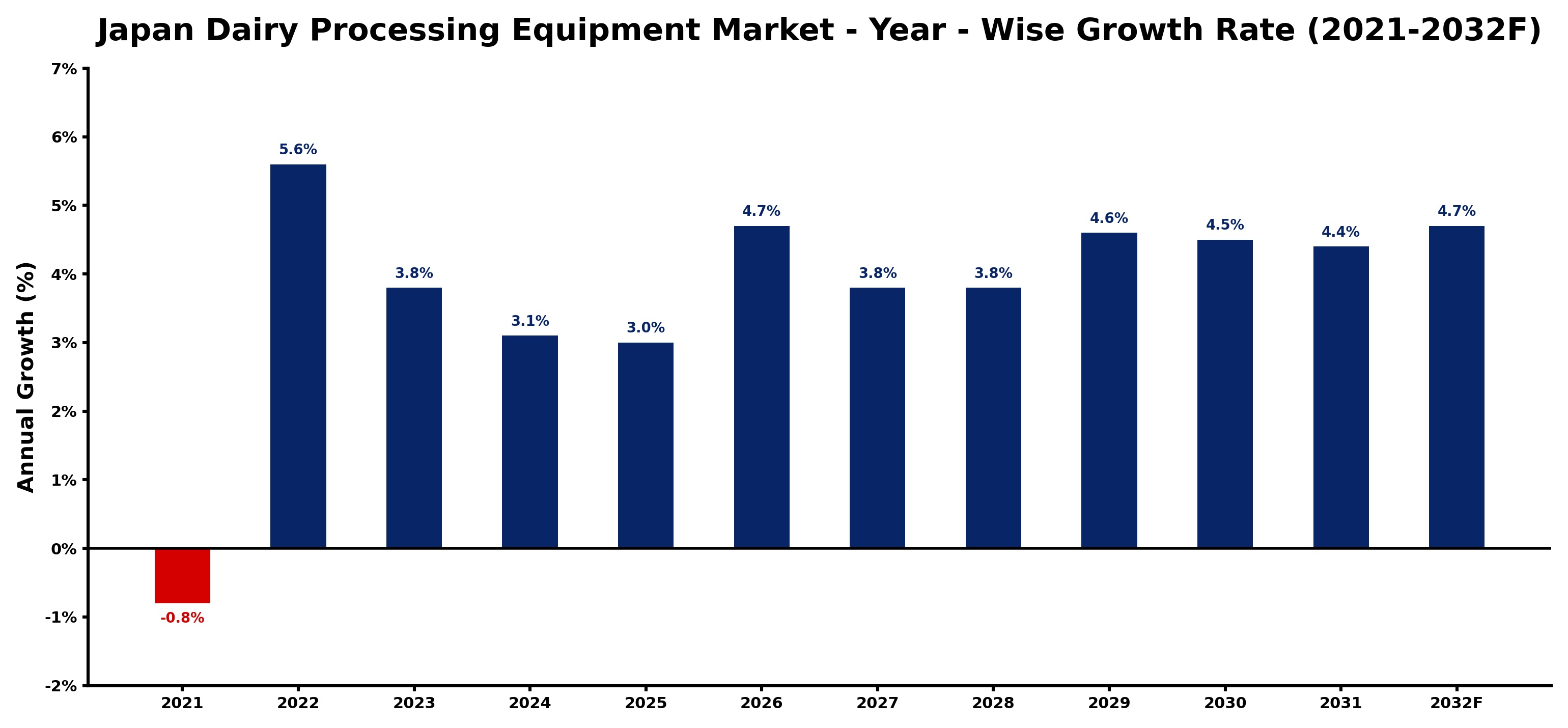
The table below presents the year‑wise growth rates along with the key drivers influencing the market
| Year | Growth Rate | Major Drivers |
| 2021 | -0.8% | Expansion of transportation and logistics networks |
| 2022 | 5.6% | Growing renewable energy integration projects |
| 2023 | 3.8% | Government infrastructure modernization initiatives |
| 2024 | 3.1% | Increasing adoption of advanced technologies |
| 2025 | 3.0% | Rising electricity demand across industries |
| 2026 | 4.7% | Expansion of manufacturing activities |
| 2027 | 3.8% | Increasing industrial infrastructure investments |
| 2028 | 3.8% | Government infrastructure modernization initiatives |
| 2029 | 4.6% | Growing urbanization and commercial development |
| 2030 | 4.5% | Expansion of manufacturing activities |
| 2031 | 4.4% | Growing urbanization and commercial development |
| 2032 | 4.7% | Rising electricity demand across industries |
Note - Market size estimations and growth projections presented in this report are based on 6Wresearch’s advanced forecasting approach, validated with industry datasets as of June 2026.
Japan Dairy Processing Equipment Market Synopsis
The market is experiencing a notable surge in demand for advanced processing equipment such as pasteurizers and homogenizers, driven by the need for high-quality dairy products that adhere to stringent food safety regulations. This shift is evident in the growing investments made by dairy producers to modernize their operations and improve efficiency.
Moreover, Japanese consumers are gravitating towards healthier and more nutritious food options. This change in consumer preferences is prompting manufacturers to diversify their product offerings, which in turn necessitates the procurement of specialized dairy processing equipment tailored to meet these evolving needs.
Japan Dairy Processing Equipment Market Key Takeaways
- The market is poised for steady growth due to increasing demand for processed dairy products.
- Technological advancements in automation and efficiency are transforming the dairy processing landscape.
- Sustainability is a key focus, with investments directed towards eco-friendly and energy-efficient equipment.
- Consumer preferences for diverse dairy offerings are driving the need for innovative processing solutions.
- Government support and favorable policies are fostering a conducive environment for market expansion.
Evaluation of Restraints in Japan Dairy Processing Equipment Market
Despite its growth trajectory, the Japan Dairy Processing Equipment Market faces several constraints. One significant challenge is the high cost associated with acquiring advanced processing technologies, which can be a barrier for smaller operators. Additionally, strict food safety regulations necessitate continuous compliance, requiring manufacturers to invest heavily in quality assurance measures. The limited pool of skilled technicians for equipment maintenance and operation further complicates matters, hindering the sector's ability to fully capitalize on advancements in technology. Competing with imported equipment that may offer lower pricing poses another challenge, necessitating a focus on quality and innovation from domestic manufacturers.
Japan Dairy Processing Equipment Market Trends
A major trend within the Japan Dairy Processing Equipment Market is the shift towards automation. Manufacturers are increasingly investing in technology that facilitates precise control over critical processes like pasteurization and homogenization, enhancing both efficiency and product quality. Sustainability is also becoming paramount, with companies prioritizing equipment that minimizes energy consumption and reduces waste.
The market is also experiencing a demand for versatility in processing equipment to accommodate a wider variety of dairy products. This adaptability not only meets consumer preferences for diverse offerings but also allows producers to innovate and stay competitive in a fast-evolving market landscape.
Japan Dairy Processing Equipment Market Opportunities
Opportunities for investment within the Japan Dairy Processing Equipment Market are abundant, driven by the growing consumption of dairy products. As health-conscious consumers continue to seek high-quality and nutritious options, the demand for sophisticated processing equipment rises. Innovations in automated systems, particularly in milking and pasteurization technologies, present avenues for enhanced productivity and cost savings. Additionally, equipment designed with sustainability in mind stands to gain traction, aligning with regulatory trends and consumer expectations.
Government Initiatives in the Japan Dairy Processing Equipment Market
Government policies play a pivotal role in shaping the landscape of the Japan Dairy Processing Equipment Market. The Food Sanitation Act ensures that dairy products meet rigorous safety and quality standards. Moreover, the Ministry of Agriculture, Forestry and Fisheries (MAFF) actively encourages the adoption of modern processing technologies through various support programs, grants, and incentives, promoting a more efficient and competitive dairy sector.
Future Insights of the Japan Dairy Processing Equipment Market
Looking ahead, the Japan Dairy Processing Equipment Market is set for continued growth as demand for dairy products escalates. The emphasis on food safety and quality will likely drive investments in advanced processing technologies. Furthermore, the integration of automation and digital solutions is expected to transform operational efficiency and product innovation. While challenges related to cost and compliance remain, the overall trajectory points towards a flourishing market, characterized by technological advancements and an unwavering focus on consumer needs.
Japan Dairy Processing Equipment Market Latest Developments (May 2025 - June 2026)
Recent developments in the Japan Dairy Processing Equipment Market indicate a strong movement towards innovation. Manufacturers are increasingly prioritizing automation to streamline operations and improve consistency in product quality. Additionally, there is a notable trend of collaborations and partnerships aimed at enhancing technological capabilities. Sustainability continues to be a focal point, with companies exploring greener alternatives in their processing equipment offerings. These shifts demonstrate an industry actively responding to changing market dynamics and consumer preferences.
Japan Dairy Processing Equipment Market - Key Attractiveness of the Report
- 10 Years of Market Numbers
- Historical Data Starting from 2022 to 2025
- Base Year: 2025
- Forecast Data until 2032
- Key Performance Indicators Impacting the Market
- Major Upcoming Developments and Projects
Key Highlights of the Report:
- Japan Dairy Processing Equipment Market Outlook
- Market Size of Japan Dairy Processing Equipment Market, 2025
- Forecast of Japan Dairy Processing Equipment Market, 2032
- Historical Data and Forecast of Japan Dairy Processing Equipment Revenues & Volume for the Period 2022-2032F
- Japan Dairy Processing Equipment Market Trend Evolution
- Japan Dairy Processing Equipment Market Drivers and Challenges
- Japan Dairy Processing Equipment Price Trends
- Japan Dairy Processing Equipment Porter's Five Forces
- Japan Dairy Processing Equipment Industry Life Cycle
- Historical Data and Forecast of Japan Dairy Processing Equipment Market Revenues & Volume By Equipment Type for the Period 2022-2032F
- Historical Data and Forecast of Japan Dairy Processing Equipment Market Revenues & Volume By Homogenizers for the Period 2022-2032F
- Historical Data and Forecast of Japan Dairy Processing Equipment Market Revenues & Volume By Membrane filtration equipment for the Period 2022-2032F
- Historical Data and Forecast of Japan Dairy Processing Equipment Market Revenues & Volume By Separators for the Period 2022-2032F
- Historical Data and Forecast of Japan Dairy Processing Equipment Market Revenues & Volume By Mixing & blending equipment for the Period 2022-2032F
- Historical Data and Forecast of Japan Dairy Processing Equipment Market Revenues & Volume By Evaporators & dryer equipment for the Period 2022-2032F
- Historical Data and Forecast of Japan Dairy Processing Equipment Market Revenues & Volume By Pasteurizers for the Period 2022-2032F
- Historical Data and Forecast of Japan Dairy Processing Equipment Market Revenues & Volume By Others for the Period 2022-2032F
- Historical Data and Forecast of Japan Dairy Processing Equipment Market Revenues & Volume By Application for the Period 2022-2032F
- Historical Data and Forecast of Japan Dairy Processing Equipment Market Revenues & Volume By Cheese for the Period 2022-2032F
- Historical Data and Forecast of Japan Dairy Processing Equipment Market Revenues & Volume By Processed Milk for the Period 2022-2032F
- Historical Data and Forecast of Japan Dairy Processing Equipment Market Revenues & Volume By Yogurt for the Period 2022-2032F
- Historical Data and Forecast of Japan Dairy Processing Equipment Market Revenues & Volume By Protein Ingredients for the Period 2022-2032F
- Historical Data and Forecast of Japan Dairy Processing Equipment Market Revenues & Volume By Milk Powder for the Period 2022-2032F
- Historical Data and Forecast of Japan Dairy Processing Equipment Market Revenues & Volume By Others for the Period 2022-2032F
- Japan Dairy Processing Equipment Import Export Trade Statistics
- Market Opportunity Assessment By Equipment Type
- Market Opportunity Assessment By Application
- Japan Dairy Processing Equipment Top Companies Market Share
- Japan Dairy Processing Equipment Competitive Benchmarking By Technical and Operational Parameters
- Japan Dairy Processing Equipment Company Profiles
- Japan Dairy Processing Equipment Key Strategic Recommendations






































