Japan Data Integration Market Size & Growth Rate (2026-2032)
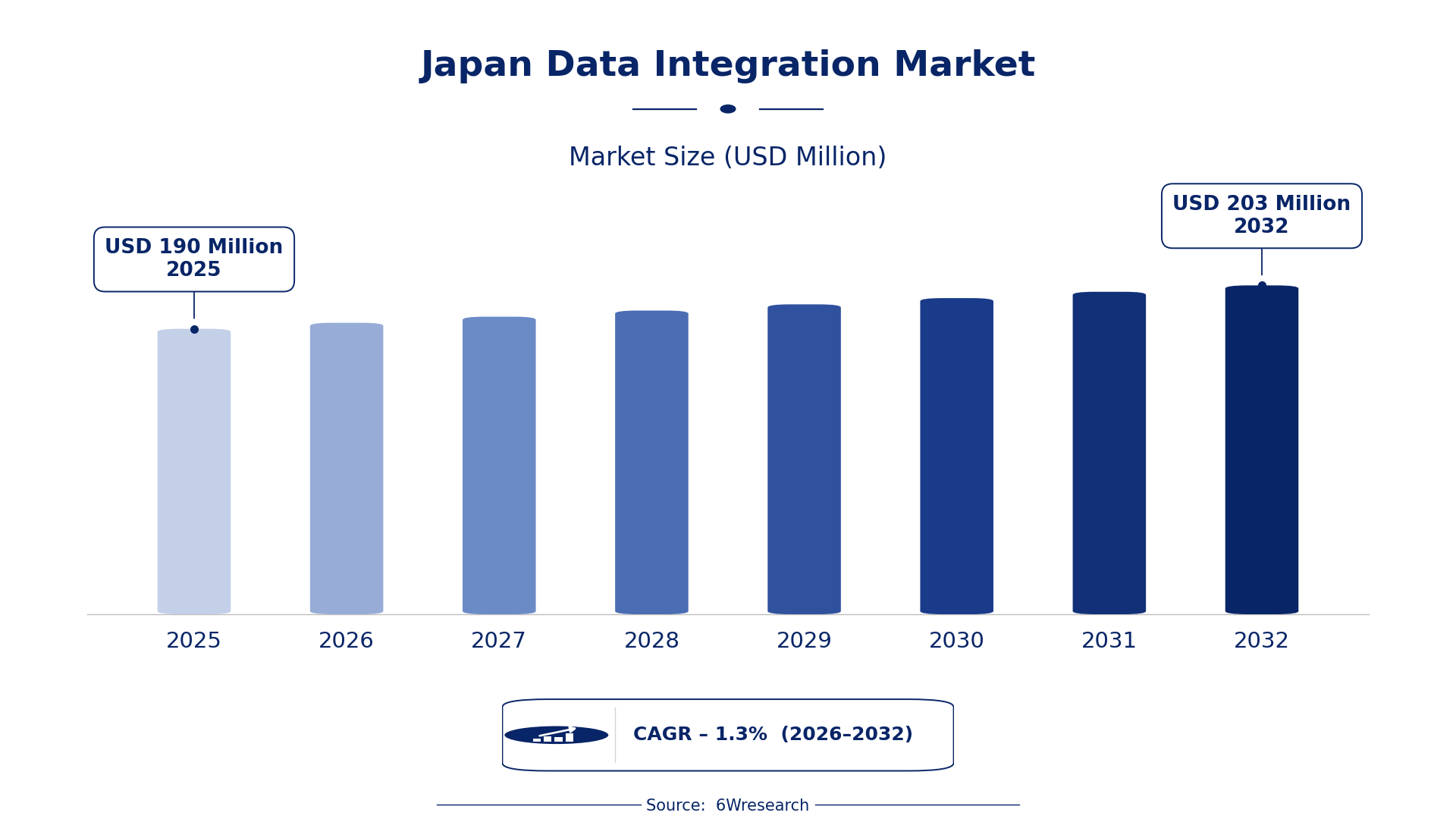
The Japan Data Integration Market was estimated at USD 190 Million in 2025 and is projected to reach USD 203 Million by 2032, growing at a CAGR of 1.3% from 2026 to 2032.
Japan Data Integration Market Synopsis
The driving force behind the Japan Data Integration Market is the surge in demand for big data analytics across various sectors. Organizations are increasingly recognizing the necessity to integrate diverse data sources to extract actionable insights, which in turn enhances their strategic decision-making.
As businesses undergo digital transformation, the emphasis on cloud-based integration solutions is intensifying. Companies are pursuing technologies that facilitate real-time data processing, while self-service integration tools are gaining traction, enabling non-technical users to harness data effectively.
Japan Data Integration Market Year-wise Growth Rate and Key Drivers
This graph illustrates the annual growth rates of the Japan Data Integration Market from 2021 to 2032, highlighting a steady upward trajectory and projected expansion over the forecast period.
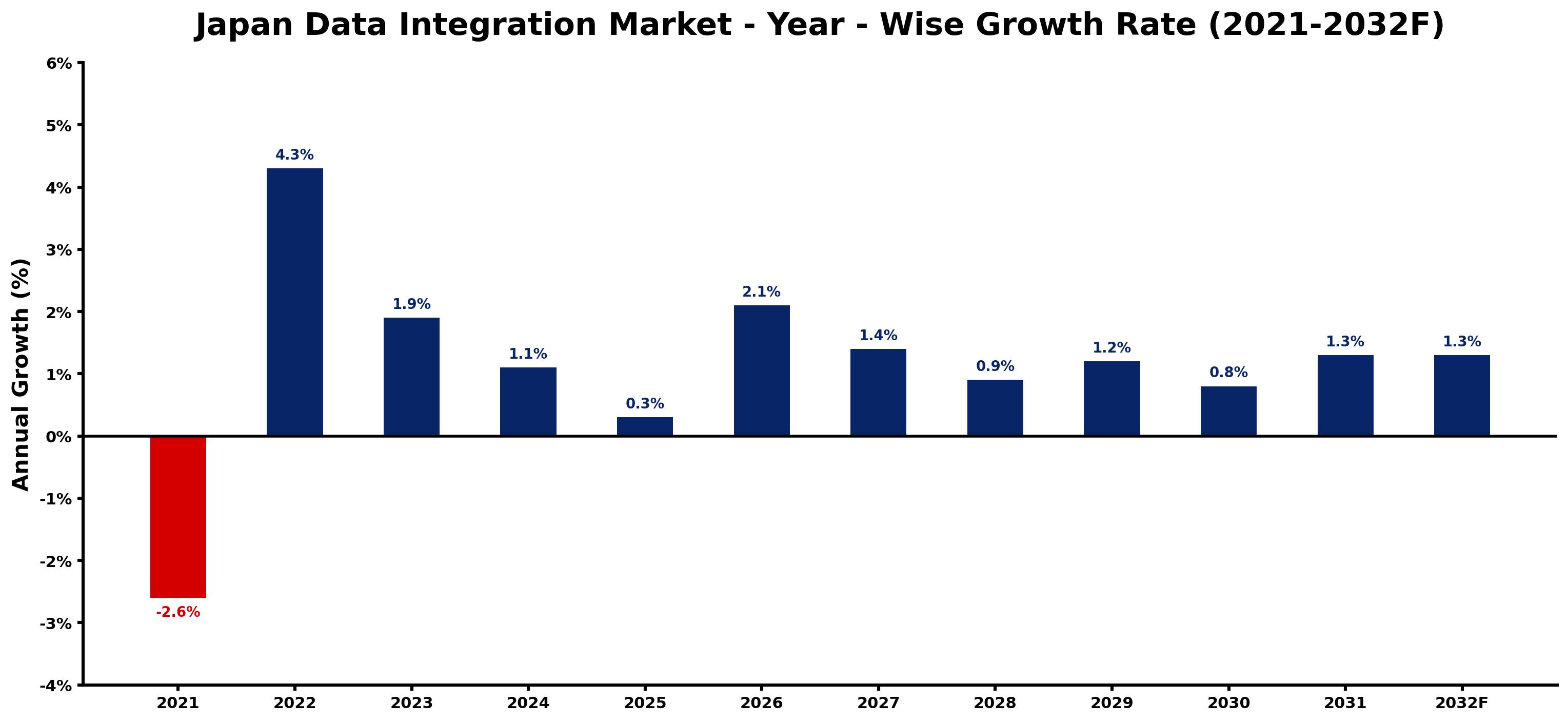
The table below presents the year‑wise growth rates along with the key drivers influencing the market
| Year | Growth Rate | Major Drivers |
| 2021 | -2.6% | Tokyo's stringent data privacy regulations hindered integration efforts. |
| 2022 | 4.3% | Increased investment in AI for data integration solutions. |
| 2023 | 1.9% | Growing regulatory requirements for data privacy and security. |
| 2024 | 1.1% | Adoption of IoT devices boosting data integration needs. |
| 2025 | 0.3% | Emergence of 5G technology enhancing data transfer efficiency. |
| 2026 | 2.1% | Rise in e-commerce driving demand for integrated systems. |
| 2027 | 1.4% | Increased collaboration among tech firms for data solutions. |
| 2028 | 0.9% | Japanese startups focusing on innovative data-driven products. |
| 2029 | 1.2% | Aggressive digital marketing strategies necessitating data integration. |
| 2030 | 0.8% | Local industries seeking operational efficiency through data synergy. |
| 2031 | 1.3% | Continuous consumer preference for personalized digital experiences. |
| 2032 | 1.3% | Growth of smart manufacturing requiring seamless data flow. |
Note: Market size estimations and growth projections presented in this report are based on 6Wresearch's proprietary forecasting methodology, utilizing the latest available industry data, government publications, and primary research inputs.
Japan Data Integration Market Key Takeaways
Below are some of the specific key takeaways from the market, including:
- The market is driven by the increasing adoption of big data analytics and cloud computing technologies.
- Organizations are prioritizing real-time data processing capabilities to support timely decision-making.
- Self-service data integration tools are empowering business users, reducing reliance on IT departments.
- Compliance with data privacy regulations is becoming a focal point for data integration initiatives.
- Investment opportunities are emerging from the growth of IoT and advanced analytics technologies.
Evaluation of Restraints in Japan Data Integration Market
Complexity remains a formidable barrier for the Japan Data Integration Market. Organizations grapple with a multitude of data sources, each presenting unique formats and standards. The challenge is further compounded by the necessity to ensure data quality and consistency while adhering to stringent data privacy regulations, such as the Personal Information Protection Law. Companies must navigate these challenges with advanced integration technologies and robust data governance practices.
Japan Data Integration Market Trends
Several notable trends are shaping the Japan Data Integration Market. Firstly, there is a marked shift towards cloud-based integration solutions, as companies seek to enhance their digital transformation strategies. Additionally, the rise of self-service integration tools is enabling greater accessibility for non-technical users, facilitating faster and more efficient data handling.
There's also an increasing emphasis on data governance and security measures. Organizations are investing in solutions that not only enhance data quality but also ensure compliance with regulatory frameworks. As organizations strive for agility and scalability, user-friendly integration solutions are expected to gain further traction.
Japan Data Integration Market Opportunities
The Japan Data Integration Market is ripe with investment opportunities, particularly in sectors that prioritize advanced technologies. With the growing need to streamline data management processes, there's high demand for innovative data integration solutions. Companies that provide tailored integration software and consulting services are well-positioned to benefit from this trend. on top of that, government initiatives to promote digital transformation across various industries are likely to bolster market growth, making this an attractive space for investors.
Government Initiatives in the Japan Data Integration Market
The Japanese government is playing a crucial role in shaping the Data Integration Market through various policies aimed at fostering innovation and economic growth. Public sector initiatives are focused on enhancing data utilization across industries, creating a conducive environment for data integration companies to thrive.
- A recently completed initiative, the Basic Act on the Advancement of Utilizing Geospatial Information, promotes the use of geospatial data across both public and private sectors.
- A current ongoing program, the Data Distribution Promotion Act, encourages the sharing of data to stimulate innovation and enhance competitive advantage.
- The establishment of the Data Trading Promotion Consortium is facilitating collaboration among businesses to promote data transactions.
- Upcoming is a planned framework to enhance data privacy compliance, expected to be introduced by mid-2026.
Future Insights of the Japan Data Integration Market
Looking ahead to 2026-2032, the Japan Data Integration Market is set for considerable growth as businesses increasingly acknowledge the value of data integration. With the ongoing rise of big data and cloud computing, organizations will continue to prioritize the acquisition of integration solutions that deliver real-time insights. The trend toward digital transformation will fuel investments in advanced data integration technologies, positioning the market for robust expansion.
Japan Data Integration Market Latest Developments
In the past year, the Japan Data Integration Market has seen a flurry of activity, with companies focusing on technological advancements and product innovations. As organizations strive for enhanced efficiency, recent developments reflect a growing alignment with market demands for improved data integration capabilities.
- A leading technology vendor launched a new cloud-based integration platform in early 2025, aimed at improving real-time data processing capabilities.
- An initiative that began in late 2024 and remains underway focuses on enhancing AI-driven data integration solutions to automate processes.
- A major consulting firm announced a partnership with a tech provider in Q1 2025 to develop customized integration solutions for small and medium enterprises.
- Upcoming in mid-2026 is a planned upgrade to existing integration tools, which will incorporate advanced analytics features.
Japan Data Integration Market - Key Attractiveness of the Report
- 10 Years of Market Numbers
- Historical Data Starting from 2022 to 2025
- Base Year: 2025
- Forecast Data until 2032
- Key Performance Indicators Impacting the Market
- Major Upcoming Developments and Projects
Key Highlights of the Report:
- Japan Data Integration Market Outlook
- Market Size of Japan Data Integration Market, 2025
- Forecast of Japan Data Integration Market, 2032
- Historical Data and Forecast of Japan Data Integration Revenues & Volume for the Period 2022-2032F
- Japan Data Integration Market Trend Evolution
- Japan Data Integration Market Drivers and Challenges
- Japan Data Integration Price Trends
- Japan Data Integration Porter's Five Forces
- Japan Data Integration Industry Life Cycle
- Historical Data and Forecast of Japan Data Integration Market Revenues & Volume By Deployment Mode for the Period 2022-2032F
- Historical Data and Forecast of Japan Data Integration Market Revenues & Volume By Cloud for the Period 2022-2032F
- Historical Data and Forecast of Japan Data Integration Market Revenues & Volume By On-premises for the Period 2022-2032F
- Historical Data and Forecast of Japan Data Integration Market Revenues & Volume By Organization Size for the Period 2022-2032F
- Historical Data and Forecast of Japan Data Integration Market Revenues & Volume By Large enterprises for the Period 2022-2032F
- Historical Data and Forecast of Japan Data Integration Market Revenues & Volume By SMEs for the Period 2022-2032F
- Historical Data and Forecast of Japan Data Integration Market Revenues & Volume By Business Application for the Period 2022-2032F
- Historical Data and Forecast of Japan Data Integration Market Revenues & Volume By Marketing for the Period 2022-2032F
- Historical Data and Forecast of Japan Data Integration Market Revenues & Volume By Sales for the Period 2022-2032F
- Historical Data and Forecast of Japan Data Integration Market Revenues & Volume By Operations for the Period 2022-2032F
- Historical Data and Forecast of Japan Data Integration Market Revenues & Volume By Finance for the Period 2022-2032F
- Historical Data and Forecast of Japan Data Integration Market Revenues & Volume By HR for the Period 2022-2032F
- Historical Data and Forecast of Japan Data Integration Market Revenues & Volume By Component for the Period 2022-2032F
- Historical Data and Forecast of Japan Data Integration Market Revenues & Volume By Tools for the Period 2022-2032F
- Historical Data and Forecast of Japan Data Integration Market Revenues & Volume By Services for the Period 2022-2032F
- Historical Data and Forecast of Japan Data Integration Market Revenues & Volume By Professional Services for the Period 2022-2032F
- Historical Data and Forecast of Japan Data Integration Market Revenues & Volume By Managed Services for the Period 2022-2032F
- Historical Data and Forecast of Japan Data Integration Market Revenues & Volume By Industry Vertical for the Period 2022-2032F
- Historical Data and Forecast of Japan Data Integration Market Revenues & Volume By BFSI for the Period 2022-2032F
- Historical Data and Forecast of Japan Data Integration Market Revenues & Volume By Retail and Consumer Goods for the Period 2022-2032F
- Historical Data and Forecast of Japan Data Integration Market Revenues & Volume By Media and Entertainment for the Period 2022-2032F
- Historical Data and Forecast of Japan Data Integration Market Revenues & Volume By Manufacturing for the Period 2022-2032F
- Historical Data and Forecast of Japan Data Integration Market Revenues & Volume By Energy and Utilities for the Period 2022-2032F
- Historical Data and Forecast of Japan Data Integration Market Revenues & Volume By Telecom and IT for the Period 2022-2032F
- Historical Data and Forecast of Japan Data Integration Market Revenues & Volume By Healthcare and Life Sciences for the Period 2022-2032F
- Historical Data and Forecast of Japan Data Integration Market Revenues & Volume By Government and Defense for the Period 2022-2032F
- Japan Data Integration Import Export Trade Statistics
- Market Opportunity Assessment By Deployment Mode
- Market Opportunity Assessment By Organization Size
- Market Opportunity Assessment By Business Application
- Market Opportunity Assessment By Component
- Market Opportunity Assessment By Industry Vertical
- Japan Data Integration Top Companies Market Share
- Japan Data Integration Competitive Benchmarking By Technical and Operational Parameters
- Japan Data Integration Company Profiles
- Japan Data Integration Key Strategic Recommendations






































