Japan Data Masking Market Size & Growth Rate (2026-2032)
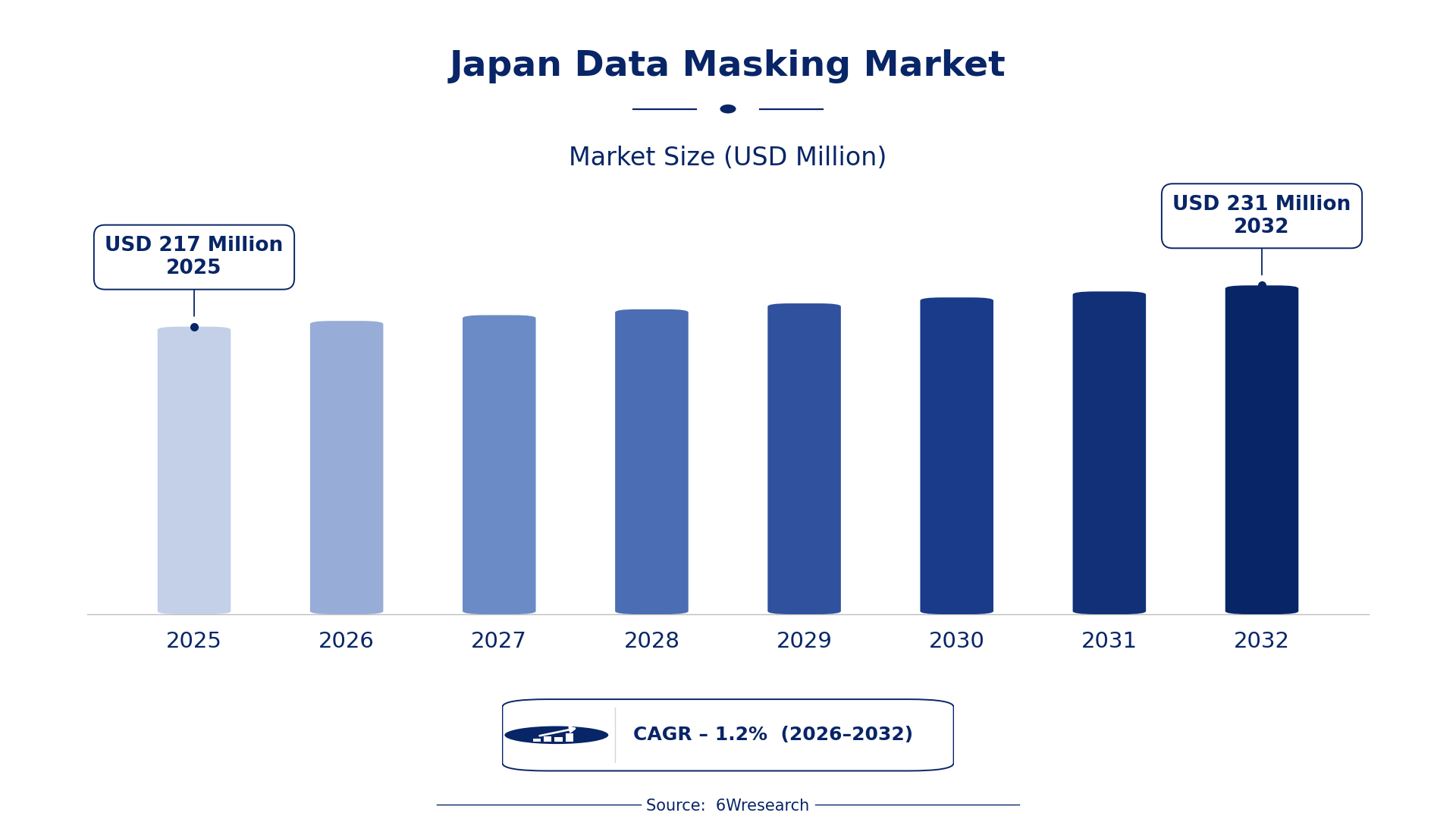
The Japan Data Masking Market was estimated at USD 217 Million in 2025 and is projected to reach USD 231 Million by 2032, growing at a CAGR of 1.2% from 2026 to 2032.
Japan Data Masking Market Synopsis
The primary force driving the Japan Data Masking Market is the increasing need for stringent data protection measures across industries. Organizations are racing to implement effective data masking solutions that not only comply with regulatory requirements but also safeguard sensitive information from data breaches.
As awareness around data privacy escalates, Japanese businesses are investing in advanced data masking technologies. This trend is particularly evident in sectors such as finance, healthcare, and retail, where the stakes of data breaches are exceedingly high. Organizations are adopting techniques like tokenization and dynamic data masking to fortify their data protection frameworks.
Japan Data Masking Market Year-wise Growth Rate and Key Drivers
This graph illustrates the annual growth rates of the Japan Data Masking Market from 2021 to 2032, highlighting a steady upward trajectory and projected expansion over the forecast period.
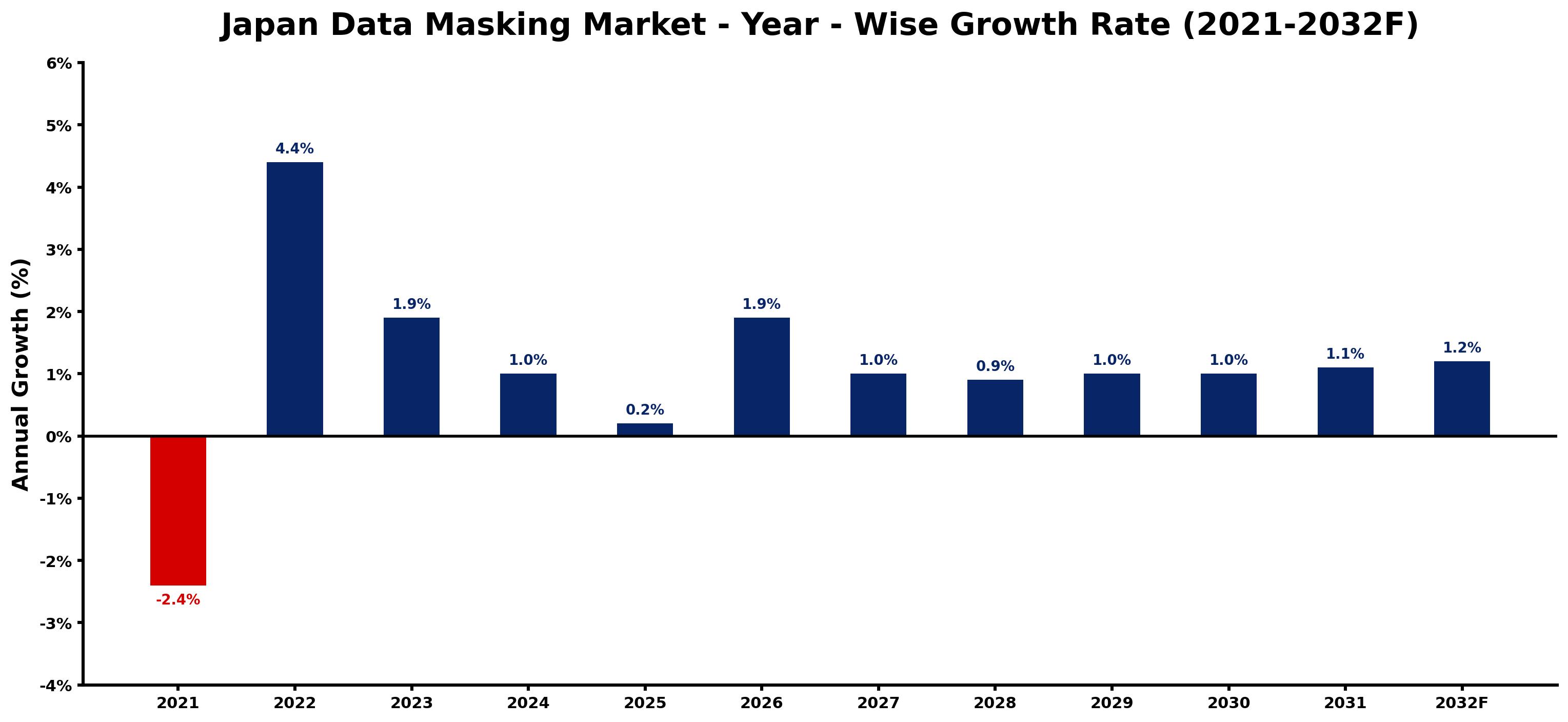
The table below presents the year‑wise growth rates along with the key drivers influencing the market
| Year | Growth Rate | Major Drivers |
| 2021 | -2.4% | Cybersecurity regulations hindered innovative data masking solutions. |
| 2022 | 4.4% | Increased regulations on data privacy under APPI. |
| 2023 | 1.9% | Growing consumer demand for personalized data protection solutions. |
| 2024 | 1.0% | Corporate investments in compliance with recent cybersecurity laws. |
| 2025 | 0.2% | Rising need for data anonymization in healthcare sector. |
| 2026 | 1.9% | Adoption of AI technologies driving advanced data masking needs. |
| 2027 | 1.0% | Digital banking expansion necessitating robust privacy measures. |
| 2028 | 0.9% | Increase in remote work raising data security concerns. |
| 2029 | 1.0% | Demand from local businesses for GDPR compliance solutions. |
| 2030 | 1.0% | Surge in smartphone usage increasing data privacy focus. |
| 2031 | 1.1% | Supportive government policies for enhancing digital trust. |
| 2032 | 1.2% | Fintech startups pushing for innovative data handling practices. |
Note: Market size estimations and growth projections presented in this report are based on 6Wresearch's proprietary forecasting methodology, utilizing the latest available industry data, government publications, and primary research inputs.
Japan Data Masking Market Key Takeaways
Below are some of the specific key takeaways from the market, including:
- The market is witnessing a shift towards more advanced data masking techniques, driven by the need for compliance and security.
- Industries such as finance and healthcare are increasingly adopting dynamic data masking solutions.
- AI and machine learning integration are becoming common in data masking tools, enhancing their effectiveness.
- Cloud migration is amplifying the demand for reliable data masking solutions in Japan.
- Investment in innovative data masking technologies presents lucrative opportunities for growth in the market.
Evaluation of Restraints in Japan Data Masking Market
A lack of comprehensive knowledge regarding data masking strategies hampers growth. Many organizations grapple with identifying sensitive data elements effectively, which complicates the implementation of appropriate data masking measures. on top of that, the fast-paced evolution of data protection regulations adds another layer of complexity, necessitating continuous adaptation from businesses. The integration of data masking across diverse systems and databases often leads to gaps in security, impeding the overall effectiveness of these solutions.
Japan Data Masking Market Trends
A trend gaining traction in the Japan Data Masking Market is the adoption of dynamic data masking techniques. Organizations are increasingly recognizing the need to protect data at rest and in transit, leading to heightened interest in tokenization technologies. The integration of AI and machine learning into data masking processes is enhancing data protection, making solutions not only more effective but also more efficient. As organizations continue to prioritize compliance with regulations like the Personal Information Protection Act, the demand for sophisticated masking solutions is set to rise.
Japan Data Masking Market Opportunities
Investment opportunities within the Japan Data Masking Market are abundant, especially in the realms of cloud-based solutions and advanced data masking technologies. Organizations are increasingly shifting towards cloud services, necessitating the deployment of robust data masking strategies to protect sensitive information. Companies providing tailored data masking solutions that align with local regulatory frameworks are likely to see significant returns. The emphasis on compliance and data security creates a fertile ground for innovative technologies and services.
Government Initiatives in the Japan Data Masking Market
Government policies are pivotal in shaping the Japan Data Masking Market, focusing on protecting data privacy and ensuring compliance with stringent regulations. The framework established by the Personal Information Protection Act (PIPA) emphasizes the importance of data masking as a protective measure. As organizations must adhere to these regulations, compliance efforts drive the demand for effective data masking solutions.
- A regulatory framework introduced in 2020 mandates enhanced data privacy measures across sectors, including requirements for data masking.
- A public-private initiative, active since 2021, aims to provide guidelines for implementing data protection strategies, highlighting the role of data masking.
- Ongoing training programs for businesses focused on data security practices are currently being conducted, enhancing awareness around data masking.
- A planned review of the Personal Information Protection Act (PIPA) expected in 2026 is likely to introduce stricter data handling protocols.
Future Insights of the Japan Data Masking Market
The Japan Data Masking Market is set for considerable expansion from 2026 to 2032. Increased regulatory scrutiny regarding data privacy will further escalate demand for effective data masking solutions. Organizations will focus on implementing technologies that not only anonymize data but also preserve its usability. As cyber threats continue to evolve, the market is expected to see advancements in dynamic data masking and AI-driven solutions, addressing the growing need for proactive data protection.
Japan Data Masking Market Latest Developments
In the last year, the Japan Data Masking Market has witnessed several noteworthy developments reflecting the sector's growth trajectory. Companies are introducing innovative solutions tailored to meet the complex demands of data protection, and partnerships are forming to enhance technological capabilities.
- A new data masking solution launched in early 2025 aimed at the healthcare sector has received positive feedback for its user-friendly interface.
- Current developments include an initiative by a major technology vendor to integrate AI capabilities into existing data masking tools, enhancing their efficiency.
- Another major rollout is expected in Q3 2026, focusing on dynamic data masking solutions specifically designed for financial institutions.
- A partnership formed between two leading data security firms is currently underway, aiming to develop comprehensive data protection solutions.
Japan Data Masking Market - Key Attractiveness of the Report
- 10 Years of Market Numbers
- Historical Data Starting from 2022 to 2025
- Base Year: 2025
- Forecast Data until 2032
- Key Performance Indicators Impacting the Market
- Major Upcoming Developments and Projects
Key Highlights of the Report:
- Japan Data Masking Market Outlook
- Market Size of Japan Data Masking Market, 2025
- Forecast of Japan Data Masking Market, 2032
- Historical Data and Forecast of Japan Data Masking Revenues & Volume for the Period 2022-2032F
- Japan Data Masking Market Trend Evolution
- Japan Data Masking Market Drivers and Challenges
- Japan Data Masking Price Trends
- Japan Data Masking Porter's Five Forces
- Japan Data Masking Industry Life Cycle
- Historical Data and Forecast of Japan Data Masking Market Revenues & Volume By Data Masking Type for the Period 2022-2032F
- Historical Data and Forecast of Japan Data Masking Market Revenues & Volume By Static for the Period 2022-2032F
- Historical Data and Forecast of Japan Data Masking Market Revenues & Volume By Dynamic for the Period 2022-2032F
- Historical Data and Forecast of Japan Data Masking Market Revenues & Volume By Component for the Period 2022-2032F
- Historical Data and Forecast of Japan Data Masking Market Revenues & Volume By Software for the Period 2022-2032F
- Historical Data and Forecast of Japan Data Masking Market Revenues & Volume By Services for the Period 2022-2032F
- Historical Data and Forecast of Japan Data Masking Market Revenues & Volume By Business Function for the Period 2022-2032F
- Historical Data and Forecast of Japan Data Masking Market Revenues & Volume By Finance for the Period 2022-2032F
- Historical Data and Forecast of Japan Data Masking Market Revenues & Volume By Marketing & Sales for the Period 2022-2032F
- Historical Data and Forecast of Japan Data Masking Market Revenues & Volume By Operations for the Period 2022-2032F
- Historical Data and Forecast of Japan Data Masking Market Revenues & Volume By Legal for the Period 2022-2032F
- Historical Data and Forecast of Japan Data Masking Market Revenues & Volume By Organization Size for the Period 2022-2032F
- Historical Data and Forecast of Japan Data Masking Market Revenues & Volume By Small and Medium-sized Enterprises (SMEs) for the Period 2022-2032F
- Historical Data and Forecast of Japan Data Masking Market Revenues & Volume By Large enterprises for the Period 2022-2032F
- Historical Data and Forecast of Japan Data Masking Market Revenues & Volume By Deployment Type for the Period 2022-2032F
- Historical Data and Forecast of Japan Data Masking Market Revenues & Volume By On-premises for the Period 2022-2032F
- Historical Data and Forecast of Japan Data Masking Market Revenues & Volume By Cloud for the Period 2022-2032F
- Historical Data and Forecast of Japan Data Masking Market Revenues & Volume By Vertical for the Period 2022-2032F
- Historical Data and Forecast of Japan Data Masking Market Revenues & Volume By BFSI for the Period 2022-2032F
- Historical Data and Forecast of Japan Data Masking Market Revenues & Volume By Healthcare and life sciences for the Period 2022-2032F
- Historical Data and Forecast of Japan Data Masking Market Revenues & Volume By Retail and eCommerce for the Period 2022-2032F
- Historical Data and Forecast of Japan Data Masking Market Revenues & Volume By Telecommunications and IT for the Period 2022-2032F
- Historical Data and Forecast of Japan Data Masking Market Revenues & Volume By Government and defense for the Period 2022-2032F
- Historical Data and Forecast of Japan Data Masking Market Revenues & Volume By Media and entertainment for the Period 2022-2032F
- Historical Data and Forecast of Japan Data Masking Market Revenues & Volume By Manufacturing for the Period 2022-2032F
- Japan Data Masking Import Export Trade Statistics
- Market Opportunity Assessment By Data Masking Type
- Market Opportunity Assessment By Component
- Market Opportunity Assessment By Business Function
- Market Opportunity Assessment By Organization Size
- Market Opportunity Assessment By Deployment Type
- Market Opportunity Assessment By Vertical
- Japan Data Masking Top Companies Market Share
- Japan Data Masking Competitive Benchmarking By Technical and Operational Parameters
- Japan Data Masking Company Profiles
- Japan Data Masking Key Strategic Recommendations






































