Japan Data Protection Market Size & Growth Rate (2026-2032)
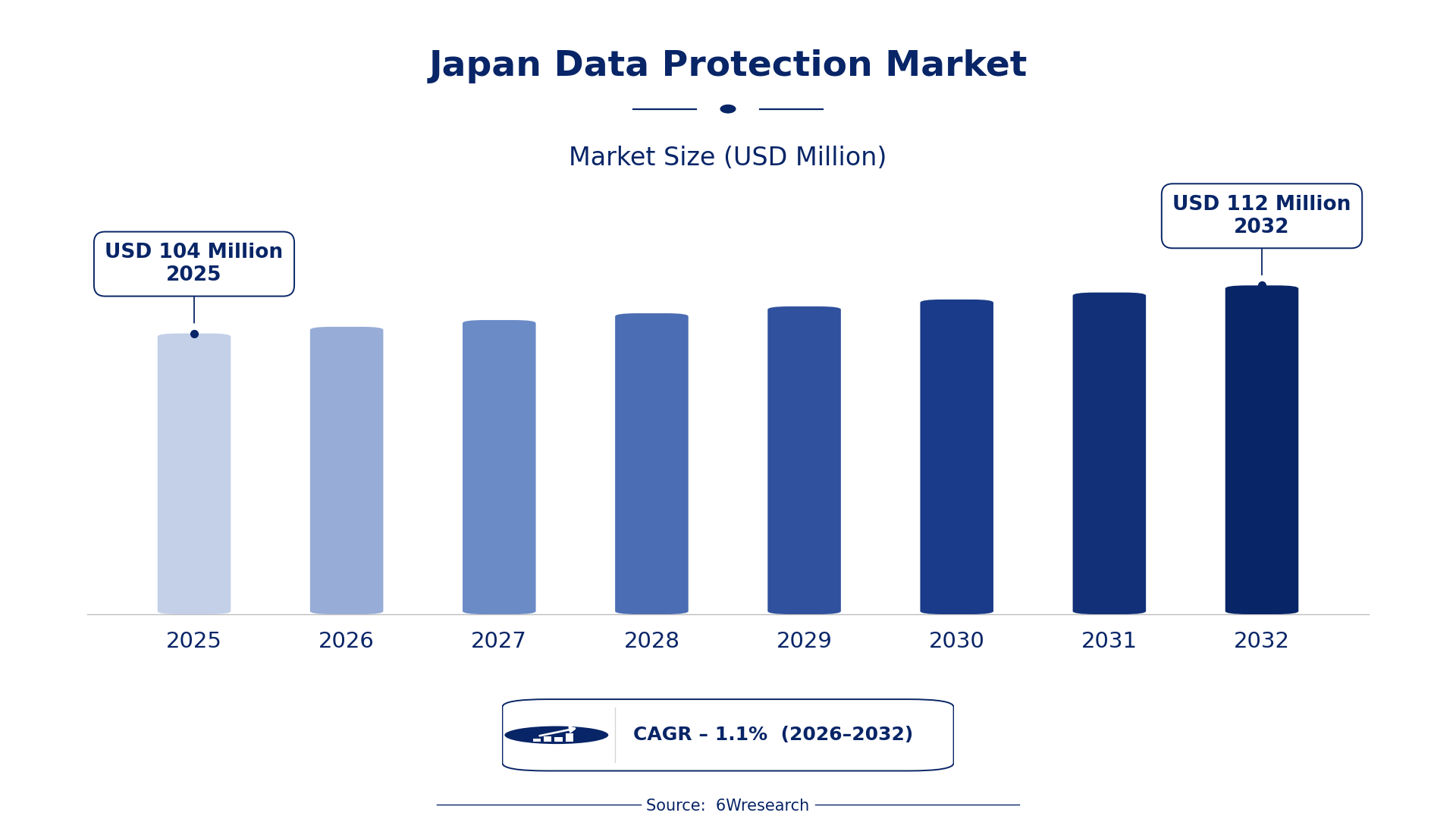
The Japan Data Protection Market was estimated at USD 104 Million in 2025 and is projected to reach USD 112 Million by 2032, growing at a CAGR of 1.1% from 2026 to 2032.
Japan Data Protection Market Synopsis
The urgency for data protection in Japan has never been greater, as businesses grapple with increasing regulatory scrutiny and a landscape rife with cyber threats. The Personal Information Protection Law (PIPL) has set a high bar for compliance, driving companies to adopt advanced solutions to safeguard sensitive data.
Japanese enterprises are investing significantly in technology to ensure compliance with both local laws and international standards like GDPR. The focus is not only on regulatory adherence but also on enhancing operational efficiency through data protection strategies that mitigate risks and foster consumer trust.
Japan Data Protection Market Year-wise Growth Rate and Key Drivers
This graph illustrates the annual growth rates of the Japan Data Protection Market from 2021 to 2032, highlighting a steady upward trajectory and projected expansion over the forecast period.
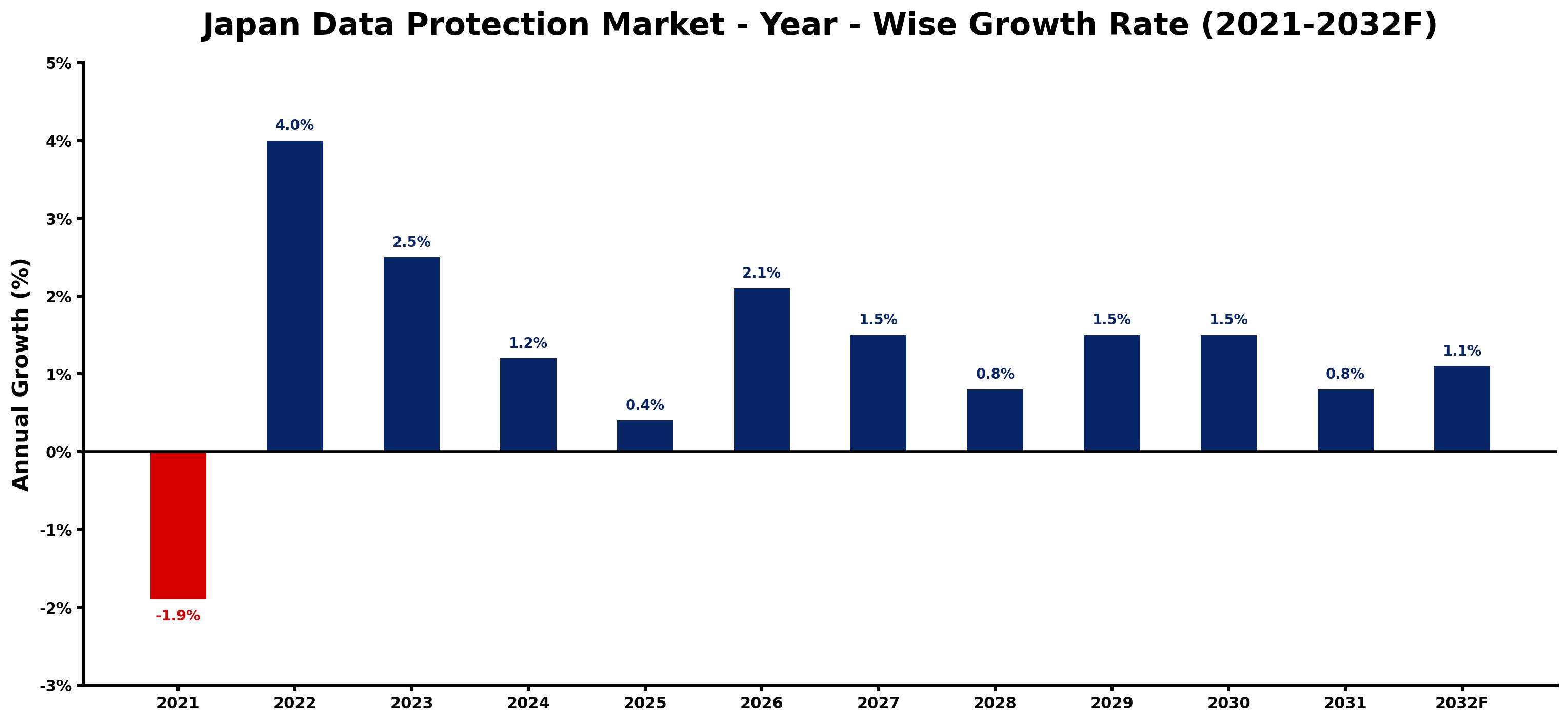
The table below presents the year‑wise growth rates along with the key drivers influencing the market
| Year | Growth Rate | Major Drivers |
| 2021 | -1.9% | Penalties from Personal Information Protection Commission increased. |
| 2022 | 4.0% | Implementation of the Act on the Protection of Personal Information. |
| 2023 | 2.5% | Growing e-commerce sector drives demand for secure transactions. |
| 2024 | 1.2% | Rising cybercrime incidents prompt stricter data regulations. |
| 2025 | 0.4% | Increased public sector transparency requirements enhance compliance needs. |
| 2026 | 2.1% | Adoption of advanced data encryption technologies boosts market. |
| 2027 | 1.5% | Government initiatives supporting cybersecurity talent development programs. |
| 2028 | 0.8% | Heightened consumer awareness on data privacy and protection. |
| 2029 | 1.5% | Law amendments for data portability promoting security solutions. |
| 2030 | 1.5% | Emergence of AI-driven data protection tools in enterprises. |
| 2031 | 0.8% | International trade agreements necessitating stronger data protection standards. |
| 2032 | 1.1% | Increased focus on healthcare data security following reforms. |
Note: Market size estimations and growth projections presented in this report are based on 6Wresearch's proprietary forecasting methodology, utilizing the latest available industry data, government publications, and primary research inputs.
Japan Data Protection Market Key Takeaways
Below are some of the specific key takeaways from the market, including:
- Demand for data protection solutions is rapidly increasing due to stringent regulatory requirements.
- Organizations are prioritizing encryption, data loss prevention, and identity access management.
- Cloud-based solutions are emerging as a preferred choice for scalable data protection.
- Investment in local data storage solutions is on the rise, driven by data residency concerns.
- A significant skills gap exists in the data protection workforce, hindering effective implementation.
Evaluation of Restraints in Japan Data Protection Market
Several factors are stalling growth in the Japan Data Protection Market. Navigating the complexities of regulatory compliance, especially with the recent enforcement of the PIPL, poses a real challenge. Organizations must balance the need for rigorous data protection with innovation and data utilization, often leading to conflicting priorities. Additionally, a lack of skilled professionals in the field hampers effective deployment and ongoing management of necessary security measures.
Japan Data Protection Market Trends
The market is witnessing an uptick in the adoption of advanced encryption techniques as organizations strive for compliance and security. Cloud-based data protection services are also gaining momentum, reflecting a shift towards flexible, scalable solutions. There’s a pronounced interest in data localization, driving firms to invest in infrastructure that complies with domestic storage regulations. This focus not only addresses legal requirements but also enhances customer confidence in data handling practices.
Japan Data Protection Market Opportunities
Opportunities abound in the cybersecurity segment as businesses seek advanced solutions to meet regulatory demands. Investments in encryption technology, compliance management tools, and cyber threat detection systems are becoming paramount. The digital transformation initiatives across sectors, including finance and healthcare, are expected to further propel demand for data protection solutions, presenting an attractive landscape for investment.
Government Initiatives in the Japan Data Protection Market
The Japanese government is taking proactive steps to shape the data protection environment, underscoring its commitment to enhancing data security standards. Recent regulations have been developed to align with international norms, particularly the GDPR. This alignment facilitates smoother data transactions and strengthens Japan’s position in the global digital economy, making such policies pivotal for businesses operating within this framework.
- A national initiative launched in early 2023 aims to enhance public-sector data security through updated compliance measures.
- Ongoing projects are focused on promoting awareness around data protection regulations among small and medium-sized enterprises (SMEs).
- A planned review of the Act on the Protection of Personal Information (APPI) is scheduled for late 2024 to refine existing policies and address evolving digital challenges.
- Current collaborations with industry stakeholders aim to develop standardized frameworks for data protection practices across sectors, fostering consistency in compliance.
Future Insights of the Japan Data Protection Market
Looking ahead to 2026-2032, the Japan Data Protection Market is set for growth fueled by increasing cyber threats and rigorous regulatory demands. Companies will likely invest heavily in more sophisticated data protection solutions, driven by the desire to remain compliant while innovating. As digital transformation accelerates, businesses will continue to prioritize security in their strategic frameworks, reflecting a cultural shift towards heightened data consciousness.
Japan Data Protection Market Latest Developments
In the past year, the Japan Data Protection Market has seen a flurry of activity aimed at enhancing security and compliance standards. Organizations are rapidly adopting advanced technologies to meet regulatory requirements, reflecting a heightened awareness of the significance of data security in business operations.
- In late 2023, a major technology vendor announced the launch of a new encryption platform designed specifically for the Japanese market.
- An ongoing initiative, started in Q1 2024, focuses on developing cybersecurity training programs for businesses to bridge the skills gap in data protection.
- By early 2025, a public-private partnership is expected to roll out new data management guidelines aimed at bolstering compliance for SMEs.
- A company is currently working on integrating AI-driven data loss prevention technologies, with a pilot program expected to commence in mid-2025.
Japan Data Protection Market - Key Attractiveness of the Report
- 10 Years of Market Numbers
- Historical Data Starting from 2022 to 2025
- Base Year: 2025
- Forecast Data until 2032
- Key Performance Indicators Impacting the Market
- Major Upcoming Developments and Projects
Key Highlights of the Report:
- Japan Data Protection Market Outlook
- Market Size of Japan Data Protection Market, 2025
- Forecast of Japan Data Protection Market, 2032
- Historical Data and Forecast of Japan Data Protection Revenues & Volume for the Period 2022-2032F
- Japan Data Protection Market Trend Evolution
- Japan Data Protection Market Drivers and Challenges
- Japan Data Protection Price Trends
- Japan Data Protection Porter's Five Forces
- Japan Data Protection Industry Life Cycle
- Historical Data and Forecast of Japan Data Protection Market Revenues & Volume By Component for the Period 2022-2032F
- Historical Data and Forecast of Japan Data Protection Market Revenues & Volume By Solutions for the Period 2022-2032F
- Historical Data and Forecast of Japan Data Protection Market Revenues & Volume By Services (Professional Services and Managed Services) for the Period 2022-2032F
- Historical Data and Forecast of Japan Data Protection Market Revenues & Volume By Deployment Mode for the Period 2022-2032F
- Historical Data and Forecast of Japan Data Protection Market Revenues & Volume By On-premises for the Period 2022-2032F
- Historical Data and Forecast of Japan Data Protection Market Revenues & Volume By Cloud for the Period 2022-2032F
- Historical Data and Forecast of Japan Data Protection Market Revenues & Volume By Industry Vertical for the Period 2022-2032F
- Historical Data and Forecast of Japan Data Protection Market Revenues & Volume By Government and defense for the Period 2022-2032F
- Historical Data and Forecast of Japan Data Protection Market Revenues & Volume By Banking, Financial Services, and Insurance (BFSI) for the Period 2022-2032F
- Historical Data and Forecast of Japan Data Protection Market Revenues & Volume By Healthcare for the Period 2022-2032F
- Historical Data and Forecast of Japan Data Protection Market Revenues & Volume By IT and telecom for the Period 2022-2032F
- Historical Data and Forecast of Japan Data Protection Market Revenues & Volume By Consumer goods and retail for the Period 2022-2032F
- Historical Data and Forecast of Japan Data Protection Market Revenues & Volume By Education for the Period 2022-2032F
- Historical Data and Forecast of Japan Data Protection Market Revenues & Volume By Media and entertainment for the Period 2022-2032F
- Historical Data and Forecast of Japan Data Protection Market Revenues & Volume By Organization Size Large Enterprises for the Period 2022-2032F
- Historical Data and Forecast of Japan Data Protection Market Revenues & Volume By SMEs for the Period 2022-2032F
- Historical Data and Forecast of Japan Data Protection Market Revenues & Volume By Large Enterprises for the Period 2022-2032F
- Japan Data Protection Import Export Trade Statistics
- Market Opportunity Assessment By Component
- Market Opportunity Assessment By Deployment Mode
- Market Opportunity Assessment By Industry Vertical
- Market Opportunity Assessment By Organization Size Large Enterprises
- Japan Data Protection Top Companies Market Share
- Japan Data Protection Competitive Benchmarking By Technical and Operational Parameters
- Japan Data Protection Company Profiles
- Japan Data Protection Key Strategic Recommendations






































