Japan Debt Collection Software Market Size & Growth Rate (2026-2032)
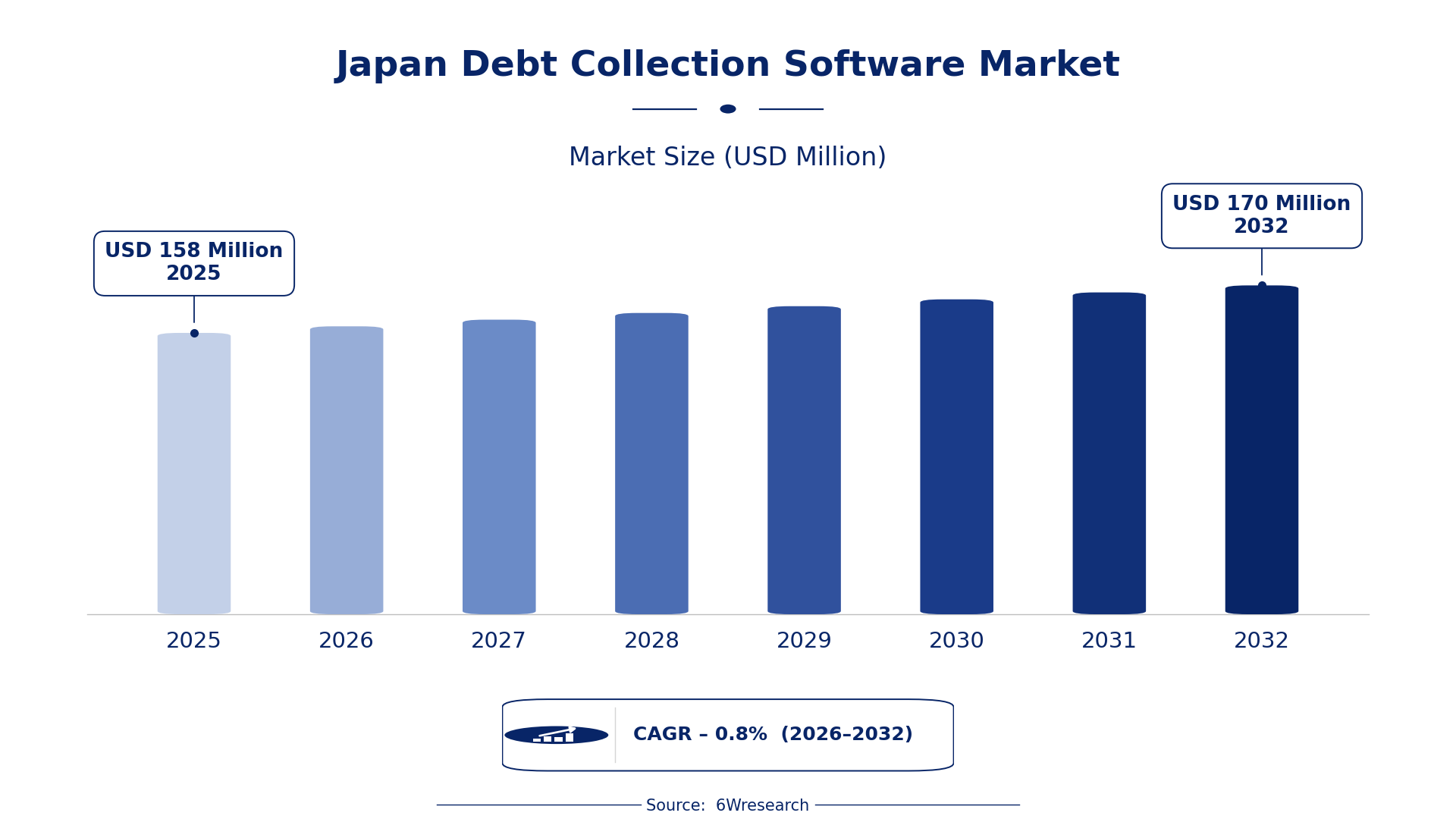
The Japan Debt Collection Software Market was estimated at USD 158 Million in 2025 and is projected to reach USD 170 Million by 2032, growing at a CAGR of 0.8% from 2026 to 2032.
Japan Debt Collection Software Market Synopsis
The Japan Debt Collection Software Market is witnessing a notable shift towards automation and digital solutions, driven by the increasing complexity of debt management. Financial institutions and collection agencies are increasingly investing in software that streamlines processes, enhances compliance, and improves recovery rates.
With the rising volume of non-performing loans and stringent regulatory requirements, the demand for efficient debt collection solutions is on the rise. Cloud-based platforms, in particular, are gaining traction for their scalability and ease of implementation, catering to the unique needs of Japanese businesses.
Japan Debt Collection Software Market Year-wise Growth Rate and Key Drivers
This graph illustrates the annual growth rates of the Japan Debt Collection Software Market from 2021 to 2032, highlighting a steady upward trajectory and projected expansion over the forecast period.
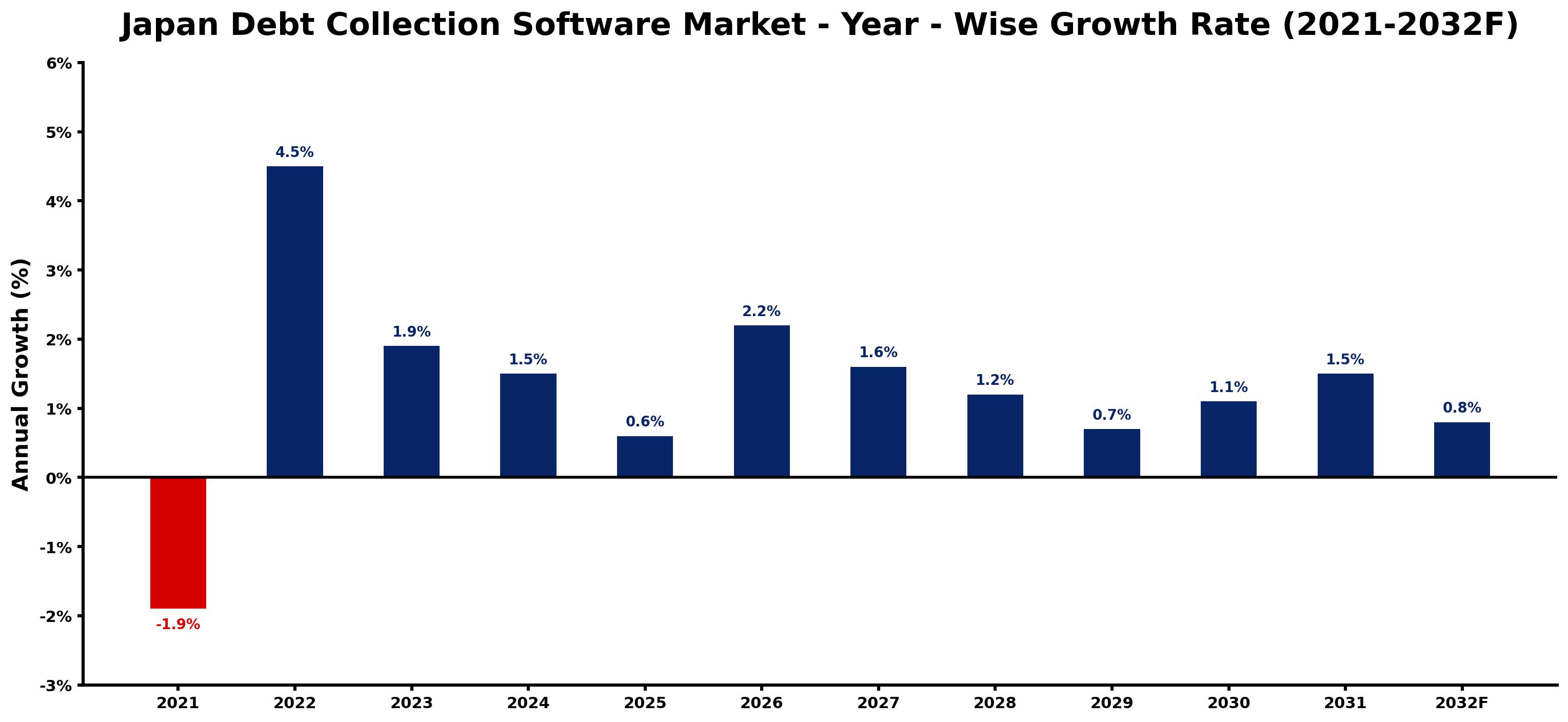
The table below presents the year‑wise growth rates along with the key drivers influencing the market
| Year | Growth Rate | Major Drivers |
| 2021 | -1.9% | New consumer protection regulations limiting collection practices. |
| 2022 | 4.5% | Increase in consumer debt due to pandemic spending |
| 2023 | 1.9% | Government initiatives to improve debt recovery processes |
| 2024 | 1.5% | Rising adoption of digital payment solutions in Japan |
| 2025 | 0.6% | Enhanced regulatory pressure for responsible lending practices |
| 2026 | 2.2% | Growing awareness of consumer rights among borrowers |
| 2027 | 1.6% | Collaboration with financial institutions for debt management tools |
| 2028 | 1.2% | Emergence of AI-driven analytics for collections optimization |
| 2029 | 0.7% | Investment in training programs for debt collection agencies |
| 2030 | 1.1% | Expanding online marketplaces increasing transactional debts |
| 2031 | 1.5% | Shift towards automation in debt collection workflows |
| 2032 | 0.8% | Support from fintech innovations for collections efficiency |
Note: Market size estimations and growth projections presented in this report are based on 6Wresearch's proprietary forecasting methodology, utilizing the latest available industry data, government publications, and primary research inputs.
Japan Debt Collection Software Market Key Takeaways
Below are some of the specific key takeaways from the market, including:
- The market is experiencing a shift towards cloud-based solutions, enhancing scalability and operational efficiency.
- Automation features are increasingly being integrated to expedite debt recovery processes.
- Compliance with Japan's stringent regulatory environment is critical for software vendors.
- Investment opportunities are emerging due to the rising levels of consumer debt.
- The integration of AI and machine learning is set to redefine collection strategies.
Evaluation of Restraints in Japan Debt Collection Software Market
While the Japan Debt Collection Software Market is on an upward trajectory, it is not without its challenges. Navigating the complex regulatory landscape can be daunting for software providers. Companies must ensure compliance with strict data protection laws, which adds an additional layer of complexity to software development.
Cultural factors also play a significant role in the effectiveness of debt collection strategies. There is a need to balance technological advancements with the necessity for personalized customer interactions, which can be difficult to achieve. As competition intensifies, companies must continuously innovate to meet evolving customer expectations without sacrificing compliance or cultural sensitivity.
Japan Debt Collection Software Market Trends
Several trends are shaping the Japan Debt Collection Software Market today. A notable shift towards cloud-based solutions is evident as organizations seek scalable options that can adapt to changing demands. This is coupled with the growing adoption of automation tools, which streamline the collection process and improve accuracy.
Artificial intelligence and machine learning are gaining prominence, offering predictive analytics that enhance decision-making in debt recovery. Additionally, the demand for mobile-friendly applications is increasing, driven by the rise of mobile technology in business operations.
Japan Debt Collection Software Market Opportunities
The market presents several growth opportunities, particularly for companies that can deliver innovative solutions tailored to Japan’s specific needs. With consumer debt levels rising, there is a clear demand for technology that simplifies and streamlines debt management.
Investing in platforms that offer automation and compliance features can yield lucrative returns as organizations look to enhance their operational efficiencies. on top of that, the shift towards digital transformation underscores a market ripe for investment, especially in cloud-based and mobile-friendly software solutions.
Government Initiatives in the Japan Debt Collection Software Market
Government regulations significantly influence the Japan Debt Collection Software Market, emphasizing consumer protection and data privacy. Regulatory bodies are increasingly focused on creating a framework that fosters compliance while promoting technological innovation in debt collection.
- A recently completed initiative mandated the adoption of enhanced data protection measures by debt collection agencies to safeguard consumer information.
- A current ongoing review of the Fair Debt Collection Practices Act (FDCPA) is aimed at tightening regulations to prevent abusive collection practices.
- A planned public-private partnership is expected to launch a program in late 2026 to support the development of compliance-focused debt collection technologies.
- Ongoing workshops and seminars organized by regulatory bodies are educating businesses on best practices in debt collection and compliance.
- New guidelines are being formulated to ensure that technology providers meet stringent data security standards by 2027.
Future Insights of the Japan Debt Collection Software Market
Looking ahead to 2026-2032, the Japan Debt Collection Software Market is set for steady growth. Factors such as increasing awareness of the importance of specialized software and the rise in consumer debt are driving this trend. The emphasis on compliance with evolving regulations will continue to shape software development priorities.
As companies increasingly recognize the value of advanced debt collection solutions, investments in technology-driven strategies are likely to intensify. The market is moving towards more user-friendly and efficient platforms that meet the demands of both businesses and regulatory requirements.
Japan Debt Collection Software Market Latest Developments
In the past year, the Japan Debt Collection Software Market has seen various developments aimed at enhancing operational efficiency and compliance. Companies are increasingly focusing on integrating advanced technologies to improve their debt collection processes.
- A major technology vendor launched a new AI-driven debt collection platform in Q1 2025, aimed at automating recovery processes and improving accuracy.
- An initiative that began in early 2025 is currently underway, focusing on the development of mobile-friendly applications for debt collection agencies.
- A planned rollout expected to begin in late 2025 will introduce new compliance features in existing debt collection software solutions.
- A collaborative project between software providers and financial institutions is ongoing, aiming to create standardized protocols for data security in debt collection.
- A recent workshop series completed in early 2025 educated stakeholders on the importance of regulatory compliance and consumer protection.
Japan Debt Collection Software Market - Key Attractiveness of the Report
- 10 Years of Market Numbers
- Historical Data Starting from 2022 to 2025
- Base Year: 2025
- Forecast Data until 2032
- Key Performance Indicators Impacting the Market
- Major Upcoming Developments and Projects
Key Highlights of the Report:
- Japan Debt Collection Software Market Outlook
- Market Size of Japan Debt Collection Software Market, 2025
- Forecast of Japan Debt Collection Software Market, 2032
- Historical Data and Forecast of Japan Debt Collection Software Revenues & Volume for the Period 2022-2032F
- Japan Debt Collection Software Market Trend Evolution
- Japan Debt Collection Software Market Drivers and Challenges
- Japan Debt Collection Software Price Trends
- Japan Debt Collection Software Porter's Five Forces
- Japan Debt Collection Software Industry Life Cycle
- Historical Data and Forecast of Japan Debt Collection Software Market Revenues & Volume By Component for the Period 2022-2032F
- Historical Data and Forecast of Japan Debt Collection Software Market Revenues & Volume By Software for the Period 2022-2032F
- Historical Data and Forecast of Japan Debt Collection Software Market Revenues & Volume By Services for the Period 2022-2032F
- Historical Data and Forecast of Japan Debt Collection Software Market Revenues & Volume By User Type for the Period 2022-2032F
- Historical Data and Forecast of Japan Debt Collection Software Market Revenues & Volume By Financial Institutions for the Period 2022-2032F
- Historical Data and Forecast of Japan Debt Collection Software Market Revenues & Volume By Collection Agencies for the Period 2022-2032F
- Historical Data and Forecast of Japan Debt Collection Software Market Revenues & Volume By Healthcare for the Period 2022-2032F
- Historical Data and Forecast of Japan Debt Collection Software Market Revenues & Volume By Government for the Period 2022-2032F
- Historical Data and Forecast of Japan Debt Collection Software Market Revenues & Volume By Telecom & Utilities for the Period 2022-2032F
- Historical Data and Forecast of Japan Debt Collection Software Market Revenues & Volume By Others for the Period 2022-2032F
- Historical Data and Forecast of Japan Debt Collection Software Market Revenues & Volume By Deployment Type for the Period 2022-2032F
- Historical Data and Forecast of Japan Debt Collection Software Market Revenues & Volume By On-Premises for the Period 2022-2032F
- Historical Data and Forecast of Japan Debt Collection Software Market Revenues & Volume By Cloud for the Period 2022-2032F
- Historical Data and Forecast of Japan Debt Collection Software Market Revenues & Volume By Organization Size for the Period 2022-2032F
- Historical Data and Forecast of Japan Debt Collection Software Market Revenues & Volume By SMEs for the Period 2022-2032F
- Historical Data and Forecast of Japan Debt Collection Software Market Revenues & Volume By Large Enterprises for the Period 2022-2032F
- Japan Debt Collection Software Import Export Trade Statistics
- Market Opportunity Assessment By Component
- Market Opportunity Assessment By User Type
- Market Opportunity Assessment By Deployment Type
- Market Opportunity Assessment By Organization Size
- Japan Debt Collection Software Top Companies Market Share
- Japan Debt Collection Software Competitive Benchmarking By Technical and Operational Parameters
- Japan Debt Collection Software Company Profiles
- Japan Debt Collection Software Key Strategic Recommendations






































