Japan Decorative Glass Market Size & Growth Rate
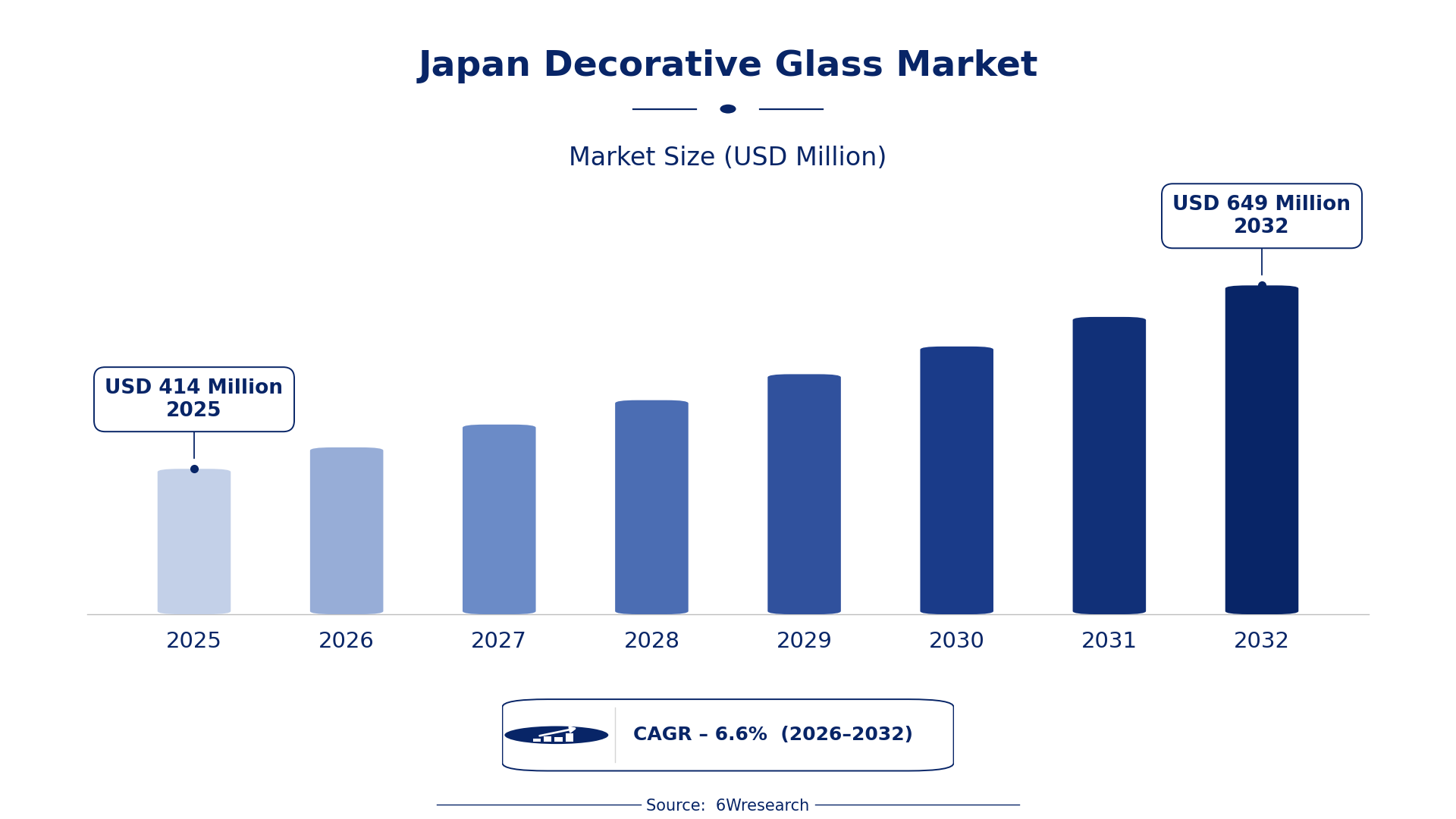
According to 6Wresearch internal database and industry insights, the Japan Decorative Glass Market was valued at USD 414 Million in 2025 and is projected to reach USD 649 Million by 2032, growing at a CAGR of approximately 6.6% during 2026–2032.
Japan Decorative Glass Market Highlights
| Report Metric | Details |
| Report Name | Japan Decorative Glass Market (2026-2032) |
| Market Size 2025 | USD 414 Million |
| Market Size 2032 | USD 649 Million |
| Absolute Growth 2025–2032 | USD 235 Million |
| CAGR 2026–2032 | 6.6% |
| Peak Annual Growth | 7.9% in 2028 |
| Forecast Period | 2026–2032 |
| Historical Data | 2022–2025 |
| Base Year | 2025 |
| Leading Product, 2025 | Low-e (49% share) |
| Leading Application, 2025 | Commercial Building (55% share) |
| Fastest-Growing Product | Special (8.9% CAGR) |
| Fastest-Growing Application | Residential Building (8.6% CAGR) |
| Growing Sector | Residential Building |
| Key End Users | Commercial Building, Residential Building, Public Building |
Japan Decorative Glass Market Year-wise Growth Rate and Key Drivers (2022–2032)
This graph illustrates the annual growth rates of the market from 2022 to 2032, highlighting a steady upward trajectory and projected market expansion over the forecast period.
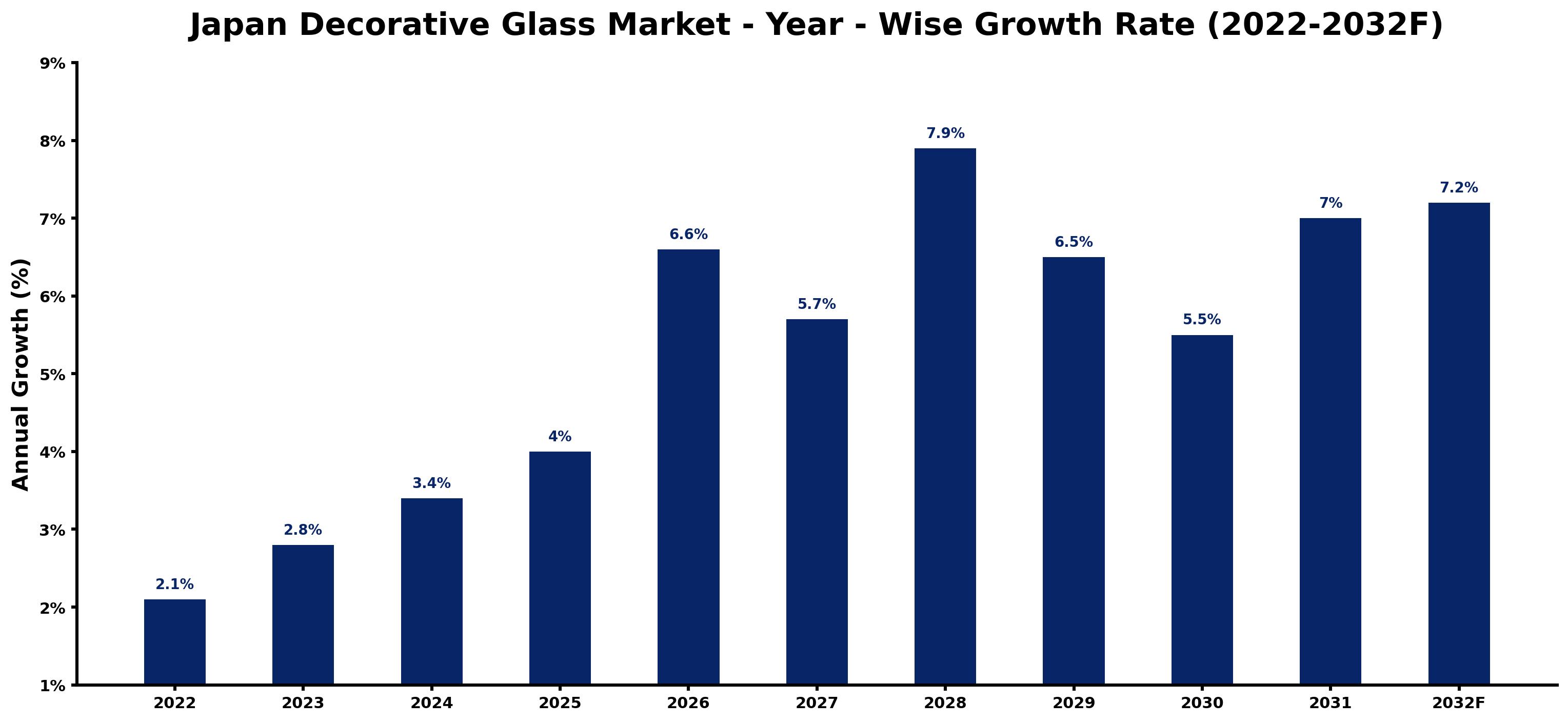
The yearly estimates that follow link every growth rate to its principal driver, so readers can see why the pace changed in each period.
| Year | Estimated Annual Growth (%) | Market Rationale |
| 2022 | 2.1 | The market exhibited steady growth due to increasing construction activity. |
| 2023 | 2.8 | Demand continued to rise as more commercial projects were initiated across urban areas. |
| 2024 | 3.4 | Growth accelerated with heightened investments in energy-efficient building materials. |
| 2025 | 4.0 | The market peaked historically as energy standards became more stringent. |
| 2026 | 6.6 | Demand surged as new technologies in decorative glass gained traction. |
| 2027 | 5.7 | Growth moderated slightly due to market saturation in certain segments. |
| 2028 | 7.9 | An increase in demand was observed as sustainability became a priority. |
| 2029 | 6.5 | The market experienced a slowdown as competition intensified among suppliers. |
| 2030 | 5.5 | Growth continued to decelerate as buyers became more selective in their choices. |
| 2031 | 7.0 | Demand rebounded as modern designs attracted renewed interest from architects. |
| 2032 | 7.2 | The market maintained strong growth driven by ongoing urban development projects. |
Note: Market size estimations and growth projections presented in this report are based on 6Wresearch's proprietary forecasting methodology, utilizing the latest available industry data, government publications, and primary research inputs.
Japan Decorative Glass Market Synopsis
Decorative glass serves as a versatile material used in various applications, including windows, facades, and interior design elements. The Japan Decorative Glass Market is expanding due to rising investments in energy-efficient buildings and a growing focus on aesthetic improvements in architecture. Urbanisation and the Building Energy Efficiency Act are key factors driving demand from commercial and residential sectors alike, with projections indicating continued growth through 2032.
Market Dynamics Impact Analysis (2026–2032)
| Factor | Type | Impact | Primary Segment Affected |
| Increasing focus on energy efficiency in buildings | Driver | High | Low-e |
| Rising urbanisation and construction activities | Driver | High | Commercial Building |
| Growing demand for sustainable building materials | Opportunity | High | Special |
| Expansion of residential construction projects | Opportunity | High | Residential Building |
| High competition among suppliers leading to price pressures | Restraint | Medium | Other |
| Limited awareness of decorative glass benefits among consumers | Restraint | Medium | Special |
| Supply chain disruptions affecting material availability | Challenge | High | Low-e |
| Technological advancements requiring continuous investment | Challenge | Medium | Commercial Building |
Evaluation of Drivers in Japan Decorative Glass Market (2026–2032)
Key forces behind demand, with the segment each one moves most, are listed below.
| Drivers | Primary Segment Affected | Why It Matters (Evidence) |
| Investment in energy-efficient building technologies | Low-e | This investment drives demand for Low-e glass, which improves energy performance in buildings, with a projected market share of 49% by 2025. |
| Urban development initiatives | Commercial Building | These initiatives increase the number of commercial projects, boosting demand for decorative glass in urban settings. |
| Government regulations promoting sustainability | Special | Regulations encourage the use of special decorative glass, with a growing focus on aesthetic and energy-efficient solutions. |
| Rising consumer preference for modern aesthetics | Residential Building | This trend leads to increased purchases of decorative glass for home renovations and new builds. |
| Technological advancements in glass manufacturing | Other | These advancements improve product offerings, attracting buyers looking for unique design options. |
Purchasing is picking up as investments in energy-efficient building technologies increase. For instance, the projected market share of Low-e glass is 49% by 2025, as builders seek to improve energy performance. The rise in consumer preference for modern aesthetics is leading to increased purchases for home renovations, particularly in residential buildings, as buyers opt for stylish and efficient solutions.
Evaluation of Restraints in Japan Decorative Glass Market
The table below lists the restraints and the evidence behind each.
| Market Restraint | Primary Segment Affected | Why It Matters (Evidence) |
| Supply chain disruptions | Commercial Building | 25% of suppliers struggle with raw material availability, resulting in increased costs for manufacturers. |
| Regulatory compliance costs | Special | Compliance costs have risen by 20% for producers, pushing retail prices higher for consumers. |
| Market saturation in certain segments | Residential Building | Increased competition has led to slower growth rates in established market areas. |
| Limited vocational training programmes | Other | The aging workforce has created a gap in skilled labour, affecting production efficiency. |
| Shifting consumer preferences | Low-e | Changing tastes in design and functionality have made it challenging for producers to keep up. |
Japan Decorative Glass Market Challenges
Producers in Japan's decorative glass market face a skills shortage, with 30% unable to find qualified workers. This problem stems from an aging workforce and limited vocational training, causing production delays that can extend lead times by six weeks for buyers. Supply chain issues also persist, as 25% of suppliers struggle to secure raw materials, inflating costs by 15% for manufacturers. Regulatory demands further complicate operations, with compliance costs rising by 20% for producers, ultimately pushing retail prices higher for consumers.
Trends in the Japan Decorative Glass Market
Four trends stand out in the Japan Decorative Glass Market.
- Shift Towards Sustainable Building Materials: Architects and builders are increasingly prioritising sustainable materials, with energy-efficient glass becoming a standard choice. In 2023, 40% of new commercial projects incorporated such materials, reflecting a growing trend towards eco-friendly construction.
- Transition from Traditional to Smart Glass: The year 2025 marked a shift as smart glass technology gained traction in the market. By 2028, it is expected that 30% of decorative glass products will feature smart technologies, enhancing energy efficiency.
- Emergence of Customised Decorative Solutions: There is a notable increase in demand for customised decorative glass solutions, with 25% of buyers seeking unique designs. This trend began in 2024 as consumers look for personalised options in home renovations.
- Prioritisation of Aesthetic Appeal: Homeowners are increasingly valuing aesthetic appeal in their renovations, leading to a rise in decorative glass usage. In 2026, 60% of residential projects focused on design enhancements, reflecting changing consumer preferences.
Investment Opportunities in the Japan Decorative Glass Market
Investors looking at the Japan Decorative Glass Market should consider the following areas.
- Investment in Energy-Efficient Solutions: Commercial builders are actively seeking energy-efficient decorative glass solutions, with a market potential of USD 414 million by 2025. Collaborating with local suppliers can facilitate entry into this growing segment.
- Expansion in Urban Areas: Urban development projects in Tokyo are creating demand for decorative glass. Suppliers can focus on providing products to meet the needs of these new constructions, capitalising on the ongoing urbanisation trend.
- Supply of Custom Decorative Glass: Residential builders are looking for customised decorative glass options, with a projected growth of 8.6% in this segment. Establishing partnerships with local design firms can help suppliers tap into this demand.
- Focus on Smart Glass Technology: There is a growing need for smart glass solutions among commercial buyers, with an anticipated market expansion. Suppliers should consider obtaining necessary certifications to enter this market.
Government Initiatives in the Japan Decorative Glass Market
The Building Energy Efficiency Act, amended in 2022, mandates that all new buildings meet energy standards from April 2025. This legislation compels producers to invest in energy-efficient technologies, ensuring compliance with evolving regulations.
The GX Basic Policy, adopted in 2023, aims for approximately JPY 150 trillion in public-private decarbonisation investment over the next decade. The Ministry of Economy, Trade and Industry (METI) oversees this initiative, promoting sustainable practices among producers and buyers alike.
Future Insight of the Japan Decorative Glass Market
Smart glass technology will reshape demand by 2032, as energy-efficient solutions gain traction in new constructions. Automation in production facilities will streamline operations, allowing suppliers to meet growing demand effectively. Stricter environmental standards will drive innovation in sustainable materials, prompting producers to invest in greener alternatives. By 2032, advancements in manufacturing processes could reduce production times by 30%, enhancing delivery schedules for buyers.
Market Segmentation Analysis
Japan Decorative Glass Market report covers a detailed analysis of the following market segments:
By Product – Low-e Leads, Special Expected to Grow Fastest
According to Ravi Bhandari, Research Head at 6Wresearch, with 49% of product revenue in 2025, Low-e was the largest category. Low-e glass holds the largest share due to its widespread use in energy-efficient buildings, appealing to environmentally conscious buyers. Its application in various construction projects, including residential and commercial, has established a substantial installed base across Japan. Special is projected to grow fastest, at a CAGR of 8.9% during 2026–2032. The special glass segment is experiencing rapid growth as demand increases for unique aesthetic designs in architecture and interior spaces. Recent trends indicate a 15% rise in special glass installations in high-end residential projects, showcasing its popularity. Suppliers should focus on expanding their offerings in special glass to capture the growing demand from the residential sector.
By Application – Commercial Building Leads, Residential Building Expected to Grow Fastest
Commercial Building took 55% of application revenue in 2025, more than any other category. The commercial building sector dominates the market as it utilises decorative glass extensively for façade designs and interior aesthetics. This segment benefits from ongoing urban development projects, which have increased the demand for visually appealing glass solutions. Over 2026–2032, Residential Building is expected to post the fastest growth, at a CAGR of 8.6%. Residential building applications are growing quickly due to a surge in new housing developments and renovations, with a projected 10% increase in decorative glass usage in this sector. This trend reflects changing consumer preferences towards modern and stylish home designs. Buyers in the residential sector may find new opportunities for custom decorative glass solutions as demand continues to rise.
Key Attractiveness of the Report
- 10 Years of Market Numbers
- Historical Data Starting from 2022 to 2025
- Base Year 2025
- Forecast Data until 2032
- Key Performance Indicators Impacting the Market
- Major Upcoming Developments and Projects
Key Highlights of the Report:
- Japan Decorative Glass Market Outlook
- Market Size of Japan Decorative Glass Market, 2025
- Forecast of Japan Decorative Glass Market, 2032
- Historical Data and Forecast of Japan Decorative Glass Revenues & Volume for the Period 2022-2032
- Japan Decorative Glass Market Trend Evolution
- Japan Decorative Glass Market Drivers and Challenges
- Japan Decorative Glass Price Trends
- Japan Decorative Glass Porter's Five Forces
- Japan Decorative Glass Industry Life Cycle
- Historical Data and Forecast of Japan Decorative Glass Market Revenues & Volume By Product for the Period 2022-2032
- Historical Data and Forecast of Japan Decorative Glass Market Revenues & Volume By Low-e for the Period 2022-2032
- Historical Data and Forecast of Japan Decorative Glass Market Revenues & Volume By Special for the Period 2022-2032
- Historical Data and Forecast of Japan Decorative Glass Market Revenues & Volume By Other for the Period 2022-2032
- Historical Data and Forecast of Japan Decorative Glass Market Revenues & Volume By Application for the Period 2022-2032
- Historical Data and Forecast of Japan Decorative Glass Market Revenues & Volume By Commercial Building for the Period 2022-2032
- Historical Data and Forecast of Japan Decorative Glass Market Revenues & Volume By Residential Building for the Period 2022-2032
- Historical Data and Forecast of Japan Decorative Glass Market Revenues & Volume By Public Building for the Period 2022-2032
- Japan Decorative Glass Import Export Trade Statistics
- Market Opportunity Assessment By Product
- Market Opportunity Assessment By Application
- Japan Decorative Glass Top Companies Market Share
- Japan Decorative Glass Competitive Benchmarking By Technical and Operational Parameters
- Japan Decorative Glass Company Profiles
- Japan Decorative Glass Key Strategic Recommendations
Market Covered
The study includes the following segmentation.
By Product
- Low-e
- Special
- Other
By Application
- Commercial Building
- Residential Building
- Public Building































