Japan Decorative tile Market Summary
The japan decorative tile market was estimated at USD 195 Million in 2025 and is projected to reach USD 210 Million by 2032, growing at a CAGR of 2.5% from 2026 to 2032.
Japan Decorative tile Market Year-wise Growth Rate and Key Drivers
This graph highlights how the Japan Decorative tile Market has steadily grown over the past five years, supported by major growth factors.
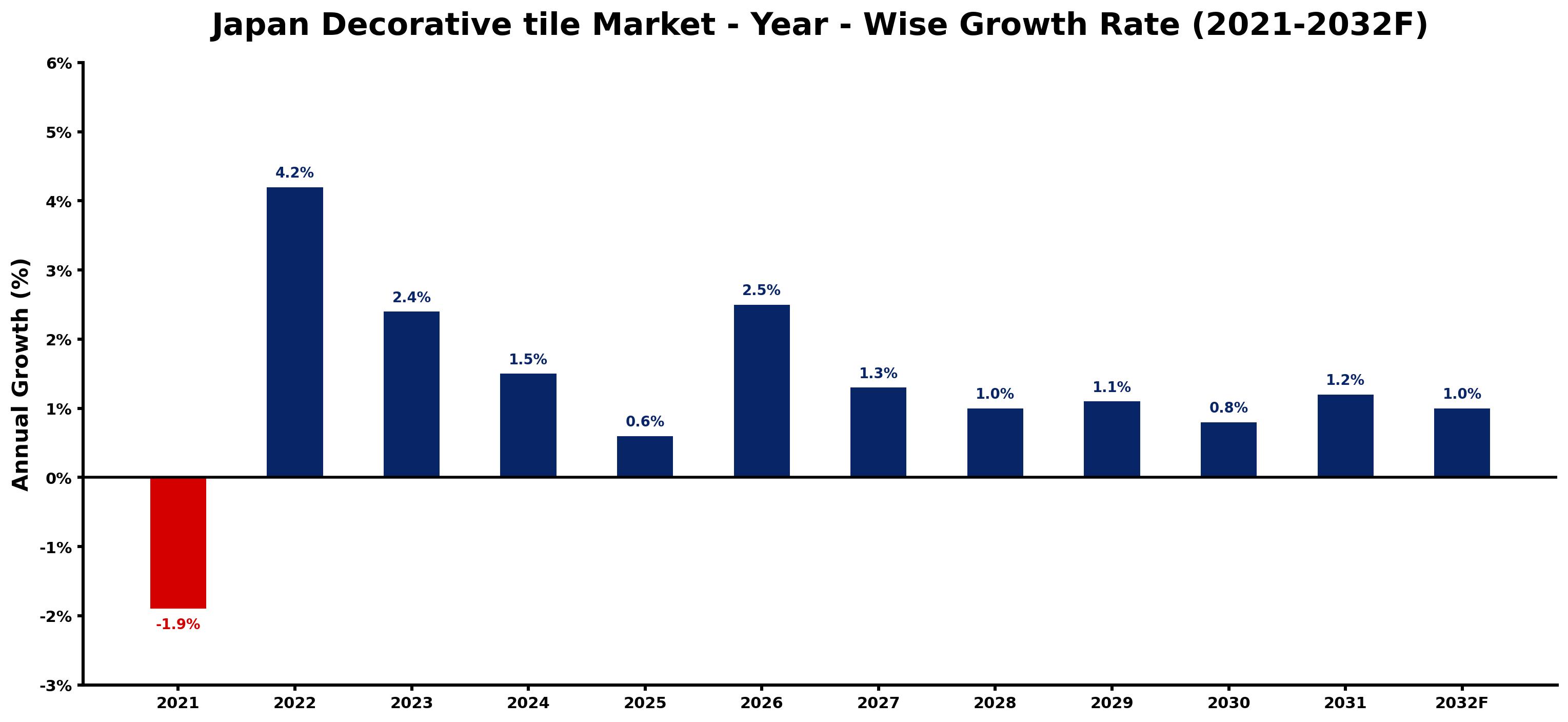
The table below presents the year wise growth rates along with the key drivers influencing the market
| Year | Growth Rate | Major Drivers |
| 2021 | -1.9% | A preference shift towards minimalist interior design diminished demand for decorative tiles in residential projects. |
| 2022 | 4.2% | Cultural appreciation for artisanal craftsmanship revitalized demand for unique decorative tiles. |
| 2023 | 2.4% | Sustainable building materials gained traction, influencing tile manufacturing processes and designs. |
| 2024 | 1.5% | Urbanization trends led to increased construction projects in metropolitan Japanese areas. |
| 2025 | 0.6% | Technological innovations in tile production created diverse customization options for consumers. |
| 2026 | 2.5% | Expansion of interior design services fueled the market for premium decorative tiles. |
| 2027 | 1.3% | Rising disposable incomes allowed households to invest in luxury home improvement projects. |
| 2028 | 1.0% | Awareness of eco-friendly materials encouraged consumers to opt for sustainable tile options. |
| 2029 | 1.1% | Collaborations between designers and manufacturers introduced exclusive tile collections for niche markets. |
| 2030 | 0.8% | Integration of smart home technology influenced tile design and installation preferences. |
| 2031 | 1.2% | Increased participation in home improvement shows spurred consumer interest in decorative tiles. |
| 2032 | 1.0% | Local artisans showcased traditional techniques, enriching the appeal of decorative tile offerings. |
Note - Market size estimations and growth projections presented in this report are based on 6Wresearch's advanced forecasting approach, validated with industry datasets as of June 2026.
Japan Decorative tile Market Synopsis
The Japan Decorative tile Market is projected to reach 2.5% and witness significant growth during the forecast period (2026-2032). This market is characterized by a strong demand for high-quality and visually appealing tiles used in both residential and commercial sectors. Japanese consumers, known for their appreciation of aesthetics, increasingly seek distinctive designs that merge traditional craftsmanship with contemporary style. A notable trend includes the preference for environmentally sustainable materials, further reinforcing the evolving consumer landscape.
Japan Decorative tile Market Growth Drivers
Several factors are fueling the growth of the Japan Decorative tile Market. Increasing urbanization is driving demand for residential and commercial spaces, where decorative tiles serve as critical design elements. Additionally, renovation projects are gaining traction as homeowners and businesses prioritize aesthetic upgrades. The following elements also contribute to market growth:
- Consumer interest in natural materials, such as ceramic and porcelain, which are favored for their durability and timeless appeal.
- An emphasis on sustainability, pushing manufacturers to innovate with eco-friendly production techniques and materials.
- Technological advancements, particularly in digital printing, which enable intricate designs and customization options.
- A surge in larger format tiles that cater to modern interior design trends, offering a seamless look in various applications.
- Growing awareness and appreciation for traditional Japanese aesthetics, encouraging designs that reflect cultural heritage.
Japan Decorative tile Market Trends and Opportunities
The Japan Decorative tile Market is experiencing several notable trends that present significant opportunities for growth. The demand for unique, artistic tile designs that embody traditional motifs is rising, with consumers actively seeking tiles that showcase intricate patterns and natural textures. Key trends in the market include:
- Sustainability-focused product lines, with consumers leaning towards tiles made from recycled materials and those produced through eco-friendly methods.
- The integration of advanced printing technologies that allow for greater design personalization, catering to individual aesthetic preferences.
- Increased interest in larger tiles that provide a modern and expansive feel to residential and commercial interiors.
- The blending of modern design elements with classic Japanese artistry, appealing to a diverse demographic.
- A growing market for luxury decorative tiles, targeting upscale consumers looking to enhance their spaces with premium products.
Japan Decorative tile Market Challenges and Restraints
Despite robust growth potential, the Japan Decorative tile Market faces several challenges that could impede progress. The competitive landscape is intensifying, as both domestic and international manufacturers strive to capture market share. Key challenges include:
- Price volatility in raw material costs, which can significantly affect profit margins for manufacturers.
- Adapting to rapidly changing consumer preferences, requiring ongoing market research and product innovation.
- Stringent regulations around safety and environmental standards that necessitate compliance, increasing operational complexity.
- The need for continual investment in design and manufacturing technologies to keep up with evolving aesthetic trends.
- Market saturation in certain segments, necessitating differentiation through innovation and unique product offerings.
Japan Decorative tile Market Government Investment and Initiatives
The Japanese government is actively involved in regulating the construction materials sector, which includes decorative tiles. Through policies like the Building Standards Law and Construction Standards Law, the government sets rigorous guidelines for quality, durability, and safety that manufacturers must adhere to. Additionally, new initiatives are emerging to promote sustainable practices across the industry. The government is encouraging the use of environmentally friendly materials in production through various incentives and grants. These initiatives aim to enhance the overall integrity of the decorative tile market and ensure consumer safety and satisfaction.
Japan Decorative tile Market Latest Developments (May 2025 - June 2026)
Recent developments in the Japan Decorative tile Market indicate a shift towards enhanced product diversity and sustainability. Innovations in production methods have gained traction, with many manufacturers exploring advanced digital printing capabilities to offer customizable tile designs. The market is also witnessing an increase in collaborations between technology firms and tile manufacturers aimed at creating smart decorative tiles that could integrate with home automation systems. Furthermore, industry events and exhibitions have showcased a growing emphasis on luxury segments, presenting opportunities for niche market players to flourish.
Japan Decorative tile Market Future Outlook
The Japan Decorative tile Market is poised for steady growth, with a forecast indicating a robust trajectory driven by evolving consumer preferences. The anticipated demand for innovative designs and eco-friendly products will further catalyze market expansion. Key factors influencing the market include:
- An ongoing focus on aesthetics in both residential and commercial sectors, leading to a preference for decorative tiles in diverse applications.
- Technological advancements in tile manufacturing processes that provide wider design options and improved product quality.
- A heightened emphasis on sustainability, which will drive consumers towards decorative tiles that boast low environmental impact.
- Continued growth in renovation activities, as homeowners opt to refresh their living spaces with modern and elegant designs.
- The increasing integration of smart home technologies, positioning decorative tiles as potential elements in modern connected environments.
Japan Decorative tile Market - Key Attractiveness of the Report
- 10 Years of Market Numbers
- Historical Data Starting from 2022 to 2025
- Base Year: 2025
- Forecast Data until 2032
- Key Performance Indicators Impacting the Market
- Major Upcoming Developments and Projects
Key Highlights of the Report:
- Japan Decorative tile Market Outlook
- Market Size of Japan Decorative tile Market, 2025
- Forecast of Japan Decorative tile Market, 2032F
- Historical Data and Forecast of Japan Decorative tile Revenues & Volume for the Period 2022-2032F
- Japan Decorative tile Market Trend Evolution
- Japan Decorative tile Market Drivers and Challenges
- Japan Decorative tile Price Trends
- Japan Decorative tile Porter's Five Forces
- Japan Decorative tile Industry Life Cycle
- Historical Data and Forecast of Japan Decorative tile Market Revenues & Volume By Type for the Period 2022-2032F
- Historical Data and Forecast of Japan Decorative tile Market Revenues & Volume By Ceramic Wall Tiles for the Period 2022-2032F
- Historical Data and Forecast of Japan Decorative tile Market Revenues & Volume By Vinyl Wall Tiles for the Period 2022-2032F
- Historical Data and Forecast of Japan Decorative tile Market Revenues & Volume By Stone Wall Tiles for the Period 2022-2032F
- Historical Data and Forecast of Japan Decorative tile Market Revenues & Volume By Other Types for the Period 2022-2032F
- Historical Data and Forecast of Japan Decorative tile Market Revenues & Volume By End-users for the Period 2022-2032F
- Historical Data and Forecast of Japan Decorative tile Market Revenues & Volume By Residential for the Period 2022-2032F
- Historical Data and Forecast of Japan Decorative tile Market Revenues & Volume By Commercial for the Period 2022-2032F
- Historical Data and Forecast of Japan Decorative tile Market Revenues & Volume By Application for the Period 2022-2032F
- Historical Data and Forecast of Japan Decorative tile Market Revenues & Volume By Flooring for the Period 2022-2032F
- Historical Data and Forecast of Japan Decorative tile Market Revenues & Volume By Wall Coverings for the Period 2022-2032F
- Historical Data and Forecast of Japan Decorative tile Market Revenues & Volume By Other Applications for the Period 2022-2032F
- Japan Decorative tile Import Export Trade Statistics
- Market Opportunity Assessment By Type
- Market Opportunity Assessment By End-users
- Market Opportunity Assessment By Application
- Japan Decorative tile Top Companies Market Share
- Japan Decorative tile Competitive Benchmarking By Technical and Operational Parameters
- Japan Decorative tile Company Profiles
- Japan Decorative tile Key Strategic Recommendations






































