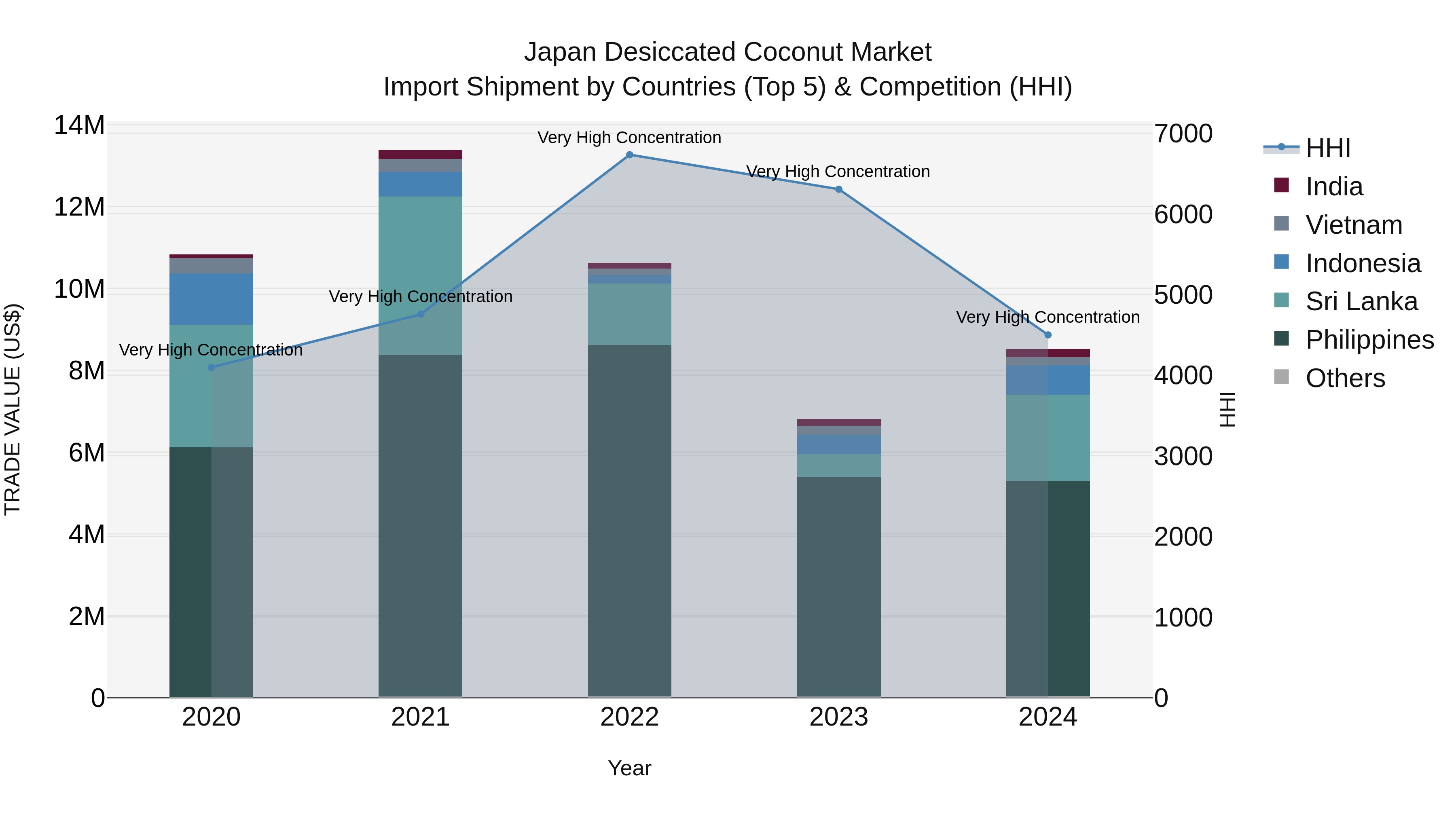
Japan Desiccated Coconut Market Import Shipment by Countries (Top 5) & Competition (HHI)
The desiccated coconut import market in Japan continued to see significant concentration in 2024, with the top exporting countries being the Philippines, Sri Lanka, Indonesia, Vietnam, and India. Despite a negative compound annual growth rate (CAGR) of -5.84% from 2020 to 2024, there was a notable growth spike of 25.04% from 2023 to 2024. This suggests a potential shift in market dynamics and opportunities for exporters to capitalize on the increasing demand for desiccated coconut in Japan.
Japan Desiccated Coconut Market Overview
The Japan Desiccated Coconut Market is experiencing steady growth due to the increasing demand for coconut-based products in the food and beverage industry. Desiccated coconut, a popular ingredient in Japanese cuisine, is widely used in confectionery, bakery, and ready-to-eat food products. The market is driven by the rising consumer awareness of the health benefits associated with coconut consumption, including its high fiber content and natural sweetness. Additionally, the versatility of desiccated coconut in various culinary applications is contributing to its growing popularity among Japanese consumers. Key players in the Japan Desiccated Coconut Market include local manufacturers as well as international companies aiming to capitalize on the expanding market opportunities in the country. Overall, the market is poised for further growth as the trend towards healthy and natural ingredients continues to drive demand for desiccated coconut products in Japan.
Japan Desiccated Coconut Market Trends
In the Japan Desiccated Coconut Market, there is a growing demand for organic and sustainably sourced desiccated coconut products. Consumers are increasingly seeking healthier and ethically produced options, leading to a rise in the availability and consumption of organic desiccated coconut in the market. Additionally, there is a trend towards innovative product offerings such as flavored desiccated coconut varieties, catering to diverse consumer preferences and enhancing the overall culinary experience. Companies in the market are also focusing on enhancing product quality and packaging to attract discerning consumers. Overall, the Japan Desiccated Coconut Market is witnessing a shift towards premium, organic, and innovative products to meet the evolving demands of health-conscious and environmentally aware consumers.
Japan Desiccated Coconut Market Challenges
In the Japan Desiccated Coconut Market, some challenges include limited domestic production leading to high dependence on imports, fluctuating prices due to currency exchange rates, and increasing competition from other coconut-producing countries. Additionally, changing consumer preferences towards healthier and organic options pose a challenge for traditional desiccated coconut products. Strict regulations and quality standards in Japan also contribute to the challenges faced by market players in ensuring compliance and maintaining product quality. To succeed in this market, companies need to focus on product innovation, sustainable sourcing practices, and effective marketing strategies to differentiate themselves and capture consumer interest in a competitive landscape.
Japan Desiccated Coconut Market Investment Opportunities
The Japan Desiccated Coconut Market presents promising investment opportunities due to the increasing consumer demand for healthy and convenient food products. With a growing trend towards plant-based and natural ingredients, desiccated coconut is gaining popularity as a versatile ingredient in various food and beverage applications. Investors can consider opportunities in desiccated coconut production, processing, and distribution to cater to the rising demand from food manufacturers, bakeries, confectioneries, and retail consumers. Additionally, leveraging technological advancements in production processes and sustainable sourcing practices can enhance competitiveness in the market. Collaborations with local farmers and suppliers to ensure a stable supply chain and adherence to quality standards will be crucial for long-term success in the Japan Desiccated Coconut Market.
Japan Desiccated Coconut Market Government Policy
The government policies related to the Japan Desiccated Coconut Market primarily focus on ensuring food safety, quality standards, and sustainable production practices. The Ministry of Agriculture, Forestry, and Fisheries (MAFF) oversee regulations concerning the import, processing, and distribution of desiccated coconut to safeguard consumer health and promote fair trade practices. Additionally, the government encourages domestic coconut cultivation through subsidies and incentives to reduce dependency on imports and enhance self-sufficiency in the market. Environmental sustainability is also a key consideration, with initiatives promoting eco-friendly production methods and waste management practices. Overall, the government`s policies aim to support the growth of the Japan Desiccated Coconut Market while upholding quality standards and environmental consciousness.
Japan Desiccated Coconut Market Future Outlook
The Japan desiccated coconut market is poised for steady growth in the coming years. Factors such as the increasing demand for healthy and natural food products, the rising popularity of coconut-based products due to their nutritional benefits, and the growing trend of clean-label and organic food choices are expected to drive market expansion. Additionally, the versatility of desiccated coconut in various applications such as bakery, confectionery, and ready-to-eat meals will further contribute to market growth. With an emphasis on quality and sustainability, market players are likely to focus on product innovation and expanding their product portfolios to cater to the evolving consumer preferences in Japan. Overall, the Japan desiccated coconut market is anticipated to experience a positive trajectory in the foreseeable future.
Key Highlights of the Report:
- Japan Desiccated Coconut Market Outlook
- Market Size of Japan Desiccated Coconut Market, 2024
- Forecast of Japan Desiccated Coconut Market, 2031
- Historical Data and Forecast of Japan Desiccated Coconut Revenues & Volume for the Period 2021 - 2031
- Japan Desiccated Coconut Market Trend Evolution
- Japan Desiccated Coconut Market Drivers and Challenges
- Japan Desiccated Coconut Price Trends
- Japan Desiccated Coconut Porter's Five Forces
- Japan Desiccated Coconut Industry Life Cycle
- Historical Data and Forecast of Japan Desiccated Coconut Market Revenues & Volume By Cut Type for the Period 2021 - 2031
- Historical Data and Forecast of Japan Desiccated Coconut Market Revenues & Volume By Regular cut for the Period 2021 - 2031
- Historical Data and Forecast of Japan Desiccated Coconut Market Revenues & Volume By Fancy cut for the Period 2021 - 2031
- Historical Data and Forecast of Japan Desiccated Coconut Market Revenues & Volume By Fat Content for the Period 2021 - 2031
- Historical Data and Forecast of Japan Desiccated Coconut Market Revenues & Volume By High fat content for the Period 2021 - 2031
- Historical Data and Forecast of Japan Desiccated Coconut Market Revenues & Volume By Low fat content for the Period 2021 - 2031
- Historical Data and Forecast of Japan Desiccated Coconut Market Revenues & Volume By Distribution Channel for the Period 2021 - 2031
- Historical Data and Forecast of Japan Desiccated Coconut Market Revenues & Volume By Supermarket for the Period 2021 - 2031
- Historical Data and Forecast of Japan Desiccated Coconut Market Revenues & Volume By Specialty stores for the Period 2021 - 2031
- Historical Data and Forecast of Japan Desiccated Coconut Market Revenues & Volume By Online sales for the Period 2021 - 2031
- Historical Data and Forecast of Japan Desiccated Coconut Market Revenues & Volume By Retail stores for the Period 2021 - 2031
- Japan Desiccated Coconut Import Export Trade Statistics
- Market Opportunity Assessment By Cut Type
- Market Opportunity Assessment By Fat Content
- Market Opportunity Assessment By Distribution Channel
- Japan Desiccated Coconut Top Companies Market Share
- Japan Desiccated Coconut Competitive Benchmarking By Technical and Operational Parameters
- Japan Desiccated Coconut Company Profiles
- Japan Desiccated Coconut Key Strategic Recommendations






































