Japan Digital Education Market Size & Growth Rate (2026-2032)
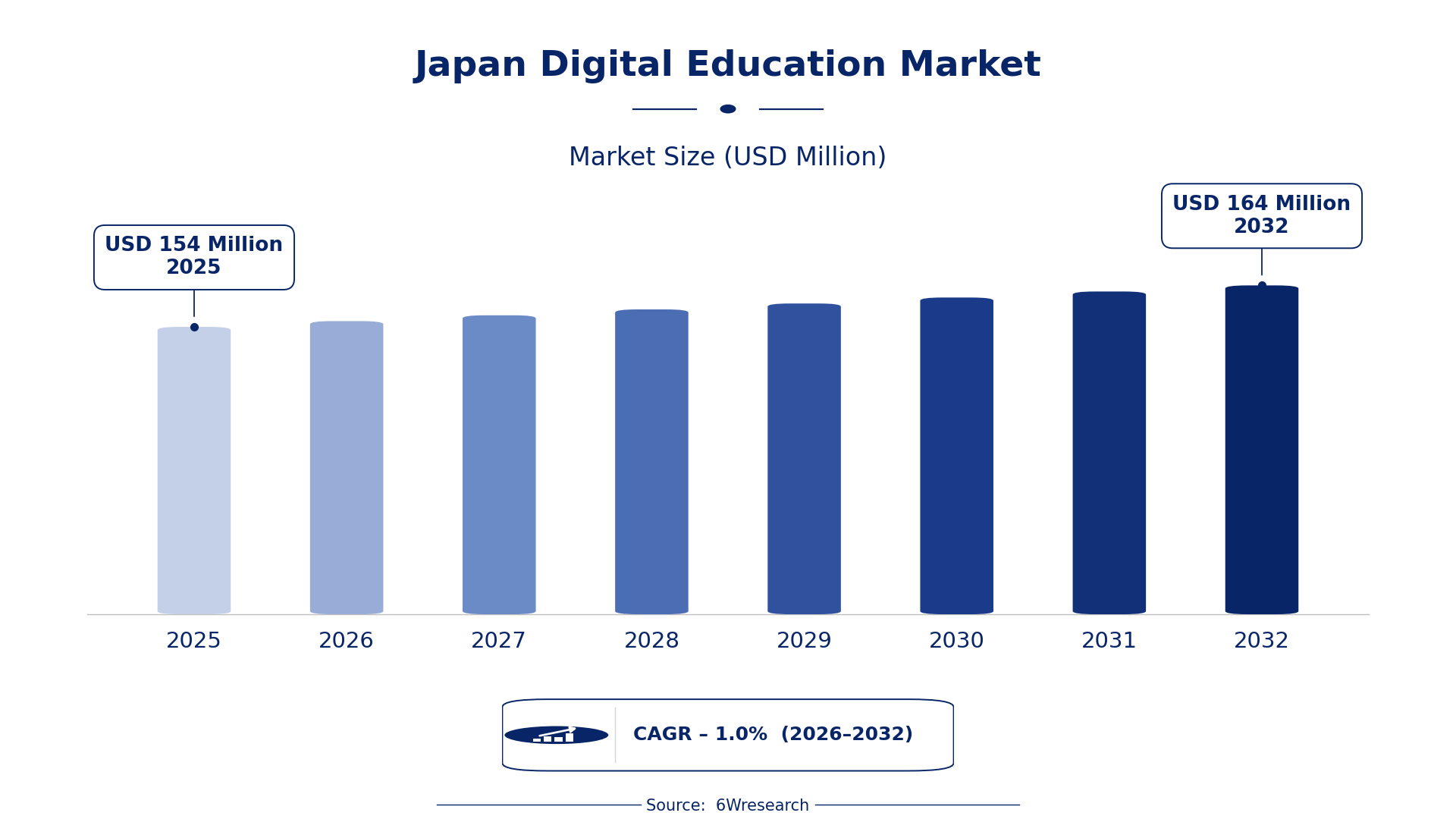
The Japan Digital Education Market was estimated at USD 154 Million in 2025 and is projected to reach USD 164 Million by 2032, growing at a CAGR of 1.0% from 2026 to 2032.
Japan Digital Education Market Synopsis
In recent years, the Japan Digital Education Market has gained momentum, driven primarily by the swift transition to online learning environments. This shift has been further accelerated by the COVID-19 pandemic, which forced educational institutions to adopt digital solutions quickly. However, as we look forward, the market is expected to evolve toward more sophisticated and interactive learning experiences, fueled by technological advancements.
While the current landscape showcases a strong preference for e-learning platforms, the future will likely focus on personalized education and adaptive learning tools. As stakeholders prioritize quality educational outcomes, innovative technologies such as artificial intelligence and virtual reality will play an increasingly central role in shaping the future of education in Japan.
Japan Digital Education Market Year-wise Growth Rate and Key Drivers
This graph illustrates the annual growth rates of the Japan Digital Education Market from 2021 to 2032, highlighting a steady upward trajectory and projected expansion over the forecast period.
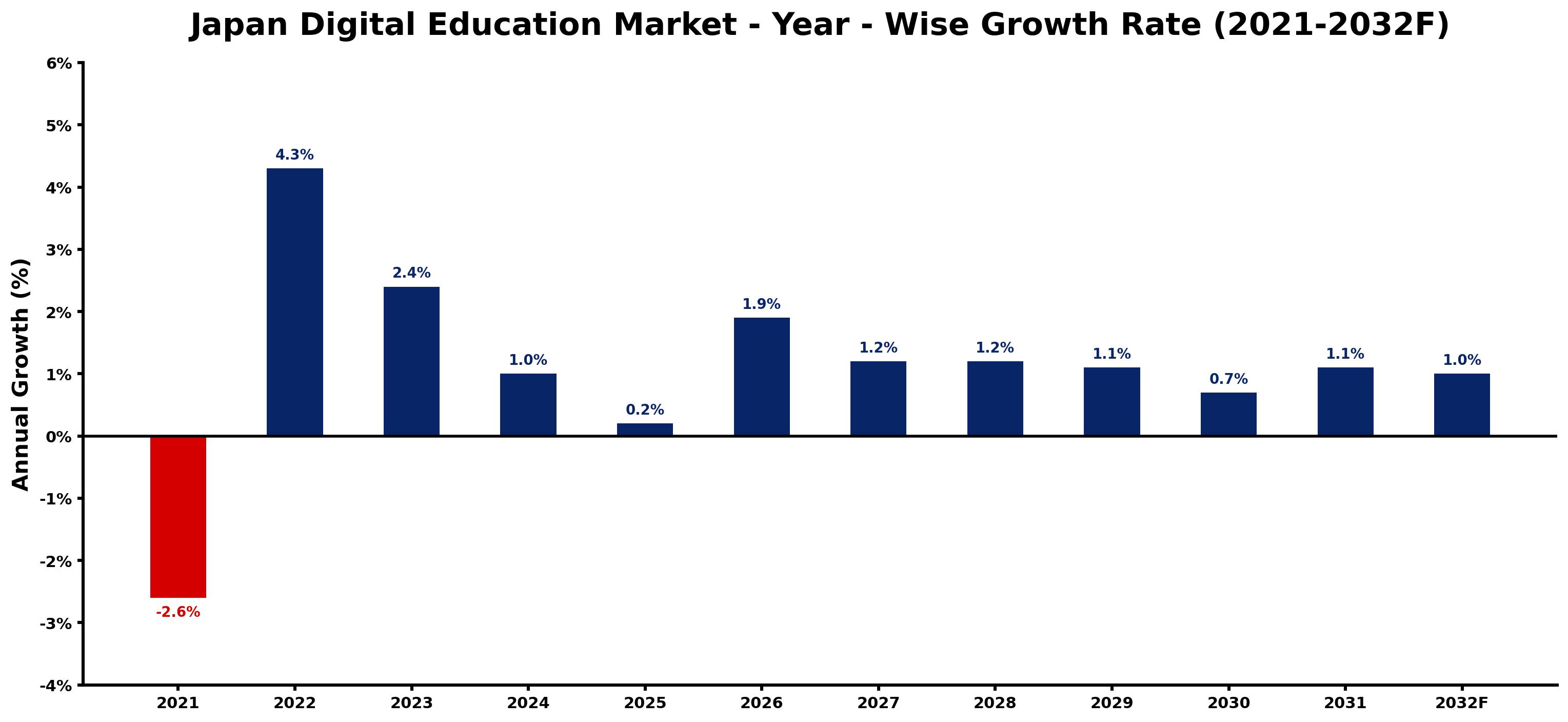
The table below presents the year‑wise growth rates along with the key drivers influencing the market
| Year | Growth Rate | Major Drivers |
| 2021 | -2.6% | School closures due to Japan's COVID-19 restrictions. |
| 2022 | 4.3% | Government funding for digital learning infrastructure rollout |
| 2023 | 2.4% | Increased adoption of online learning due to pandemic |
| 2024 | 1.0% | Rise in digital literacy initiatives among older populations |
| 2025 | 0.2% | Supportive policies encouraging edtech startups in Japan |
| 2026 | 1.9% | Integration of Japanese culture in digital curricula |
| 2027 | 1.2% | Enhanced mobile connectivity facilitating remote learning options |
| 2028 | 1.2% | Corporate training programs incorporating digital education tools |
| 2029 | 1.1% | Growing awareness of e-learning benefits among parents |
| 2030 | 0.7% | Regulatory support for edtech innovation and investment |
| 2031 | 1.1% | Cultural shift towards lifelong learning in digital environments |
| 2032 | 1.0% | Investment in gamified learning experiences for engagement |
Note: Market size estimations and growth projections presented in this report are based on 6Wresearch's proprietary forecasting methodology, utilizing the latest available industry data, government publications, and primary research inputs.
Japan Digital Education Market Key Takeaways
Below are some of the specific key takeaways from the market, including:
- The market is driven by growing demand for personalized and interactive learning experiences.
- Government initiatives are critical in promoting digital education across schools.
- Edtech startups are thriving, focusing on innovative solutions for various learning needs.
- Challenges such as digital literacy and traditional teaching methods still need to be addressed.
- Investment opportunities are on the rise, particularly in e-learning platforms and educational apps.
Evaluation of Restraints in Japan Digital Education Market
Despite the promising growth trajectory, several factors are limiting the potential of the Japan Digital Education Market. Resistance to change remains a significant barrier, as many educators are accustomed to traditional teaching methods and may be hesitant to adopt new technologies. Concerns regarding the quality of online education also persist, impacting both institutional trust and student enrollment in digital programs.
on top of that, digital literacy is a pressing issue; both educators and students may lack the necessary skills to fully utilize digital tools. Infrastructure investments are crucial for broadening access to these resources, yet the complex regulatory environment can stifle innovation and hinder rapid market growth. Collaborative efforts among government, educational institutions, and technology providers are essential to overcome these challenges.
Japan Digital Education Market Trends
Several trends are influencing the Japan Digital Education Market. The increasing popularity of e-learning platforms reflects a shift towards flexible learning solutions, allowing students to learn at their own pace. Personalized learning experiences are gaining traction, with adaptive technologies catering to diverse learning styles and needs.
on top of that, the integration of advanced technologies such as AI and VR is reshaping educational methodologies, enhancing engagement and retention rates. The emphasis on lifelong learning is also prompting educational institutions to expand their offerings, catering to adult learners seeking new skills and knowledge. These trends suggest a dynamic future for digital education in Japan.
Japan Digital Education Market Opportunities
Opportunities abound in the Japan Digital Education Market, particularly for investors looking to capitalize on the surge in digital transformation within education. As demand for online learning platforms grows, there is a significant need for innovative solutions that address various learning requirements, from language acquisition to test preparation.
Additionally, the government's commitment to digitalizing education creates favorable conditions for startups and established companies alike. Investors should look toward developing educational apps, interactive content, and online tutoring services as key areas for growth. This evolving market presents a unique chance for stakeholders to innovate and meet the diverse needs of students and educators.
Government Initiatives in the Japan Digital Education Market
The Japanese government is actively shaping the Digital Education Market through various initiatives aimed at enhancing the educational experience. By prioritizing digital transformation, these initiatives are designed to improve accessibility and foster a culture of innovation within the education sector.
- A recently completed "FutureSchool Initiative" introduced digital textbooks and tablets in schools, enhancing student engagement.
- Current efforts focus on improving digital infrastructure in educational institutions, ensuring equitable access to technology.
- Ongoing teacher training programs are being implemented to bolster educators' digital skills and confidence.
- Future plans include a national policy framework aimed at ensuring data privacy and security in digital education platforms.
- Government funding is being allocated for the development of educational software to support online learning initiatives.
Future Insights of the Japan Digital Education Market
Looking ahead to 2026-2032, the Japan Digital Education Market is set for noteworthy expansion. The increasing integration of technology in education, driven by both necessity and innovation, will continue to reshape how learning occurs. Personalized learning will gain prominence, reflecting a broader trend toward catering to individual student needs.
As a result, edtech companies will be challenged to innovate continually, developing tools and platforms that align with the changing educational landscape. The emphasis on lifelong learning will also drive demand for a broader range of offerings, ensuring that the market remains dynamic and responsive to the evolving needs of learners.
Japan Digital Education Market Latest Developments
Recent developments in the Japan Digital Education Market reflect a proactive approach to embracing technology and enhancing educational experiences. Over the past 12-14 months, there has been a marked increase in the adoption of digital solutions across various educational sectors.
- A major technology vendor launched a comprehensive e-learning platform in early 2025, receiving positive feedback from both educators and students.
- A regional operator is currently underway with an initiative to expand digital access in rural schools, aiming for completion by late 2025.
- A partnership between educational institutions and edtech startups was formed to develop interactive learning tools, with ongoing collaboration expected throughout 2026.
- Upcoming plans involve a nationwide campaign to promote digital literacy among students and teachers, set to launch in mid-2026.
- A service upgrade to existing online tutoring platforms is scheduled for Q4 2025, incorporating AI-driven personalized learning features.
Japan Digital Education Market - Key Attractiveness of the Report
- 10 Years of Market Numbers
- Historical Data Starting from 2022 to 2025
- Base Year: 2025
- Forecast Data until 2032
- Key Performance Indicators Impacting the Market
- Major Upcoming Developments and Projects
Key Highlights of the Report:
- Japan Digital Education Market Outlook
- Market Size of Japan Digital Education Market, 2025
- Forecast of Japan Digital Education Market, 2032
- Historical Data and Forecast of Japan Digital Education Revenues & Volume for the Period 2022-2032F
- Japan Digital Education Market Trend Evolution
- Japan Digital Education Market Drivers and Challenges
- Japan Digital Education Price Trends
- Japan Digital Education Porter's Five Forces
- Japan Digital Education Industry Life Cycle
- Historical Data and Forecast of Japan Digital Education Market Revenues & Volume By End User for the Period 2022-2032F
- Historical Data and Forecast of Japan Digital Education Market Revenues & Volume By Academic Institutions for the Period 2022-2032F
- Historical Data and Forecast of Japan Digital Education Market Revenues & Volume By Enterprises and Public Sector for the Period 2022-2032F
- Historical Data and Forecast of Japan Digital Education Market Revenues & Volume By Learning Type for the Period 2022-2032F
- Historical Data and Forecast of Japan Digital Education Market Revenues & Volume By Self-paced Online Education for the Period 2022-2032F
- Historical Data and Forecast of Japan Digital Education Market Revenues & Volume By Instructor-led Online Education for the Period 2022-2032F
- Historical Data and Forecast of Japan Digital Education Market Revenues & Volume By Course Type for the Period 2022-2032F
- Historical Data and Forecast of Japan Digital Education Market Revenues & Volume By Science and Technology Courses for the Period 2022-2032F
- Historical Data and Forecast of Japan Digital Education Market Revenues & Volume By Entrepreneurship and Business Management Courses for the Period 2022-2032F
- Historical Data and Forecast of Japan Digital Education Market Revenues & Volume By Other Courses for the Period 2022-2032F
- Japan Digital Education Import Export Trade Statistics
- Market Opportunity Assessment By End User
- Market Opportunity Assessment By Learning Type
- Market Opportunity Assessment By Course Type
- Japan Digital Education Top Companies Market Share
- Japan Digital Education Competitive Benchmarking By Technical and Operational Parameters
- Japan Digital Education Company Profiles
- Japan Digital Education Key Strategic Recommendations






































