Japan Digital Imaging Market Size & Growth Rate
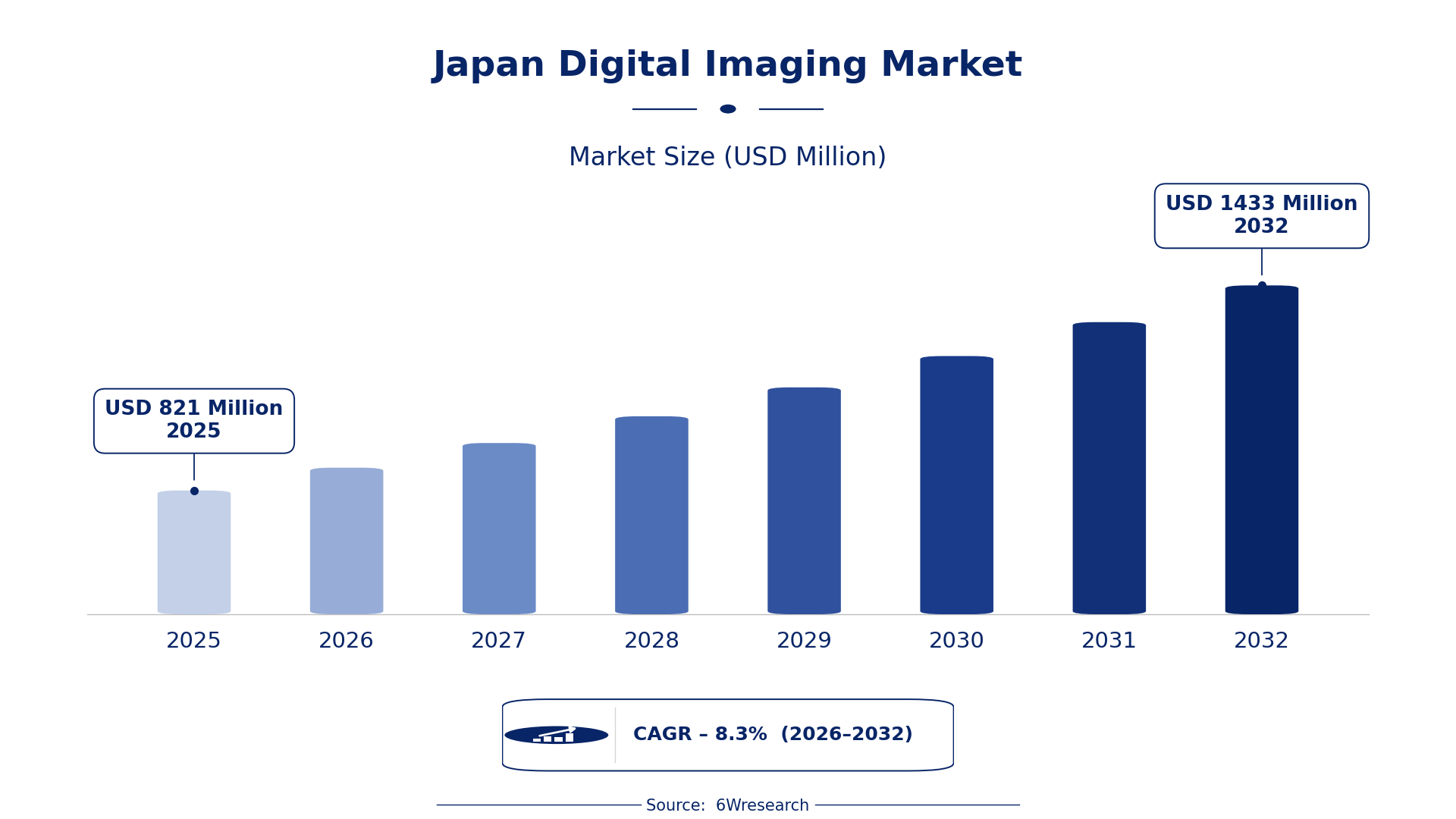
According to 6Wresearch internal database and industry insights, the Japan Digital Imaging Market was valued at USD 821 Million in 2025 and is projected to reach USD 1,433 Million by 2032, growing at a CAGR of approximately 8.3% during 2026–2032.
Japan Digital Imaging Market Highlights
| Report Metric | Details |
| Report Name | Japan Digital Imaging Market (2026-2032) |
| Market Size 2025 | USD 821 Million |
| Market Size 2032 | USD 1,433 Million |
| Absolute Growth 2025–2032 | USD 612 Million |
| CAGR 2026–2032 | 8.3% |
| Peak Annual Growth | 9.6% in 2028 |
| Forecast Period | 2026–2032 |
| Historical Data | 2022–2025 |
| Base Year | 2025 |
| Leading Technology, 2025 | Machine Vision (48% share) |
| Leading Application, 2025 | Inspection (60% share) |
| Leading Industry, 2025 | Automotive (45% share) |
| Fastest-Growing Technology | Metrology (11.4% CAGR) |
| Fastest-Growing Application | Reverse Engineering (10.7% CAGR) |
| Fastest-Growing Industry | Aerospace (10.5% CAGR) |
| Growing Sector | automotive |
| Key End Users | automotive manufacturers, healthcare providers, construction firms, aerospace companies |
Japan Digital Imaging Market Year-wise Growth Rate and Key Drivers (2022–2032)
This graph illustrates the annual growth rates of the market from 2022 to 2032, highlighting a steady upward trajectory and projected market expansion over the forecast period.
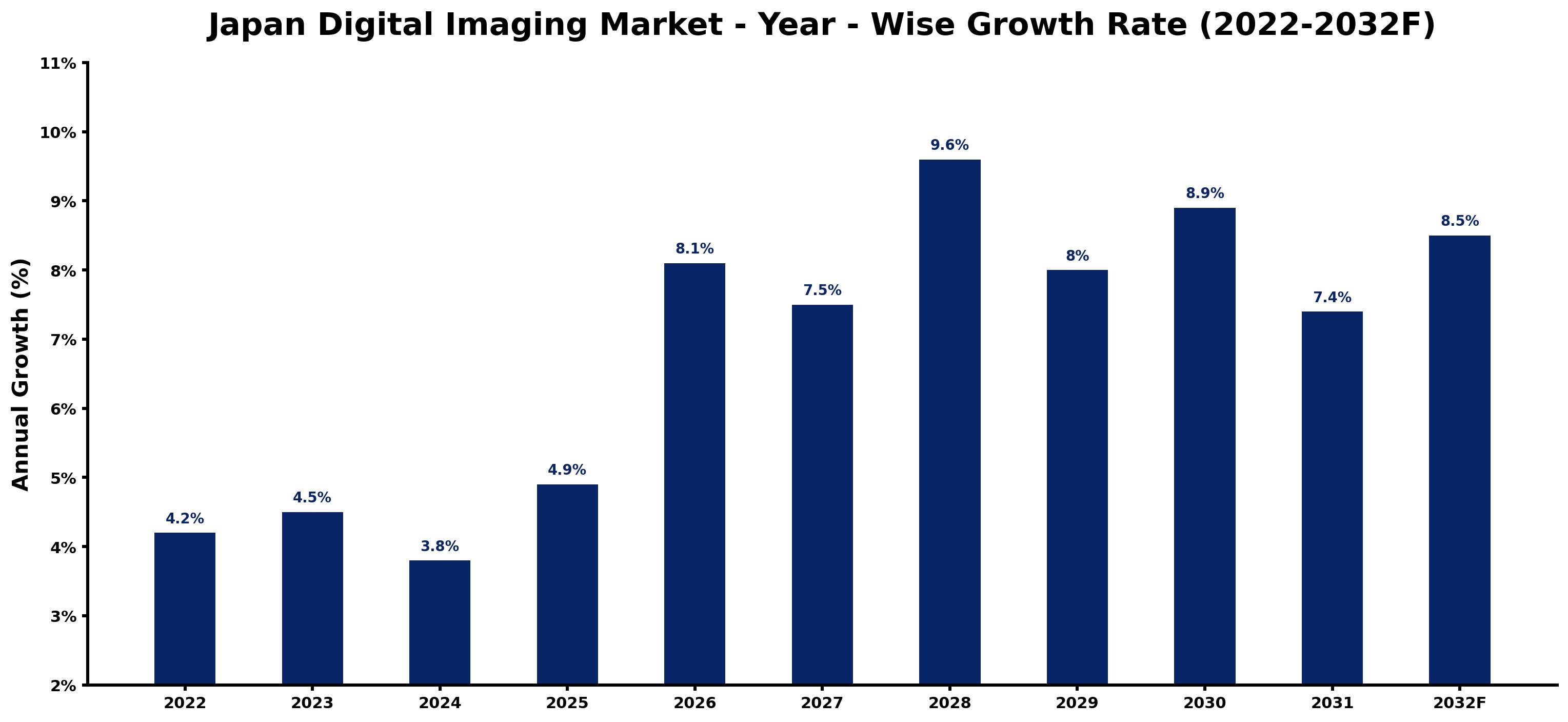
Year by year, the estimates below pair each growth rate with the development that shaped it.
| Year | Estimated Annual Growth (%) | Market Rationale |
| 2022 | 4.2 | Market activity was stable, reflecting ongoing demand from key sectors. |
| 2023 | 4.5 | Growth accelerated as the automotive sector expanded its digital imaging applications. |
| 2024 | 3.8 | Growth slowed slightly due to market saturation in some areas. |
| 2025 | 4.9 | Investment in advanced manufacturing technologies boosted market growth. |
| 2026 | 8.1 | Demand surged as companies adopted new imaging solutions. |
| 2027 | 7.5 | Growth moderated as the market adjusted to increased competition. |
| 2028 | 9.6 | The peak growth year saw advancements in imaging technology. |
| 2029 | 8.0 | Growth slowed as the market began to stabilise after rapid expansion. |
| 2030 | 8.9 | Investment in LiDAR technology spurred renewed interest in digital imaging. |
| 2031 | 7.4 | Growth decelerated slightly due to market maturity. |
| 2032 | 8.5 | The market is expected to benefit from ongoing technological advancements. |
Note: Market size estimations and growth projections presented in this report are based on 6Wresearch's proprietary forecasting methodology, utilizing the latest available industry data, government publications, and primary research inputs.
Japan Digital Imaging Market Synopsis
Digital imaging involves the capture, storage, and manipulation of images through digital technology, primarily used in sectors like automotive, medical imaging, and surveying. The Japan Digital Imaging Market is valued at approximately 1.5 billion USD as of 2023, driven by the automotive sector employing over 5 million people. Key growth factors include the adoption of ISO 9001 for quality management and government programs promoting advanced manufacturing technologies, such as the 2023 initiative by the Ministry of Economy, Trade and Industry.
Market Dynamics Impact Analysis (2026–2032)
| Factor | Type | Impact | Primary Segment Affected |
| Growing demand for quality control in manufacturing processes | Driver | High | Machine Vision |
| Increasing applications in medical imaging and diagnostics | Driver | High | Radiography |
| Rising need for urban planning solutions | Opportunity | High | LiDAR |
| Expanding aerospace sector requiring advanced imaging technology | Opportunity | High | Aerospace |
| High costs associated with advanced imaging systems | Restraint | Medium | Metrology |
| Limited awareness of digital imaging benefits in smaller firms | Restraint | Medium | Inspection |
| Challenges in integrating new technologies into existing systems | Challenge | High | Automotive |
| Shortage of skilled professionals in imaging technology | Challenge | Medium | Surveying |
Evaluation of Drivers in Japan Digital Imaging Market (2026–2032)
Below are the drivers that matter most for revenue growth, with supporting evidence.
| Drivers | Primary Segment Affected | Why It Matters (Evidence) |
| Increased automation in manufacturing processes | Machine Vision | The automotive sector's demand for quality control drives investment in machine vision technologies, employing over 5 million people. |
| Growing healthcare needs for advanced diagnostics | Radiography | With over 8,000 hospitals in Japan, the need for advanced imaging systems is critical for patient care. |
| Urban development initiatives requiring mapping solutions | LiDAR | LiDAR technology is increasingly used in urban planning, supporting environmental monitoring capabilities. |
| Expansion of aerospace industry requiring compliance checks | Aerospace | The aerospace sector's growth necessitates advanced imaging for safety and compliance, driving demand. |
| Rising investments in research and development | Metrology | The government allocated 200 million JPY for R&D in imaging technologies, promoting innovation. |
A wider customer base explains much of the growth, as the automotive sector employs over 5 million people, driving demand for machine vision technologies. In healthcare, over 8,000 hospitals rely on advanced radiography systems, increasing the need for new imaging solutions. The aerospace sector's expansion necessitates compliance checks, further boosting demand for advanced imaging.
Evaluation of Restraints in Japan Digital Imaging Market
These are the pressures that could keep growth below its potential.
| Market Restraint | Primary Segment Affected | Why It Matters (Evidence) |
| High costs associated with advanced imaging systems | Metrology | The high investment required for precision measurement tools limits adoption among smaller firms. |
| Limited awareness of digital imaging benefits in smaller firms | Inspection | Many smaller manufacturers are unaware of the advantages digital imaging offers for quality control. |
| Integration challenges with existing systems | Automotive | Automakers face difficulties in seamlessly integrating new imaging technologies into their production lines. |
| Shortage of skilled professionals in imaging technology | Surveying | The lack of trained personnel hampers the effective implementation of advanced imaging solutions. |
| Regulatory compliance costs for imaging technologies | Radiography | Compliance with medical imaging regulations adds to the operational costs for healthcare providers. |
Japan Digital Imaging Market Challenges
High costs for digital imaging technologies hinder hospitals, as advanced systems can exceed 10 million JPY, delaying necessary upgrades and impacting patient care. Supply chain disruptions arise from reliance on specific components, causing project delays for producers in key regions like Tokyo and Aichi, where demand is robust. Technology integration issues stem from the need to comply with ISO 9001 standards, extending development times for suppliers by up to six months. Buyers face price volatility linked to government funding changes, with 200 million JPY allocated for R&D potentially increasing costs for imaging solutions.
Trends in the Japan Digital Imaging Market
The shifts below are changing how Japan Digital Imaging Market products are bought and supplied.
- Shift in Automotive Quality Control: Automotive manufacturers are increasingly adopting digital imaging for quality assurance, improving production efficiency. In 2023, the automotive sector employed over 5 million people, driving this trend.
- Transition to Advanced Medical Imaging: Healthcare facilities are moving towards advanced radiography systems for better diagnostics. In 2023, over 8,000 hospitals in Japan utilized such technologies, reflecting this shift.
- LiDAR Technology Gaining Traction: LiDAR technology is becoming essential for urban planning and environmental monitoring. In 2023, its adoption increased, with various municipalities investing in mapping solutions.
- Increased Focus on R&D in Imaging Technologies: The Japanese government has prioritised research in imaging technologies, allocating funds for development in 2023. This funding is expected to drive innovation across multiple sectors.
Investment Opportunities in the Japan Digital Imaging Market
Below are the investment opportunities with the strongest case in the Japan Digital Imaging Market.
- Investment in Advanced Imaging Solutions: With a projected market size of 1.5 billion USD in 2023, there is a clear gap for advanced imaging solutions in manufacturing. Automotive manufacturers are seeking new technologies to improve production quality.
- Expansion of LiDAR Applications: The growing need for urban planning solutions creates opportunities for LiDAR technology. Municipalities across Japan are looking to invest in mapping and surveying technologies.
- Aerospace Sector Growth: The aerospace industry is expanding, with a projected growth rate for imaging technologies. Companies involved in aerospace manufacturing are increasingly investing in advanced imaging systems.
- Partnerships for Technology Development: Collaborative ventures between local firms and international technology providers can improve imaging capabilities. Establishing joint ventures in regions like Tokyo can facilitate market entry.
Government Initiatives in the Japan Digital Imaging Market
The Semiconductor and Digital Industry Strategy, enacted by METI in June 2021, aims to secure domestic semiconductor manufacturing, which directly impacts technological advancements in digital imaging. Additionally, the AI Promotion Act of 2025 outlines a national framework for AI research, enhancing imaging technology applications across various industries.
The Ministry of Economy, Trade and Industry (METI) funds various initiatives to promote advanced manufacturing technologies, including digital imaging. In 2023, the government allocated substantial funds for R&D in imaging technologies, supporting innovation and development in this sector.
Future Insight of the Japan Digital Imaging Market
The 2023 National Development Plan will drive a policy shift towards advanced manufacturing technologies, prompting suppliers to innovate in digital imaging. By 2032, increased investment in R&D, including 200 million JPY for imaging technologies, will enhance diagnostic tools for hospitals. New standards will streamline processes, enabling buyers to adopt advanced solutions more efficiently. As urban planning evolves, demand for digital imaging in environmental monitoring will grow, offering suppliers opportunities to expand their offerings.
Market Segmentation Analysis
Japan Digital Imaging Market report covers a detailed analysis of the following market segments:
By Technology – Machine Vision Leads, Metrology Expected to Grow Fastest
According to Vasudha, AM at 6Wresearch, the largest technology category in 2025 was Machine Vision, at 48% of revenue. Machine Vision holds the largest share due to its widespread application in automated inspection processes within manufacturing. This technology is essential for ensuring quality control, particularly in regions like Aichi, known for its automotive production. Over 2026–2032, Metrology is expected to post the fastest growth, at a CAGR of 11.4%. Metrology is experiencing rapid growth as industries increasingly rely on precise measurements for quality assurance. The push for accuracy in manufacturing processes, supported by the 2023 National Development Plan, will further accelerate this segment's expansion. Suppliers should focus on developing advanced metrology solutions to meet the rising demand in precision-driven industries.
By Application – Inspection Leads, Reverse Engineering Expected to Grow Fastest
Inspection accounted for 60% of the market by application in 2025. Inspection holds the largest share as it is critical for quality control in production lines, especially within the automotive sector. The automotive industry, employing over 5 million people, drives substantial demand for inspection technologies. Reverse Engineering is projected to grow fastest, at a CAGR of 10.7% during 2026–2032. Reverse Engineering is witnessing rapid growth as manufacturers seek to recreate designs from existing products for improved innovation. This trend is particularly evident in the automotive sector, where frequent design iterations are necessary. Suppliers should prioritise the development of inspection technologies to address the increasing demands for quality assurance in production.
By Industry – Automotive Leads, Aerospace Expected to Grow Fastest
Automotive held 45% of the Japan Digital Imaging Market by industry in 2025. The Automotive sector dominates the market due to its essential role in quality assurance during vehicle manufacturing processes. This industry significantly influences the demand for digital imaging technologies with its extensive workforce. The quickest growth will come from Aerospace, forecast to expand at a CAGR of 10.5% between 2026 and 2032. Aerospace is the fastest-growing segment as the need for stringent safety inspections and compliance checks becomes more pronounced. The rising focus on safety standards is expected to drive further investment in imaging technologies within this sector. Buyers in the aerospace industry must consider advanced imaging solutions to comply with heightened safety requirements.
Key Attractiveness of the Report
- 10 Years of Market Numbers
- Historical Data Starting from 2022 to 2025
- Base Year 2025
- Forecast Data until 2032
- Key Performance Indicators Impacting the Market
- Major Upcoming Developments and Projects
Key Highlights of the Report:
- Japan Digital Imaging Market Outlook
- Market Size of Japan Digital Imaging Market, 2025
- Forecast of Japan Digital Imaging Market, 2032
- Historical Data and Forecast of Japan Digital Imaging Revenues & Volume for the Period 2022-2032
- Japan Digital Imaging Market Trend Evolution
- Japan Digital Imaging Market Drivers and Challenges
- Japan Digital Imaging Price Trends
- Japan Digital Imaging Porter's Five Forces
- Japan Digital Imaging Industry Life Cycle
- Historical Data and Forecast of Japan Digital Imaging Market Revenues & Volume By Technology for the Period 2022-2032
- Historical Data and Forecast of Japan Digital Imaging Market Revenues & Volume By Machine Vision for the Period 2022-2032
- Historical Data and Forecast of Japan Digital Imaging Market Revenues & Volume By Metrology for the Period 2022-2032
- Historical Data and Forecast of Japan Digital Imaging Market Revenues & Volume By Radiography for the Period 2022-2032
- Historical Data and Forecast of Japan Digital Imaging Market Revenues & Volume By LiDAR for the Period 2022-2032
- Historical Data and Forecast of Japan Digital Imaging Market Revenues & Volume By Application for the Period 2022-2032
- Historical Data and Forecast of Japan Digital Imaging Market Revenues & Volume By Inspection for the Period 2022-2032
- Historical Data and Forecast of Japan Digital Imaging Market Revenues & Volume By Reverse Engineering for the Period 2022-2032
- Historical Data and Forecast of Japan Digital Imaging Market Revenues & Volume By Surveying for the Period 2022-2032
- Historical Data and Forecast of Japan Digital Imaging Market Revenues & Volume By Industry for the Period 2022-2032
- Historical Data and Forecast of Japan Digital Imaging Market Revenues & Volume By Automotive for the Period 2022-2032
- Historical Data and Forecast of Japan Digital Imaging Market Revenues & Volume By Aerospace for the Period 2022-2032
- Historical Data and Forecast of Japan Digital Imaging Market Revenues & Volume By Oil & Gas for the Period 2022-2032
- Japan Digital Imaging Import Export Trade Statistics
- Market Opportunity Assessment By Technology
- Market Opportunity Assessment By Application
- Market Opportunity Assessment By Industry
- Japan Digital Imaging Top Companies Market Share
- Japan Digital Imaging Competitive Benchmarking By Technical and Operational Parameters
- Japan Digital Imaging Company Profiles
- Japan Digital Imaging Key Strategic Recommendations
Market Covered
The following segment groups are covered in the report.
By Technology
- Machine Vision
- Metrology
- Radiography
- LiDAR
By Application
- Inspection
- Reverse Engineering
- Surveying
By Industry
- Automotive
- Aerospace
- Oil & Gas































