Japan Digital Market Size & Growth Rate (2026-2032)
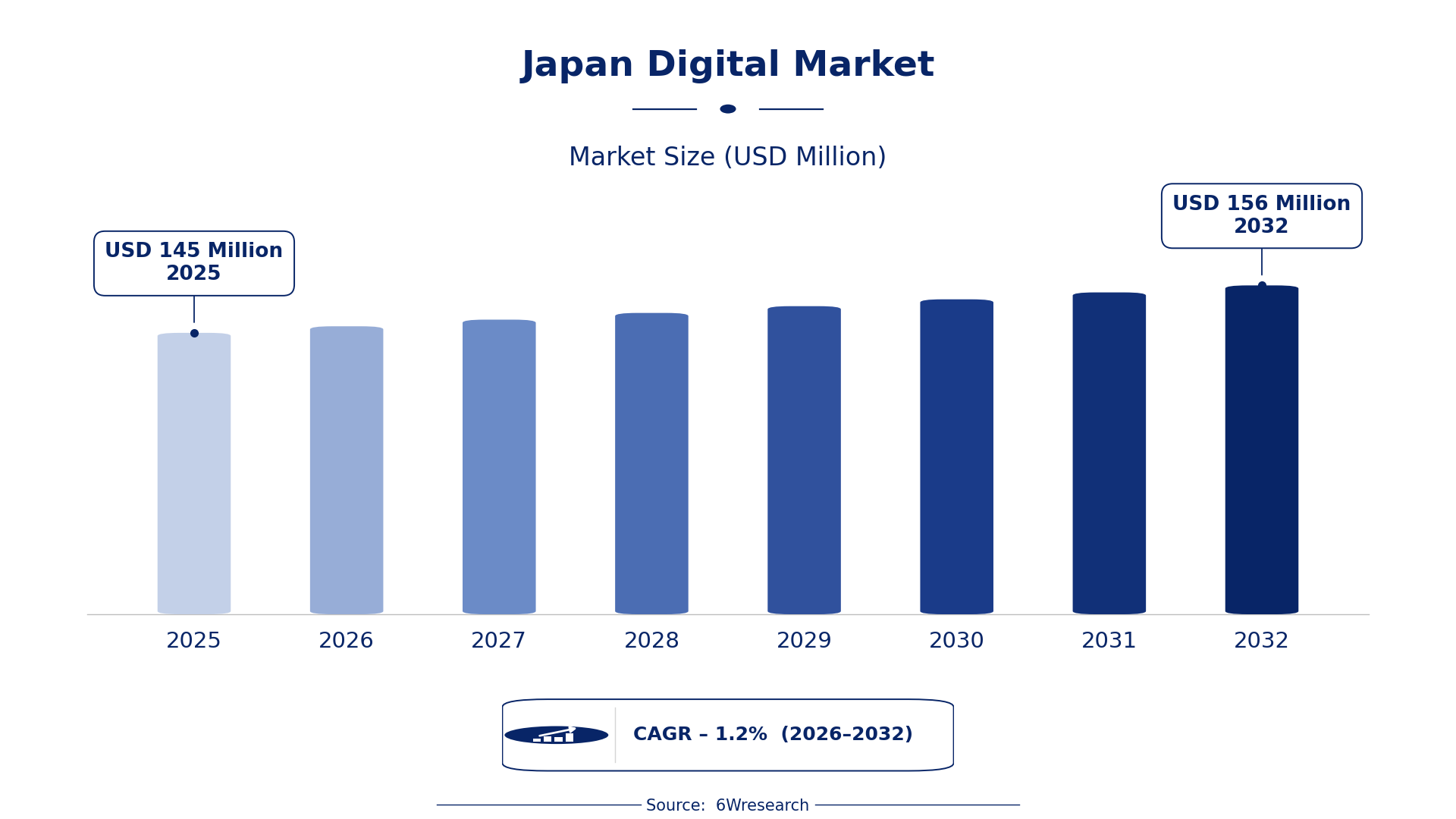
The Japan Digital Market was estimated at USD 145 Million in 2025 and is projected to reach USD 156 Million by 2032, growing at a CAGR of 1.2% from 2026 to 2032.
Japan Digital Market Synopsis
The Japan Digital Market thrives on a robust e-commerce ecosystem, with consumers increasingly favoring online shopping for its convenience and efficiency. Major platforms dominate the space, yet new entrants continually emerge, looking to carve out their share in this competitive environment.
Mobile device usage is soaring, driving growth in mobile commerce and gaming. This shift not only reshapes consumer habits but also demands that businesses adapt their strategies to engage effectively with a tech-savvy audience.
Japan Digital Market Year-wise Growth Rate and Key Drivers
This graph illustrates the annual growth rates of the Japan Digital Market from 2021 to 2032, highlighting a steady upward trajectory and projected expansion over the forecast period.
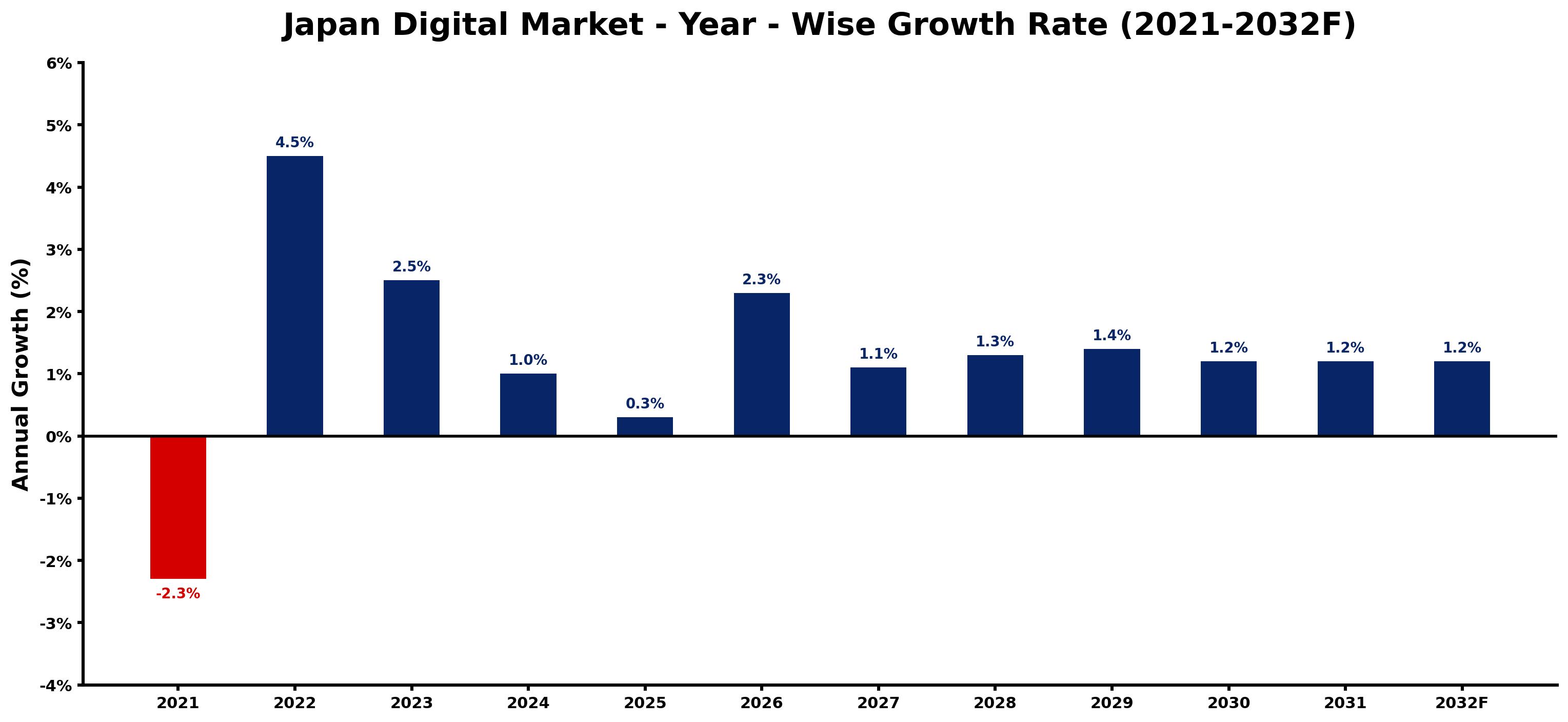
The table below presents the year‑wise growth rates along with the key drivers influencing the market
| Year | Growth Rate | Major Drivers |
| 2021 | -2.3% | Declining consumer spending due to COVID-19 restrictions. |
| 2022 | 4.5% | Increased e-commerce spending during pandemic recovery phase |
| 2023 | 2.5% | Boost in telecommuting leading to higher software subscriptions |
| 2024 | 1.0% | Advancements in AI technologies enhancing digital service offerings |
| 2025 | 0.3% | Growing popularity of mobile payment solutions in urban areas |
| 2026 | 2.3% | Regulatory push for digital identity verification services |
| 2027 | 1.1% | Surge in online gaming attracting new user segments |
| 2028 | 1.3% | Government incentives for digital cashless transactions initiatives |
| 2029 | 1.4% | Rise in health tech applications driving digital engagement |
| 2030 | 1.2% | Growing interest in virtual reality experiences among consumers |
| 2031 | 1.2% | Increased investment in FinTech innovations for payment solutions |
| 2032 | 1.2% | Continuous rise in remote learning driving digital platform usage |
Note: Market size estimations and growth projections presented in this report are based on 6Wresearch's proprietary forecasting methodology, utilizing the latest available industry data, government publications, and primary research inputs.
Japan Digital Market Key Takeaways
Below are some of the specific key takeaways from the market, including:
- Japan's high internet penetration supports rapid digital adoption across various sectors.
- Mobile commerce and gaming are becoming primary revenue streams in the digital market.
- Social media platforms are increasingly pivotal for brand engagement and consumer interaction.
- Investment in cybersecurity is essential due to rising data privacy concerns.
- Government initiatives are actively promoting digital transformation and innovation.
Evaluation of Restraints in Japan Digital Market
The Japan Digital Market faces notable restraints that limit its potential. Intense competition from established domestic players poses a barrier for new entrants, making market penetration a significant challenge. Additionally, cultural preferences for in-person interactions can slow the adoption of fully digital solutions. Companies must also navigate strict data privacy regulations, which, while essential for consumer protection, complicate data usage for marketing and analytics. Staying ahead in this rapidly changing environment demands continuous innovation and adaptation.
Japan Digital Market Trends
Several trends are shaping the Japan Digital Market today. A surge in mobile-centric strategies highlights the need for businesses to optimize their offerings for smartphone users. E-commerce continues its upward trajectory, with consumers leaning more towards online shopping. The push for digital transformation spans industries, as firms invest in technologies like artificial intelligence to enhance operations. on top of that, social media marketing strategies are evolving, with brands finding new ways to connect and engage with consumers through platforms like Line and Instagram.
Japan Digital Market Opportunities
Investment opportunities in the Japan Digital Market are diverse and promising. The e-commerce sector is ripe for growth, especially for platforms that can offer unique services or cater to niche markets. Fintech is another area where innovation can flourish, particularly in mobile payment solutions. Digital entertainment, including online streaming and gaming, presents substantial prospects for investors, reflecting changing consumer preferences. Cybersecurity, driven by increasing regulatory focus on data protection, is essential for businesses aiming to thrive in this digital era.
Government Initiatives in the Japan Digital Market
Government policies in Japan play a crucial role in shaping the digital market. With a focus on fostering innovation, the establishment of the Digital Agency aims to spearhead digital transformation efforts across various sectors. This agency is pivotal in enhancing the digital infrastructure and promoting advanced technologies, ensuring that the market remains competitive and secure.
- A recent initiative includes the launch of a national digital infrastructure upgrade program aimed at enhancing broadband access across rural areas.
- Currently underway is a regulatory framework that mandates increased transparency in digital marketing practices to protect consumer interests.
- A planned public-private partnership is expected to support startup growth in the digital sector, slated to begin by the end of 2026.
- Additionally, initiatives to strengthen cybersecurity measures are ongoing, addressing the increasing threats in the digital landscape.
- The government is also working on a policy that promotes the adoption of artificial intelligence in small and medium enterprises.
Future Insights of the Japan Digital Market
Looking ahead to 2026-2032, the Japan Digital Market is expected to experience considerable expansion. Increased consumer acceptance of digital solutions, coupled with continued government support for innovation, will drive this growth. E-commerce, mobile payments, and digital advertising are set to flourish, propelled by shifting consumer behaviors. As businesses adapt to these changes, the market will likely emerge as a crucial player in the global digital economy.
Japan Digital Market Latest Developments
Recent developments in the Japan Digital Market reflect an upward trajectory in innovation and consumer engagement. Over the past year, companies have ramped up efforts to enhance their digital offerings, catering to a growing demand for convenient and efficient services.
- A major technology vendor launched a new mobile payment solution aimed at small businesses in early 2025, improving transaction efficiency.
- In Q2 2025, an initiative focusing on expanding digital literacy programs was introduced to help consumers better navigate online platforms.
- By mid-2025, a prominent streaming service completed a significant content expansion, adding local Japanese productions to attract regional audiences.
- An ongoing partnership between major telecommunications providers aims to enhance network infrastructure, which began in late 2024 and remains active.
- A planned rollout of augmented reality features in retail applications is set to begin in early 2026, enhancing the shopping experience for consumers.
Japan Digital Market - Key Attractiveness of the Report
- 10 Years of Market Numbers
- Historical Data Starting from 2022 to 2025
- Base Year: 2025
- Forecast Data until 2032
- Key Performance Indicators Impacting the Market
- Major Upcoming Developments and Projects
Key Highlights of the Report:
- Japan Digital Market Outlook
- Market Size of Japan Digital Market, 2025
- Forecast of Japan Digital Market, 2032
- Historical Data and Forecast of Japan Digital Revenues & Volume for the Period 2022-2032F
- Japan Digital Market Trend Evolution
- Japan Digital Market Drivers and Challenges
- Japan Digital Price Trends
- Japan Digital Porter's Five Forces
- Japan Digital Industry Life Cycle
- Historical Data and Forecast of Japan Digital Market Revenues & Volume By Software for the Period 2022-2032F
- Historical Data and Forecast of Japan Digital Market Revenues & Volume By CRM Software for the Period 2022-2032F
- Historical Data and Forecast of Japan Digital Market Revenues & Volume By Email Marketing Software for the Period 2022-2032F
- Historical Data and Forecast of Japan Digital Market Revenues & Volume By Social Media Advertising for the Period 2022-2032F
- Japan Digital Import Export Trade Statistics
- Market Opportunity Assessment By Software
- Japan Digital Top Companies Market Share
- Japan Digital Competitive Benchmarking By Technical and Operational Parameters
- Japan Digital Company Profiles
- Japan Digital Key Strategic Recommendations






































