Japan Electrical Conduit Market Size Growth Rate
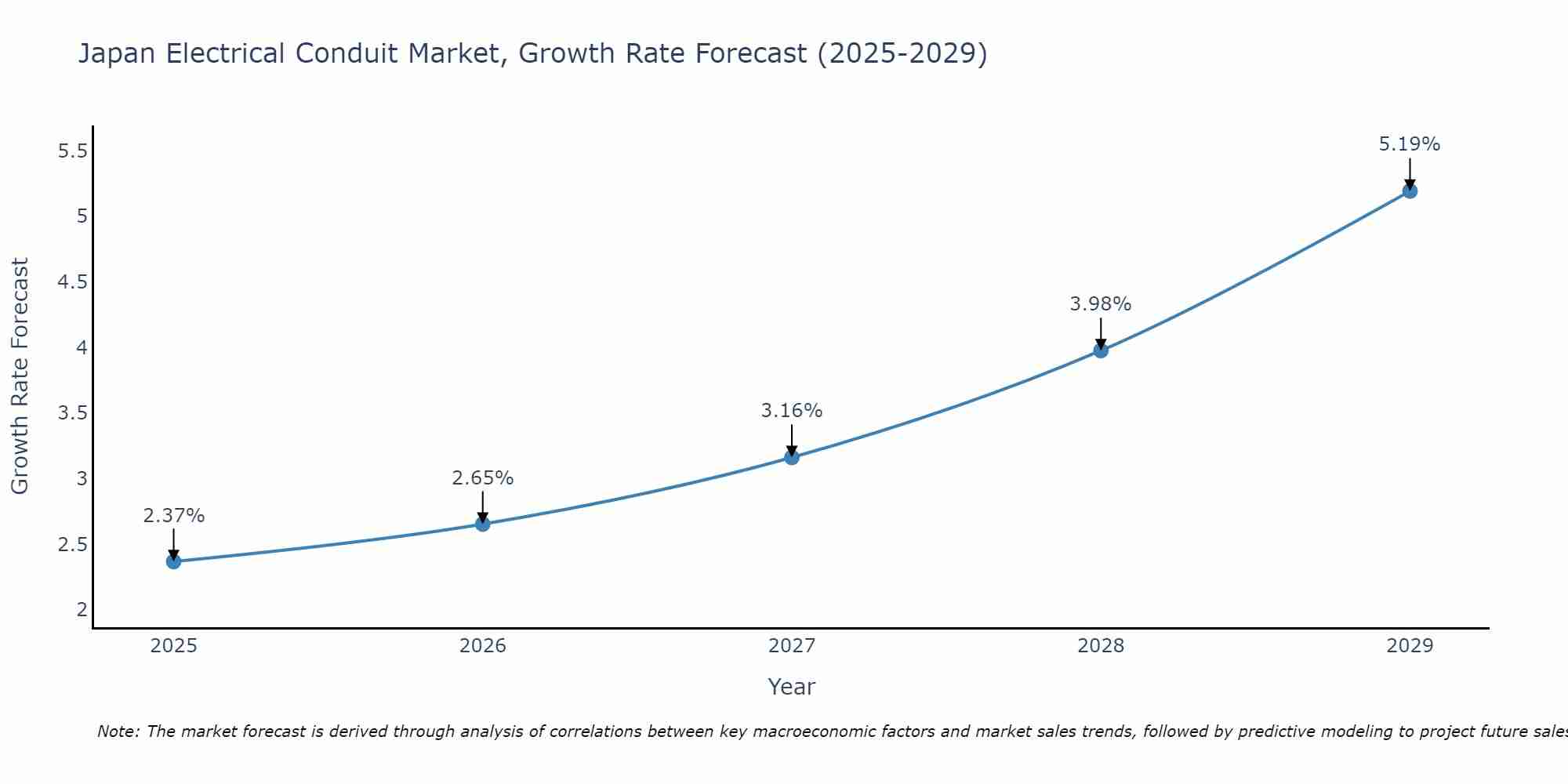
The Japan Electrical Conduit Market is likely to experience consistent growth rate gains over the period 2025 to 2029. From 2.37% in 2025, the growth rate steadily ascends to 5.19% in 2029.
Japan Electrical Conduit Market Overview
The Japan Electrical Conduit Market is witnessing steady growth due to increasing construction activities in residential, commercial, and industrial sectors. The market is primarily driven by the need for efficient wiring systems to ensure safety and compliance with building regulations. PVC conduits are the most widely used type, favored for their durability and cost-effectiveness. However, there is a growing trend towards the adoption of flexible metallic conduits for their superior protection and ease of installation. With the government emphasizing energy efficiency and sustainable construction practices, there is a rising demand for eco-friendly conduit materials. Leading players in the market include Sekisui Chemical Co., Ltd., Rinnai Corporation, and Kyowa Co., Ltd., who are focusing on product innovation and strategic partnerships to maintain their competitive edge in the market.
Japan Electrical Conduit Market Trends
The Japan Electrical Conduit Market is currently experiencing a shift towards more sustainable and durable materials, such as PVC and fiberglass, in response to increasing environmental regulations and a growing emphasis on energy efficiency. There is also a rising demand for flexible conduit solutions to accommodate complex wiring configurations in modern buildings. Additionally, advancements in technology are driving the adoption of smart conduits equipped with sensors for monitoring and maintenance purposes. The market is witnessing consolidation among key players to enhance their product portfolios and expand their geographical reach. Overall, the Japan Electrical Conduit Market is evolving towards more innovative and eco-friendly solutions to meet the changing needs of the construction and infrastructure sectors.
Japan Electrical Conduit Market Challenges
The Japan Electrical Conduit Market faces challenges such as intense competition among key players, particularly in the manufacturing sector, leading to pricing pressures. Additionally, maintaining compliance with stringent regulations and standards in the construction industry poses a challenge for conduit manufacturers. Another issue is the increasing demand for sustainable and environmentally friendly materials, which requires companies to innovate and develop eco-friendly conduit solutions. Furthermore, fluctuations in raw material prices and supply chain disruptions can impact production costs and lead to uncertainties in the market. Overall, companies in the Japan Electrical Conduit Market need to constantly adapt to market dynamics, technological advancements, and regulatory changes to stay competitive and meet the evolving needs of customers.
Japan Electrical Conduit Market Investment Opportunities
The Japan Electrical Conduit Market presents various investment opportunities for both domestic and international investors. With the increasing focus on infrastructure development and the growing demand for electricity in the country, there is a rising need for efficient electrical conduit systems. Investing in companies that manufacture electrical conduits, fittings, and accessories can be lucrative. Additionally, there is potential for growth in the market with the adoption of advanced technologies such as fiber optic conduits and the increasing trend towards sustainable and energy-efficient solutions. Investing in research and development for innovative products and expanding distribution networks to reach a wider customer base can also be profitable strategies in this market. Overall, the Japan Electrical Conduit Market offers promising investment opportunities for those looking to capitalize on the country`s infrastructure development and technological advancements.
Japan Electrical Conduit Market Government Policy
The Japan Electrical Conduit Market is subject to various government policies aimed at regulating the industry and ensuring safety standards. The Electrical Appliances and Materials Safety Act in Japan mandates the certification of electrical products, including conduits, to meet safety requirements. Additionally, the Construction Standards Act sets guidelines for the installation of electrical systems, including the use of conduits in construction projects. The Japanese government also promotes energy efficiency and sustainability in the construction sector through initiatives such as the Top Runner Program, which sets energy efficiency standards for various products, including electrical conduits. Overall, government policies in Japan play a crucial role in shaping the regulatory environment for the electrical conduit market and ensuring the quality and safety of electrical products in the country.
Japan Electrical Conduit Market Future Outlook
The Japan Electrical Conduit Market is expected to witness steady growth in the coming years due to increasing investments in infrastructure development, particularly in the construction sector. The growing emphasis on modernizing and upgrading existing electrical systems to enhance efficiency and safety standards will drive the demand for electrical conduits in Japan. Additionally, the rising adoption of smart technologies and the integration of renewable energy sources in buildings will further boost market growth. The introduction of advanced materials and innovative product designs to meet evolving industry requirements will also play a significant role in shaping the future of the Japan Electrical Conduit Market. Overall, with a focus on sustainable development and technological advancements, the market is poised for expansion and innovation in the foreseeable future.
Key Highlights of the Report:
- Japan Electrical Conduit Market Outlook
- Market Size of Japan Electrical Conduit Market, 2021
- Forecast of Japan Electrical Conduit Market, 2031
- Historical Data and Forecast of Japan Electrical Conduit Revenues & Volume for the Period 2018 - 2031
- Japan Electrical Conduit Market Trend Evolution
- Japan Electrical Conduit Market Drivers and Challenges
- Japan Electrical Conduit Price Trends
- Japan Electrical Conduit Porter's Five Forces
- Japan Electrical Conduit Industry Life Cycle
- Historical Data and Forecast of Japan Electrical Conduit Market Revenues & Volume By Type for the Period 2018 - 2031
- Historical Data and Forecast of Japan Electrical Conduit Market Revenues & Volume By Rigid for the Period 2018 - 2031
- Historical Data and Forecast of Japan Electrical Conduit Market Revenues & Volume By Flexible for the Period 2018 - 2031
- Historical Data and Forecast of Japan Electrical Conduit Market Revenues & Volume By Material for the Period 2018 - 2031
- Historical Data and Forecast of Japan Electrical Conduit Market Revenues & Volume By Metallic for the Period 2018 - 2031
- Historical Data and Forecast of Japan Electrical Conduit Market Revenues & Volume By Non-metallic for the Period 2018 - 2031
- Historical Data and Forecast of Japan Electrical Conduit Market Revenues & Volume By End-Use Industry for the Period 2018 - 2031
- Historical Data and Forecast of Japan Electrical Conduit Market Revenues & Volume By Building & Construction for the Period 2018 - 2031
- Historical Data and Forecast of Japan Electrical Conduit Market Revenues & Volume By Industrial Manufacturing for the Period 2018 - 2031
- Historical Data and Forecast of Japan Electrical Conduit Market Revenues & Volume By IT & Telecommunication for the Period 2018 - 2031
- Historical Data and Forecast of Japan Electrical Conduit Market Revenues & Volume By Oil & Gas for the Period 2018 - 2031
- Historical Data and Forecast of Japan Electrical Conduit Market Revenues & Volume By Energy & Utility for the Period 2018 - 2031
- Historical Data and Forecast of Japan Electrical Conduit Market Revenues & Volume By Others for the Period 2018 - 2031
- Japan Electrical Conduit Import Export Trade Statistics
- Market Opportunity Assessment By Type
- Market Opportunity Assessment By Material
- Market Opportunity Assessment By End-Use Industry
- Japan Electrical Conduit Top Companies Market Share
- Japan Electrical Conduit Competitive Benchmarking By Technical and Operational Parameters
- Japan Electrical Conduit Company Profiles
- Japan Electrical Conduit Key Strategic Recommendations






































