Japan End User Computing Market Size & Growth Rate (2026-2032)
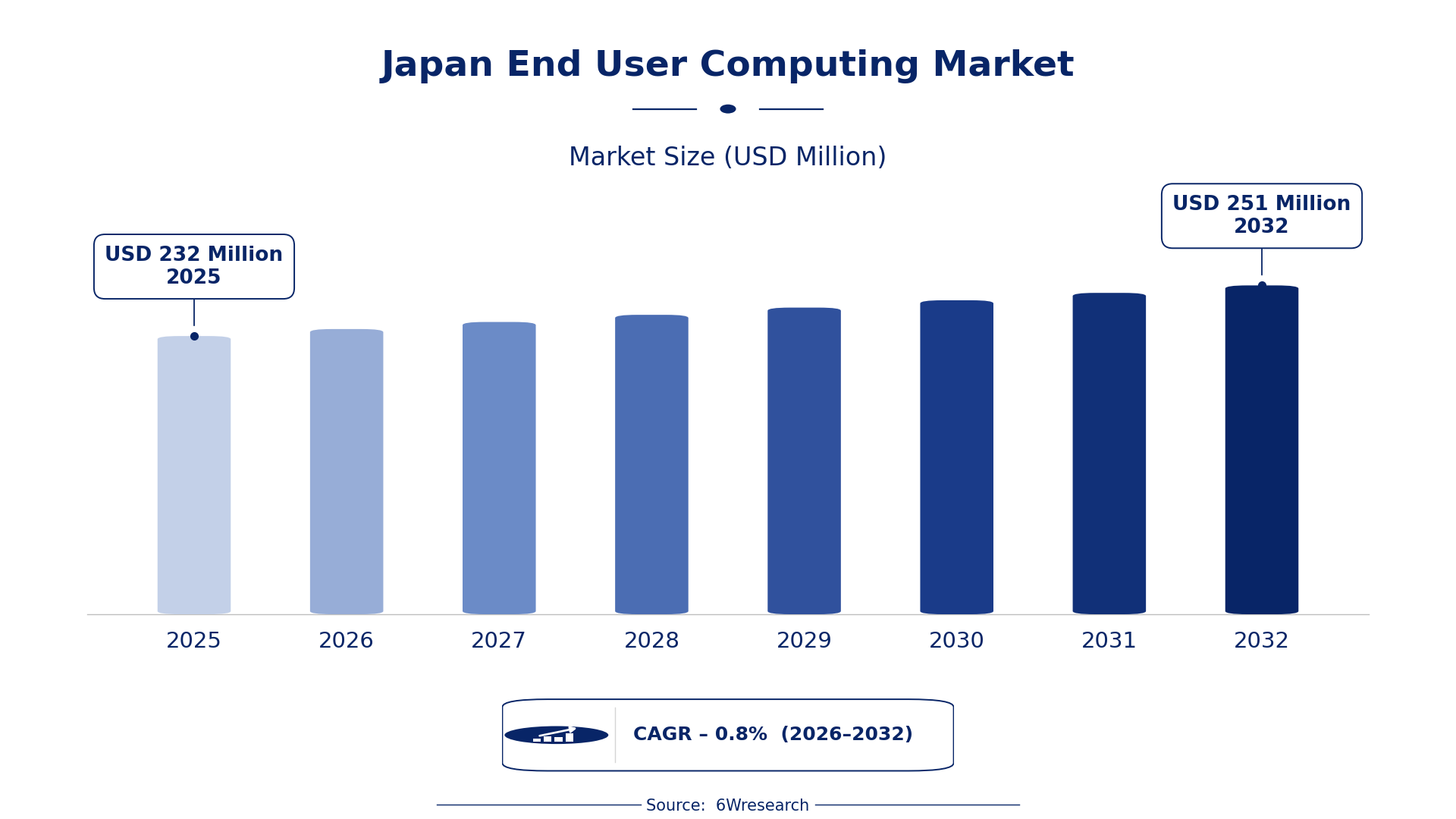
The Japan End User Computing Market was estimated at USD 232 Million in 2025 and is projected to reach USD 251 Million by 2032, growing at a CAGR of 0.8% from 2026 to 2032.
Japan End User Computing Market Synopsis
The demand for personalized and secure computing solutions is on the rise in Japan, as both businesses and consumers seek devices that enhance mobility and productivity. This shift is evident in the increasing adoption of mobile devices and cloud-based technologies, which are reshaping user preferences.
In this competitive market, organizations are prioritizing user experience, with a strong focus on virtualization and cybersecurity. The ongoing trend towards remote work and virtual collaboration is driving innovation and investment in technologies that support a flexible workforce.
Japan End User Computing Market Year-wise Growth Rate and Key Drivers
This graph illustrates the annual growth rates of the Japan End User Computing Market from 2021 to 2032, highlighting a steady upward trajectory and projected expansion over the forecast period.
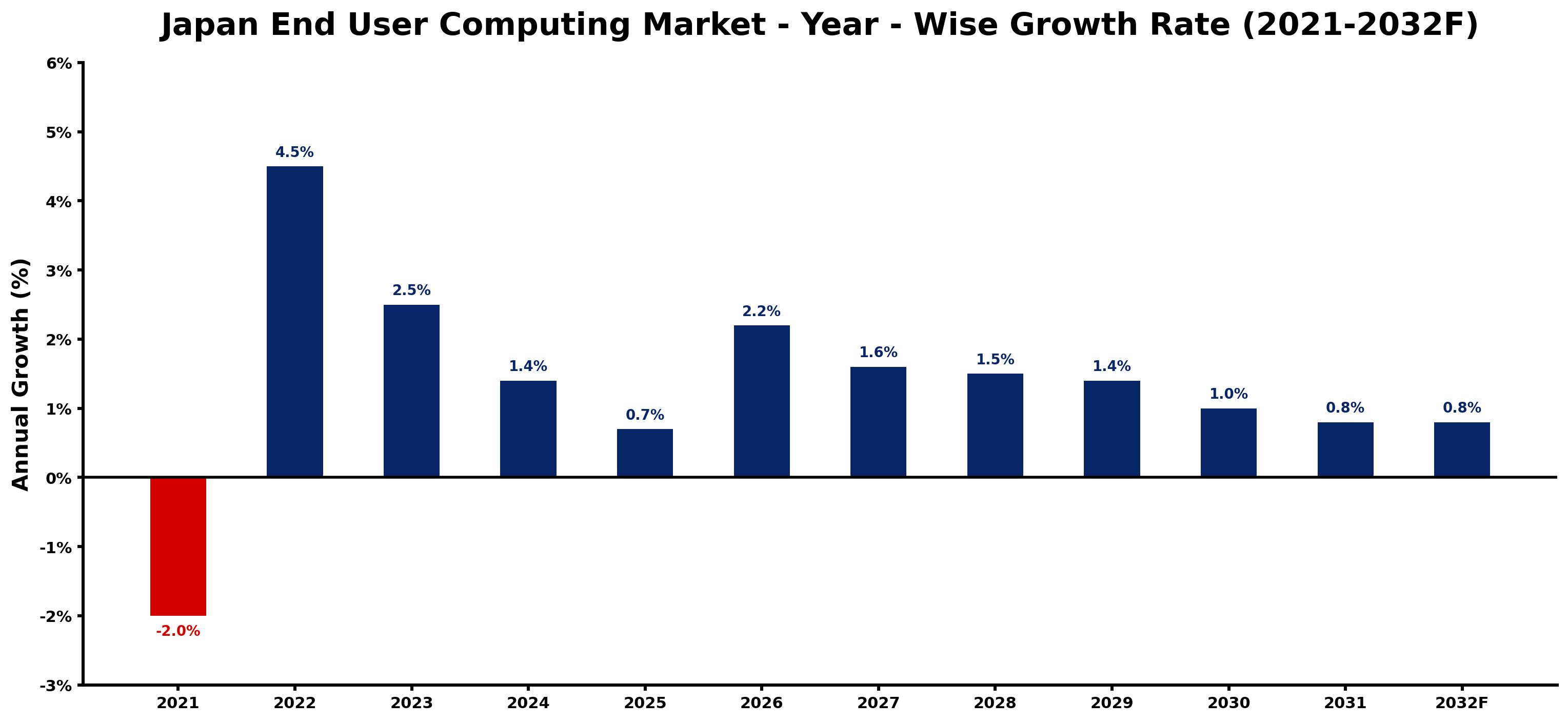
The table below presents the year‑wise growth rates along with the key drivers influencing the market
| Year | Growth Rate | Major Drivers |
| 2021 | -2.0% | Tokai University's digital transformation initiative stalled progress. |
| 2022 | 4.5% | Rise in telecommuting driving PC hardware upgrades. |
| 2023 | 2.5% | Increased cybersecurity regulations boosting endpoint security investments. |
| 2024 | 1.4% | Growing adoption of AI tools enhancing productivity software. |
| 2025 | 0.7% | Government support for remote work policies fostering demand. |
| 2026 | 2.2% | Integration of 5G technology improving device connectivity options. |
| 2027 | 1.6% | Aging workforce prompts new user-friendly tech solutions. |
| 2028 | 1.5% | Increased focus on digital literacy training programs. |
| 2029 | 1.4% | Emergence of hybrid work models driving device diversifications. |
| 2030 | 1.0% | Sustainability initiatives pushing for energy-efficient computing. |
| 2031 | 0.8% | School initiatives emphasizing tech-driven learning environments. |
| 2032 | 0.8% | Retirement of legacy systems necessitating modernizations. |
Note: Market size estimations and growth projections presented in this report are based on 6Wresearch's proprietary forecasting methodology, utilizing the latest available industry data, government publications, and primary research inputs.
Japan End User Computing Market Key Takeaways
Below are some of the specific key takeaways from the market, including:
- The market is witnessing an increasing demand for mobile devices, driven by the remote work culture.
- Cloud computing and virtualization are key factors influencing end-user computing strategies.
- Cybersecurity remains a top priority as organizations navigate evolving digital threats.
- Investment opportunities abound in virtual desktop infrastructure and mobile device management solutions.
- Government policies are actively supporting digital transformation and cybersecurity initiatives.
Evaluation of Restraints in Japan End User Computing Market
The Japan End User Computing Market faces notable constraints primarily stemming from a declining workforce due to an aging population. This situation leads to a shortage of skilled IT professionals, hindering the rapid deployment of advanced technologies. Additionally, businesses must grapple with the high costs associated with integrating new solutions and ensuring compliance with stringent data protection regulations. The complex landscape of cybersecurity threats further complicates matters, as firms strive to protect sensitive data while managing operational efficiency.
Japan End User Computing Market Trends
The trend towards remote work continues to influence the Japan End User Computing Market, with organizations adopting virtual desktop infrastructure (VDI) and mobile device management (MDM) solutions. Enhanced productivity and user experience are driving demand for devices that prioritize mobility, such as lightweight laptops and tablets with extended battery life. As the workforce becomes increasingly digital, companies are investing in cybersecurity measures to protect their operations and data integrity.
Japan End User Computing Market Opportunities
Investment opportunities are expanding within the Japan End User Computing Market, particularly in VDI, MDM, and endpoint security solutions. As organizations embrace remote work and bring-your-own-device policies, the need for secure, user-friendly computing experiences becomes paramount. Companies that provide innovative solutions and services tailored to these demands will likely find lucrative growth prospects, especially with ongoing government support for digital transformation.
Government Initiatives in the Japan End User Computing Market
The Japanese government is actively shaping the End User Computing Market through a series of initiatives aimed at fostering innovation and enhancing cybersecurity. By improving digital infrastructure and promoting research in emerging technologies, these policies are designed to strengthen the nation's competitive edge. The focus on cybersecurity and digital transformation is critical for maintaining consumer trust and driving growth in the sector.
- A recently completed "Cybersecurity Strategy" program aimed at strengthening data protection and privacy regulations.
- A current initiative focused on supporting the adoption of cloud computing technologies among SMEs to enhance productivity.
- A planned public-private partnership expected to expand digital infrastructure access by 2028.
- Ongoing regulatory updates to encourage investment in cybersecurity measures within the financial sector.
- A comprehensive digital literacy program intended to address the skills gap in the IT workforce.
Future Insights of the Japan End User Computing Market
Looking ahead to 2026-2032, the Japan End User Computing Market is set for steady growth as technological advancements continue to shape user expectations. Companies will increasingly invest in modernizing their IT infrastructure to support a mobile workforce and enhance operational efficiency. The demand for innovative devices and applications that facilitate remote work and collaboration is likely to rise, driven by ongoing shifts in work culture and digital transformation efforts across industries.
Japan End User Computing Market Latest Developments
In the past year, the Japan End User Computing Market has seen dynamic shifts as companies respond to changing workforce needs and technological advancements. A growing emphasis on cybersecurity and the integration of cloud technologies is reshaping the sector. Organizations are eager to adopt new solutions that support flexibility and security in a rapidly changing environment.
- A major technology vendor launched a new suite of cloud-based collaboration tools in late 2025, aimed at enhancing remote teamwork.
- An initiative that began in early 2025 is currently underway to implement advanced endpoint security solutions across multiple industries.
- A recent partnership between leading firms in the sector is focused on developing innovative VDI solutions, expected to enhance remote access capabilities.
- A rollout of new mobile device management software is anticipated in Q2 2026 to address the BYOD trend.
- By late 2025, a government-backed program is set to provide funding for startups developing cybersecurity technologies.
Japan End User Computing Market - Key Attractiveness of the Report
- 10 Years of Market Numbers
- Historical Data Starting from 2022 to 2025
- Base Year: 2025
- Forecast Data until 2032
- Key Performance Indicators Impacting the Market
- Major Upcoming Developments and Projects
Key Highlights of the Report:
- Japan End User Computing Market Outlook
- Market Size of Japan End User Computing Market, 2025
- Forecast of Japan End User Computing Market, 2032
- Historical Data and Forecast of Japan End User Computing Revenues & Volume for the Period 2022-2032F
- Japan End User Computing Market Trend Evolution
- Japan End User Computing Market Drivers and Challenges
- Japan End User Computing Price Trends
- Japan End User Computing Porter's Five Forces
- Japan End User Computing Industry Life Cycle
- Historical Data and Forecast of Japan End User Computing Market Revenues & Volume By Solution for the Period 2022-2032F
- Historical Data and Forecast of Japan End User Computing Market Revenues & Volume By Virtual Desktop Infrastructure for the Period 2022-2032F
- Historical Data and Forecast of Japan End User Computing Market Revenues & Volume By Device Management for the Period 2022-2032F
- Historical Data and Forecast of Japan End User Computing Market Revenues & Volume By Unified Communication for the Period 2022-2032F
- Historical Data and Forecast of Japan End User Computing Market Revenues & Volume By Software Asset Management for the Period 2022-2032F
- Historical Data and Forecast of Japan End User Computing Market Revenues & Volume By Service for the Period 2022-2032F
- Historical Data and Forecast of Japan End User Computing Market Revenues & Volume By Consulting for the Period 2022-2032F
- Historical Data and Forecast of Japan End User Computing Market Revenues & Volume By Support for the Period 2022-2032F
- Historical Data and Forecast of Japan End User Computing Market Revenues & Volume By Maintenance for the Period 2022-2032F
- Historical Data and Forecast of Japan End User Computing Market Revenues & Volume By Training for the Period 2022-2032F
- Historical Data and Forecast of Japan End User Computing Market Revenues & Volume By Education for the Period 2022-2032F
- Historical Data and Forecast of Japan End User Computing Market Revenues & Volume By Managed Services for the Period 2022-2032F
- Historical Data and Forecast of Japan End User Computing Market Revenues & Volume By Industry Vertical for the Period 2022-2032F
- Historical Data and Forecast of Japan End User Computing Market Revenues & Volume By IT and telecom for the Period 2022-2032F
- Historical Data and Forecast of Japan End User Computing Market Revenues & Volume By Banking, Financial Services, and Insurance (BFSI) for the Period 2022-2032F
- Historical Data and Forecast of Japan End User Computing Market Revenues & Volume By Education for the Period 2022-2032F
- Historical Data and Forecast of Japan End User Computing Market Revenues & Volume By Healthcare for the Period 2022-2032F
- Historical Data and Forecast of Japan End User Computing Market Revenues & Volume By Government for the Period 2022-2032F
- Historical Data and Forecast of Japan End User Computing Market Revenues & Volume By Retail for the Period 2022-2032F
- Historical Data and Forecast of Japan End User Computing Market Revenues & Volume By Media and entertainment for the Period 2022-2032F
- Historical Data and Forecast of Japan End User Computing Market Revenues & Volume By Manufacturing for the Period 2022-2032F
- Japan End User Computing Import Export Trade Statistics
- Market Opportunity Assessment By Solution
- Market Opportunity Assessment By Service
- Market Opportunity Assessment By Industry Vertical
- Japan End User Computing Top Companies Market Share
- Japan End User Computing Competitive Benchmarking By Technical and Operational Parameters
- Japan End User Computing Company Profiles
- Japan End User Computing Key Strategic Recommendations






































