Japan Ethyl Hexanol Market (2025-2031) | Revenue, Demand, Size, Share, Investment Trends, Analysis, Outlook, Challenges, Strategy, Supply, Industry, Restraints, Opportunities, Consumer Insights, Pricing Analysis, Segmentation, Trends, Segments, Competitive, Strategic Insights, Value, Growth, Companies, Forecast, Drivers, Competition
Market Forecast By Type (2-Ethylhexanol, N-Ethylhexanol, High Purity Ethyl Hexanol, Custom Blends), By Application (Plasticizers, Coatings, Adhesives, Lubricants), By Industry Vertical (Plastics & Polymers, Paints & Coatings, Adhesives & Sealants, Automotive), By Purity Level (99% Pure, 98% Pure, 95% Pure, Specialty Grade), By Functionality (Solvent, Intermediate, Wetting Agent, Surfactant) And Competitive Landscape
| Product Code: ETC11907154 | Publication Date: Apr 2025 | Updated Date: Nov 2025 | Product Type: Market Research Report | |
| Publisher: 6Wresearch | Author: Ravi Bhandari | No. of Pages: 65 | No. of Figures: 34 | No. of Tables: 19 |
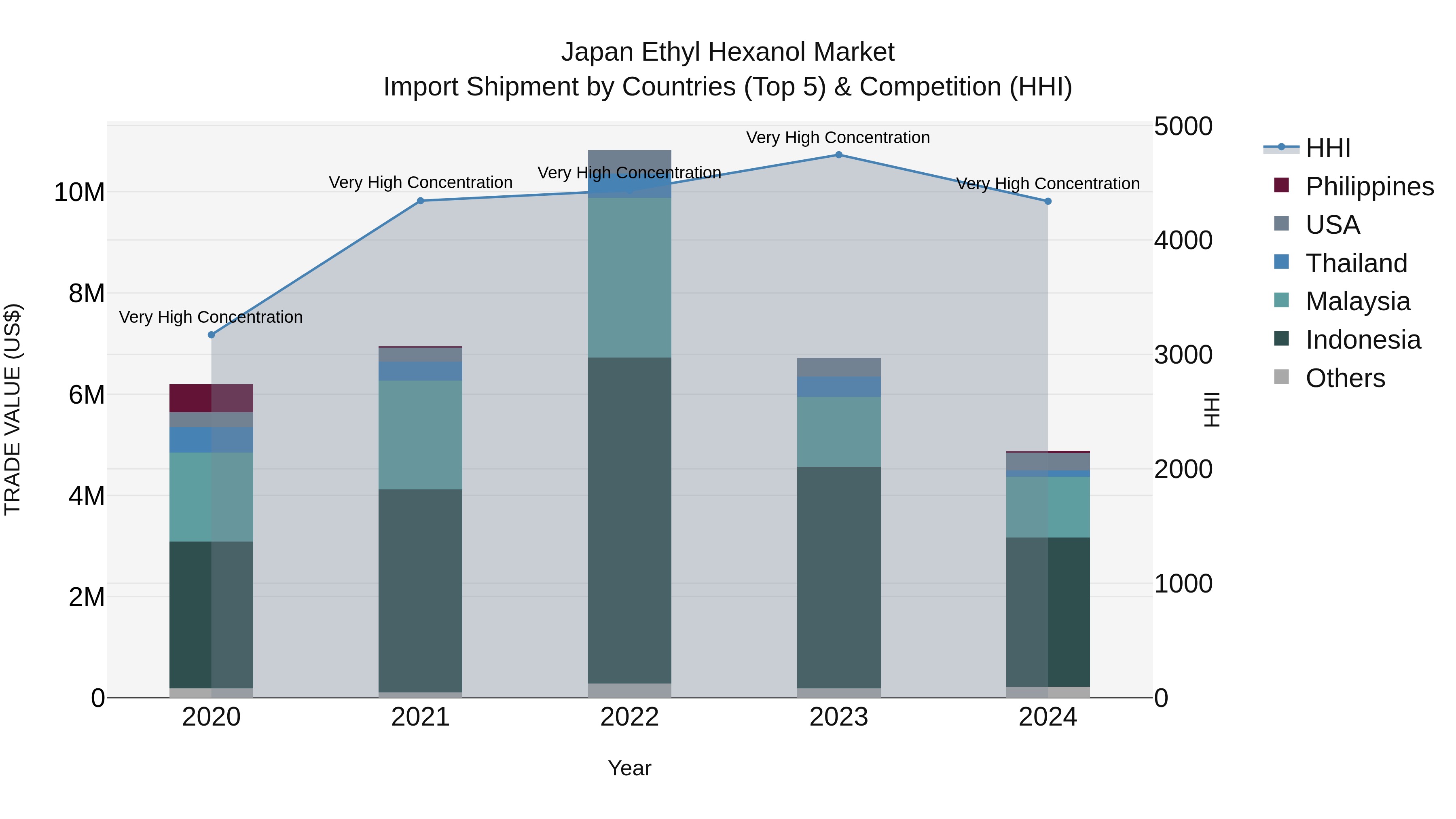
Japan Ethyl Hexanol Market Import Shipment by Countries (Top 5) & Competition (HHI)
Japan's ethyl hexanol import market in 2024 saw top shipments from Indonesia, Malaysia, USA, India, and Thailand. Despite a high Herfindahl-Hirschman Index indicating market concentration, the industry experienced a concerning -5.83% compound annual growth rate from 2020 to 2024. Additionally, the growth rate plummeted by -27.4% from 2023 to 2024, highlighting potential challenges and shifts in the market dynamics that importers and stakeholders need to navigate.
Japan Ethyl Hexanol Market Growth Rate
According to 6Wresearch internal database and industry insights, the Japan Ethyl Hexanol Market is growing at a compound annual growth rate (CAGR) of 5.8% during the forecast period (2025-2031).
Five-Years Growth Trajectory of the Japan Ethyl Hexanol Market with Core Drivers
Below mentioned are the evaluation of year-wise growth rate along with key drivers:
| Year | Est. Annual Growth (%) | Growth Drivers |
| 2020 | 4.5% | Increasing demand for ethyl hexanol in plasticizers. |
| 2021 | 4.8% | Growth in automotive and construction sectors. |
| 2022 | 5% | Rise in use of ethyl hexanol in coatings and adhesives. |
| 2023 | 5.2% | Growing demand in high-performance lubricants. |
| 2024 | 5.3% | Expansion in the paints and coatings industry. |
Topics Covered in the Japan Ethyl Hexanol Market Report
The Japan Ethyl Hexanol Market report thoroughly covers the market by types, applications, industry verticals, purity levels, and functionality. The report provides an unbiased and detailed analysis of ongoing market trends, opportunities/high growth areas, and market drivers, which would help stakeholders devise and align their market strategies according to the current and future market dynamics.
| Report Name | Japan Ethyl Hexanol Market |
| Forecast Period | 2025–2031 |
| CAGR | 5.80% |
| Market Size | Growing Market |
| Growing Sector | Plasticizers |
Japan Ethyl Hexanol Market Synopsis
The Japan Ethyl Hexanol Market is expected to witness steady growth, driven by the increasing demand for ethyl hexanol in a variety of applications such as plasticizers, coatings, adhesives, and lubricants. The market is also bolstered by significant demand from key industry verticals, including plastics & polymers, paints & coatings, and automotive. Government initiatives aimed at enhancing the industrial chemical sector and the growing need for eco-friendly chemicals are expected to further contribute to market expansion.
Evaluation of Growth Drivers in the Japan Ethyl Hexanol Market
Below mentioned some growth drivers and their impact on market dynamics:
| Drivers | Primary Segments Affected | Why It Matters |
| Growth in Plasticizers Demand | By Application (Plasticizers) | Boosts market growth with increased ethyl hexanol use. |
| Development of Coatings & Adhesives | By Application (Coatings, Adhesives) | Drives ethyl hexanol demand in automotive and construction. |
| Increased Use in Lubricants & Polymers | By Application (Lubricants) | Fuels market growth in automotive and industrial lubrication. |
| Government Initiatives for Chemical Industry Growth | By Industry Vertical (Plastics & Polymers, Paints & Coatings) | Supports production and sustainable chemical practices. |
| Rising Demand for High-Purity Ethyl Hexanol | By Purity Level (99% Pure, Specialty Grade) | Drives demand for premium applications. |
Japan Ethyl Hexanol Market is expected to grow significantly at a CAGR of 5.8% during the forecast period of 2025-2031. The main forces stimulating the Japan Ethyl Hexanol Market are the increasing requirement for plasticizers in the automotive and construction industries, the rise of coatings and adhesives markets, and the growing use of high-performance lubricants. Government initiatives favoring the production of industrial chemicals and an upsurge in demand from the paints and coatings sector are other factors contributing to the market's growth. Moreover, the increasing choice of high-purity ethyl hexanol for specialized applications is another factor that has a positive impact on the market by creating opportunities for the market to expand and innovate.
Evaluation of Restraints in the Japan Ethyl Hexanol Market
Below mentioned are some major restraints and their influence on market dynamics:
| Restraints | Primary Segments Affected | What This Means |
| Raw Material Price Fluctuations | By Type (2-Ethylhexanol, N-Ethylhexanol) | Affects production costs and pricing stability. |
| Regulatory Compliance | By Functionality (Solvent, Intermediate) | Impacts manufacturing and market access. |
| Competition from Alternative Chemicals | By Application (Plasticizers, Coatings) | Limits market growth due to substitute chemicals. |
| Environmental Concerns | By Application (Wetting Agent, Surfactant) | Hinders growth of certain chemical applications. |
| Limited Production Capacities | By Industry Vertical (Plastics & Polymers, Automotive) | Restricts ethyl hexanol supply for emerging industries. |
Japan Ethyl Hexanol Market Challenges
The Japan Ethyl Hexanol Market is confronted with issues including the volatility of raw material prices, difficulties in compliance with regulations, and the presence of substitutes in the form of alternative chemicals. Besides, the concerns regarding the environment and the slow uptake of eco-friendly production methods are among the factors that amplify the challenges. In addition, the scarcity of ethyl hexanol production plants that can produce large volumes of the chemical is a limiting factor especially in supplying the growing demand in different uses.
Japan Ethyl Hexanol Market Trends
Some major trends contributing to the development of the Japan Ethyl Hexanol Market Growth are:
- Increasing Demand in Plasticizers & Coatings: Rising demand in automotive and construction sectors drives ethyl hexanol use as a plasticizer.
- Sustainability Focus in Chemical Production: Shift towards bio-based ethyl hexanol and eco-friendly production processes.
- Technological Advancements in Lubricants: Ethyl hexanol’s growing role in high-performance automotive lubricants creates opportunities.
- Expansion of Paints & Coatings Sector: Strong growth in the paints and coatings market boosts ethyl hexanol consumption.
- Emergence of High-Purity Ethyl Hexanol Products: Increased demand for high-purity ethyl hexanol in specialized applications.
Investment Opportunities in the Japan Ethyl Hexanol Market
Here are some investment opportunities in the Japan Ethyl Hexanol Industry:
- Investment in Sustainable Production: Invest in bio-based and sustainable ethyl hexanol production.
- Expansion in Automotive & Industrial Applications: Enhance ethyl hexanol applications in automotive lubricants and coatings.
- Technological Advancements in Chemical Processes: Advance production technologies to increase yield and reduce costs.
- Increased Focus on High-Purity Products: Develop high-purity ethyl hexanol for premium niche applications.
- Strategic Partnerships for Export Expansion: Partner with key players to expand exports to Asia-Pacific and Europe.
Top 5 Leading Players in the Japan Ethyl Hexanol Market
Here are some top companies contributing to Japan Ethyl Hexanol Market Share:
1. Mitsubishi Chemical Corporation
| Company Name | Mitsubishi Chemical Corporation |
| Headquarters | Tokyo, Japan |
| Established | 1933 |
| Website | Click Here |
Mitsubishi Chemical is a leader in the ethyl hexanol market in Japan, offering a wide range of chemical products including ethyl hexanol used in plasticizers, lubricants, and coatings. Their focus on sustainability and technological innovation makes them a key player in the market.
2. Sumitomo Chemical Co., Ltd.
| Company Name | Sumitomo Chemical Co., Ltd. |
| Headquarters | Osaka, Japan |
| Established | 1913 |
| Website | Click Here |
Sumitomo Chemical is a prominent player in the production of ethyl hexanol, primarily catering to the plastics, coatings, and automotive sectors. Their product line includes both standard and high-purity ethyl hexanol.
3. Tokuyama Corporation
| Company Name | Tokuyama Corporation |
| Headquarters | Shunan, Japan |
| Established | 1918 |
| Website | Click Here |
Tokuyama Corporation is known for its production of a wide array of chemicals, including ethyl hexanol. Their product offerings are critical in the plasticizers, lubricants, and coatings industries.
4. Daicel Corporation
| Company Name | Daicel Corporation |
| Headquarters | Osaka, Japan |
| Established | 1919 |
| Website | Click Here |
Daicel Corporation is a major player in Japan’s chemical industry, producing a variety of chemicals including ethyl hexanol for plasticizers, solvents, and coatings. They are recognized for their focus on high-purity chemicals.
5. LG Chem Ltd.
| Company Name | LG Chem Ltd. |
| Headquarters | Seoul, South Korea |
| Established | 1947 |
| Website | Click Here |
Although based in South Korea, LG Chem operates extensively in Japan’s chemical market, providing ethyl hexanol for diverse applications including adhesives, lubricants, and coatings. Their extensive R&D ensures their dominance in the sector.
Government Regulations Introduced in the Japan Ethyl Hexanol Market
According to Japanese government data, The evolution of the Japan Ethyl Hexanol Market is significantly shaped by governmental laws designed to foster sustainability and environmental accountability. The Chemical Substances Control Law (CSCL) regulates the manufacture and utilization of industrial chemicals, guaranteeing compliance with stringent environmental and safety regulations. The Act on the Rational Use of Energy and programs like Japan’s Green Growth Strategy promote the utilization of environmentally friendly chemicals, including bio-based ethyl hexanol.
Future Insights of the Japan Ethyl Hexanol Market
The market for ethyl hexanol in Japan is seen as a market that is going to be very good with a constant rise in demand from many industrial applications. The demand for ethyl hexanol will be subject to the continuous growth of the automotive and construction industries and the support of the government for environmentally friendly manufacturing practices. Moreover, the progress in technology and the greater use of ethyl hexanol in high-purity applications will still be the driving forces for the market throughout the forecast period.
Market Segmentation Analysis
The report offers a comprehensive study of the subsequent market segments and their leading categories.
High Purity Ethyl Hexanol to Dominate the Market - By Type
According to Guneet Kaur, Senior Research Analyst, 6Wresearch, high purity ethyl hexanol is gaining dominance due to its critical role in industries requiring superior quality solvents for sensitive applications such as coatings and adhesives, driving growth in the market.
Plasticizers to Dominate the Market – By Application
Plasticizers are the fastest-growing application, driven by their essential role in enhancing flexibility and durability in plastics and polymers. As demand for flexible materials in automotive and construction sectors rises, plasticizers are seeing increased use, boosting market growth.
Automotive to Dominate the Market – By Industry Vertical
The automotive industry’s demand for high-performance ethyl hexanol products, used in coatings and adhesives, is growing rapidly. The industry's expansion, especially in electric vehicles, increases the need for efficient and durable materials, boosting demand for ethyl hexanol.
99% Pure to Dominate the Market – By Purity Level
The demand for 99% pure ethyl hexanol is growing due to its high quality, making it preferred in applications requiring precision, such as coatings, adhesives, and plasticizers. Its use in advanced manufacturing processes is driving increased consumption.
Solvent to Dominate the Market – By Functionality
The solvent segment is seeing rapid growth, with ethyl hexanol being used extensively in various applications like coatings and adhesives. Its ability to provide optimal dissolving power and efficiency in chemical processes makes it highly sought after in multiple industries.
Key Attractiveness of the Report
- 10 Years Market Numbers
- Historical Data from 2021 to 2024
- Base Year: 2024
- Forecast Data until 2031
- Key Performance Indicators Impacting the Market
- Major Upcoming Developments and Projects
Key Highlights of the Report:
- Japan Ethyl Hexanol Market Outlook
- Market Size of Japan Ethyl Hexanol Market,2024
- Forecast of Japan Ethyl Hexanol Market, 2031
- Historical Data and Forecast of Japan Ethyl Hexanol Revenues & Volume for the Period 2021-2031F
- Japan Ethyl Hexanol Market Trend Evolution
- Japan Ethyl Hexanol Market Drivers and Challenges
- Japan Ethyl Hexanol Price Trends
- Japan Ethyl Hexanol Porter's Five Forces
- Japan Ethyl Hexanol Industry Life Cycle
- Historical Data and Forecast of Japan Ethyl Hexanol Market Revenues & Volume By Type for the Period 2021-2031F
- Historical Data and Forecast of Japan Ethyl Hexanol Market Revenues & Volume By 2-Ethylhexanol for the Period 2021-2031F
- Historical Data and Forecast of Japan Ethyl Hexanol Market Revenues & Volume By N-Ethylhexanol for the Period 2021-2031F
- Historical Data and Forecast of Japan Ethyl Hexanol Market Revenues & Volume By High Purity Ethyl Hexanol for the Period 2021-2031F
- Historical Data and Forecast of Japan Ethyl Hexanol Market Revenues & Volume By Custom Blends for the Period 2021-2031F
- Historical Data and Forecast of Japan Ethyl Hexanol Market Revenues & Volume By Application for the Period 2021-2031F
- Historical Data and Forecast of Japan Ethyl Hexanol Market Revenues & Volume By Plasticizers for the Period 2021-2031F
- Historical Data and Forecast of Japan Ethyl Hexanol Market Revenues & Volume By Coatings for the Period 2021-2031F
- Historical Data and Forecast of Japan Ethyl Hexanol Market Revenues & Volume By Adhesives for the Period 2021-2031F
- Historical Data and Forecast of Japan Ethyl Hexanol Market Revenues & Volume By Lubricants for the Period 2021-2031F
- Historical Data and Forecast of Japan Ethyl Hexanol Market Revenues & Volume By Industry Vertical for the Period 2021-2031F
- Historical Data and Forecast of Japan Ethyl Hexanol Market Revenues & Volume By Plastics & Polymers for the Period 2021-2031F
- Historical Data and Forecast of Japan Ethyl Hexanol Market Revenues & Volume By Paints & Coatings for the Period 2021-2031F
- Historical Data and Forecast of Japan Ethyl Hexanol Market Revenues & Volume By Adhesives & Sealants for the Period 2021-2031F
- Historical Data and Forecast of Japan Ethyl Hexanol Market Revenues & Volume By Automotive for the Period 2021-2031F
- Historical Data and Forecast of Japan Ethyl Hexanol Market Revenues & Volume By Purity Level for the Period 2021-2031F
- Historical Data and Forecast of Japan Ethyl Hexanol Market Revenues & Volume By 99% Pure for the Period 2021-2031F
- Historical Data and Forecast of Japan Ethyl Hexanol Market Revenues & Volume By 98% Pure for the Period 2021-2031F
- Historical Data and Forecast of Japan Ethyl Hexanol Market Revenues & Volume By 95% Pure for the Period 2021-2031F
- Historical Data and Forecast of Japan Ethyl Hexanol Market Revenues & Volume By Specialty Grade for the Period 2021-2031F
- Historical Data and Forecast of Japan Ethyl Hexanol Market Revenues & Volume By Functionality for the Period 2021-2031F
- Historical Data and Forecast of Japan Ethyl Hexanol Market Revenues & Volume By Solvent for the Period 2021-2031F
- Historical Data and Forecast of Japan Ethyl Hexanol Market Revenues & Volume By Intermediate for the Period 2021-2031F
- Historical Data and Forecast of Japan Ethyl Hexanol Market Revenues & Volume By Wetting Agent for the Period 2021-2031F
- Historical Data and Forecast of Japan Ethyl Hexanol Market Revenues & Volume By Surfactant for the Period 2021 - 2031F
- Japan Ethyl Hexanol Import Export Trade Statistics
- Market Opportunity Assessment By Type
- Market Opportunity Assessment By Application
- Market Opportunity Assessment By Industry Vertical
- Market Opportunity Assessment By Purity Level
- Market Opportunity Assessment By Functionality
- Japan Ethyl Hexanol Top Companies Market Share
- Japan Ethyl Hexanol Competitive Benchmarking By Technical and Operational Parameters
- Japan Ethyl Hexanol Company Profiles
- Japan Ethyl Hexanol Key Strategic Recommendations
Market Covered
The report subsequently covers the market by following segments and subsegments:
By Type
- 2-Ethylhexanol
- N-Ethylhexanol
- High Purity Ethyl Hexanol
- Custom Blends
By Application
- Plasticizers
- Coatings
- Adhesives
- Lubricants
By Industry Vertical
- Plastics & Polymers
- Paints & Coatings
- Adhesives & Sealants
- Automotive
By Purity Level
- 99% Pure
- 98% Pure
- 95% Pure
- Specialty Grade
By Functionality
- Solvent
- Intermediate
- Wetting Agent
- Surfactant
Japan Ethyl Hexanol Market (2025-2031): FAQs
The Japan Ethyl Hexanol Market is projected to grow at a CAGR of 5.8% during the forecast period.
The market size of the Japan Ethyl Hexanol Market is growing steadily with increasing demand in multiple applications.
2-Ethylhexanol is expected to dominate the market due to its extensive applications across industries.
Key drivers include growth in the plasticizers, coatings, and automotive sectors, alongside government support for the chemical industry.
The Japanese government promotes sustainability through regulations like the Chemical Substances Control Law and Japan’s Green Growth Strategy.
6Wresearch actively monitors the Japan Ethyl Hexanol Market and publishes its comprehensive annual report, highlighting emerging trends, growth drivers, revenue analysis, and forecast outlook. Our insights help businesses to make data-backed strategic decisions with ongoing market dynamics. Our analysts track relevent industries related to the Japan Ethyl Hexanol Market, allowing our clients with actionable intelligence and reliable forecasts tailored to emerging regional needs.
Yes, we provide customisation as per your requirements. To learn more, feel free to contact us on sales@6wresearch.com
| 1 Executive Summary |
| 2 Introduction |
| 2.1 Key Highlights of the Report |
| 2.2 Report Description |
| 2.3 Market Scope & Segmentation |
| 2.4 Research Methodology |
| 2.5 Assumptions |
| 3 Japan Ethyl Hexanol Market Overview |
| 3.1 Japan Country Macro Economic Indicators |
| 3.2 Japan Ethyl Hexanol Market Revenues & Volume, 2021 & 2031F |
| 3.3 Japan Ethyl Hexanol Market - Industry Life Cycle |
| 3.4 Japan Ethyl Hexanol Market - Porter's Five Forces |
| 3.5 Japan Ethyl Hexanol Market Revenues & Volume Share, By Type, 2021 & 2031F |
| 3.6 Japan Ethyl Hexanol Market Revenues & Volume Share, By Application, 2021 & 2031F |
| 3.7 Japan Ethyl Hexanol Market Revenues & Volume Share, By Industry Vertical, 2021 & 2031F |
| 3.8 Japan Ethyl Hexanol Market Revenues & Volume Share, By Purity Level, 2021 & 2031F |
| 3.9 Japan Ethyl Hexanol Market Revenues & Volume Share, By Functionality, 2021 & 2031F |
| 4 Japan Ethyl Hexanol Market Dynamics |
| 4.1 Impact Analysis |
| 4.2 Market Drivers |
| 4.2.1 Growth in the construction industry in Japan leading to increased demand for ethyl hexanol for paints, coatings, and adhesives. |
| 4.2.2 Rising adoption of ethyl hexanol as a solvent in the chemical industry due to its properties such as high boiling point and low volatility. |
| 4.2.3 Government initiatives promoting the use of environmentally friendly products, leading to a shift towards bio-based ethyl hexanol production. |
| 4.3 Market Restraints |
| 4.3.1 Fluctuating prices of raw materials used in ethyl hexanol production impacting the overall production cost. |
| 4.3.2 Stringent regulations regarding the emissions and disposal of chemical waste, increasing compliance costs for ethyl hexanol manufacturers. |
| 4.3.3 Competition from alternative solvents and chemicals affecting the market share of ethyl hexanol. |
| 5 Japan Ethyl Hexanol Market Trends |
| 6 Japan Ethyl Hexanol Market, By Types |
| 6.1 Japan Ethyl Hexanol Market, By Type |
| 6.1.1 Overview and Analysis |
| 6.1.2 Japan Ethyl Hexanol Market Revenues & Volume, By Type, 2021 - 2031F |
| 6.1.3 Japan Ethyl Hexanol Market Revenues & Volume, By 2-Ethylhexanol, 2021 - 2031F |
| 6.1.4 Japan Ethyl Hexanol Market Revenues & Volume, By N-Ethylhexanol, 2021 - 2031F |
| 6.1.5 Japan Ethyl Hexanol Market Revenues & Volume, By High Purity Ethyl Hexanol, 2021 - 2031F |
| 6.1.6 Japan Ethyl Hexanol Market Revenues & Volume, By Custom Blends, 2021 - 2031F |
| 6.2 Japan Ethyl Hexanol Market, By Application |
| 6.2.1 Overview and Analysis |
| 6.2.2 Japan Ethyl Hexanol Market Revenues & Volume, By Plasticizers, 2021 - 2031F |
| 6.2.3 Japan Ethyl Hexanol Market Revenues & Volume, By Coatings, 2021 - 2031F |
| 6.2.4 Japan Ethyl Hexanol Market Revenues & Volume, By Adhesives, 2021 - 2031F |
| 6.2.5 Japan Ethyl Hexanol Market Revenues & Volume, By Lubricants, 2021 - 2031F |
| 6.3 Japan Ethyl Hexanol Market, By Industry Vertical |
| 6.3.1 Overview and Analysis |
| 6.3.2 Japan Ethyl Hexanol Market Revenues & Volume, By Plastics & Polymers, 2021 - 2031F |
| 6.3.3 Japan Ethyl Hexanol Market Revenues & Volume, By Paints & Coatings, 2021 - 2031F |
| 6.3.4 Japan Ethyl Hexanol Market Revenues & Volume, By Adhesives & Sealants, 2021 - 2031F |
| 6.3.5 Japan Ethyl Hexanol Market Revenues & Volume, By Automotive, 2021 - 2031F |
| 6.4 Japan Ethyl Hexanol Market, By Purity Level |
| 6.4.1 Overview and Analysis |
| 6.4.2 Japan Ethyl Hexanol Market Revenues & Volume, By 99% Pure, 2021 - 2031F |
| 6.4.3 Japan Ethyl Hexanol Market Revenues & Volume, By 98% Pure, 2021 - 2031F |
| 6.4.4 Japan Ethyl Hexanol Market Revenues & Volume, By 95% Pure, 2021 - 2031F |
| 6.4.5 Japan Ethyl Hexanol Market Revenues & Volume, By Specialty Grade, 2021 - 2031F |
| 6.5 Japan Ethyl Hexanol Market, By Functionality |
| 6.5.1 Overview and Analysis |
| 6.5.2 Japan Ethyl Hexanol Market Revenues & Volume, By Solvent, 2021 - 2031F |
| 6.5.3 Japan Ethyl Hexanol Market Revenues & Volume, By Intermediate, 2021 - 2031F |
| 6.5.4 Japan Ethyl Hexanol Market Revenues & Volume, By Wetting Agent, 2021 - 2031F |
| 6.5.5 Japan Ethyl Hexanol Market Revenues & Volume, By Surfactant, 2021 - 2031F |
| 7 Japan Ethyl Hexanol Market Import-Export Trade Statistics |
| 7.1 Japan Ethyl Hexanol Market Export to Major Countries |
| 7.2 Japan Ethyl Hexanol Market Imports from Major Countries |
| 8 Japan Ethyl Hexanol Market Key Performance Indicators |
| 8.1 Adoption rate of bio-based ethyl hexanol in the market. |
| 8.2 Percentage of ethyl hexanol production from sustainable and renewable sources. |
| 8.3 Research and development investments in improving the production efficiency and sustainability of ethyl hexanol. |
| 8.4 Environmental impact metrics such as carbon footprint and waste generation per unit of ethyl hexanol produced. |
| 9 Japan Ethyl Hexanol Market - Opportunity Assessment |
| 9.1 Japan Ethyl Hexanol Market Opportunity Assessment, By Type, 2021 & 2031F |
| 9.2 Japan Ethyl Hexanol Market Opportunity Assessment, By Application, 2021 & 2031F |
| 9.3 Japan Ethyl Hexanol Market Opportunity Assessment, By Industry Vertical, 2021 & 2031F |
| 9.4 Japan Ethyl Hexanol Market Opportunity Assessment, By Purity Level, 2021 & 2031F |
| 9.5 Japan Ethyl Hexanol Market Opportunity Assessment, By Functionality, 2021 & 2031F |
| 10 Japan Ethyl Hexanol Market - Competitive Landscape |
| 10.1 Japan Ethyl Hexanol Market Revenue Share, By Companies, 2024 |
| 10.2 Japan Ethyl Hexanol Market Competitive Benchmarking, By Operating and Technical Parameters |
| 11 Company Profiles |
| 12 Recommendations |
| 13 Disclaimer |
Export potential assessment - trade Analytics for 2030
Export potential enables firms to identify high-growth global markets with greater confidence by combining advanced trade intelligence with a structured quantitative methodology. The framework analyzes emerging demand trends and country-level import patterns while integrating macroeconomic and trade datasets such as GDP and population forecasts, bilateral import–export flows, tariff structures, elasticity differentials between developed and developing economies, geographic distance, and import demand projections. Using weighted trade values from 2020–2024 as the base period to project country-to-country export potential for 2030, these inputs are operationalized through calculated drivers such as gravity model parameters, tariff impact factors, and projected GDP per-capita growth. Through an analysis of hidden potentials, demand hotspots, and market conditions that are most favorable to success, this method enables firms to focus on target countries, maximize returns, and global expansion with data, backed by accuracy.
By factoring in the projected importer demand gap that is currently unmet and could be potential opportunity, it identifies the potential for the Exporter (Country) among 190 countries, against the general trade analysis, which identifies the biggest importer or exporter.
To discover high-growth global markets and optimize your business strategy:
Click Here
Pricing
- Single User License$ 1,995
- Department License$ 2,400
- Site License$ 3,120
- Global License$ 3,795

Search
Thought Leadership and Analyst Meet





Our Clients








Latest Reports
- Taiwan Food Delivery Platform Market (2026-2032) | Companies, Outlook, Analysis, Trends, Value, Revenue, Segmentation, Share, Forecast, Competitive Landscape, Growth, Size & Forecast
- United Kingdom (UK) Long-term Care Insurance Market (2026-2032) | Growth, Share, Consumer Insights, Drivers, Opportunities, Competition, Pricing Analysis, Segments, Restraints, Companies, Competitive, Value, Outlook, Size, Demand, Analysis, Challenges, Strategic Insights, Investment Trends, Revenue, Trends, Supply, Forecast
- United Kingdom (UK) Long Term Care Market (2026-2032) | Companies, Outlook, Analysis, Trends, Value, Revenue, Segmentation, Share, Forecast, Competitive Landscape, Growth, Size & Forecast
- Iraq Insulation and Waterproofing Market (2026-2032) | Outlook, Drivers, Growth, Size, Share, Industry, Revenue, Trends, Demand, Competitive, Strategic Insights, Opportunities, Segments, Companies, Challenges, Strategy, Consumer Insights, Analysis, Investment Trends, Value, Segmentation, Forecast, Restraints
- India Switchgear Market Outlook (2026-2032) | Size, Share, Trends, Growth, Revenue, Forecast, Analysis, Value, Outlook
- Pakistan Contraceptive Implants Market (2025-2031) | Demand, Growth, Size, Share, Industry, Pricing Analysis, Competitive, Strategic Insights, Strategy, Consumer Insights, Analysis, Investment Trends, Opportunities, Revenue, Segments, Value, Segmentation, Supply, Forecast, Restraints, Outlook, Competition, Drivers, Trends, Companies, Challenges
- Sri Lanka Packaging Market (2026-2032) | Outlook, Competition, Drivers, Trends, Demand, Pricing Analysis, Competitive, Strategic Insights, Companies, Challenges, Strategy, Consumer Insights, Analysis, Investment Trends, Opportunities, Growth, Size, Share, Industry, Revenue, Segments, Value, Segmentation, Supply, Forecast, Restraints
- India Kids Watches Market (2026-2032) | Strategy, Consumer Insights, Analysis, Investment Trends, Opportunities, Growth, Size, Share, Industry, Revenue, Segments, Value, Segmentation, Supply, Forecast, Restraints, Outlook, Competition, Drivers, Trends, Demand, Pricing Analysis, Competitive, Strategic Insights, Companies, Challenges
- Saudi Arabia Core Assurance Service Market (2025-2031) | Strategy, Consumer Insights, Analysis, Investment Trends, Opportunities, Growth, Size, Share, Industry, Revenue, Segments, Value, Segmentation, Supply, Forecast, Restraints, Outlook, Competition, Drivers, Trends, Demand, Pricing Analysis, Competitive, Strategic Insights, Companies, Challenges
- Romania Uninterruptible Power Supply (UPS) Market (2026-2032) | Industry, Analysis, Revenue, Size, Forecast, Outlook, Value, Trends, Share, Growth & Companies
Industry Events and Analyst Meet

India EV Show 2026

EV tech India Expo 2026

Auto Tech Asia 2026

Battery Tech India 2026

Smart Production Solutions Guangzhou 2026
Whitepaper
- Middle East & Africa Commercial Security Market Click here to view more.
- Middle East & Africa Fire Safety Systems & Equipment Market Click here to view more.
- GCC Drone Market Click here to view more.
- Middle East Lighting Fixture Market Click here to view more.
- GCC Physical & Perimeter Security Market Click here to view more.
6WResearch In News
- Doha a strategic location for EV manufacturing hub: IPA Qatar
- Demand for luxury TVs surging in the GCC, says Samsung
- Empowering Growth: The Thriving Journey of Bangladesh’s Cable Industry
- Demand for luxury TVs surging in the GCC, says Samsung
- Video call with a traditional healer? Once unthinkable, it’s now common in South Africa
- Intelligent Buildings To Smooth GCC’s Path To Net Zero


