Japan Family Indoor Entertainment Centers Market Size & Growth Rate
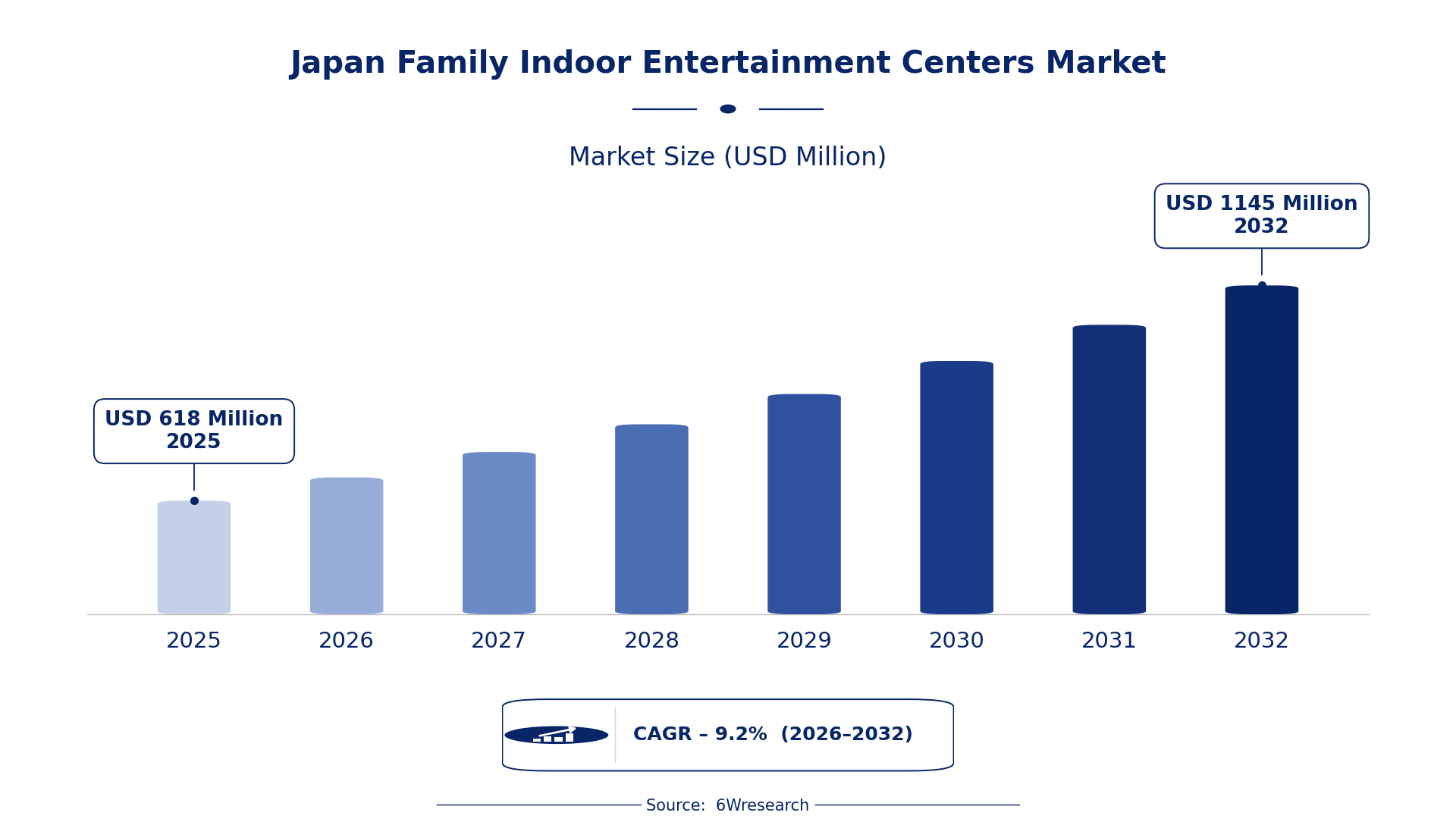
According to 6Wresearch internal database and industry insights, the Japan Family Indoor Entertainment Centers Market was valued at USD 618 Million in 2025 and is projected to reach USD 1,145 Million by 2032, growing at a CAGR of approximately 9.2% during 2026–2032.
Japan Family Indoor Entertainment Centers Market Highlights
| Report Metric | Details |
| Report Name | Japan Family Indoor Entertainment Centers Market (2026-2032) |
| Market Size 2025 | USD 618 Million |
| Market Size 2032 | USD 1,145 Million |
| Absolute Growth 2025–2032 | USD 527 Million |
| CAGR 2026–2032 | 9.2% |
| Peak Annual Growth | 10.2% in 2028 |
| Forecast Period | 2026–2032 |
| Historical Data | 2022–2025 |
| Base Year | 2025 |
| Leading Product Type, 2025 | Trampoline Parks (41% share) |
| Leading Technology Type, 2025 | Spring-based Technology (48% share) |
| Leading End User, 2025 | Families with Children (68% share) |
| Leading Application, 2025 | Physical Fitness and Fun (47% share) |
| Fastest-Growing Product Type | Indoor Play Zones (12.5% CAGR) |
| Fastest-Growing Technology Type | Soft Play Equipment (12.7% CAGR) |
| Fastest-Growing End User | Toddlers and Young Children (11.3% CAGR) |
| Fastest-Growing Application | Safe Entertainment for Children (12.9% CAGR) |
| Growing Sector | Family entertainment and recreation |
| Key End Users | Families with Children, Toddlers and Young Children, Urban Families, Health-conscious Families |
Japan Family Indoor Entertainment Centers Market Year-wise Growth Rate and Key Drivers (2022–2032)
This graph illustrates the annual growth rates of the market from 2022 to 2032, highlighting a steady upward trajectory and projected market expansion over the forecast period.
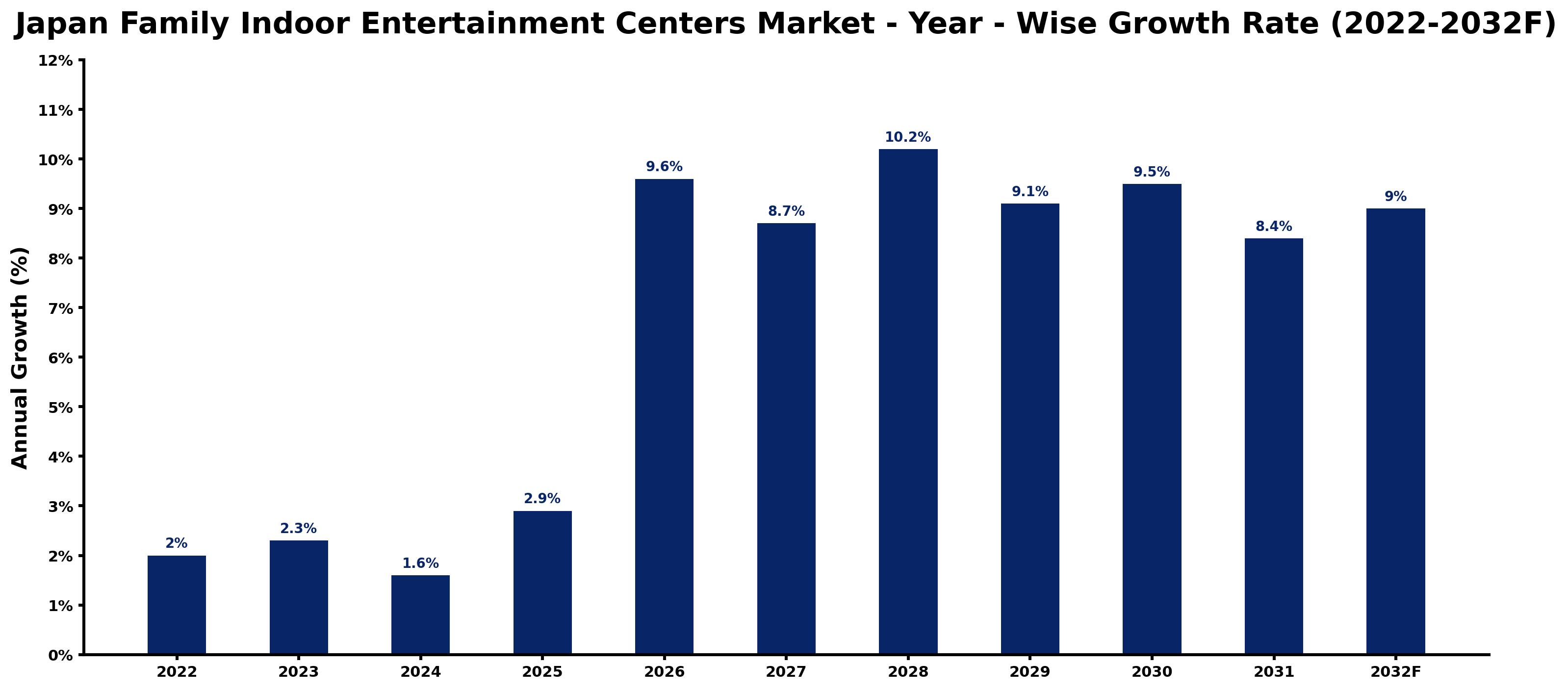
Each row of the following table gives one year's estimated growth and the event or demand shift that explains it.
| Year | Estimated Annual Growth (%) | Market Rationale |
| 2022 | 2.0 | The market experienced steady growth, reflecting strong interest in family entertainment. |
| 2023 | 2.3 | Growth accelerated as families sought safe recreational options for children. |
| 2024 | 1.6 | Growth slowed slightly due to market saturation in some urban areas. |
| 2025 | 2.9 | The market rebounded with increased family visits to entertainment centers. |
| 2026 | 9.6 | Demand is expected to surge as new facilities open, attracting more visitors. |
| 2027 | 8.7 | Growth will decelerate as competition intensifies among entertainment centers. |
| 2028 | 10.2 | The market is projected to peak with heightened interest in immersive experiences. |
| 2029 | 9.1 | Growth is expected to slow as the novelty of new attractions begins to fade. |
| 2030 | 9.5 | Demand will increase again as families return to recreational activities. |
| 2031 | 8.4 | Growth is projected to moderate as market maturity sets in, stabilising demand. |
| 2032 | 9.0 | The market is expected to grow steadily with ongoing innovation. |
Note: Market size estimations and growth projections presented in this report are based on 6Wresearch's proprietary forecasting methodology, utilizing the latest available industry data, government publications, and primary research inputs.
Japan Family Indoor Entertainment Centers Market Synopsis
Family Indoor Entertainment Centers in Japan are recreational facilities designed for families, particularly children, featuring attractions like trampolines and play zones. With over 200 centers catering to approximately 12 million children aged 0-14, the Japan Family Indoor Entertainment Centers Market is growing due to rising demand for safe recreational options, government initiatives promoting family-friendly spaces, and increasing investment in immersive entertainment experiences. The average family spends about ¥5,000 per visit, which further fuels growth in this sector.
Market Dynamics Impact Analysis (2026–2032)
| Factor | Type | Impact | Primary Segment Affected |
| Increasing urbanisation leads to higher demand for family entertainment options. | Driver | High | Trampoline Parks |
| Growing popularity of immersive experiences attracts tech-savvy families. | Driver | High | Virtual Reality Zones |
| Expansion of family-friendly recreational spaces creates new investment opportunities. | Opportunity | High | Indoor Play Zones |
| Rising interest in physical fitness among families opens new market segments. | Opportunity | Medium | Physical Fitness and Fun |
| Regulatory compliance costs for safety standards can limit growth. | Restraint | High | Soft Play Equipment |
| Market saturation in urban areas may slow new center openings. | Restraint | Medium | Indoor Play Zones |
| High competition among centers can affect pricing strategies. | Challenge | High | Trampoline Parks |
| Shifts in consumer preferences towards home entertainment options. | Challenge | Medium | Interactive Video Games |
Evaluation of Drivers in Japan Family Indoor Entertainment Centers Market (2026–2032)
The factors lifting demand, and the evidence behind each, are summarised below.
| Drivers | Primary Segment Affected | Why It Matters (Evidence) |
| Urbanisation drives demand for recreational facilities in metropolitan areas. | Trampoline Parks | Tokyo and Osaka have seen a rise in family entertainment centers, catering to local demand. |
| The popularity of immersive experiences attracts families seeking unique entertainment. | Virtual Reality Zones | High tech adoption in urban areas is integrating VR experiences into family entertainment. |
| Government initiatives promote family-friendly recreational spaces in urban planning. | Indoor Play Zones | Local programs are encouraging the establishment of safe play areas for children. |
| Increased disposable income allows families to spend more on entertainment. | Interactive Video Games | Families are willing to invest in digital gaming experiences for educational entertainment. |
| Growing awareness of physical fitness promotes visits to entertainment centers. | Physical Fitness and Fun | The Ministry of Education's promotion of fitness programs encourages active recreation. |
The strongest pull on demand comes from urbanisation, particularly in metropolitan areas where family entertainment centers are thriving. Approximately 12 million children aged 0-14 in Japan drive the need for safe recreational options. Families are increasingly investing in immersive experiences, with the average family spending about ¥5,000 per visit. Awareness of physical fitness boosts demand, as families seek active recreation opportunities. Urban areas are experiencing a surge in new facilities, enriching the overall entertainment offering.
Evaluation of Restraints in Japan Family Indoor Entertainment Centers Market
The following restraints limit how fast demand can grow.
| Market Restraint | Primary Segment Affected | Why It Matters (Evidence) |
| Compliance with safety regulations increases operational costs for centers. | Soft Play Equipment | Investment in safety measures under JIS standards raises operational expenses. |
| Market saturation in urban areas limits new center openings. | Indoor Play Zones | High competition in cities like Tokyo restricts opportunities for new entrants. |
| Consumer preference shifts towards home entertainment can reduce visits to centers. | Interactive Video Games | Families may prefer home gaming systems over visiting entertainment centers. |
| High operational costs can limit the variety of attractions offered. | Trampoline Parks | Maintaining safety standards and equipment requires ongoing investment. |
| Economic fluctuations can impact discretionary spending on entertainment. | Virtual Reality Zones | Families may reduce entertainment expenses during economic downturns. |
Japan Family Indoor Entertainment Centers Market Challenges
Trampoline Parks in urban areas face stringent safety regulations, which can delay new facility openings by up to six months, impacting revenue for operators. Limited workforce skills hinder the delivery of quality customer service, potentially leading to a 15% drop in repeat visits and lower overall satisfaction for families. Supply chain disruptions for soft play equipment can extend lead times by three months, forcing centers to limit their offerings and reducing their appeal to families. Rising operational costs in urban locations can push average family spending to ¥5,500 per visit, straining budgets for many households.
Trends in the Japan Family Indoor Entertainment Centers Market
Four trends stand out in the Japan Family Indoor Entertainment Centers Market.
- Shift from Traditional Play Areas to Immersive Experiences: Family Indoor Entertainment Centers are increasingly incorporating immersive experiences, such as Virtual Reality Zones, to attract tech-savvy families. In urban areas, these experiences are gaining traction, with a notable rise in visitors seeking unique entertainment options.
- Transition from Physical to Digital Entertainment: The trend towards digital gaming is becoming more pronounced as Interactive Video Games are integrated into family entertainment experiences. This shift is particularly noticeable in urban centres, where families are investing in digital entertainment options.
- Emergence of Themed Indoor Play Zones: Themed Indoor Play Zones are becoming more prevalent, enhancing engagement for children. In 2023, many centers began adopting themes to create immersive environments, responding to the demand for unique play experiences.
- Growing Focus on Health and Fitness: Family Indoor Entertainment Centers are placing greater emphasis on physical fitness activities. Government programs promoting fitness have led to an increase in centres offering physical fitness and fun activities for families.
Investment Opportunities in the Japan Family Indoor Entertainment Centers Market
The openings below show where demand in the Japan Family Indoor Entertainment Centers Market is visible and how suppliers can enter.
- Investment in Virtual Reality Zones: With the rise of immersive experiences, there is a strong opportunity to invest in Virtual Reality Zones. Urban areas with high tech adoption are ideal for such developments, as demand for unique entertainment experiences grows.
- Expansion of Indoor Play Zones: Now is an opportune time to invest in Indoor Play Zones, as families increasingly seek safe recreational options. Regions with high populations of children represent a substantial market for these facilities.
- Development of Themed Entertainment Experiences: Themed entertainment experiences are in demand, particularly among families with young children. Investing in themed attractions can draw more visitors, especially in urban centres where competition is high.
- Enhancement of Physical Fitness Offerings: Investing in physical fitness activities within Family Indoor Entertainment Centers is timely. The Ministry of Education's promotion of fitness programs creates a strong market for facilities focused on active recreation.
Government Initiatives in the Japan Family Indoor Entertainment Centers Market
The Building Energy Efficiency Act, amended in 2022, mandates that all new buildings meet energy standards from April 2025, ensuring safety and sustainability in Family Indoor Entertainment Centers. This law builds on previous regulations by requiring facilities to be designed for energy efficiency, which is increasingly important for attracting environmentally conscious families.
The Tokyo Metropolitan Government's initiatives support indoor recreation facilities by providing funding for safety upgrades and community engagement programs. These measures ensure that Family Indoor Entertainment Centers can meet safety standards while promoting family-friendly activities in urban planning.
Future Insight of the Japan Family Indoor Entertainment Centers Market
Government initiatives will drive a shift towards more family-friendly recreational spaces by 2032, encouraging the development of new entertainment facilities. Suppliers will need to integrate advanced technology, including immersive VR experiences, to cater to tech-savvy families. The Tokyo Metropolitan Government's support for indoor recreation will likely increase foot traffic, benefiting existing centers. By 2032, the average size of new Family Indoor Entertainment Centers may expand to 2,000 square meters, allowing for a broader range of attractions and enhanced family engagement.
Market Segmentation Analysis
Japan Family Indoor Entertainment Centers Market report covers a detailed analysis of the following market segments:
By Product Type – Trampoline Parks Lead, Indoor Play Zones Expected to Grow Fastest
According to Shubham Deep, Research Manager at 6Wresearch, in 2025, Trampoline Parks led the product type split with a 41% share. Trampoline Parks dominate the market due to their ability to provide physical activity and entertainment, making them highly appealing to families in urban centres. Their presence is particularly strong in cities like Tokyo and Osaka, where demand for such recreational facilities is robust. Indoor Play Zones are projected to grow fastest, at a CAGR of 12.5% during 2026–2032. Indoor Play Zones are experiencing rapid growth as they cater specifically to children aged 1-12 years, a demographic that includes approximately 12 million children in Japan. Government initiatives promoting safe recreational spaces further fuel this expansion, ensuring continued interest from families. This indicates that suppliers should focus on developing offerings tailored to the needs of Indoor Play Zones to capitalise on the increasing demand.
By Technology Type – Spring-based Technology Leads, Soft Play Equipment Expected to Grow Fastest
Spring-based Technology took 48% of technology type revenue in 2025, more than any other category. Spring-based Technology leads the market as it is essential for ensuring safety in trampoline designs, which is a primary concern for families. The widespread adoption of this technology across trampoline parks solidifies its position. The quickest growth will come from Soft Play Equipment, forecast to expand at a CAGR of 12.7% between 2026 and 2032. Soft Play Equipment is growing quickly as it provides safe play environments for toddlers, which is increasingly demanded by parents. This segment's expansion is driven by the need for age-appropriate recreational options. Buyers will benefit from a wider range of safe play equipment as suppliers respond to this growing demand.
By End User – Families with Children Leads, Toddlers and Young Children Expected to Grow Fastest
With 68% of end user revenue in 2025, Families with Children was the largest category. Families with Children represent the largest user group, accounting for over 60% of visitors to family entertainment centers. This demographic's preference for safe and engaging environments drives the market's growth. Toddlers and Young Children is set to record the highest CAGR in this split, 11.3% over 2026–2032. Toddlers and Young Children are the fastest-growing segment as facilities increasingly design attractions specifically for their safety and enjoyment. This focus on younger children aligns with the overall trend towards family-oriented recreational activities. Suppliers should tailor their offerings to meet the specific needs of toddlers and young children to capture this expanding market.
By Application – Physical Fitness and Fun Leads, Safe Entertainment for Children Expected to Grow Fastest
The largest application category in 2025 was Physical Fitness and Fun, at 47% of revenue. Physical Fitness and Fun represents the core purpose of family entertainment centers, attracting families seeking active recreational options. This focus resonates with the largest user group, families with children, who account for over 60% of visitors. Over 2026–2032, Safe Entertainment for Children is expected to post the fastest growth, at a CAGR of 12.9%. Safe Entertainment for Children is increasingly important as parents prioritise safety in their recreational choices. The trend is reflected in the growing number of facilities designed with child safety as a primary feature. Suppliers need to innovate to deliver safe entertainment solutions that align with the expectations of families.
Key Attractiveness of the Report
- 10 Years of Market Numbers
- Historical Data Starting from 2022 to 2025
- Base Year 2025
- Forecast Data until 2032
- Key Performance Indicators Impacting the Market
- Major Upcoming Developments and Projects
Key Highlights of the Report:
- Japan Family Indoor Entertainment Centers Market Outlook
- Market Size of Japan Family Indoor Entertainment Centers Market,2025
- Forecast of Japan Family Indoor Entertainment Centers Market, 2032
- Historical Data and Forecast of Japan Family Indoor Entertainment Centers Revenues & Volume for the Period 2022-2032
- Japan Family Indoor Entertainment Centers Market Trend Evolution
- Japan Family Indoor Entertainment Centers Market Drivers and Challenges
- Japan Family Indoor Entertainment Centers Price Trends
- Japan Family Indoor Entertainment Centers Porter's Five Forces
- Japan Family Indoor Entertainment Centers Industry Life Cycle
- Historical Data and Forecast of Japan Family Indoor Entertainment Centers Market Revenues & Volume By Product Type for the Period 2022-2032
- Historical Data and Forecast of Japan Family Indoor Entertainment Centers Market Revenues & Volume By Trampoline Parks for the Period 2022-2032
- Historical Data and Forecast of Japan Family Indoor Entertainment Centers Market Revenues & Volume By Indoor Play Zones for the Period 2022-2032
- Historical Data and Forecast of Japan Family Indoor Entertainment Centers Market Revenues & Volume By Virtual Reality Zones for the Period 2022-2032
- Historical Data and Forecast of Japan Family Indoor Entertainment Centers Market Revenues & Volume By Interactive Video Games for the Period 2022-2032
- Historical Data and Forecast of Japan Family Indoor Entertainment Centers Market Revenues & Volume By Technology Type for the Period 2022-2032
- Historical Data and Forecast of Japan Family Indoor Entertainment Centers Market Revenues & Volume By Spring-based Technology for the Period 2022-2032
- Historical Data and Forecast of Japan Family Indoor Entertainment Centers Market Revenues & Volume By Soft Play Equipment for the Period 2022-2032
- Historical Data and Forecast of Japan Family Indoor Entertainment Centers Market Revenues & Volume By Immersive VR for the Period 2022-2032
- Historical Data and Forecast of Japan Family Indoor Entertainment Centers Market Revenues & Volume By Touchscreen Technology for the Period 2022-2032
- Historical Data and Forecast of Japan Family Indoor Entertainment Centers Market Revenues & Volume By End User for the Period 2022-2032
- Historical Data and Forecast of Japan Family Indoor Entertainment Centers Market Revenues & Volume By Families with Children for the Period 2022-2032
- Historical Data and Forecast of Japan Family Indoor Entertainment Centers Market Revenues & Volume By Toddlers and Young Children for the Period 2022-2032
- Historical Data and Forecast of Japan Family Indoor Entertainment Centers Market Revenues & Volume By Application for the Period 2022-2032
- Historical Data and Forecast of Japan Family Indoor Entertainment Centers Market Revenues & Volume By Physical Fitness and Fun for the Period 2022-2032
- Historical Data and Forecast of Japan Family Indoor Entertainment Centers Market Revenues & Volume By Safe Entertainment for Children for the Period 2022-2032
- Historical Data and Forecast of Japan Family Indoor Entertainment Centers Market Revenues & Volume By Virtual Reality Experiences for the Period 2022-2032
- Historical Data and Forecast of Japan Family Indoor Entertainment Centers Market Revenues & Volume By Digital Gaming and Skill-building for the Period 2022-2032
- Japan Family Indoor Entertainment Centers Import Export Trade Statistics
- Market Opportunity Assessment By Product Type
- Market Opportunity Assessment By Technology Type
- Market Opportunity Assessment By End User
- Market Opportunity Assessment By Application
- Japan Family Indoor Entertainment Centers Top Companies Market Share
- Japan Family Indoor Entertainment Centers Competitive Benchmarking By Technical and Operational Parameters
- Japan Family Indoor Entertainment Centers Company Profiles
- Japan Family Indoor Entertainment Centers Key Strategic Recommendations
Market Covered
Coverage by segment is as follows.
By Product Type
- Trampoline Parks
- Indoor Play Zones
- Virtual Reality Zones
- Interactive Video Games
By Technology Type
- Spring-based Technology
- Soft Play Equipment
- Immersive VR
- Touchscreen Technology
By End User
- Families with Children
- Toddlers and Young Children
By Application
- Physical Fitness and Fun
- Safe Entertainment for Children
- Virtual Reality Experiences
- Digital Gaming and Skill-building































