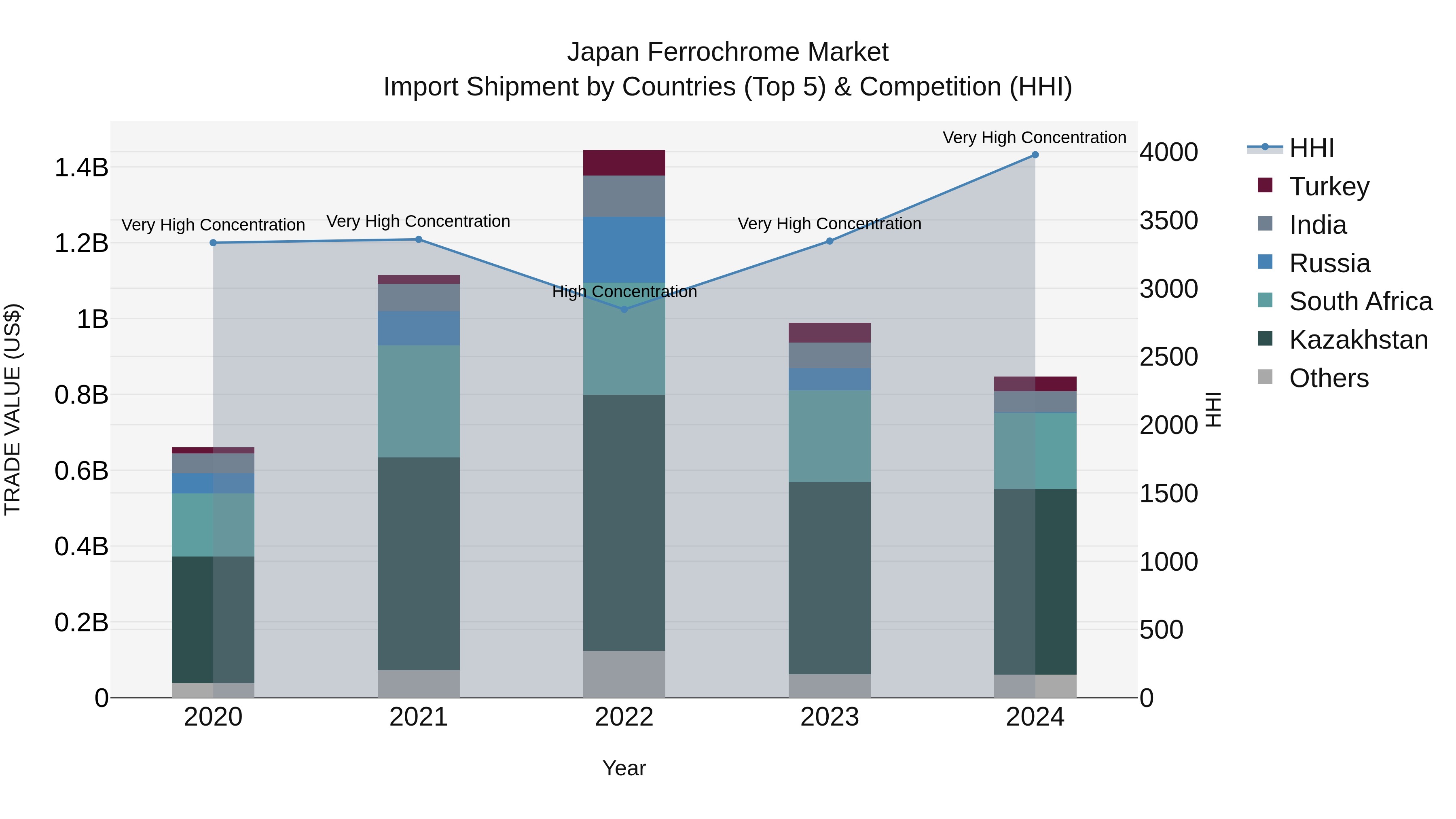
Japan Ferrochrome Market Import Shipment by Countries (Top 5) & Competition (HHI)
Japan's ferrochrome import market in 2024 continued to be dominated by top exporting countries like Kazakhstan, South Africa, India, Turkey, and Sweden. The Herfindahl-Hirschman Index (HHI) indicated a very high concentration of imports, reflecting limited market competition. Despite a healthy compound annual growth rate (CAGR) of 6.43% from 2020 to 2024, there was a notable decline in the growth rate in 2024, with a -14.31% decrease from the previous year. This suggests a potential shift in market dynamics or temporary challenges impacting the import trade of ferrochrome into Japan.
Japan Ferrochrome Market Overview
The Japan Ferrochrome market is characterized by steady demand from the stainless steel industry, which is a key consumer of ferrochrome due to its corrosion-resistant properties. Japan, being a major producer of stainless steel, relies heavily on imported ferrochrome to meet its manufacturing needs. The market is influenced by factors such as global stainless steel production trends, raw material prices, and trade policies. Market players in Japan include both domestic producers and international suppliers, with competition driven by product quality, pricing, and supply chain reliability. As sustainability concerns grow, there is a shift towards utilizing more environmentally friendly production methods in the ferrochrome industry. Overall, the Japan Ferrochrome market is expected to continue its stable growth trajectory, supported by the country`s strong stainless steel sector and evolving industry dynamics.
Japan Ferrochrome Market Trends
In Japan, the Ferrochrome market is experiencing steady growth driven by the increasing demand from the stainless steel industry. The construction and automotive sectors are also contributing to this demand. Environmental regulations and sustainability concerns are pushing manufacturers to adopt more efficient production processes. Additionally, the trend towards lightweight and high-strength materials in various industries is boosting the need for ferrochrome. The market is witnessing a shift towards higher chromium content ferrochrome to meet the stringent quality requirements of end-users. Importantly, the tight supply of raw materials and the fluctuating prices of chrome ore are influencing market dynamics. Overall, the Japan Ferrochrome market is expected to continue its growth trajectory with a focus on innovation and sustainable practices.
Japan Ferrochrome Market Challenges
In the Japan Ferrochrome market, one of the key challenges is the reliance on imported raw materials due to limited domestic production of chrome ore. This dependency on foreign sources makes the market vulnerable to fluctuations in global supply and prices, impacting the overall competitiveness of Japanese ferrochrome manufacturers. Additionally, environmental regulations and energy costs in Japan are relatively high, adding to the production costs for ferrochrome producers. Furthermore, competition from other Asian countries with lower production costs can put pressure on Japanese companies, highlighting the need for efficiency improvements and technological advancements to sustain their market position. Overall, addressing these challenges through strategic partnerships, innovation, and operational enhancements will be crucial for the long-term growth and sustainability of the Japan Ferrochrome market.
Japan Ferrochrome Market Investment Opportunities
Investment opportunities in the Japan Ferrochrome market include investing in companies involved in the production and distribution of ferrochrome, as Japan is a major consumer of this alloy in industries such as stainless steel manufacturing and automotive production. With the increasing demand for stainless steel products in Japan and globally, there is potential for growth in the ferrochrome market. Additionally, investing in research and development of innovative production processes for ferrochrome could provide opportunities for market disruption and competitive advantage. Another potential area for investment is in companies focusing on sustainability and environmentally friendly practices in ferrochrome production, as there is a growing emphasis on ESG factors in the market. Overall, the Japan Ferrochrome market presents opportunities for investors looking to capitalize on the country`s industrial growth and technological advancements.
Japan Ferrochrome Market Government Policy
The Japanese government has implemented various policies to regulate the ferrochrome market in the country. One key policy is the Industrial Structure Council`s recommendation to promote domestic production of ferrochrome to reduce reliance on imports. Additionally, the Ministry of Economy, Trade and Industry (METI) has introduced measures to support the development of technology for eco-friendly ferrochrome production processes. Another important aspect of government policy is the enforcement of environmental regulations and standards to ensure sustainable and responsible production practices within the ferrochrome industry. Overall, these policies aim to enhance the competitiveness of the Japanese ferrochrome market, promote domestic production, and drive innovation in eco-friendly production methods.
Japan Ferrochrome Market Future Outlook
The Japan Ferrochrome Market is expected to witness steady growth in the coming years. The increasing demand for stainless steel in various industries such as automotive, construction, and electronics is a key driver for the market. Japan`s focus on infrastructure development and technological advancements will further boost the demand for ferrochrome, as it is a crucial ingredient in stainless steel production. Additionally, the government`s initiatives towards promoting sustainable practices and reducing carbon emissions are likely to drive the market towards more environmentally friendly production processes. Overall, with the growing industrial activities and emphasis on sustainability, the Japan Ferrochrome Market is poised for a positive outlook in the foreseeable future.
Key Highlights of the Report:
- Japan Ferrochrome Market Outlook
- Market Size of Japan Ferrochrome Market, 2021
- Forecast of Japan Ferrochrome Market, 2027
- Historical Data and Forecast of Japan Ferrochrome Revenues & Volume for the Period 2018 - 2027
- Japan Ferrochrome Market Trend Evolution
- Japan Ferrochrome Market Drivers and Challenges
- Japan Ferrochrome Price Trends
- Japan Ferrochrome Porter's Five Forces
- Japan Ferrochrome Industry Life Cycle
- Historical Data and Forecast of Japan Ferrochrome Market Revenues & Volume By Type for the Period 2018 - 2027
- Historical Data and Forecast of Japan Ferrochrome Market Revenues & Volume By High carbon for the Period 2018 - 2027
- Historical Data and Forecast of Japan Ferrochrome Market Revenues & Volume By Medium carbon for the Period 2018 - 2027
- Historical Data and Forecast of Japan Ferrochrome Market Revenues & Volume By Low carbon for the Period 2018 - 2027
- Historical Data and Forecast of Japan Ferrochrome Market Revenues & Volume By Applications for the Period 2018 - 2027
- Historical Data and Forecast of Japan Ferrochrome Market Revenues & Volume By Stainless steel for the Period 2018 - 2027
- Historical Data and Forecast of Japan Ferrochrome Market Revenues & Volume By Other steels for the Period 2018 - 2027
- Japan Ferrochrome Import Export Trade Statistics
- Market Opportunity Assessment By Type
- Market Opportunity Assessment By Applications
- Japan Ferrochrome Top Companies Market Share
- Japan Ferrochrome Competitive Benchmarking By Technical and Operational Parameters
- Japan Ferrochrome Company Profiles
- Japan Ferrochrome Key Strategic Recommendations






































