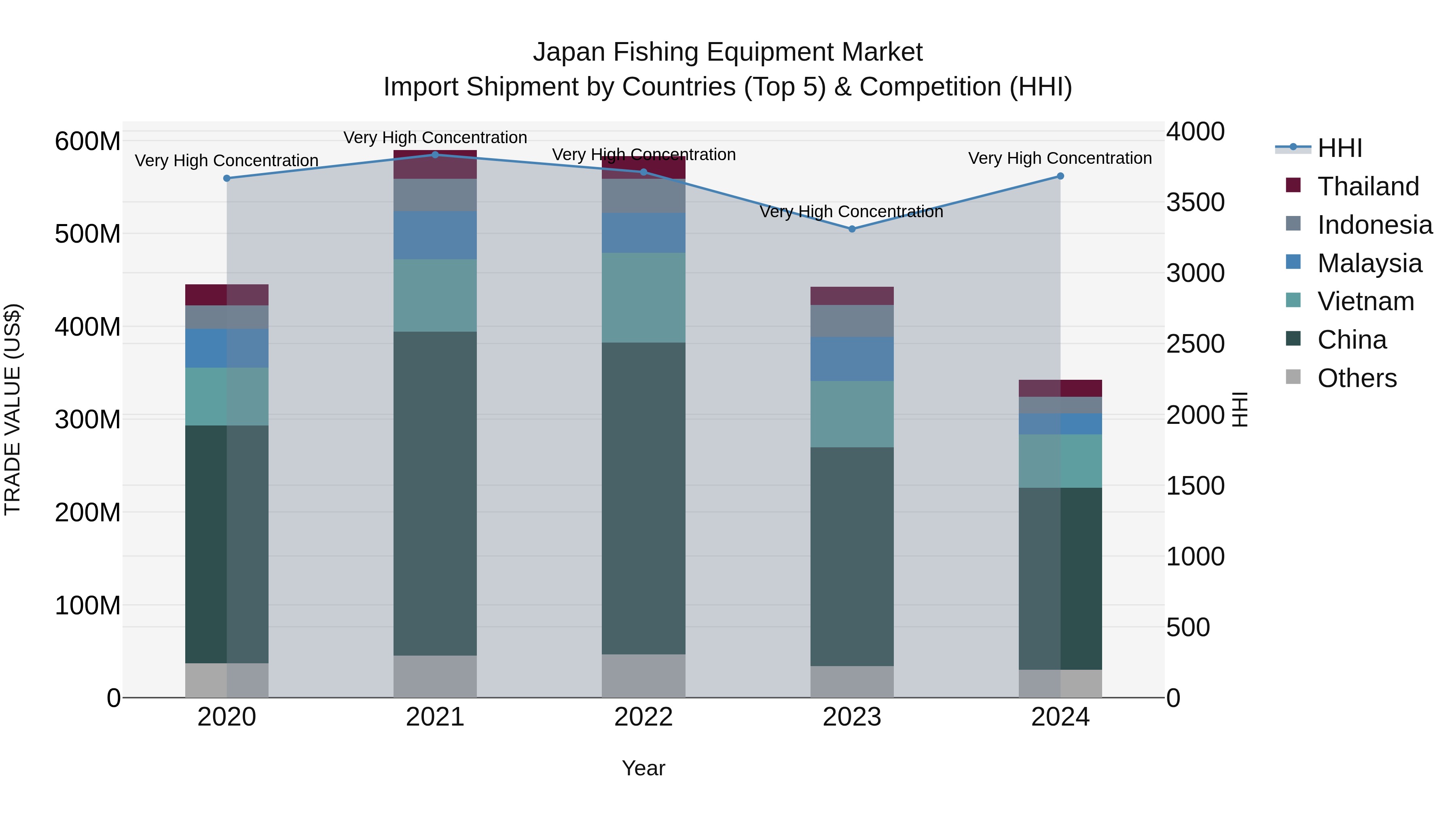
Japan Fishing Equipment Market Import Shipment by Countries (Top 5) & Competition (HHI)
Despite the challenging market conditions reflected in the negative CAGR and growth rate, Japan continues to be a significant importer of fishing equipment. The high concentration of shipments from top exporting countries like China, Vietnam, Malaysia, Thailand, and Indonesia underscores the competitive landscape in the industry. The declining growth rate in 2024 may be attributed to various factors impacting the market. It will be interesting to monitor how these trends develop and whether there will be any shifts in the market dynamics in the coming years.
Japan Fishing Equipment Market Overview
The Japan Fishing Equipment Market is a vibrant and dynamic industry characterized by a wide range of products catering to various fishing techniques and preferences. With a strong fishing culture deeply rooted in tradition and modern innovation, the market offers a diverse selection of fishing rods, reels, lures, lines, and accessories for both recreational and professional anglers. Key trends driving market growth include the rising popularity of recreational fishing, increasing interest in eco-friendly and sustainable fishing practices, and technological advancements in equipment design and materials. Leading domestic and international brands compete in the market, offering high-quality products to meet the diverse needs of consumers. Overall, the Japan Fishing Equipment Market continues to evolve with a focus on innovation, quality, and sustainability to meet the demands of the growing fishing enthusiast community.
Japan Fishing Equipment Market Trends
The Japan Fishing Equipment Market is experiencing several notable trends. Firstly, there is a growing demand for technologically advanced fishing gear, such as high-resolution fish finders and GPS-equipped devices, among both recreational and professional anglers. Additionally, sustainability and eco-friendly practices are becoming increasingly important, leading to the rise of environmentally conscious fishing equipment made from recycled materials or with minimal environmental impact. Furthermore, there is a shift towards specialized and niche fishing gear catering to specific types of fishing, such as fly fishing or deep-sea fishing. E-commerce platforms are also gaining traction in the market, providing consumers with a convenient way to purchase fishing equipment online. Overall, these trends indicate a market that is evolving to meet the changing preferences and demands of modern anglers in Japan.
Japan Fishing Equipment Market Challenges
In the Japan Fishing Equipment Market, some key challenges include increased competition from both domestic and international manufacturers, fluctuating raw material prices affecting production costs, and changing consumer preferences towards more sustainable and eco-friendly products. Additionally, the aging population in Japan poses a challenge as younger generations are less interested in traditional fishing activities, leading to a decline in the overall market demand. Furthermore, stringent regulations on fishing practices and equipment standards set by the government can also impact the market dynamics and require manufacturers to constantly adapt and innovate their products to meet these requirements. Overall, navigating these challenges while maintaining product quality and staying competitive in the market can be a significant task for companies operating in the Japan Fishing Equipment Market.
Japan Fishing Equipment Market Investment Opportunities
The Japan Fishing Equipment Market offers various investment opportunities for businesses looking to capitalize on the country`s strong fishing culture. With a significant portion of the population actively participating in fishing as a recreational activity, there is a growing demand for high-quality fishing equipment such as rods, reels, lures, and accessories. Investing in innovative and technologically advanced fishing gear that caters to the preferences of Japanese anglers can be a lucrative opportunity. Additionally, there is potential for growth in eco-friendly and sustainable fishing equipment to align with Japan`s environmental conservation efforts. Collaborating with local manufacturers or distributors, establishing partnerships with fishing clubs or retailers, and leveraging digital marketing strategies to reach a wider audience are effective ways to enter and expand within this market segment.
Japan Fishing Equipment Market Government Policy
The Japan Fishing Equipment Market is heavily influenced by government policies aimed at regulating fishing activities to ensure sustainability and conservation of marine resources. The Japanese government implements strict quotas and regulations on fishing practices to prevent overfishing and protect endangered species. Additionally, there are subsidies and incentives provided to fishing equipment manufacturers to encourage innovation and development of sustainable fishing gear. Importantly, the government also promotes research and development in the fishing industry to improve efficiency and reduce environmental impact. Overall, government policies in Japan focus on balancing economic interests with environmental conservation in the fishing equipment market.
Japan Fishing Equipment Market Future Outlook
The Japan Fishing Equipment Market is expected to experience steady growth in the coming years due to factors such as increasing interest in recreational fishing among the younger population, technological advancements in fishing gear, and a growing emphasis on sustainable fishing practices. The market is also likely to benefit from the rise of online retail channels offering a wide range of fishing equipment to consumers. Additionally, the government`s efforts to promote tourism and outdoor activities could further boost the demand for fishing equipment in Japan. Overall, the future outlook for the Japan Fishing Equipment Market appears positive, with opportunities for innovation and expansion in both domestic and international markets.
Key Highlights of the Report:
- Japan Fishing Equipment Market Outlook
- Market Size of Japan Fishing Equipment Market, 2021
- Forecast of Japan Fishing Equipment Market, 2031
- Historical Data and Forecast of Japan Fishing Equipment Revenues & Volume for the Period 2018 - 2031
- Japan Fishing Equipment Market Trend Evolution
- Japan Fishing Equipment Market Drivers and Challenges
- Japan Fishing Equipment Price Trends
- Japan Fishing Equipment Porter's Five Forces
- Japan Fishing Equipment Industry Life Cycle
- Historical Data and Forecast of Japan Fishing Equipment Market Revenues & Volume By Type for the Period 2018 - 2031
- Historical Data and Forecast of Japan Fishing Equipment Market Revenues & Volume By Hooks for the Period 2018 - 2031
- Historical Data and Forecast of Japan Fishing Equipment Market Revenues & Volume By Lines for the Period 2018 - 2031
- Historical Data and Forecast of Japan Fishing Equipment Market Revenues & Volume By Sinkers & Floats for the Period 2018 - 2031
- Historical Data and Forecast of Japan Fishing Equipment Market Revenues & Volume By Rods for the Period 2018 - 2031
- Historical Data and Forecast of Japan Fishing Equipment Market Revenues & Volume By Reels for the Period 2018 - 2031
- Historical Data and Forecast of Japan Fishing Equipment Market Revenues & Volume By Nets & Traps for the Period 2018 - 2031
- Historical Data and Forecast of Japan Fishing Equipment Market Revenues & Volume By Spear & Gaffs for the Period 2018 - 2031
- Historical Data and Forecast of Japan Hooks Fishing Equipment Market Revenues & Volume By Others for the Period 2018 - 2031
- Historical Data and Forecast of Japan Fishing Equipment Market Revenues & Volume By Nature for the Period 2018 - 2031
- Historical Data and Forecast of Japan Fishing Equipment Market Revenues & Volume By Fresh Water for the Period 2018 - 2031
- Historical Data and Forecast of Japan Fishing Equipment Market Revenues & Volume By Salt Water for the Period 2018 - 2031
- Historical Data and Forecast of Japan Fishing Equipment Market Revenues & Volume By Fly Fishing for the Period 2018 - 2031
- Historical Data and Forecast of Japan Fishing Equipment Market Revenues & Volume By Distribution Channel for the Period 2018 - 2031
- Historical Data and Forecast of Japan Fishing Equipment Market Revenues & Volume By Online for the Period 2018 - 2031
- Historical Data and Forecast of Japan Fishing Equipment Market Revenues & Volume By Offline for the Period 2018 - 2031
- Japan Fishing Equipment Import Export Trade Statistics
- Market Opportunity Assessment By Type
- Market Opportunity Assessment By Nature
- Market Opportunity Assessment By Distribution Channel
- Japan Fishing Equipment Top Companies Market Share
- Japan Fishing Equipment Competitive Benchmarking By Technical and Operational Parameters
- Japan Fishing Equipment Company Profiles
- Japan Fishing Equipment Key Strategic Recommendations






































