Japan Food Coating Market Size & Growth Rate
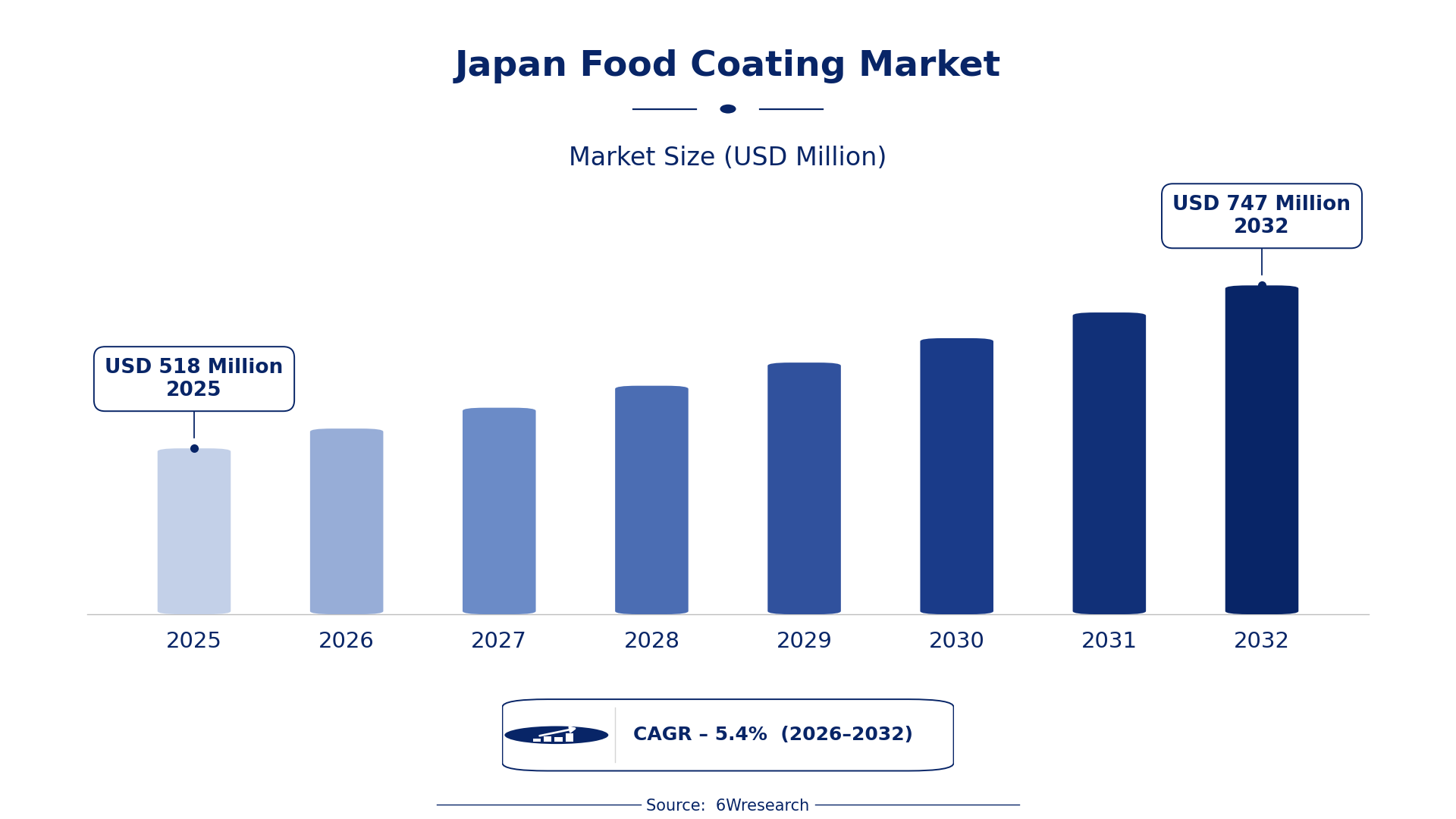
According to 6Wresearch internal database and industry insights, the Japan Food Coating Market was valued at USD 518 Million in 2025 and is projected to reach USD 747 Million by 2032, growing at a CAGR of approximately 5.4% during 2026–2032.
Japan Food Coating Market Highlights
| Report Metric | Details |
| Report Name | Japan Food Coating Market (2026-2032) |
| Market Size 2025 | USD 518 Million |
| Market Size 2032 | USD 747 Million |
| Absolute Growth 2025–2032 | USD 229 Million |
| CAGR 2026–2032 | 5.4% |
| Peak Annual Growth | 6.6% in 2028 |
| Forecast Period | 2026–2032 |
| Historical Data | 2022–2025 |
| Base Year | 2025 |
| Leading Ingredient Type, 2025 | Fats & Oils (33% share) |
| Leading Application, 2025 | Meat & Seafood Products (45% share) |
| Leading Equipment Type, 2025 | Coaters & Applicators (43% share) |
| Leading Form, 2025 | Dry (55% share) |
| Leading Mode of Operation Semi, 2025 | Automatic (64% share) |
| Fastest-Growing Ingredient Type | Cocoa & Chocolate (8.1% CAGR) |
| Fastest-Growing Application | Bakery Products (7.5% CAGR) |
| Fastest-Growing Equipment Type | Breader Applicators (8.3% CAGR) |
| Fastest-Growing Form | Liquid (7.3% CAGR) |
| Fastest-Growing Mode of Operation Semi | Semi-automatic (7.0% CAGR) |
| Growing Sector | snack food |
| Key End Users | food processors, meat processors, bakery manufacturers, snack producers |
Japan Food Coating Market Year-wise Growth Rate and Key Drivers (2022–2032)
This graph illustrates the annual growth rates of the market from 2022 to 2032, highlighting a steady upward trajectory and projected market expansion over the forecast period.
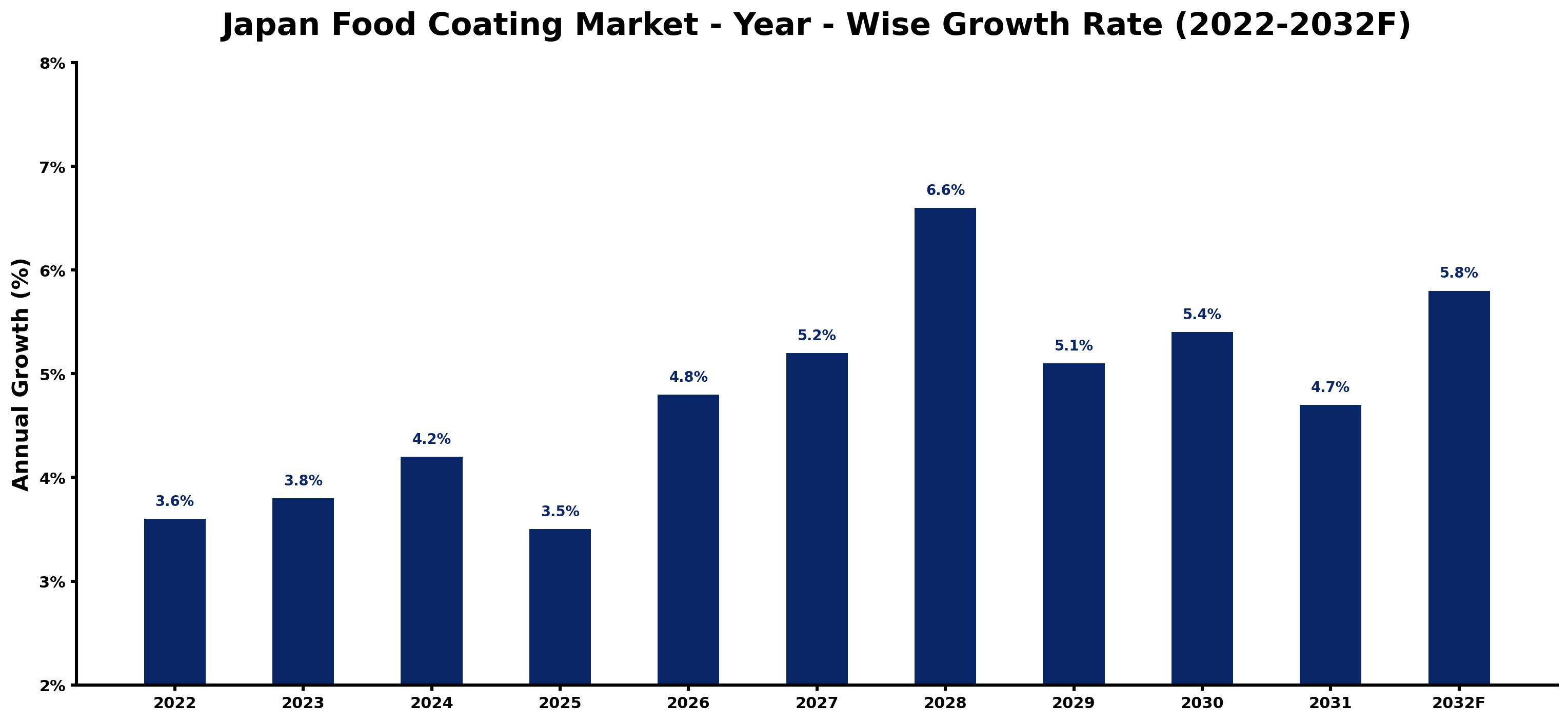
The yearly estimates that follow link every growth rate to its principal driver, so readers can see why the pace changed in each period.
| Year | Estimated Annual Growth (%) | Market Rationale |
| 2022 | 3.6 | The market showed steady growth, reflecting ongoing demand from food processors. |
| 2023 | 3.8 | Growth accelerated due to increased consumer interest in snack foods and coatings. |
| 2024 | 4.2 | The market continued to expand as more food manufacturers adopted new coating technologies. |
| 2025 | 3.5 | Growth slowed as manufacturers faced challenges in sourcing raw materials amid rising costs. |
| 2026 | 4.8 | Demand surged as the bakery sector invested in new production technologies and equipment. |
| 2027 | 5.2 | The market experienced further growth driven by rising consumption of meat products. |
| 2028 | 6.6 | Growth peaked as the confectionery sector expanded, boosting demand for coatings. |
| 2029 | 5.1 | Growth slowed slightly as market saturation began to impact new investments. |
| 2030 | 5.4 | Demand increased again as automation in food processing gained traction. |
| 2031 | 4.7 | Growth moderated as manufacturers adjusted to changing consumer preferences. |
| 2032 | 5.8 | The market is expected to grow as new food safety standards drive advancements. |
Note: Market size estimations and growth projections presented in this report are based on 6Wresearch's proprietary forecasting methodology, utilizing the latest available industry data, government publications, and primary research inputs.
Japan Food Coating Market Synopsis
Food coating is a technology that improves the appearance and flavour of food products by combining fats, oils, and sugars. The Japan Food Coating Market is expanding due to rising consumer demand for snacks, with the average Japanese consuming about 30 kg of snacks annually. The bakery sector, with over 25,000 establishments, is investing in modern coating technologies, while government initiatives like the subsidy program for food technology advancements are stimulating further market growth.
Market Dynamics Impact Analysis (2026–2032)
| Factor | Type | Impact | Primary Segment Affected |
| Rising consumer demand for snacks and convenience foods | Driver | High | Snacks |
| Increased investment in food processing technologies | Driver | High | Bakery Products |
| Expansion of the bakery industry | Opportunity | High | Bakery Products |
| Growing interest in healthier food options | Opportunity | High | Meat & Seafood Products |
| Fluctuations in raw material prices | Restraint | High | Fats & Oils |
| Regulatory compliance costs for food safety | Restraint | Medium | Fats & Oils |
| Challenges in sourcing high-quality ingredients | Challenge | High | Fats & Oils |
| Increased competition from imported coatings | Challenge | Medium | Fats & Oils |
Evaluation of Drivers in Japan Food Coating Market (2026–2032)
Below are the drivers that matter most for revenue growth, with supporting evidence.
| Drivers | Primary Segment Affected | Why It Matters (Evidence) |
| Growing consumption of snacks | Snacks | The average Japanese consumes about 30 kg of snacks annually, increasing demand for coatings that enhance taste and appearance. |
| Investment in food processing technologies | Bakery Products | The bakery industry, with over 25,000 establishments, is investing in advanced coating technologies to improve product quality. |
| Rising meat consumption | Meat & Seafood Products | The average annual consumption of meat per person in Japan is around 50 kg, driving demand for coatings that enhance flavor and texture. |
| Focus on food safety standards | Fats & Oils | Compliance with ISO 22000 standards encourages manufacturers to adopt coatings that meet safety requirements. |
| Innovation in food coating technologies | Confectionery Products | The confectionery sector, expected to reach 1 trillion yen by 2025, is driving demand for advanced coating solutions. |
Much of the new demand traces back to the bakery sector, which is investing heavily in new coating technologies. In 2023, Japan's food processing market was valued at approximately 50 trillion yen, reflecting strong growth in food coatings. The average annual meat consumption of 50 kg per person further drives demand for coatings that improve flavour and texture. Compliance with ISO 22000 standards is prompting manufacturers to adopt safer coating solutions. The confectionery sector's projected growth to 1 trillion yen by 2025 is increasing the need for advanced coating technologies.
Evaluation of Restraints in Japan Food Coating Market
The table below lists the restraints and the evidence behind each.
| Market Restraint | Primary Segment Affected | Why It Matters (Evidence) |
| Fluctuations in raw material prices | Fats & Oils | The national weighted-average minimum wage rose to JPY 1,055 per hour in October 2024, increasing production costs for manufacturers. |
| Regulatory compliance costs for food safety | Fats & Oils | The Food Sanitation Act amendment requires manufacturers to invest in compliance measures to meet safety standards. |
| Challenges in sourcing high-quality ingredients | Fats & Oils | Japan's declining population has affected the availability of skilled labour, impacting ingredient sourcing for food coatings. |
| Increased competition from imported coatings | Fats & Oils | The influx of imported coatings has intensified competition, pressuring local manufacturers to reduce prices. |
| Market saturation in certain segments | Snacks | As the average Japanese consumes about 30 kg of snacks annually, market saturation limits growth opportunities. |
Japan Food Coating Market Challenges
Over 60% of fried food products in Japan depend on food coatings, yet outdated technology limits production efficiency, raising costs for buyers. A shortage of skilled workers in food processing has emerged, delaying product launches and affecting suppliers' ability to meet demand. Rising operational costs burden producers as Japan's national minimum wage reached JPY 1,055 per hour, leading to increased prices for consumers. Supply chain disruptions arise from Japan's declining population, complicating logistics for suppliers and extending lead times for buyers, which complicates their inventory management.
Trends in the Japan Food Coating Market
The trends below show where the Japan Food Coating Market is heading.
- Shift from Traditional to Modern Coatings: Food processors are increasingly adopting new coatings to improve product appeal. For instance, the bakery sector is investing significantly in new coating technologies, with over 25,000 establishments in Japan.
- Growing Demand for Healthier Coatings: Consumers are prioritising healthier options, leading to a rise in demand for coatings that improve nutritional value. The average annual meat consumption of 50 kg per person reflects this trend.
- Transition to Automated Coating Processes: The food processing industry is moving towards automation in coating applications. Facilities in the Tokyo region are upgrading to automatic systems to improve efficiency and consistency.
- Expansion of Snack Coating Applications: The snack food segment is experiencing notable growth, with the average Japanese consuming about 30 kg of snacks annually, driving demand for new coating solutions.
Investment Opportunities in the Japan Food Coating Market
The opportunities below stand out in the Japan Food Coating Market for new entrants and existing suppliers.
- Snack Manufacturers Seeking Advanced Coatings: Snack manufacturers are looking for advanced coating solutions to improve product appeal. With the average annual consumption of snacks at 30 kg per person, there is a clear gap for suppliers.
- Investment in Bakery Technologies: The bakery sector's growth represents a significant opportunity, with over 25,000 establishments needing modern coating technologies to improve product quality.
- Meat Processors Demanding Flavour Enhancements: Meat processors are increasingly interested in coatings that improve flavour and texture. The average annual meat consumption of 50 kg per person indicates a strong market potential.
- Partnerships for Safety Compliance: Food manufacturers are seeking partnerships to ensure compliance with safety standards. Collaborating with local regulatory bodies can facilitate smoother approval processes.
Government Initiatives in the Japan Food Coating Market
The Food Recycling Law, enacted in 2000, mandates food businesses to reduce waste and recycle it into feed and energy. This law promotes sustainable practices in food processing, which is important for the food coating industry. The Food Sanitation Act amendment in 2018 introduced a system requiring manufacturers to ensure safety in food coatings, improving food safety standards.
The Japan Food Industry Association assists food manufacturers in complying with safety regulations. The association provides resources and guidance on implementing the Food Sanitation Act, ensuring that producers meet necessary standards for food coatings.
Future Insight of the Japan Food Coating Market
The rollout of new food processing facilities will transform coating technologies by 2032. Adoption of ISO 22000 standards will improve safety and quality in food coatings, benefiting both buyers and suppliers. The bakery industry will require enhanced coatings to attract consumers, reflecting changing tastes. As the average Japanese consumes about 30 kg of snacks annually, suppliers will need to adapt their offerings to meet evolving preferences.
Market Segmentation Analysis
Japan Food Coating Market report covers a detailed analysis of the following market segments:
By Ingredient Type – Fats & Oils Lead, Cocoa & Chocolate Expected to Grow Fastest
According to Shubham Deep, Research Manager at 6Wresearch, in 2025, Fats & Oils led the ingredient type split with a 33% share. Fats and oils play a vital role in maintaining moisture and enhancing flavour, particularly in fried foods where they are essential for over 60% of products. Their extensive application across various food segments reinforces their dominant position in the market. Cocoa & Chocolate is projected to grow fastest, at a CAGR of 8.1% during 2026–2032. Cocoa and chocolate are rapidly becoming popular in the confectionery and bakery sectors, reflecting a shift in consumer tastes towards sweeter options. The anticipated growth of the confectionery sector, projected to reach 1 trillion yen by 2025, supports this trend. Suppliers should focus on expanding their cocoa and chocolate product lines to capitalise on this growing demand.
By Application – Meat & Seafood Products Lead, Bakery Products Expected to Grow Fastest
Meat & Seafood Products took 45% of application revenue in 2025, more than any other category. Meat and seafood products are the primary application for coatings, significantly enhancing flavour and texture, which aligns with the average consumption of around 50 kg of meat per person annually. This established consumer behaviour ensures a strong market presence for coatings in these areas. The quickest growth will come from Bakery Products, forecast to expand at a CAGR of 7.5% between 2026 and 2032. Bakery products are witnessing the highest growth rate as coatings are extensively used to improve texture and flavour in baked goods. With over 25,000 establishments in the bakery industry, this segment is crucial for driving demand. Investing in advanced coating technologies will be critical for buyers in the bakery sector to meet increasing consumer expectations.
By Equipment Type – Coaters & Applicators Lead, Breader Applicators Expected to Grow Fastest
With 43% of equipment type revenue in 2025, Coaters & Applicators was the largest category. Coaters and applicators lead the market as they are essential for applying coatings to food, ensuring consistency and quality in production. Their widespread use across various food processing facilities, especially in the Tokyo region, reinforces their dominant position. Breader Applicators are set to record the highest CAGR in this split, 8.3% over 2026–2032. Breader applicators are growing rapidly as they are specialised for applying breading to food products, aligning with the increasing popularity of fried foods. This growth is supported by the high demand for coatings in over 60% of fried food products. Suppliers should prioritise the development of advanced breader applicators to capture this expanding market.
By Form – Dry Leads, Liquid Expected to Grow Fastest
The largest form category in 2025 was Dry, at 55% of revenue. Dry coatings are widely used in the market, offering versatility and suitability across various applications, making them a preferred choice among food manufacturers. Their established presence ensures they maintain a strong market share in food processing. Over 2026–2032, Liquid is expected to post the fastest growth, at a CAGR of 7.3%. Liquid coatings are rapidly gaining traction, particularly for batters and specific applications, as they provide unique advantages in texture and application. This trend reflects a shift towards more diverse food textures preferred by consumers. Manufacturers should consider expanding their liquid coating options to better align with changing consumer preferences.
By Mode of Operation Semi – Automatic Leads, Semi-automatic Expected to Grow Fastest
Automatic accounted for 64% of the market by mode of operation semi in 2025. Automatic systems dominate large-scale food production, providing efficiency and consistency in coating applications, particularly in a food processing market valued at approximately 50 trillion yen. This preference underscores the importance of automation in fulfilling high production requirements. Semi-automatic is projected to grow fastest, at a CAGR of 7.0% during 2026–2032. Semi-automatic systems are experiencing notable growth, especially in medium-scale food processing, as they offer a balance of efficiency and flexibility. The rise in medium-sized establishments in the food industry is a key factor in this trend. Investing in semi-automatic solutions could enhance operational efficiency for medium-sized food processors.
Key Attractiveness of the Report
- 10 Years of Market Numbers
- Historical Data Starting from 2022 to 2025
- Base Year 2025
- Forecast Data until 2032
- Key Performance Indicators Impacting the Market
- Major Upcoming Developments and Projects
Key Highlights of the Report:
- Japan Food Coating Market Outlook
- Market Size of Japan Food Coating Market, 2025
- Forecast of Japan Food Coating Market, 2032
- Historical Data and Forecast of Japan Food Coating Revenues & Volume for the Period 2022-2032
- Japan Food Coating Market Trend Evolution
- Japan Food Coating Market Drivers and Challenges
- Japan Food Coating Price Trends
- Japan Food Coating Porter's Five Forces
- Japan Food Coating Industry Life Cycle
- Historical Data and Forecast of Japan Food Coating Market Revenues & Volume By Ingredient Type for the Period 2022-2032
- Historical Data and Forecast of Japan Food Coating Market Revenues & Volume By Cocoa & Chocolate for the Period 2022-2032
- Historical Data and Forecast of Japan Food Coating Market Revenues & Volume By Fats & Oils for the Period 2022-2032
- Historical Data and Forecast of Japan Food Coating Market Revenues & Volume By Flours for the Period 2022-2032
- Historical Data and Forecast of Japan Food Coating Market Revenues & Volume By Breaders for the Period 2022-2032
- Historical Data and Forecast of Japan Food Coating Market Revenues & Volume By Batter for the Period 2022-2032
- Historical Data and Forecast of Japan Food Coating Market Revenues & Volume By Sugars & Syrups for the Period 2022-2032
- Historical Data and Forecast of Japan Food Coating Market Revenues & Volume By Application for the Period 2022-2032
- Historical Data and Forecast of Japan Food Coating Market Revenues & Volume By Meat & Seafood Products for the Period 2022-2032
- Historical Data and Forecast of Japan Food Coating Market Revenues & Volume By Confectionery Products for the Period 2022-2032
- Historical Data and Forecast of Japan Food Coating Market Revenues & Volume By Bakery Products for the Period 2022-2032
- Historical Data and Forecast of Japan Food Coating Market Revenues & Volume By Bakery Cereals for the Period 2022-2032
- Historical Data and Forecast of Japan Food Coating Market Revenues & Volume By Snacks for the Period 2022-2032
- Historical Data and Forecast of Japan Food Coating Market Revenues & Volume By Equipment Type for the Period 2022-2032
- Historical Data and Forecast of Japan Food Coating Market Revenues & Volume By Coaters & Applicators for the Period 2022-2032
- Historical Data and Forecast of Japan Food Coating Market Revenues & Volume By Breader Applicators for the Period 2022-2032
- Historical Data and Forecast of Japan Food Coating Market Revenues & Volume By Flour Applicators for the Period 2022-2032
- Historical Data and Forecast of Japan Food Coating Market Revenues & Volume By Batter Applicators for the Period 2022-2032
- Historical Data and Forecast of Japan Food Coating Market Revenues & Volume By Seasoning Applicators for the Period 2022-2032
- Historical Data and Forecast of Japan Food Coating Market Revenues & Volume By Other Coaters & Applicators for the Period 2022-2032
- Historical Data and Forecast of Japan Food Coating Market Revenues & Volume By Form for the Period 2022-2032
- Historical Data and Forecast of Japan Food Coating Market Revenues & Volume By Dry for the Period 2022-2032
- Historical Data and Forecast of Japan Food Coating Market Revenues & Volume By Liquid for the Period 2022-2032
- Historical Data and Forecast of Japan Food Coating Market Revenues & Volume By Mode of Operation Semi for the Period 2022-2032
- Historical Data and Forecast of Japan Food Coating Market Revenues & Volume By Semi-automatic for the Period 2022-2032
- Historical Data and Forecast of Japan Food Coating Market Revenues & Volume By Automatic for the Period 2022-2032
- Japan Food Coating Import Export Trade Statistics
- Market Opportunity Assessment By Ingredient Type
- Market Opportunity Assessment By Application
- Market Opportunity Assessment By Equipment Type
- Market Opportunity Assessment By Form
- Market Opportunity Assessment By Mode of Operation Semi
- Japan Food Coating Top Companies Market Share
- Japan Food Coating Competitive Benchmarking By Technical and Operational Parameters
- Japan Food Coating Company Profiles
- Japan Food Coating Key Strategic Recommendations
Market Covered
Segments analysed in this report are listed below.
By Ingredient Type
- Cocoa & Chocolate
- Fats & Oils
- Flours
- Breaders
- Batter
- Sugars & Syrups
By Application
- Meat & Seafood Products
- Confectionery Products
- Bakery Products
- Bakery Cereals
- Snacks
By Equipment Type
- Coaters & Applicators
- Breader Applicators
- Flour Applicators
- Batter Applicators
- Seasoning Applicators
- Other Coaters & Applicators
By Form
- Dry
- Liquid
By Mode of Operation Semi
- Semi-automatic
- Automatic































