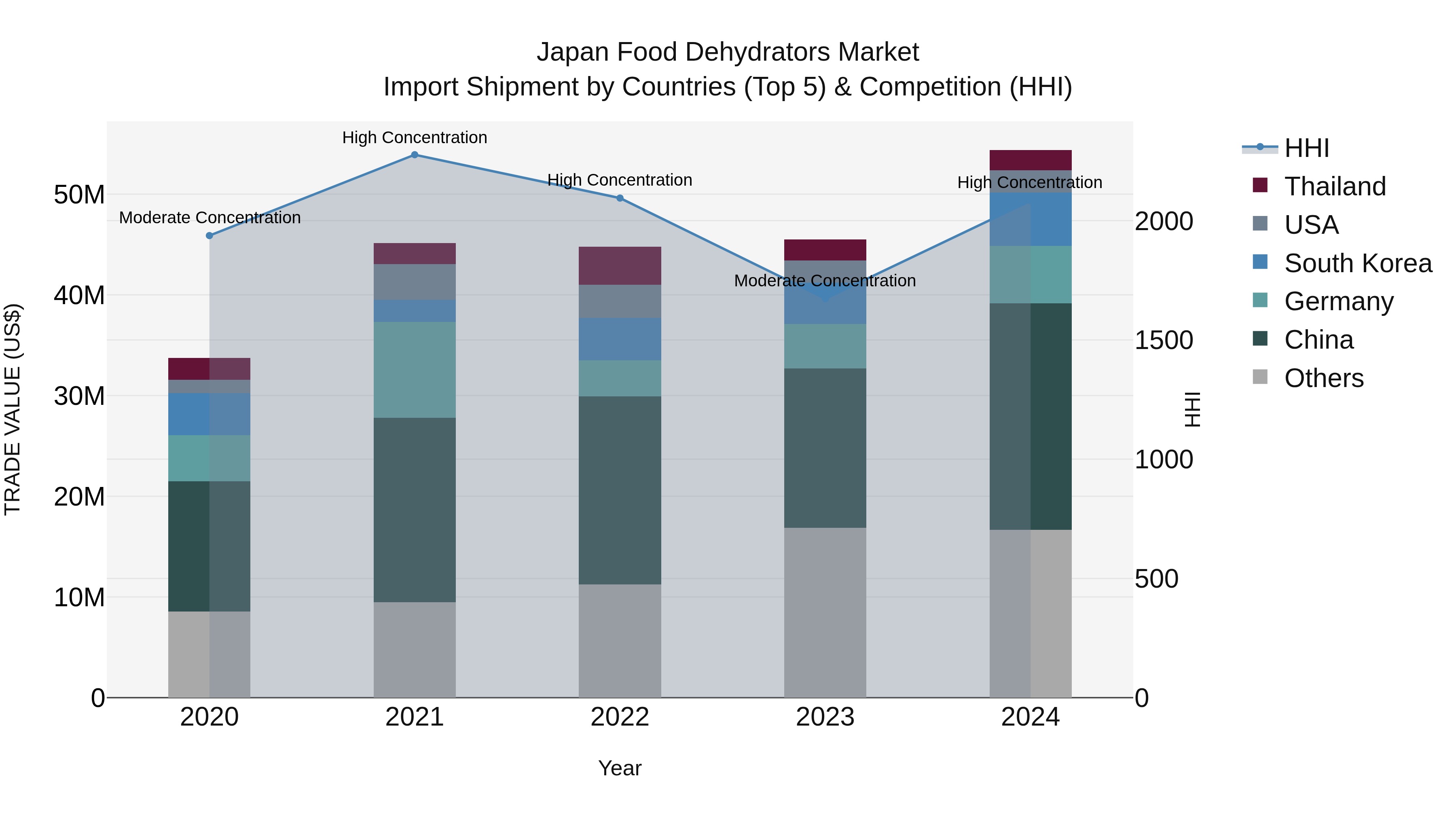
Japan Food Dehydrators Market Import Shipment by Countries (Top 5) & Competition (HHI)
The Japan food dehydrator import market experienced a significant increase in concentration levels in 2024, with the top exporting countries being China, Germany, South Korea, Italy, and Poland. The industry demonstrated strong growth with a CAGR of 12.68% from 2020 to 2024, and a notable growth rate of 19.44% from 2023 to 2024. This suggests a growing demand for food dehydrators in Japan, with key players likely focusing on innovation and market expansion strategies to capitalize on this trend.
Japan Food Dehydrators Market Overview
The Japan Food Dehydrators Market is experiencing steady growth driven by the rising demand for healthy and convenient food preservation solutions. Consumers are increasingly adopting food dehydrators to extend the shelf life of fruits, vegetables, and meats while preserving their nutritional value. The market is characterized by the presence of both domestic manufacturers and international players offering a wide range of dehydrator products catering to different consumer needs. Key trends in the market include the development of advanced dehydrator technologies, compact and user-friendly designs, and energy-efficient models. With growing awareness about the benefits of dehydrated foods and a shift towards healthier eating habits, the Japan Food Dehydrators Market is poised for further expansion in the coming years.
Japan Food Dehydrators Market Trends
The Japan Food Dehydrators Market is experiencing a growing demand for compact and energy-efficient dehydrators that cater to the needs of modern, health-conscious consumers. There is a noticeable trend towards dehydrators with advanced features such as adjustable temperature settings, multiple trays for increased capacity, and timer functions for convenience. Additionally, there is a rising interest in dehydrators that are versatile enough to accommodate a variety of foods beyond fruits and vegetables, including meats, herbs, and even homemade snacks. Manufacturers are also focusing on incorporating user-friendly designs and materials that are easy to clean and maintain. Overall, the market is witnessing a shift towards innovative, high-quality food dehydrators that offer efficient and reliable performance to meet the evolving needs of consumers in Japan.
Japan Food Dehydrators Market Challenges
The Japan Food Dehydrators Market faces several challenges, including high competition from traditional drying methods such as sun drying and air drying, which are still widely used in the country. Additionally, there is a lack of awareness among consumers about the benefits of food dehydrators and how they can improve food preservation and reduce food waste. The high initial cost of purchasing a food dehydrator is also a barrier for many consumers, especially in a market where cost-consciousness is prevalent. Furthermore, the limited availability of space in Japanese kitchens poses a challenge for consumers looking to invest in a food dehydrator, as these appliances can be bulky and require additional storage space. Overall, overcoming these challenges will require education, marketing efforts, and potentially product innovations to cater to the unique needs and preferences of the Japanese market.
Japan Food Dehydrators Market Investment Opportunities
The Japan Food Dehydrators Market presents lucrative investment opportunities due to the increasing adoption of healthy eating habits and the growing demand for convenient food preservation methods. Investing in innovative food dehydrator technologies that offer energy efficiency, compact designs, and user-friendly features can be a promising venture. Additionally, catering to the rising trend of home cooking and DIY food processing among Japanese consumers by introducing compact, affordable, and versatile dehydrators can capture a significant market share. Collaborating with local food processing companies or retailers to promote dehydrated food products and educating consumers about the benefits of dehydrated foods can further enhance investment prospects in this market. Overall, tapping into the Japan Food Dehydrators Market with innovative products and strategic partnerships can yield profitable returns for investors.
Japan Food Dehydrators Market Government Policy
The Japanese government has implemented various policies to regulate the food dehydrators market. These policies primarily focus on ensuring food safety and quality standards, promoting energy efficiency in dehydrator manufacturing, and supporting innovation and technological advancements in the industry. The Ministry of Health, Labour and Welfare oversees regulations related to food safety and hygiene standards, while the Ministry of Economy, Trade and Industry promotes energy-efficient practices and supports manufacturers in complying with environmental regulations. Additionally, the government offers subsidies and incentives to encourage research and development activities in the food dehydrator sector, aiming to enhance product quality and competitiveness in both domestic and international markets.
Japan Food Dehydrators Market Future Outlook
The Japan Food Dehydrators Market is poised for steady growth in the coming years due to the increasing consumer preference for healthy and convenient food options. The market is expected to benefit from the rising awareness about the benefits of dehydrated foods, such as extended shelf life, retention of nutrients, and reduced food waste. Additionally, the trend of home cooking and DIY food preservation is fueling the demand for food dehydrators among households. Manufacturers are focusing on introducing innovative features, energy-efficient models, and compact designs to cater to the evolving consumer needs. With a growing emphasis on sustainability and health-conscious living, the Japan Food Dehydrators Market is projected to expand further as more consumers seek to adopt a healthier lifestyle through food dehydration.
Key Highlights of the Report:
- Japan Food Dehydrators Market Outlook
- Market Size of Japan Food Dehydrators Market, 2024
- Forecast of Japan Food Dehydrators Market, 2031
- Historical Data and Forecast of Japan Food Dehydrators Revenues & Volume for the Period 2021 - 2031
- Japan Food Dehydrators Market Trend Evolution
- Japan Food Dehydrators Market Drivers and Challenges
- Japan Food Dehydrators Price Trends
- Japan Food Dehydrators Porter's Five Forces
- Japan Food Dehydrators Industry Life Cycle
- Historical Data and Forecast of Japan Food Dehydrators Market Revenues & Volume By Technology for the Period 2021 - 2031
- Historical Data and Forecast of Japan Food Dehydrators Market Revenues & Volume By Vertical Flow for the Period 2021 - 2031
- Historical Data and Forecast of Japan Food Dehydrators Market Revenues & Volume By Horizontal Flow for the Period 2021 - 2031
- Historical Data and Forecast of Japan Food Dehydrators Market Revenues & Volume By End-Use for the Period 2021 - 2031
- Historical Data and Forecast of Japan Food Dehydrators Market Revenues & Volume By Industrial for the Period 2021 - 2031
- Historical Data and Forecast of Japan Food Dehydrators Market Revenues & Volume By Commercial for the Period 2021 - 2031
- Historical Data and Forecast of Japan Food Dehydrators Market Revenues & Volume By Residential for the Period 2021 - 2031
- Historical Data and Forecast of Japan Food Dehydrators Market Revenues & Volume By Others for the Period 2021 - 2031
- Historical Data and Forecast of Japan Food Dehydrators Market Revenues & Volume By Energy Source for the Period 2021 - 2031
- Historical Data and Forecast of Japan Food Dehydrators Market Revenues & Volume By Electricity for the Period 2021 - 2031
- Historical Data and Forecast of Japan Food Dehydrators Market Revenues & Volume By Biofuel for the Period 2021 - 2031
- Historical Data and Forecast of Japan Food Dehydrators Market Revenues & Volume By Solar for the Period 2021 - 2031
- Historical Data and Forecast of Japan Food Dehydrators Market Revenues & Volume By Others for the Period 2021 - 2031
- Japan Food Dehydrators Import Export Trade Statistics
- Market Opportunity Assessment By Technology
- Market Opportunity Assessment By End-Use
- Market Opportunity Assessment By Energy Source
- Japan Food Dehydrators Top Companies Market Share
- Japan Food Dehydrators Competitive Benchmarking By Technical and Operational Parameters
- Japan Food Dehydrators Company Profiles
- Japan Food Dehydrators Key Strategic Recommendations






































