Japan Fruit Sorting Machinery Market Size, Share & Growth Rate
The Japan Fruit Sorting Machinery Market was estimated at USD 156 Million in 2025 and is projected to reach USD 167 Million by 2032, growing at a CAGR of 1.0% from 2026 to 2032. This growth trajectory is being fueled by increasing adoption of automated sorting solutions as farmers and producers seek to enhance efficiency and product quality. The trend towards advanced technologies like AI and machine learning also plays a pivotal role in the market's expansion, driving innovations that cater specifically to the unique requirements of the Japanese fruit industry.
Japan Fruit Sorting Machinery Market Year-wise Growth Rate and Key Drivers
This graph highlights how the Japan Fruit Sorting Machinery Market has steadily grown over the years, supported by major growth factors.
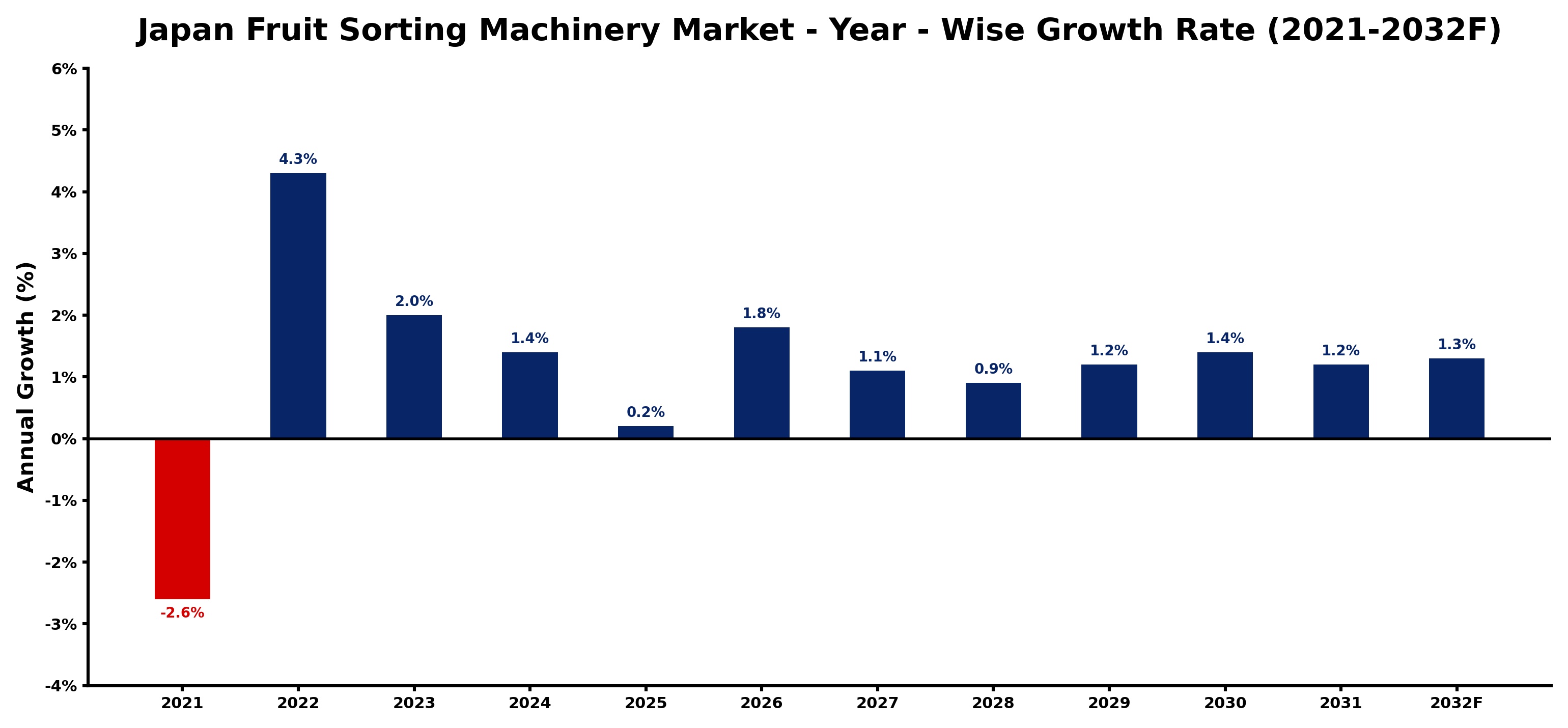
The table below presents the year‑wise growth rates along with the key drivers influencing the market
| Year | Growth Rate | Major Drivers |
| 2021 | -2.6% | Increasing industrial infrastructure investments |
| 2022 | 4.3% | Increasing industrial infrastructure investments |
| 2023 | 2.0% | Increasing smart city development projects |
| 2024 | 1.4% | Increasing industrial automation investments |
| 2025 | 0.2% | Increasing adoption of advanced technologies |
| 2026 | 1.8% | Rising electricity demand across industries |
| 2027 | 1.1% | Government infrastructure modernization initiatives |
| 2028 | 0.9% | Growing urbanization and commercial development |
| 2029 | 1.2% | Expansion of manufacturing activities |
| 2030 | 1.4% | Growing renewable energy integration projects |
| 2031 | 1.2% | Increasing industrial automation investments |
| 2032 | 1.3% | Government infrastructure modernization initiatives |
Note - Market size estimations and growth projections presented in this report are based on 6Wresearch’s advanced forecasting approach, validated with industry datasets as of June 2026.
Japan Fruit Sorting Machinery Market Synopsis
The most significant force shaping the Japan Fruit Sorting Machinery Market today is the demand for efficiency and accuracy in fruit processing. As consumers become more discerning, producers are under pressure to ensure consistent quality, which necessitates advanced sorting machinery capable of meeting rigorous standards.
Additionally, the integration of sustainable practices is increasingly influencing this market. The rising awareness of environmental concerns is prompting manufacturers to innovate sorting solutions that not only improve efficiency but also reduce waste and resource consumption, thus aligning with the broader goals of sustainability in agriculture.
Japan Fruit Sorting Machinery Market Key Takeaways
- The market is projected to grow steadily, reflecting a shift toward automation in fruit sorting processes.
- Emerging technologies like AI and machine learning are enhancing sorting accuracy and operational efficiency.
- Consumer demand for high-quality produce is driving investments in advanced sorting machinery.
- Sustainability practices are influencing the design and functionality of sorting equipment.
- Strategic partnerships with local producers can enhance market penetration for manufacturers.
Evaluation of Restraints in Japan Fruit Sorting Machinery Market
Several restraints are impeding growth in the Japan Fruit Sorting Machinery Market. One primary challenge is the significant initial investment needed for modern sorting technology, which can deter smaller producers. Furthermore, the rapid pace of technological advancement necessitates continuous updates, creating pressure on manufacturers to innovate consistently. Compounding these issues is the shortage of skilled personnel capable of operating and maintaining advanced sorting machinery, resulting in increased training costs. Finally, compliance with stringent regulations regarding food safety and quality can increase operational burdens for businesses in this sector, making it essential for companies to navigate these constraints adeptly.
Japan Fruit Sorting Machinery Market Trends
Current trends in the Japan Fruit Sorting Machinery Market indicate a pronounced shift toward the incorporation of robotics and automation technologies. These advancements streamline the sorting process and significantly cut labor costs, appealing to producers aiming for greater efficiency. Additionally, the rising adoption of eco-friendly machinery reflects a growing emphasis on sustainability within agricultural practices. As data analytics and remote monitoring capabilities become increasingly integrated into sorting solutions, manufacturers can optimize performance and enhance their competitive edge.
Japan Fruit Sorting Machinery Market Opportunities
The Japan Fruit Sorting Machinery Market presents numerous investment opportunities, particularly for companies focusing on innovative sorting technologies. With an ever-increasing need for efficient sorting solutions, investors can capitalize on the development of machinery that employs AI, machine learning, and computer vision tailored to the Japanese fruit sector's specific demands. Forming strategic alliances with local producers and distributors can also facilitate smoother market entry and expand operational reach in this dynamic landscape.
Government Initiatives in the Japan Fruit Sorting Machinery Market
Government policies significantly impact the Japan Fruit Sorting Machinery Market, as there are various initiatives aimed at enhancing agricultural efficiency and competitiveness. The Japanese government supports the adoption of advanced technologies in fruit sorting through subsidies for purchasing modern equipment, and regulatory frameworks designed to uphold stringent food safety standards. Furthermore, investments in research and development foster innovation, while initiatives promoting sustainable agricultural practices encourage the transition toward eco-friendly machinery solutions.
Future Insights of the Japan Fruit Sorting Machinery Market
Looking ahead to 2026-2032, the Japan Fruit Sorting Machinery Market is poised for ongoing expansion driven by technological advancements and a persistent demand for improved sorting efficiency. As producers strive for higher quality and compliance with international standards, the adoption of automated sorting machinery is expected to rise. The evolving landscape of sustainable agriculture, combined with consumer expectations for consistent product quality, will further propel market dynamics and fuel continued investment in innovative sorting solutions.
Japan Fruit Sorting Machinery Market Latest Developments (May 2025 - June 2026)
Recent developments within the Japan Fruit Sorting Machinery Market reflect a growing trend towards digitization and automation. Manufacturers are launching enhanced sorting machines that integrate advanced technologies, such as AI and predictive analytics, to improve operational efficiency. Additionally, many companies are focusing on developing eco-friendly machinery that aligns with sustainability goals, as consumer preferences increasingly favor environmentally responsible practices. The market is also witnessing heightened collaboration between technology providers and agricultural producers to tailor solutions that meet specific sorting needs.
Japan Fruit Sorting Machinery Market - Key Attractiveness of the Report
- 10 Years of Market Numbers
- Historical Data Starting from 2022 to 2025
- Base Year: 2025
- Forecast Data until 2032
- Key Performance Indicators Impacting the Market
- Major Upcoming Developments and Projects
Key Highlights of the Report:
- Japan Fruit Sorting Machinery Market Outlook
- Market Size of Japan Fruit Sorting Machinery Market, 2025
- Forecast of Japan Fruit Sorting Machinery Market, 2032
- Historical Data and Forecast of Japan Fruit Sorting Machinery Revenues & Volume for the Period 2022-2032F
- Japan Fruit Sorting Machinery Market Trend Evolution
- Japan Fruit Sorting Machinery Market Drivers and Challenges
- Japan Fruit Sorting Machinery Price Trends
- Japan Fruit Sorting Machinery Porter's Five Forces
- Japan Fruit Sorting Machinery Industry Life Cycle
- Historical Data and Forecast of Japan Fruit Sorting Machinery Market Revenues & Volume By Product for the Period 2022-2032F
- Historical Data and Forecast of Japan Fruit Sorting Machinery Market Revenues & Volume By Automated fruit sorting machinery for the Period 2022-2032F
- Historical Data and Forecast of Japan Fruit Sorting Machinery Market Revenues & Volume By Mechanical fruit sorting machinery for the Period 2022-2032F
- Historical Data and Forecast of Japan Fruit Sorting Machinery Market Revenues & Volume By Application for the Period 2022-2032F
- Historical Data and Forecast of Japan Fruit Sorting Machinery Market Revenues & Volume By Orchard for the Period 2022-2032F
- Historical Data and Forecast of Japan Fruit Sorting Machinery Market Revenues & Volume By Mall for the Period 2022-2032F
- Historical Data and Forecast of Japan Fruit Sorting Machinery Market Revenues & Volume By Other for the Period 2022-2032F
- Japan Fruit Sorting Machinery Import Export Trade Statistics
- Market Opportunity Assessment By Product
- Market Opportunity Assessment By Application
- Japan Fruit Sorting Machinery Top Companies Market Share
- Japan Fruit Sorting Machinery Competitive Benchmarking By Technical and Operational Parameters
- Japan Fruit Sorting Machinery Company Profiles
- Japan Fruit Sorting Machinery Key Strategic Recommendations






































