Japan Gas Chromatography Systems Market Size, Share & Growth Rate
The Japan Gas Chromatography Systems Market was estimated at USD 219 Million in 2025 and is projected to reach USD 234 Million by 2032, growing at a CAGR of 1.0% from 2026 to 2032. This gradual growth trajectory is largely fueled by a combination of stringent regulatory frameworks and increasing demand across vital sectors such as pharmaceuticals and environmental testing. As businesses seek more precise and efficient analytical techniques, the market is also expected to benefit from technological advancements that enhance the capabilities of gas chromatography systems.
Japan Gas Chromatography Systems Market Year-wise Growth Rate and Key Drivers
This graph highlights how the Japan Gas Chromatography Systems Market has steadily grown over the years, supported by major growth factors.
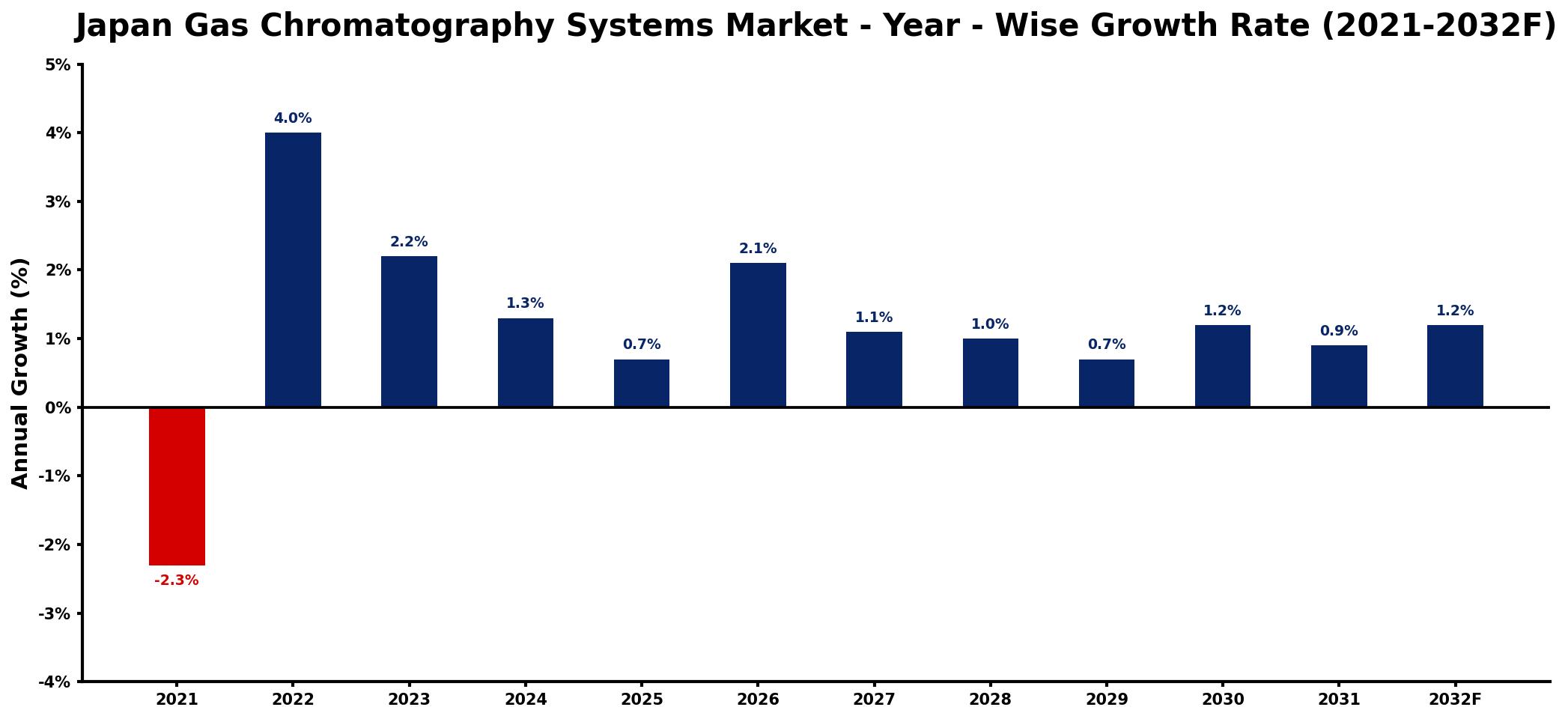
The table below presents the year‑wise growth rates along with the key drivers influencing the market
| Year | Growth Rate | Major Drivers |
| 2021 | -2.3% | decreased industrial research funding |
| 2022 | 4.0% | growing environmental regulations compliance |
| 2023 | 2.2% | increased pharmaceutical development activities |
| 2024 | 1.3% | expansion in food safety testing |
| 2025 | 0.7% | rising demand for petrochemical analysis |
| 2026 | 2.1% | enhanced focus on quality control |
| 2027 | 1.1% | growing academic research initiatives |
| 2028 | 1.0% | demand for environmental monitoring |
| 2029 | 0.7% | increased investments in healthcare research |
| 2030 | 1.2% | expansion of biotechnology applications |
| 2031 | 0.9% | rising interest in analytical methods |
| 2032 | 1.2% | growing need for regulatory compliance |
Note: Market size estimations and growth projections presented in this report are based on 6Wresearch's proprietary forecasting methodology, utilizing the latest available industry data, government publications, and primary research inputs.
Japan Gas Chromatography Systems Market Synopsis
The strongest force currently shaping the Japan Gas Chromatography Systems Market is the demand for advanced analytical solutions in highly regulated industries. This is particularly prominent in pharmaceuticals, where compliance with rigorous quality control standards necessitates the use of reliable and accurate testing methodologies.
In addition to regulatory pressures, technological innovation is a key driver of growth within the market. Companies are increasingly focusing on the development of gas chromatography systems that feature enhanced sensitivity, quicker analysis times, and seamless integration with other analytical technologies, setting the stage for continued market expansion.
Japan Gas Chromatography Systems Market Key Takeaways
- Robust demand in pharmaceuticals and environmental testing is significantly propelling market growth.
- Technological advancements are leading to improved performance and efficiency in gas chromatography systems.
- Automated and portable systems are becoming increasingly popular, catering to the need for rapid on-site analysis.
- Stringent government regulations are driving the need for reliable analytical instruments.
- Companies must prioritize innovation and compliance to sustain competitive advantage.
Evaluation of Restraints in Japan Gas Chromatography Systems Market
While the Japan Gas Chromatography Systems Market exhibits promising growth potential, it faces several restraints that could hinder progress. Chief among these is the intense competition among existing market players, which can lead to pricing pressures and reduced profit margins. Additionally, the rapid pace of technological advancement necessitates ongoing investment in innovation, challenging companies to stay relevant. Compliance with stringent regulations can also be resource-intensive, further complicating operational capabilities. Moreover, fluctuations in raw material prices and the impacts of recent global events, including the COVID-19 pandemic, have disrupted supply chains and created economic uncertainties that may pose risks to market growth.
Japan Gas Chromatography Systems Market Trends
Current trends within the Japan Gas Chromatography Systems Market indicate a notable shift towards more sophisticated analytical technologies. The adoption of mass spectrometry detectors is on the rise, providing enhanced sensitivity and specificity for complex sample analysis. Additionally, there is a growing demand for portable and miniaturized gas chromatography systems, reflecting the need for efficient on-site testing solutions, especially in environmental monitoring and food safety sectors. Furthermore, increasing emphasis on workflow automation and integration of software solutions aims to improve laboratory efficiency and streamline data processing, signaling a broader transition towards user-friendly, innovative systems.
Japan Gas Chromatography Systems Market Opportunities
The Japan Gas Chromatography Systems Market presents substantial investment opportunities, particularly as various industries seek cutting-edge solutions to meet evolving demands. Advanced gas chromatography systems with features such as enhanced automation, high sensitivity, and rapid analysis capabilities are becoming increasingly sought after. Additionally, the imperative for compliance with stringent quality and safety regulations further amplifies the need for reliable analytical instruments. The development of portable systems and integrated software solutions tailored to specific industry applications offers significant potential for companies looking to capture market share. Furthermore, strategic partnerships and collaborations with local distributors can facilitate market penetration and enhance product offerings.
Government Initiatives in the Japan Gas Chromatography Systems Market
Government policies play a crucial role in shaping the Japan Gas Chromatography Systems Market. Regulatory frameworks such as the Chemical Substances Control Law ensure the safe production and use of chemical substances in gas chromatography systems, safeguarding public health and the environment. The Pharmaceutical Affairs Law and the Industrial Safety and Health Law set essential standards that govern product quality and workplace safety in drug development and industrial applications. Companies must navigate these policies diligently to maintain compliance and secure market access, reinforcing the need for high-quality analytical instruments.
Future Insights of the Japan Gas Chromatography Systems Market
Looking ahead to the period from 2026 to 2032, the Japan Gas Chromatography Systems Market is poised for steady growth. The increasing demand for gas chromatography systems in pharmaceuticals, environmental testing, food and beverage industries, and petrochemicals will continue to drive market expansion. The continuous evolution of technology, alongside heightened research and development activities and the enforcement of stringent regulations concerning safety and quality control, will further support this trajectory. As industries increasingly prioritize healthcare and environmental sustainability, the adoption of gas chromatography systems is expected to rise, creating a wealth of opportunities for both manufacturers and suppliers.
Japan Gas Chromatography Systems Market Latest Developments (2025 - 2026)
In recent months, the Japan Gas Chromatography Systems Market has seen various developments aimed at enhancing system capabilities and efficiency. Innovations are focused on integrating artificial intelligence with gas chromatography systems to streamline analytical processes. Furthermore, there has been an uptick in collaborative efforts among industry players and research institutions to drive advancements in automation and data analysis software, addressing the growing demand for user-friendly solutions. Additionally, discussions around sustainability initiatives are prompting manufacturers to explore eco-friendly materials and processes in system production.
Japan Gas Chromatography Systems Market - Key Attractiveness of the Report
- 10 Years of Market Numbers
- Historical Data Starting from 2022 to 2025
- Base Year: 2025
- Forecast Data until 2032
- Key Performance Indicators Impacting the Market
- Major Upcoming Developments and Projects
Key Highlights of the Report:
- Japan Gas Chromatography Systems Market Outlook
- Market Size of Japan Gas Chromatography Systems Market, 2025
- Forecast of Japan Gas Chromatography Systems Market, 2032
- Historical Data and Forecast of Japan Gas Chromatography Systems Revenues & Volume for the Period 2022-2032F
- Japan Gas Chromatography Systems Market Trend Evolution
- Japan Gas Chromatography Systems Market Drivers and Challenges
- Japan Gas Chromatography Systems Price Trends
- Japan Gas Chromatography Systems Porter's Five Forces
- Japan Gas Chromatography Systems Industry Life Cycle
- Historical Data and Forecast of Japan Gas Chromatography Systems Market Revenues & Volume By Product for the Period 2022-2032F
- Historical Data and Forecast of Japan Gas Chromatography Systems Market Revenues & Volume By Systems for the Period 2022-2032F
- Historical Data and Forecast of Japan Gas Chromatography Systems Market Revenues & Volume By Detectors for the Period 2022-2032F
- Historical Data and Forecast of Japan Gas Chromatography Systems Market Revenues & Volume By Auto-samplers for the Period 2022-2032F
- Historical Data and Forecast of Japan Gas Chromatography Systems Market Revenues & Volume By Fraction Collectors for the Period 2022-2032F
- Historical Data and Forecast of Japan Gas Chromatography Systems Market Revenues & Volume By Other Products for the Period 2022-2032F
- Historical Data and Forecast of Japan Gas Chromatography Systems Market Revenues & Volume By End User for the Period 2022-2032F
- Historical Data and Forecast of Japan Gas Chromatography Systems Market Revenues & Volume By Pharmaceutical and Bioindustries for the Period 2022-2032F
- Historical Data and Forecast of Japan Gas Chromatography Systems Market Revenues & Volume By Academic Research Institutes for the Period 2022-2032F
- Historical Data and Forecast of Japan Gas Chromatography Systems Market Revenues & Volume By Other End Users for the Period 2022-2032F
- Japan Gas Chromatography Systems Import Export Trade Statistics
- Market Opportunity Assessment By Product
- Market Opportunity Assessment By End User
- Japan Gas Chromatography Systems Top Companies Market Share
- Japan Gas Chromatography Systems Competitive Benchmarking By Technical and Operational Parameters
- Japan Gas Chromatography Systems Company Profiles
- Japan Gas Chromatography Systems Key Strategic Recommendations






































