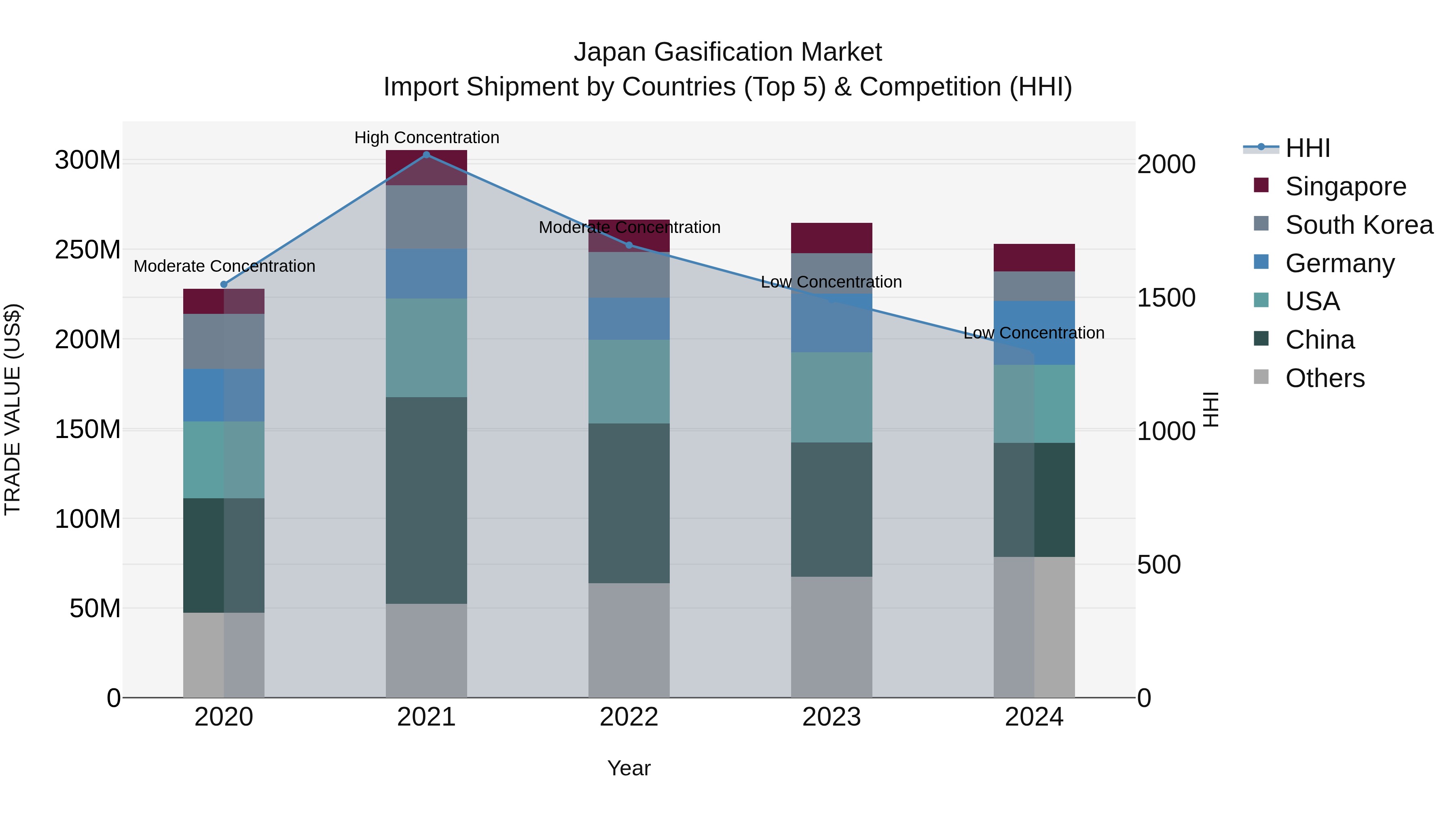
Japan Gasification Market Import Shipment by Countries (Top 5) & Competition (HHI)
Japan's gasification import shipments in 2024 saw top exporters including China, USA, Germany, South Korea, and Singapore. Despite the diversity of sources, the Herfindahl-Hirschman Index (HHI) indicated low market concentration. The compound annual growth rate (CAGR) for gasification imports from 2020 to 2024 was moderate at 2.64%. However, there was a slight decline in growth rate from 2023 to 2024, with a decrease of -4.42%. This data suggests a stable but slightly decelerating trend in Japan's gasification import market.
Japan Gasification Market Overview
The Japan gasification market is experiencing steady growth driven by increasing adoption of cleaner energy solutions and government initiatives to reduce carbon emissions. Gasification technologies are being increasingly used in Japan to convert various feedstocks such as coal, biomass, and municipal solid waste into syngas for power generation and chemical production. The country`s focus on energy security and sustainability is driving investments in gasification projects, particularly in the power generation and industrial sectors. Key players in the Japan gasification market include Mitsubishi Heavy Industries, Air Water, and JFE Engineering Corporation. With growing awareness about the benefits of gasification in reducing environmental impact and diversifying energy sources, the market is expected to witness further expansion in the coming years.
Japan Gasification Market Trends
The Japan gasification market is experiencing a shift towards cleaner and more efficient technologies driven by increasing environmental concerns and government regulations. There is a growing focus on utilizing gasification for waste-to-energy applications to reduce landfill waste and lower greenhouse gas emissions. Additionally, there is a rising interest in using gasification for the production of hydrogen as part of Japan`s efforts to transition to a hydrogen-based economy. Companies in the market are investing in research and development to improve gasification technologies, enhance process efficiency, and reduce operating costs. Overall, the Japan gasification market is witnessing a trend towards sustainable and innovative solutions to meet the country`s energy and environmental challenges.
Japan Gasification Market Challenges
In the Japan gasification market, some key challenges include regulatory hurdles, high upfront costs, and limited feedstock availability. The regulatory environment in Japan can be complex and stringent, requiring companies to navigate various permits and approvals for gasification projects. Additionally, the initial investment required for setting up gasification facilities is significant, which can deter potential investors. Moreover, there is a limited supply of suitable feedstock for gasification processes in Japan, leading to competition for resources and potential supply chain disruptions. Addressing these challenges will require strategic partnerships, technological innovations, and policy support to drive the growth of the gasification market in Japan.
Japan Gasification Market Investment Opportunities
The Japan gasification market presents promising investment opportunities due to the country`s increasing focus on reducing carbon emissions and shifting towards cleaner energy sources. Gasification technology, which converts various feedstocks into valuable products such as synthetic natural gas, hydrogen, and chemicals, is seen as a sustainable solution to meet Japan`s energy needs while minimizing environmental impact. With government initiatives promoting the development of gasification projects and the potential for partnerships with established energy companies, investors can capitalize on the growing demand for cleaner energy solutions in Japan. Investing in gasification projects in sectors such as power generation, waste management, and industrial applications could yield attractive returns while supporting Japan`s transition to a more sustainable energy landscape.
Japan Gasification Market Government Policy
The Japanese government has been actively promoting gasification technologies as part of its energy diversification and environmental sustainability efforts. Policies such as the Strategic Energy Plan and the Basic Energy Plan outline the promotion of gasification technologies to increase energy security, reduce greenhouse gas emissions, and enhance resource efficiency. Incentives such as subsidies and tax breaks are provided to companies investing in gasification projects, while regulations are in place to ensure the safe and efficient operation of gasification facilities. The government`s strong support for gasification technologies is driving innovation and investment in the sector, with a focus on utilizing a variety of feedstocks including biomass, coal, and municipal solid waste to produce cleaner energy sources like syngas and hydrogen.
Japan Gasification Market Future Outlook
The future outlook for the Japan gasification market appears promising, driven by the country`s increasing focus on sustainable energy solutions and reducing carbon emissions. With Japan`s commitment to transitioning towards a more environmentally friendly energy mix, gasification technologies are expected to play a crucial role in converting various feedstocks into clean energy sources like hydrogen and renewable natural gas. The government`s support through policies and incentives to promote gasification projects further strengthens the market`s growth potential. Additionally, the growing interest from industries looking to decarbonize their operations and the development of innovative gasification technologies are likely to fuel market expansion in the coming years, positioning Japan as a key player in the global gasification industry.
Key Highlights of the Report:
- Japan Gasification Market Outlook
- Market Size of Japan Gasification Market,2024
- Forecast of Japan Gasification Market, 2031
- Historical Data and Forecast of Japan Gasification Revenues & Volume for the Period 2021-2031
- Japan Gasification Market Trend Evolution
- Japan Gasification Market Drivers and Challenges
- Japan Gasification Price Trends
- Japan Gasification Porter's Five Forces
- Japan Gasification Industry Life Cycle
- Historical Data and Forecast of Japan Gasification Market Revenues & Volume By Gasifier Medium for the Period 2021-2031
- Historical Data and Forecast of Japan Gasification Market Revenues & Volume By Air for the Period 2021-2031
- Historical Data and Forecast of Japan Gasification Market Revenues & Volume By Oxygen for the Period 2021-2031
- Historical Data and Forecast of Japan Gasification Market Revenues & Volume By Vapor for the Period 2021-2031
- Historical Data and Forecast of Japan Gasification Market Revenues & Volume By Application for the Period 2021-2031
- Historical Data and Forecast of Japan Gasification Market Revenues & Volume By Electricity for the Period 2021-2031
- Historical Data and Forecast of Japan Gasification Market Revenues & Volume By Chemicals for the Period 2021-2031
- Historical Data and Forecast of Japan Gasification Market Revenues & Volume By Fertilizers for the Period 2021-2031
- Historical Data and Forecast of Japan Gasification Market Revenues & Volume By Liquid Fuels for the Period 2021-2031
- Historical Data and Forecast of Japan Gasification Market Revenues & Volume By Synthetic Natural Gas (SNG) for the Period 2021 - 2029
- Historical Data and Forecast of Japan Gasification Market Revenues & Volume By Hydrogen for the Period 2021 - 2029
- Historical Data and Forecast of Japan Gasification Market Revenues & Volume By Type for the Period 2021-2031
- Historical Data and Forecast of Japan Gasification Market Revenues & Volume By Fixed Bed for the Period 2021-2031
- Historical Data and Forecast of Japan Gasification Market Revenues & Volume By Fluidized Bed for the Period 2021-2031
- Historical Data and Forecast of Japan Gasification Market Revenues & Volume By Entrained Flow for the Period 2021-2031
- Historical Data and Forecast of Japan Gasification Market Revenues & Volume By Feedstock for the Period 2021-2031
- Historical Data and Forecast of Japan Gasification Market Revenues & Volume By Biomass for the Period 2021-2031
- Historical Data and Forecast of Japan Gasification Market Revenues & Volume By Waste for the Period 2021-2031
- Historical Data and Forecast of Japan Gasification Market Revenues & Volume By Coal for the Period 2021-2031
- Historical Data and Forecast of Japan Gasification Market Revenues & Volume By Petroleum for the Period 2021-2031
- Historical Data and Forecast of Japan Gasification Market Revenues & Volume By Gas for the Period 2021 - 2029
- Historical Data and Forecast of Japan Gasification Market Revenues & Volume By Petcoke for the Period 2021 - 2029
- Japan Gasification Import Export Trade Statistics
- Market Opportunity Assessment By Gasifier Medium
- Market Opportunity Assessment By Application
- Market Opportunity Assessment By Type
- Market Opportunity Assessment By Feedstock
- Japan Gasification Top Companies Market Share
- Japan Gasification Competitive Benchmarking By Technical and Operational Parameters
- Japan Gasification Company Profiles
- Japan Gasification Key Strategic Recommendations






































