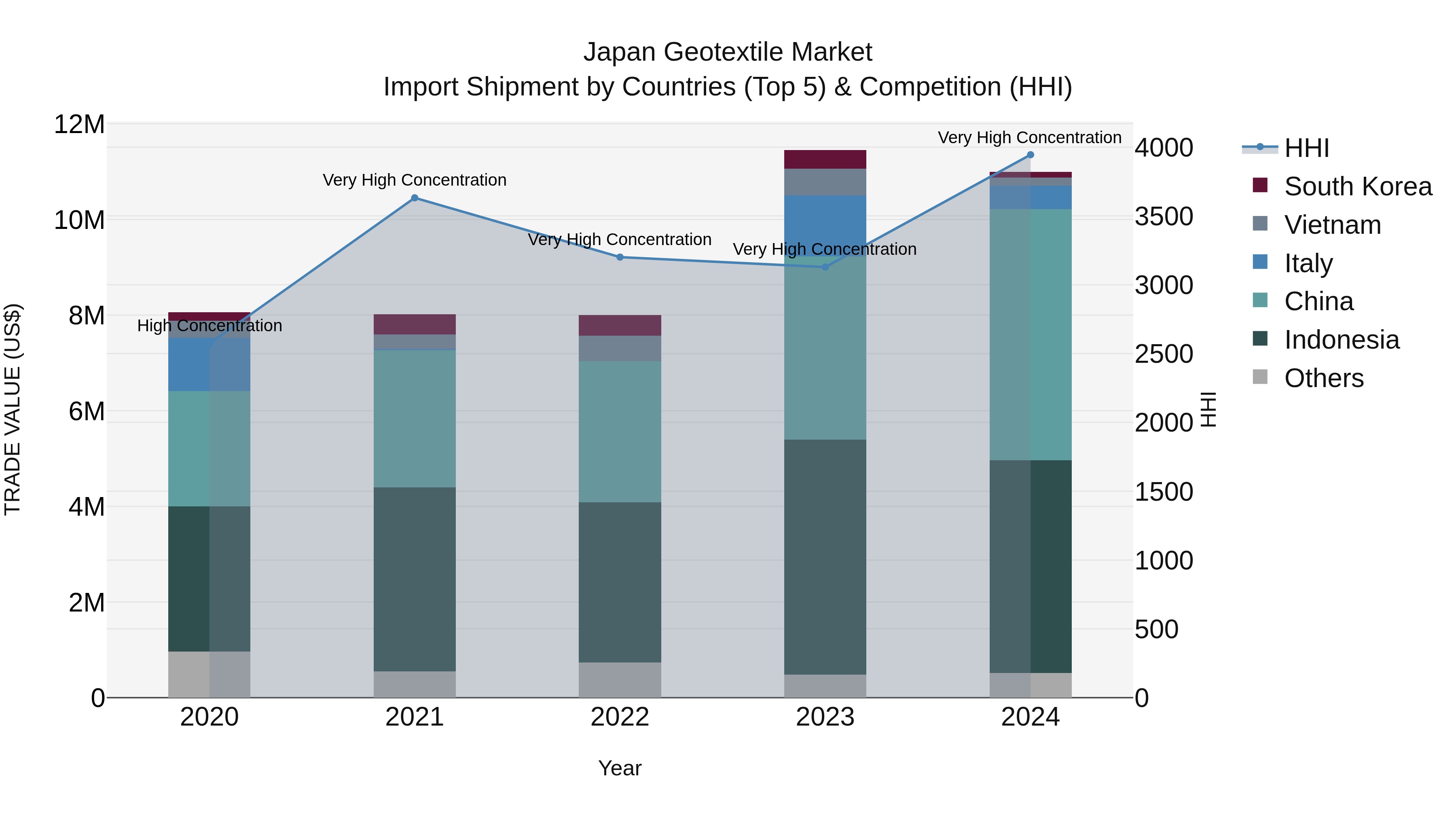
Japan Geotextile Market Import Shipment by Countries (Top 5) & Competition (HHI)
In 2024, Japan continued to heavily rely on imports of geotextiles, with China, Indonesia, Italy, Vietnam, and Germany being the top exporting countries. Despite the high Herfindahl-Hirschman Index (HHI) indicating market concentration, the industry saw a steady compound annual growth rate of 8.09% from 2020 to 2024. However, there was a slight decline in the growth rate from 2023 to 2024 at -3.95%, suggesting potential challenges or shifts in the market landscape. It will be crucial for market players to monitor these trends closely for strategic decision-making.
Japan Geotextile Market Synopsis
The Japan Geotextile Market is experiencing steady growth attributed to increasing infrastructure development projects and a growing focus on environmental sustainability. Geotextiles are being widely used in various applications such as road construction, drainage systems, erosion control, and landfill engineering. The market is characterized by a competitive landscape with key players including Toyobo Co., Ltd., Asahi Kasei Corporation, and Mitsui Chemicals, Inc. Government initiatives promoting the use of geotextiles in construction projects to enhance durability and reduce environmental impact are further driving market growth. The demand for high-quality geotextiles that offer superior strength, filtration, and erosion resistance properties is expected to continue to rise, positioning Japan as a key market for geotextile manufacturers and suppliers.
Japan Geotextile Market Trends
The Japan Geotextile Market is experiencing significant growth driven by the increasing demand for infrastructure development, environmental protection, and coastal protection projects. One key trend in the market is the rising adoption of sustainable and eco-friendly geotextile solutions to address environmental concerns. Another opportunity lies in the growing focus on soil erosion control and land reclamation efforts, particularly in areas prone to natural disasters such as earthquakes and tsunamis. Additionally, the construction industry`s shift towards innovative construction materials and techniques is creating a demand for high-performance geotextiles with enhanced durability and strength properties. Overall, the Japan Geotextile Market is poised for continued expansion as stakeholders prioritize sustainable development practices and invest in infrastructure resilience measures.
Japan Geotextile Market Challenges
The Japan geotextile market faces several challenges, including price volatility of raw materials, high production costs, and limited awareness among end-users about the benefits of geotextiles. Additionally, the market is highly competitive with a large number of domestic and international players vying for market share. Regulatory hurdles and strict standards for geotextile products also pose challenges for manufacturers looking to enter or expand in the market. Furthermore, the relatively slow adoption of advanced geotextile technologies and sustainable practices in construction projects hinders market growth. Overcoming these challenges will require industry players to focus on innovation, cost-effective production methods, and effective marketing strategies to educate customers about the advantages of using geotextiles in various applications.
Japan Geotextile Market Investment Opportunities
The Japan Geotextile Market is primarily driven by the growing infrastructure development projects in the country, including road construction, erosion control, and environmental protection initiatives. The increasing focus on sustainable and eco-friendly construction practices is also fueling the demand for geotextiles, as they offer solutions for soil stabilization and reinforcement. Additionally, the rising awareness about the benefits of geotextiles in improving the longevity and performance of civil engineering projects is prompting more adoption in the construction industry. Government regulations promoting the use of geotextiles for various applications further contribute to market growth. Overall, the Japan Geotextile Market is driven by the need for efficient and cost-effective solutions for addressing challenges in infrastructure development and environmental sustainability.
Japan Geotextile Market Government Policie
The government policies related to the Japan Geotextile Market are primarily focused on promoting the use of geotextiles in infrastructure development projects to improve sustainability and resilience. The Japanese government has implemented regulations and standards to ensure the quality and performance of geotextile products, encouraging their adoption in various construction applications such as roadways, railways, and land reclamation projects. Additionally, there are initiatives to support research and development in geotextile materials and technologies to enhance their effectiveness and environmental benefits. The government also provides subsidies and incentives to promote the use of geotextiles, aiming to drive growth in the market while addressing key challenges such as soil erosion, drainage, and slope stabilization.
Japan Geotextile Market Future Outlook
The Japan geotextile market is poised for steady growth in the coming years due to increasing infrastructure development projects, the focus on environmental sustainability, and the growing awareness of geotextile benefits in construction and civil engineering applications. Factors such as government initiatives to promote geotextile usage, advancements in material technology, and the rising demand for erosion control and soil stabilization solutions are expected to drive market expansion. Additionally, the growing adoption of geotextiles in road construction, railway projects, and waste management facilities is likely to fuel market growth. With a strong emphasis on quality and durability in construction practices, the Japan geotextile market is forecasted to experience sustained demand and innovation, presenting opportunities for both domestic and international players in the industry.
Key Highlights of the Report:
- Japan Geotextile Market Outlook
- Market Size of Japan Geotextile Market, 2024
- Forecast of Japan Geotextile Market, 2031
- Historical Data and Forecast of Japan Geotextile Revenues & Volume for the Period 2021 - 2031
- Japan Geotextile Market Trend Evolution
- Japan Geotextile Market Drivers and Challenges
- Japan Geotextile Price Trends
- Japan Geotextile Porter's Five Forces
- Japan Geotextile Industry Life Cycle
- Historical Data and Forecast of Japan Geotextile Market Revenues & Volume By Material Type for the Period 2021 - 2031
- Historical Data and Forecast of Japan Geotextile Market Revenues & Volume By Synthetic for the Period 2021 - 2031
- Historical Data and Forecast of Japan Geotextile Market Revenues & Volume By Natural for the Period 2021 - 2031
- Historical Data and Forecast of Japan Geotextile Market Revenues & Volume By Product Type for the Period 2021 - 2031
- Historical Data and Forecast of Japan Geotextile Market Revenues & Volume By Nonwoven for the Period 2021 - 2031
- Historical Data and Forecast of Japan Geotextile Market Revenues & Volume By Woven for the Period 2021 - 2031
- Historical Data and Forecast of Japan Geotextile Market Revenues & Volume By Knitted for the Period 2021 - 2031
- Historical Data and Forecast of Japan Geotextile Market Revenues & Volume By Application for the Period 2021 - 2031
- Historical Data and Forecast of Japan Geotextile Market Revenues & Volume By Road Construction for the Period 2021 - 2031
- Historical Data and Forecast of Japan Geotextile Market Revenues & Volume By Pavement Repair for the Period 2021 - 2031
- Historical Data and Forecast of Japan Geotextile Market Revenues & Volume By Erosion for the Period 2021 - 2031
- Historical Data and Forecast of Japan Geotextile Market Revenues & Volume By Drainage for the Period 2021 - 2031
- Historical Data and Forecast of Japan Geotextile Market Revenues & Volume By Railway Work for the Period 2021 - 2031
- Historical Data and Forecast of Japan Geotextile Market Revenues & Volume By Agriculture for the Period 2021 - 2031
- Japan Geotextile Import Export Trade Statistics
- Market Opportunity Assessment By Material Type
- Market Opportunity Assessment By Product Type
- Market Opportunity Assessment By Application
- Japan Geotextile Top Companies Market Share
- Japan Geotextile Competitive Benchmarking By Technical and Operational Parameters
- Japan Geotextile Company Profiles
- Japan Geotextile Key Strategic Recommendations






































