Japan Hand Dryers Market Size & Growth Rate
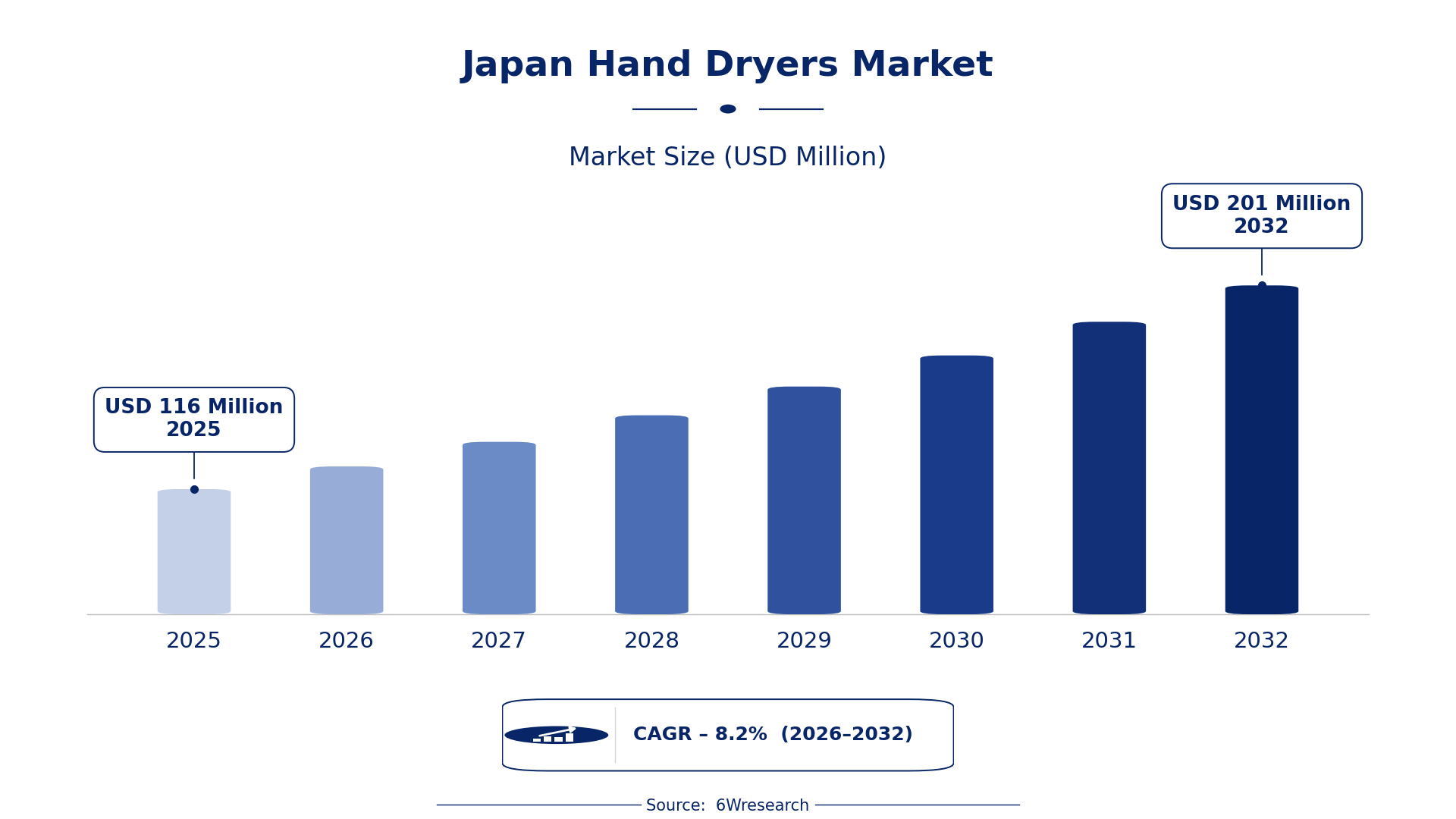
According to 6Wresearch internal database and industry insights, the Japan Hand Dryers Market was valued at USD 116 Million in 2025 and is projected to reach USD 201 Million by 2032, growing at a CAGR of approximately 8.2% during 2026–2032.
Japan Hand Dryers Market Highlights
| Report Metric | Details |
| Report Name | Japan Hand Dryers Market (2026-2032) |
| Market Size 2025 | USD 116 Million |
| Market Size 2032 | USD 201 Million |
| Absolute Growth 2025–2032 | USD 85 Million |
| CAGR 2026–2032 | 8.2% |
| Peak Annual Growth | 9.0% in 2026 |
| Forecast Period | 2026–2032 |
| Historical Data | 2022–2025 |
| Base Year | 2025 |
| Leading Product Type, 2025 | Jet Air (58% share) |
| Leading Operation Mode, 2025 | Manual On-Automatic Off (66% share) |
| Leading Mounting Technique, 2025 | Surface Mounted (62% share) |
| Leading End-users, 2025 | Airports (35% share) |
| Fastest-Growing Product Type | Hot Air (11.0% CAGR) |
| Fastest-Growing Operation Mode | Fully Automatic (10.7% CAGR) |
| Fastest-Growing Mounting Technique | Wall Mounted (10.1% CAGR) |
| Fastest-Growing End-users | Hotel & Restaurants (10.8% CAGR) |
| Growing Sector | Hotel & Restaurants |
| Key End Users | Airports, Hotel & Restaurants, Hospitals, Offices |
Japan Hand Dryers Market Year-wise Growth Rate and Key Drivers (2022–2032)
This graph illustrates the annual growth rates of the market from 2022 to 2032, highlighting a steady upward trajectory and projected market expansion over the forecast period.
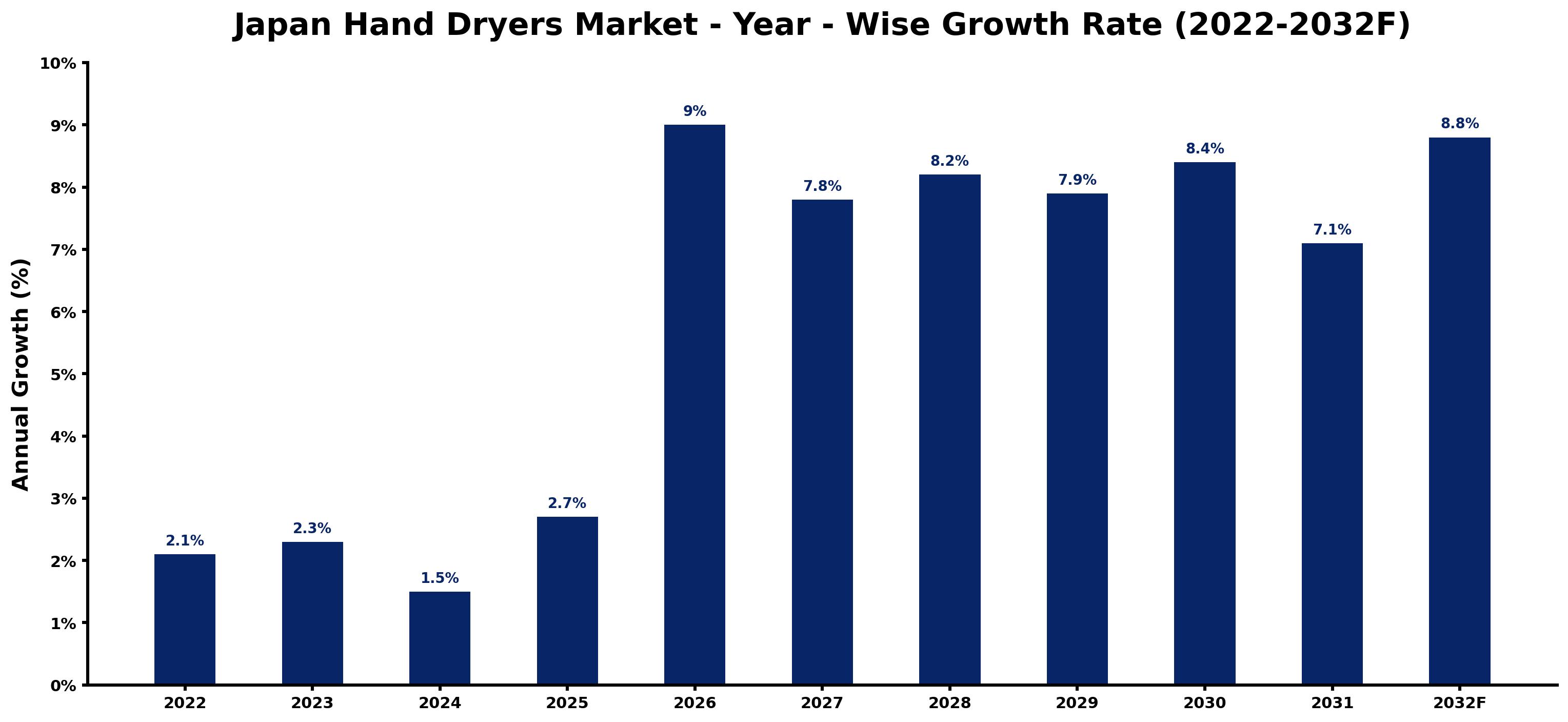
For each year, the table pairs the estimated growth rate with the leading influence on demand, showing how the drivers changed across the period.
| Year | Estimated Annual Growth (%) | Market Rationale |
| 2022 | 2.1 | The market experienced steady growth due to increasing hygiene awareness. |
| 2023 | 2.3 | Growth was faster than the previous year, driven by urbanisation and public health initiatives. |
| 2024 | 1.5 | The market saw slower growth as demand stabilised after previous increases. |
| 2025 | 2.7 | Growth accelerated again, supported by rising installations in public facilities. |
| 2026 | 9.0 | The market is projected to peak due to heightened demand for modern hygiene solutions in facilities. |
| 2027 | 7.8 | Growth is expected to slow as the market begins to normalise after the peak. |
| 2028 | 8.2 | Demand will increase again, driven by technological advancements in hand dryer models. |
| 2029 | 7.9 | Growth is anticipated to slow slightly, reflecting a mature market with established players. |
| 2030 | 8.4 | The market will experience renewed growth as new standards for hygiene are adopted. |
| 2031 | 7.1 | Growth is projected to slow as the market adjusts to established demand patterns. |
| 2032 | 8.8 | The market is expected to grow as fully automatic models gain popularity. |
Note: Market size estimations and growth projections presented in this report are based on 6Wresearch's proprietary forecasting methodology, utilizing the latest available industry data, government publications, and primary research inputs.
Japan Hand Dryers Market Synopsis
Hand dryers are electric devices that dry hands after washing, utilising jet air or hot air technology. In Japan, these products are common in public restrooms, airports, and restaurants, highlighting hygiene and convenience. The Japan Hand Dryers Market is growing, driven by rising demand from domestic users and the installation of advanced models in high-traffic areas. With a focus on hygiene, over 70% of airports have modern hand dryers, reflecting a trend towards touchless solutions in public facilities.
Market Dynamics Impact Analysis (2026–2032)
| Factor | Type | Impact | Primary Segment Affected |
| Increasing hygiene awareness among consumers and businesses | Driver | High | Fully Automatic |
| Technological advancements in hand dryer efficiency | Driver | High | Jet Air |
| Growing urbanisation leading to more public facilities | Opportunity | High | Airports |
| Rising demand for touchless solutions in hygiene-sensitive environments | Opportunity | High | Hospitals |
| High installation costs limiting adoption in smaller facilities | Restraint | Medium | Hot Air |
| Market saturation in urban areas slowing growth | Restraint | Medium | Surface Mounted |
| Competition from alternative drying solutions impacting market share | Challenge | High | Manual On-Automatic Off |
| Technological barriers in adopting advanced models in older facilities | Challenge | Medium | Wall Mounted |
Evaluation of Drivers in Japan Hand Dryers Market (2026–2032)
Demand rests on the following drivers, each shown with the segment it touches most.
| Drivers | Primary Segment Affected | Why It Matters (Evidence) |
| Increased focus on hygiene in public spaces | Airports | This has led to higher installations of hand dryers, with over 70% of airports adopting modern models. |
| Advancements in jet air technology | Jet Air | These innovations improve drying efficiency, prompting more purchases from facilities prioritising quick service. |
| Rising foot traffic in urban areas | Shopping Malls | This drives demand for hand dryers, with over 1,000 malls in Japan increasing the need for efficient hand drying solutions. |
| Growing preference for touchless technology | Fully Automatic | This trend is particularly strong in hospitals, where infection control is critical, leading to increased purchases. |
| Government initiatives promoting hygiene standards | Jet Air | The Tokyo Metropolitan Government's programme promotes restroom facilities, boosting hand dryer installations. |
Most of the extra volume comes from a heightened focus on hygiene in public spaces, resulting in increased installations in facilities with high foot traffic. The rising demand for efficient hand drying solutions is evident in urban areas, particularly in shopping malls, which have surpassed 1,000 in number. Technological advancements in jet air technology have led to improved drying efficiency, prompting facilities to invest in these models. The growing preference for touchless technology is particularly strong in healthcare settings, where infection control is paramount, resulting in increased purchases of fully automatic models.
Evaluation of Restraints in Japan Hand Dryers Market
The following restraints limit how fast demand can grow.
| Market Restraint | Primary Segment Affected | Why It Matters (Evidence) |
| Supply chain disruptions affecting component availability | Jet Air | Reliance on imported components can delay production timelines by up to three months for hand dryer manufacturing. |
| Skills shortages in technical maintenance | Fully Automatic | This creates challenges for buyers, as the average repair time can extend to two weeks, impacting operational efficiency. |
| High installation costs in urban areas | Shopping Malls | Increased installation costs, averaging 30,000 JPY, can deter upgrades to modern units. |
| Lagging technology adoption in public facilities | Hot Air | This leads to outdated models that do not meet current hygiene standards, risking compliance with health regulations. |
| Limited awareness of advanced models | Others | Many facilities continue to use older models, missing out on efficiency and hygiene improvements. |
Japan Hand Dryers Market Challenges
Producers encounter supply chain disruptions due to reliance on imported components, causing production delays of up to three months. Skills shortages in technical maintenance result in repair times extending to two weeks, affecting operational efficiency for clinics using older models. Buyers in urban areas face installation costs averaging 30,000 JPY, which may impede the transition to modern hand dryers. Technology adoption is slow in public facilities, leading to increased maintenance costs for hospitals that must frequently replace outdated units due to non-compliance with health regulations.
Trends in the Japan Hand Dryers Market
The trends below show where the Japan Hand Dryers Market is heading.
- Shift towards Touchless Solutions in Urban Areas: Tokyo is experiencing a shift towards touchless hand dryers in public restrooms, reflecting hygiene concerns. Over 70% of airports have adopted modern touchless models, showcasing this trend.
- Increase in Jet Air Dryer Installations: In recent years, jet air dryers have seen a rise in installations across public facilities, particularly in shopping malls. This change is evident as more than 1,000 malls now feature these efficient models.
- Growing Preference for Fully Automatic Models in Healthcare: Hospitals are increasingly opting for fully automatic hand dryers to improve infection control measures. This trend is supported by a significant rise in installations, particularly in urban healthcare facilities.
- Expansion of Hygiene Standards in Public Facilities: The Tokyo Metropolitan Government's programme is raising hygiene standards in public restrooms, leading to increased demand for modern hand dryers. This initiative is expected to boost installations significantly.
Investment Opportunities in the Japan Hand Dryers Market
Investors looking at the Japan Hand Dryers Market should consider the following areas.
- Investment in Advanced Touchless Technology: With over 70% of airports adopting modern hand dryers, there is a significant opportunity to supply advanced touchless models. Suppliers can enter this market by partnering with local distributors.
- Growing Demand in Shopping Malls: The increase in shopping malls, now exceeding 1,000, presents a gap for efficient hand drying solutions. Suppliers should focus on providing high-efficiency models to meet this rising demand.
- Focus on Healthcare Facilities: The trend towards fully automatic models in hospitals highlights an opportunity for suppliers to invest in touchless technologies. Collaborating with healthcare providers can facilitate market entry.
- Enhancing Public Restroom Facilities: The Tokyo Metropolitan Government's programme for restroom enhancements creates a demand for modern hand dryers. Suppliers can engage with local authorities to provide compliant products.
Government Initiatives in the Japan Hand Dryers Market
The AI Promotion Act (2025) encourages automation in manufacturing processes, impacting hand dryer technology by promoting advancements in hygiene solutions. This law builds on earlier measures, enhancing the focus on modernisation and efficiency in public facilities.
In 2023, the Ministry of Health, Labour and Welfare allocated 500 million JPY to improve hygiene standards in public facilities. This funding supports initiatives to upgrade hand dryer installations across various sectors, ensuring compliance with health regulations.
Future Insight of the Japan Hand Dryers Market
By 2032, a policy-driven emphasis on hygiene in public restrooms will compel suppliers to create advanced hand dryer models. The initiative from the Tokyo Metropolitan Government will facilitate more installations in urban settings, improving public sanitation. Enhanced adherence to ISO 9001 and JIS standards will raise quality and safety benchmarks for hand dryers. With over 1,000 shopping malls in Japan, suppliers will need to innovate to fulfil the growing need for efficient and hygienic solutions.
Market Segmentation Analysis
Japan Hand Dryers Market report covers a detailed analysis of the following market segments:
By Product Type – Jet Air Leads, Hot Air Expected to Grow Fastest
According to Sumit Sagar, AM at 6Wresearch, Jet Air took 58% of product type revenue in 2025, more than any other category. Jet air dryers hold the largest share due to their efficiency and speed, making them suitable for high-traffic locations such as airports. Their rapid drying capability meets the hygiene standards set by the Ministry of Health, Labour and Welfare, ensuring user satisfaction. Hot Air is projected to grow fastest, at a CAGR of 11.0% during 2026–2032. The hot air segment is growing as traditional technology continues to be utilised, particularly in facilities prioritising cost over speed. With over 70% of airports equipped with modern hand dryers, the relevance of hot air models remains strong. Suppliers should focus on improving the features of jet air dryers to maintain their leading position.
By Operation Mode – Manual On-Automatic Off Leads, Fully Automatic Expected to Grow Fastest
In 2025, Manual On-Automatic Off led the operation mode split with a 66% share. The manual on-automatic off mode is prevalent in various facilities due to its cost-effectiveness, particularly in locations with lower visitor numbers. This mode's established presence in many public restrooms reflects its continued relevance despite the shift towards automated solutions. The quickest growth will come from Fully Automatic, forecast to expand at a CAGR of 10.7% between 2026 and 2032. Fully automatic hand dryers are becoming increasingly sought after as venues prioritise touchless technology to enhance hygiene. This trend is particularly strong in environments where cleanliness is paramount, such as healthcare facilities, driving rapid adoption of these models. Suppliers should focus on developing fully automatic models to align with the growing demand for hygiene and convenience.
By Mounting Technique – Surface Mounted Leads, Wall Mounted Expected to Grow Fastest
With 62% of mounting technique revenue in 2025, Surface Mounted was the largest category. Surface mounted hand dryers are widely used due to their suitability for compact spaces, making them a common choice in urban facilities. Their installation flexibility allows for efficient use of available space. Over 2026–2032, Wall Mounted is expected to post the fastest growth, at a CAGR of 10.1%. Wall mounted dryers are becoming more popular as they represent the standard installation method in most facilities. This trend is supported by the increasing number of shopping malls, which require efficient hand drying solutions. Suppliers should consider offering a range of mounting options to cater to diverse facility needs.
By End-users – Airports Lead, Hotel & Restaurants Expected to Grow Fastest
Airports accounted for 35% of the market by end-users in 2025. Airports lead the market as they experience high foot traffic and maintain stringent hygiene protocols, necessitating efficient hand drying solutions. With over 70% of airports in Japan equipped with modern hand dryers, this segment demonstrates a strong and consistent demand. Hotel & Restaurants are set to record the highest CAGR in this split, 10.8% over 2026–2032. The hotel and restaurant sector is witnessing rapid growth as these establishments increasingly prioritise customer satisfaction and cleanliness. The rise in dining and hospitality venues is significantly boosting the need for effective hand dryers in these settings. Suppliers should customise their offerings to meet the specific needs of the hospitality industry to take advantage of this expanding market.
Key Attractiveness of the Report
- 10 Years of Market Numbers
- Historical Data Starting from 2022 to 2025
- Base Year 2025
- Forecast Data until 2032
- Key Performance Indicators Impacting the Market
- Major Upcoming Developments and Projects
Key Highlights of the Report:
- Japan Hand Dryers Market Outlook
- Market Size of Japan Hand Dryers Market, 2025
- Forecast of Japan Hand Dryers Market, 2032
- Historical Data and Forecast of Japan Hand Dryers Revenues & Volume for the Period 2022-2032
- Japan Hand Dryers Market Trend Evolution
- Japan Hand Dryers Market Drivers and Challenges
- Japan Hand Dryers Price Trends
- Japan Hand Dryers Porter's Five Forces
- Japan Hand Dryers Industry Life Cycle
- Historical Data and Forecast of Japan Hand Dryers Market Revenues & Volume By Product Type for the Period 2022-2032
- Historical Data and Forecast of Japan Hand Dryers Market Revenues & Volume By Jet Air for the Period 2022-2032
- Historical Data and Forecast of Japan Hand Dryers Market Revenues & Volume By Hot Air for the Period 2022-2032
- Historical Data and Forecast of Japan Hand Dryers Market Revenues & Volume By Operation Mode for the Period 2022-2032
- Historical Data and Forecast of Japan Hand Dryers Market Revenues & Volume By Manual On-Automatic Off for the Period 2022-2032
- Historical Data and Forecast of Japan Hand Dryers Market Revenues & Volume By Fully Automatic for the Period 2022-2032
- Historical Data and Forecast of Japan Hand Dryers Market Revenues & Volume By Mounting Technique for the Period 2022-2032
- Historical Data and Forecast of Japan Hand Dryers Market Revenues & Volume By Surface Mounted for the Period 2022-2032
- Historical Data and Forecast of Japan Hand Dryers Market Revenues & Volume By Wall Mounted for the Period 2022-2032
- Historical Data and Forecast of Japan Hand Dryers Market Revenues & Volume By End-users for the Period 2022-2032
- Historical Data and Forecast of Japan Hand Dryers Market Revenues & Volume By Airports for the Period 2022-2032
- Historical Data and Forecast of Japan Hand Dryers Market Revenues & Volume By Hotel & Restaurants for the Period 2022-2032
- Historical Data and Forecast of Japan Hand Dryers Market Revenues & Volume By Hospitals for the Period 2022-2032
- Historical Data and Forecast of Japan Hand Dryers Market Revenues & Volume By Offices for the Period 2022-2032
- Historical Data and Forecast of Japan Hand Dryers Market Revenues & Volume By Shopping Malls for the Period 2022-2032
- Historical Data and Forecast of Japan Hand Dryers Market Revenues & Volume By Others for the Period 2022-2032
- Japan Hand Dryers Import Export Trade Statistics
- Market Opportunity Assessment By Product Type
- Market Opportunity Assessment By Operation Mode
- Market Opportunity Assessment By Mounting Technique
- Market Opportunity Assessment By End-users
- Japan Hand Dryers Top Companies Market Share
- Japan Hand Dryers Competitive Benchmarking By Technical and Operational Parameters
- Japan Hand Dryers Company Profiles
- Japan Hand Dryers Key Strategic Recommendations
Market Covered
Segments analysed in this report are listed below.
By Product Type
- Jet Air
- Hot Air
By Operation Mode
- Manual On-Automatic Off
- Fully Automatic
By Mounting Technique
- Surface Mounted
- Wall Mounted
By End-users
- Airports
- Hotel & Restaurants
- Hospitals
- Offices
- Shopping Malls
- Others































