Japan Hepatitis Vaccine Market Size, Share & Growth Rate
The Japan Hepatitis Vaccine Market was estimated at USD 226 Million in 2025 and is projected to reach USD 242 Million by 2032, growing at a CAGR of 1.0% from 2026 to 2032. This steady growth trajectory is primarily driven by heightened public awareness surrounding hepatitis prevention and government-backed vaccination initiatives. Furthermore, ongoing advancements in vaccine technology and the introduction of new combination vaccines that target multiple strains are expected to further propel market expansion in the coming years.
Japan Hepatitis Vaccine Market Year-wise Growth Rate and Key Drivers
This graph highlights how the Japan Hepatitis Vaccine Market has steadily grown over the years, supported by major growth factors.
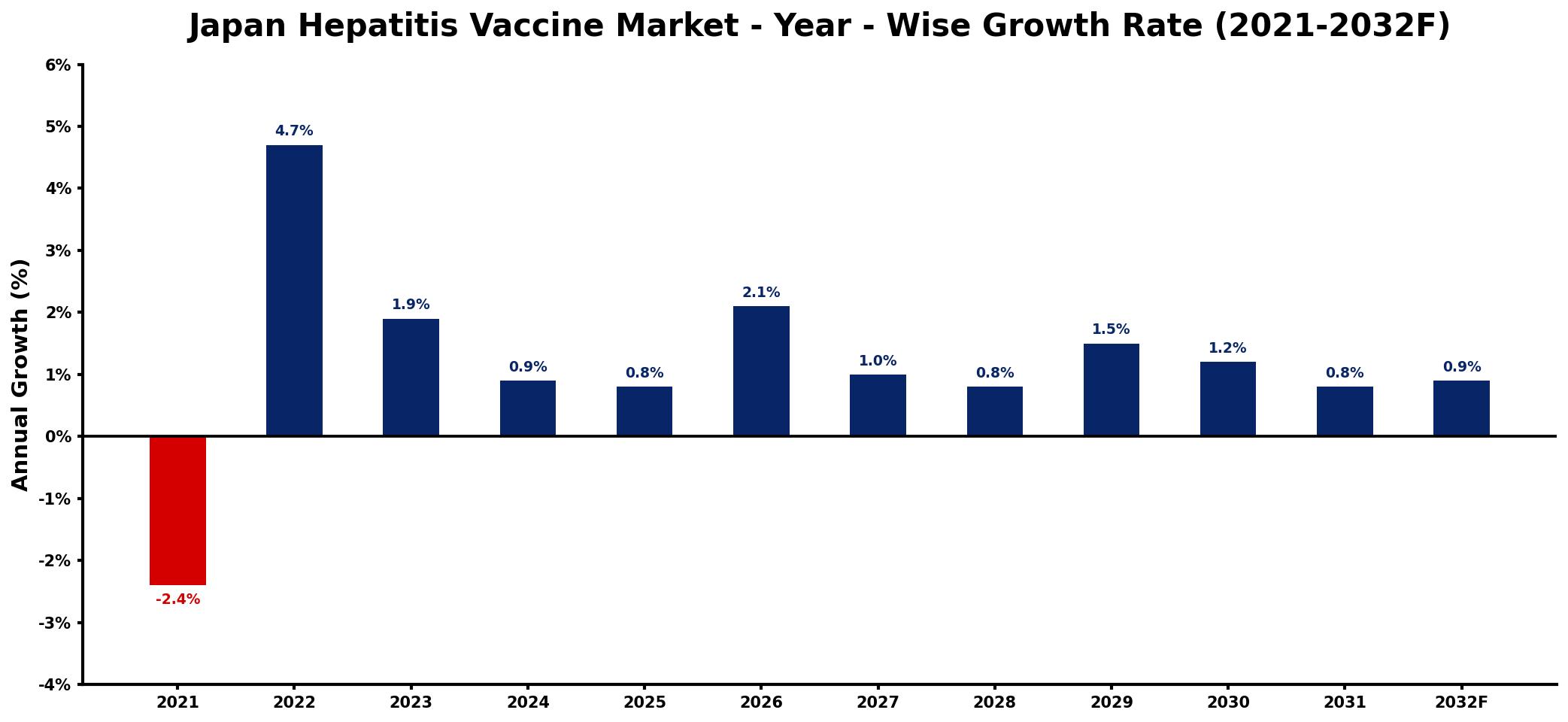
The table below presents the year‑wise growth rates along with the key drivers influencing the market
| Year | Growth Rate | Major Drivers |
| 2021 | -2.4% | decreased healthcare funding allocations |
| 2022 | 4.7% | increased public health initiatives |
| 2023 | 1.9% | growing awareness of preventive care |
| 2024 | 0.9% | rising demand for immunization programs |
| 2025 | 0.8% | expanding healthcare infrastructure investments |
| 2026 | 2.1% | increased collaboration with stakeholders |
| 2027 | 1.0% | growing focus on chronic diseases |
| 2028 | 0.8% | emerging research and development funding |
| 2029 | 1.5% | heightened government health policies |
| 2030 | 1.2% | increased private sector partnerships |
| 2031 | 0.8% | growing international health collaborations |
| 2032 | 0.9% | enhanced community health outreach programs |
Note: Market size estimations and growth projections presented in this report are based on 6Wresearch's proprietary forecasting methodology, utilizing the latest available industry data, government publications, and primary research inputs.
Japan Hepatitis Vaccine Market Synopsis
The Japan Hepatitis Vaccine Market has gained momentum in recent years, owing to increased awareness about the importance of vaccination and robust government initiatives aimed at controlling hepatitis infections. As the country continues to strengthen its healthcare infrastructure, the demand for effective and accessible vaccines is poised to rise significantly.
Despite recent progress, the market faces ongoing challenges, including low public awareness among certain demographics and the prevalence of generic vaccine alternatives. However, concerted efforts from healthcare providers and partnerships with pharmaceutical companies are expected to enhance vaccine distribution and accessibility, ensuring that more individuals are reached with vital vaccination services.
Japan Hepatitis Vaccine Market Key Takeaways
- The market is driven by increasing public awareness and government initiatives to combat hepatitis infections.
- Advancements in vaccine technology are facilitating the development of more effective and safer vaccines.
- New combination vaccines are emerging, offering protection against multiple strains of hepatitis.
- Targeted public health campaigns aim to boost vaccination rates among high-risk populations.
- Investment opportunities are growing due to the expanding healthcare sector and rising demand for hepatitis vaccines.
Evaluation of Restraints in Japan Hepatitis Vaccine Market
The Japan Hepatitis Vaccine Market is hindered by several key restraints, notably low public awareness regarding hepatitis and the importance of vaccination. This lack of understanding often translates into lower demand for vaccines, particularly among adults who are also at risk. Additionally, the presence of generic vaccine alternatives poses a challenge to manufacturers, impacting their revenue potential. Regulatory barriers and pricing pressures further complicate the landscape, necessitating strategic solutions to enhance both public education and competitive positioning in the market.
Japan Hepatitis Vaccine Market Trends
Emerging trends in the Japan Hepatitis Vaccine Market indicate a significant shift toward preventative healthcare, with a growing emphasis on vaccination. The Japanese population is becoming increasingly aware of the critical role vaccines play in protecting against hepatitis infections. This trend is complemented by a rise in the adoption of advanced vaccines, including recombinant hepatitis B vaccines, which offer improved efficacy and reduced side effects. Additionally, government initiatives are further driving vaccination uptake through comprehensive public health campaigns and outreach programs.
Japan Hepatitis Vaccine Market Opportunities
The Japan Hepatitis Vaccine Market presents substantial investment opportunities fueled by the increasing prevalence of hepatitis and the government's push for vaccination. Firms involved in the development, manufacture, and distribution of hepatitis vaccines stand to benefit from this rising demand. Moreover, forming strategic partnerships with healthcare providers and governmental agencies for vaccination campaigns can enhance market positioning and contribute to the overall goal of improving public health outcomes in Japan.
Government Initiatives in the Japan Hepatitis Vaccine Market
The Japanese government has implemented several policies aimed at hepatitis prevention and vaccination. Routine hepatitis B vaccinations for infants are now a standard component of the national immunization program, underscoring the government's commitment to controlling the disease. Moreover, financial support is extended for vaccinations among high-risk groups, including healthcare workers and individuals with chronic liver conditions. Public awareness campaigns further bolster these initiatives, focusing on educating the population about hepatitis prevention and the importance of vaccination.
Future Insights of the Japan Hepatitis Vaccine Market
Looking ahead to the period from 2026 to 2032, the Japan Hepatitis Vaccine Market is set to expand, driven by a combination of increased awareness, supportive government initiatives, and advancements in healthcare infrastructure. The ongoing development of effective and affordable vaccines will likely enhance access, particularly for high-risk groups. Furthermore, the rising prevalence of hepatitis infections is anticipated to further stimulate demand, ensuring that the market remains a vital component of Japan's public health strategy.
Japan Hepatitis Vaccine Market Latest Developments (2025 - 2026)
Recent developments in the Japan Hepatitis Vaccine Market highlight a trend towards innovation and collaboration. Companies are increasingly focusing on research and development initiatives to introduce enhanced vaccine formulations. Additionally, collaborations between pharmaceutical entities and healthcare providers are becoming more common, aimed at optimizing distribution networks and improving accessibility for high-risk populations. Public health campaigns are also evolving to ensure widespread understanding of hepatitis and the benefits of vaccination.
Japan Hepatitis Vaccine Market - Key Attractiveness of the Report
- 10 Years of Market Numbers
- Historical Data Starting from 2022 to 2025
- Base Year: 2025
- Forecast Data until 2032
- Key Performance Indicators Impacting the Market
- Major Upcoming Developments and Projects
Key Highlights of the Report:
- Japan Hepatitis Vaccine Market Outlook
- Market Size of Japan Hepatitis Vaccine Market, 2025
- Forecast of Japan Hepatitis Vaccine Market, 2032
- Historical Data and Forecast of Japan Hepatitis Vaccine Revenues & Volume for the Period 2022-2032F
- Japan Hepatitis Vaccine Market Trend Evolution
- Japan Hepatitis Vaccine Market Drivers and Challenges
- Japan Hepatitis Vaccine Price Trends
- Japan Hepatitis Vaccine Porter's Five Forces
- Japan Hepatitis Vaccine Industry Life Cycle
- Historical Data and Forecast of Japan Hepatitis Vaccine Market Revenues & Volume By Indication for the Period 2022-2032F
- Historical Data and Forecast of Japan Hepatitis Vaccine Market Revenues & Volume By Hepatitis A for the Period 2022-2032F
- Historical Data and Forecast of Japan Hepatitis Vaccine Market Revenues & Volume By Hepatitis B for the Period 2022-2032F
- Historical Data and Forecast of Japan Hepatitis Vaccine Market Revenues & Volume By Vaccine Type for the Period 2022-2032F
- Historical Data and Forecast of Japan Hepatitis Vaccine Market Revenues & Volume By Recombinant Vaccine for the Period 2022-2032F
- Historical Data and Forecast of Japan Hepatitis Vaccine Market Revenues & Volume By Inactivated Vaccine for the Period 2022-2032F
- Historical Data and Forecast of Japan Hepatitis Vaccine Market Revenues & Volume By Distribution Channel for the Period 2022-2032F
- Historical Data and Forecast of Japan Hepatitis Vaccine Market Revenues & Volume By Hospitals for the Period 2022-2032F
- Historical Data and Forecast of Japan Hepatitis Vaccine Market Revenues & Volume By Retail Pharmacy for the Period 2022-2032F
- Historical Data and Forecast of Japan Hepatitis Vaccine Market Revenues & Volume By Online Pharmacy for the Period 2022-2032F
- Japan Hepatitis Vaccine Import Export Trade Statistics
- Market Opportunity Assessment By Indication
- Market Opportunity Assessment By Vaccine Type
- Market Opportunity Assessment By Distribution Channel
- Japan Hepatitis Vaccine Top Companies Market Share
- Japan Hepatitis Vaccine Competitive Benchmarking By Technical and Operational Parameters
- Japan Hepatitis Vaccine Company Profiles
- Japan Hepatitis Vaccine Key Strategic Recommendations






































