Japan Herbal Cosmetics Market Size, Share & Growth Rate
The Japan Herbal Cosmetics Market was estimated at USD 201 Million in 2025 and is projected to reach USD 216 Million by 2032, growing at a CAGR of 1.0% from 2026 to 2032. This growth trajectory is predominantly driven by the Japanese consumers' increasing preference for natural and organic beauty solutions. The cultural inclination towards herbal remedies and heightened awareness about product safety further enhances the demand for herbal cosmetics across the nation.
Japan Herbal Cosmetics Market Year-wise Growth Rate and Key Drivers
This graph highlights how the Japan Herbal Cosmetics Market has steadily grown over the years, supported by major growth factors.
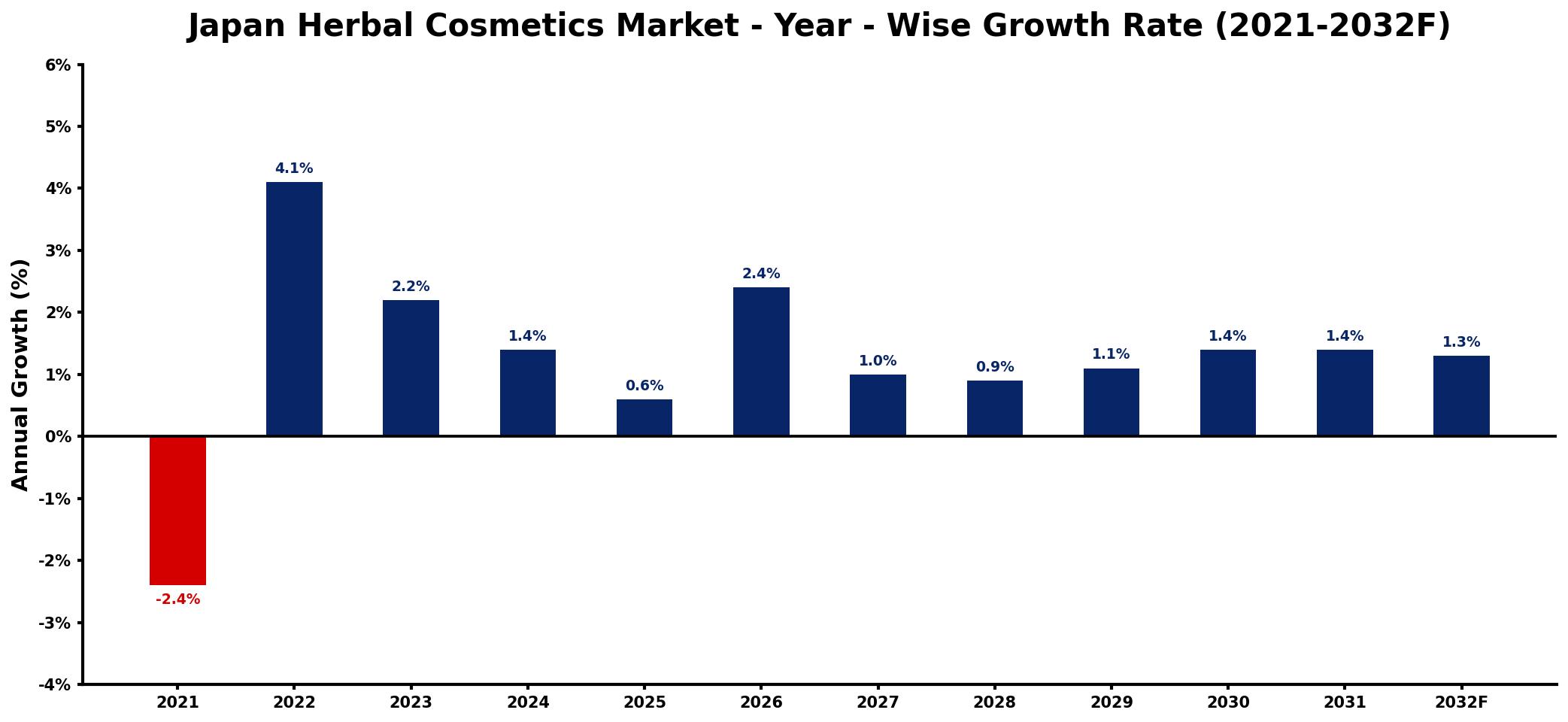
The table below presents the year‑wise growth rates along with the key drivers influencing the market
| Year | Growth Rate | Major Drivers |
| 2021 | -2.4% | Consumer interest in natural ingredients |
| 2022 | 4.1% | Rise in clean beauty trends |
| 2023 | 2.2% | Increased online shopping preferences |
| 2024 | 1.4% | Growing awareness of sustainability |
| 2025 | 0.6% | Expansion of retail distribution channels |
| 2026 | 2.4% | Investment in eco-friendly packaging |
| 2027 | 1.0% | Emergence of new product lines |
| 2028 | 0.9% | Collaborations with local brands |
| 2029 | 1.1% | Focus on personalized beauty solutions |
| 2030 | 1.4% | Advancements in product formulations |
| 2031 | 1.4% | Strengthening of brand loyalty programs |
| 2032 | 1.3% | Enhancement of consumer education initiatives |
Note: Market size estimations and growth projections presented in this report are based on 6Wresearch's proprietary forecasting methodology, utilizing the latest available industry data, government publications, and primary research inputs.
Japan Herbal Cosmetics Market Synopsis
The most significant force shaping the Japan Herbal Cosmetics Market is the growing preference for natural and organic beauty products among consumers. This shift is rooted in Japan's rich tradition of utilizing herbal ingredients, which are not only perceived as safer but also more effective in enhancing skin health.
As consumers become more educated about the benefits of herbal cosmetics, there is a notable increase in demand for formulations featuring ingredients like green tea, rice bran, and cherry blossom. This rising consumer awareness, paired with a robust emphasis on sustainability, has prompted brands to innovate their offerings and practices.
Japan Herbal Cosmetics Market Key Takeaways
- Consumer preference for natural beauty products is driving market growth.
- Traditional Japanese herbal ingredients are becoming key components in product formulations.
- There is a growing trend towards sustainable and eco-friendly packaging in the industry.
- The market faces challenges from regulatory complexities and competition from mainstream brands.
- Investment opportunities abound in innovative product development tailored to local preferences.
Evaluation of Restraints in Japan Herbal Cosmetics Market
Despite the promising prospects, the Japan Herbal Cosmetics Market grapples with several restraints. Regulatory hurdles regarding the approval of herbal ingredients can impede market entry and product innovation. Additionally, competition from well-established mainstream beauty brands poses a significant challenge. Furthermore, consumer skepticism concerning the efficacy of herbal cosmetics may hinder purchasing decisions. The costliness of sourcing quality natural ingredients also places financial pressure on producers, potentially inflating retail prices and affecting market competitiveness.
Japan Herbal Cosmetics Market Trends
Current trends in the Japan Herbal Cosmetics Market are marked by a noticeable shift towards ingredients celebrated for their holistic benefits, such as anti-aging and skin hydration. The use of traditional Japanese botanicals like camellia oil is on the rise, reflecting consumers' desire for authentic and effective solutions. Additionally, brands are increasingly focusing on sustainable practices, including eco-conscious packaging, to resonate with environmentally aware consumers. Innovative product formulations are also gaining traction, catering to specific consumer needs while enhancing product efficacy.
Japan Herbal Cosmetics Market Opportunities
The market presents various investment opportunities fueled by the growing consumer demand for herbal products. Companies can capitalize on this trend by developing unique herbal skincare and makeup products tailored specifically for the Japanese market. Collaborations with local herbal suppliers to incorporate traditional botanicals can further increase product appeal. Additionally, implementing marketing strategies that highlight the sustainability and natural qualities of herbal cosmetics can help attract a broader customer base focused on clean beauty.
Government Initiatives in the Japan Herbal Cosmetics Market
In Japan, the government regulates herbal cosmetics under the Pharmaceutical and Medical Device Act, which mandates stringent safety and efficacy standards for manufacturers. This regulatory framework ensures transparency through labeling requirements and ingredient disclosures. Furthermore, the Ministry of Health, Labour and Welfare actively oversees the cosmetics industry, encouraging innovation through grants and collaboration with industry stakeholders. These initiatives not only aim to protect consumers but also support the growth of the herbal cosmetics sector.
Future Insights of the Japan Herbal Cosmetics Market
Looking ahead to the years 2026-2032, the Japan Herbal Cosmetics Market is set to thrive, driven by the continuing shift toward natural and organic products. With an increasing focus on sustainability, consumers will likely favor herbal formulations that are gentle on the skin and devoid of harmful chemicals. As innovative product offerings expand, the demand for traditional Japanese ingredients will remain strong, positioning the market for steady growth as wellness and clean beauty continue to gain prominence in consumer purchasing habits.
Japan Herbal Cosmetics Market Latest Developments (2025 - 2026)
Recent developments in the Japan Herbal Cosmetics Market indicate a robust commitment to sustainability and product innovation. Brands are increasingly focusing on harnessing local herbal resources and enhancing product transparency. Additionally, there is a noticeable shift in marketing strategies, with companies emphasizing the natural efficacy of their offerings while engaging consumers through eco-friendly initiatives and community involvement. This evolution reflects the market's adaptability to changing consumer expectations and preferences.
Japan Herbal Cosmetics Market - Key Attractiveness of the Report
- 10 Years of Market Numbers
- Historical Data Starting from 2022 to 2025
- Base Year: 2025
- Forecast Data until 2032
- Key Performance Indicators Impacting the Market
- Major Upcoming Developments and Projects
Key Highlights of the Report:
- Japan Herbal Cosmetics Market Outlook
- Market Size of Japan Herbal Cosmetics Market, 2025
- Forecast of Japan Herbal Cosmetics Market, 2032
- Historical Data and Forecast of Japan Herbal Cosmetics Revenues & Volume for the Period 2022-2032F
- Japan Herbal Cosmetics Market Trend Evolution
- Japan Herbal Cosmetics Market Drivers and Challenges
- Japan Herbal Cosmetics Price Trends
- Japan Herbal Cosmetics Porter's Five Forces
- Japan Herbal Cosmetics Industry Life Cycle
- Historical Data and Forecast of Japan Herbal Cosmetics Market Revenues & Volume By Physical State for the Period 2022-2032F
- Historical Data and Forecast of Japan Herbal Cosmetics Market Revenues & Volume By Solid for the Period 2022-2032F
- Historical Data and Forecast of Japan Herbal Cosmetics Market Revenues & Volume By Semi-solid for the Period 2022-2032F
- Historical Data and Forecast of Japan Herbal Cosmetics Market Revenues & Volume By Liquid for the Period 2022-2032F
- Historical Data and Forecast of Japan Herbal Cosmetics Market Revenues & Volume By Product for the Period 2022-2032F
- Historical Data and Forecast of Japan Herbal Cosmetics Market Revenues & Volume By Skin Care Product for the Period 2022-2032F
- Historical Data and Forecast of Japan Herbal Cosmetics Market Revenues & Volume By Hair Care Product for the Period 2022-2032F
- Historical Data and Forecast of Japan Herbal Cosmetics Market Revenues & Volume By Baby Care Product for the Period 2022-2032F
- Historical Data and Forecast of Japan Herbal Cosmetics Market Revenues & Volume By Oral Care Product for the Period 2022-2032F
- Historical Data and Forecast of Japan Herbal Cosmetics Market Revenues & Volume By Make-up Product for the Period 2022-2032F
- Historical Data and Forecast of Japan Herbal Cosmetics Market Revenues & Volume By Distribution Channel for the Period 2022-2032F
- Historical Data and Forecast of Japan Herbal Cosmetics Market Revenues & Volume By Supermarket for the Period 2022-2032F
- Historical Data and Forecast of Japan Herbal Cosmetics Market Revenues & Volume By Pharmacy for the Period 2022-2032F
- Historical Data and Forecast of Japan Herbal Cosmetics Market Revenues & Volume By Departmental Store for the Period 2022-2032F
- Historical Data and Forecast of Japan Herbal Cosmetics Market Revenues & Volume By Beauty Spa/Salon for the Period 2022-2032F
- Historical Data and Forecast of Japan Herbal Cosmetics Market Revenues & Volume By Internet Retailing for the Period 2022-2032F
- Historical Data and Forecast of Japan Herbal Cosmetics Market Revenues & Volume By Specialty Store for the Period 2022-2032F
- Japan Herbal Cosmetics Import Export Trade Statistics
- Market Opportunity Assessment By Physical State
- Market Opportunity Assessment By Product
- Market Opportunity Assessment By Distribution Channel
- Japan Herbal Cosmetics Top Companies Market Share
- Japan Herbal Cosmetics Competitive Benchmarking By Technical and Operational Parameters
- Japan Herbal Cosmetics Company Profiles
- Japan Herbal Cosmetics Key Strategic Recommendations






































