Japan High Performance Plastics Market Import Shipment by Countries (Top 5) & Competition (HHI)
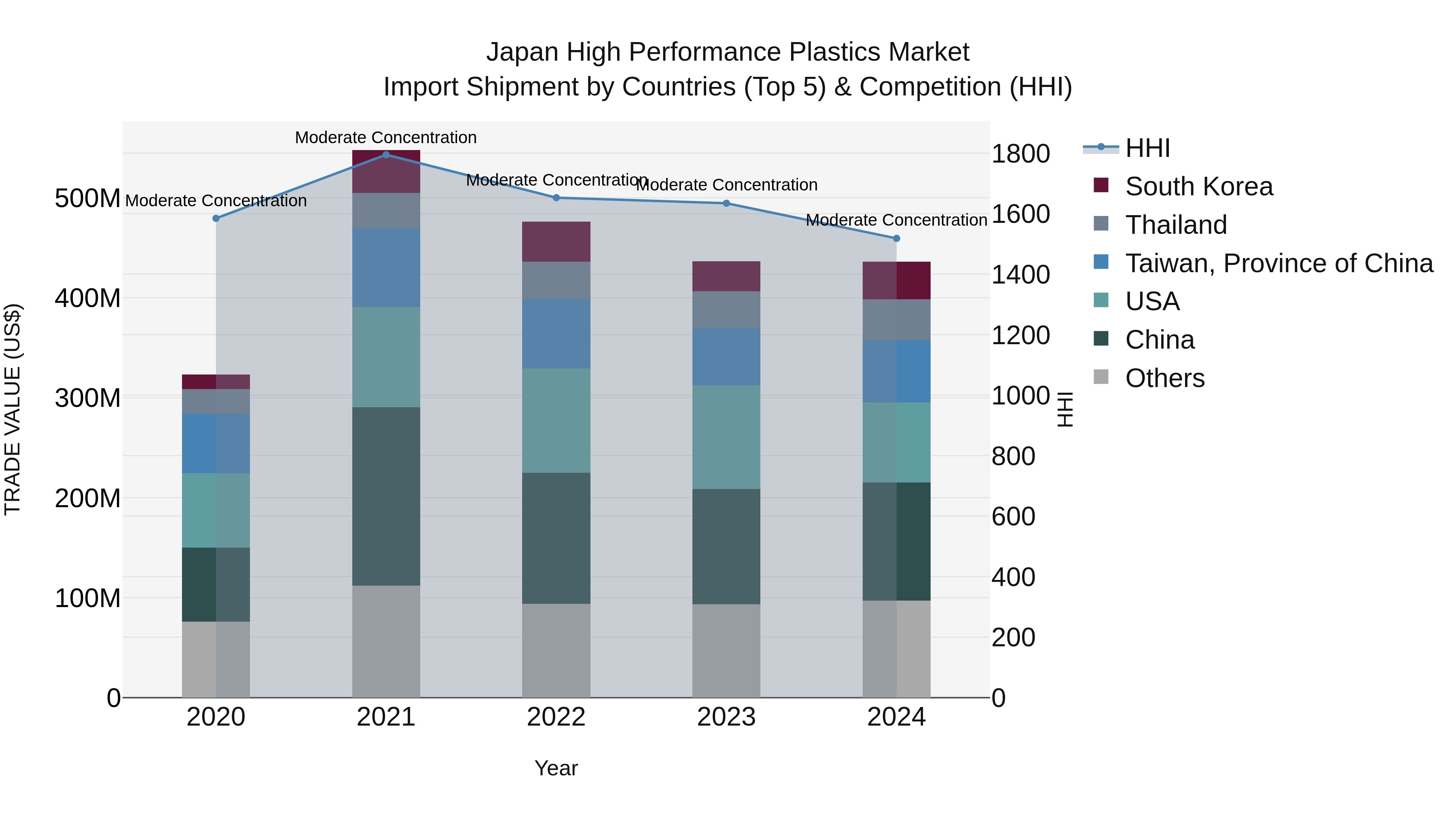
Japan's import shipments of high performance plastics in 2024 continued to be dominated by key suppliers, including China, USA, Taiwan, Thailand, and South Korea. The market displayed moderate concentration levels, with a healthy Compound Annual Growth Rate (CAGR) of 7.77% from 2020 to 2024. However, there was a slight decline in growth rate from 2023 to 2024, indicating a potential stabilization in the market. This data suggests a continued reliance on these top exporting countries for high performance plastics in Japan, with steady growth and a competitive market landscape.
Japan High Performance Plastics Market Overview
The Japan High Performance Plastics Market is experiencing steady growth driven by industries such as automotive, electronics, and healthcare. High performance plastics offer superior properties such as durability, lightweight, and resistance to chemicals and high temperatures, making them ideal for various applications. The market is witnessing increasing demand for materials like polyamide, fluoropolymers, and polyetheretherketone (PEEK) due to their versatility and performance benefits. Rising environmental concerns have also led to a shift towards sustainable options like bio-based high performance plastics. Key players in the market are focusing on innovation and product development to cater to evolving customer needs and stringent regulatory requirements, thereby contributing to the overall growth and competitiveness of the Japan High Performance Plastics Market.
Japan High Performance Plastics Market Trends and Opportunities
The Japan High Performance Plastics Market is experiencing growth driven by increasing demand in various industries such as automotive, electronics, and healthcare. The market is witnessing a shift towards lightweight and durable materials to improve fuel efficiency and performance in automobiles, enhance electronic devices, and develop innovative medical devices. Key trends include the adoption of bio-based high performance plastics for sustainability, advancements in additive manufacturing technologies for customized products, and increasing focus on recycling and waste management to reduce environmental impact. Opportunities in the market lie in the development of high performance plastics with enhanced properties such as heat resistance, chemical resistance, and electrical conductivity to meet the evolving needs of industries in Japan and globally.
Japan High Performance Plastics Market Challenges
In the Japan High Performance Plastics Market, some challenges that are commonly faced include intense competition from global players, fluctuating raw material prices, and stringent environmental regulations. Global competitors often have established brands and distribution networks, making it challenging for local companies to compete. The volatility of raw material prices can impact production costs and ultimately affect pricing strategies. Additionally, strict environmental regulations in Japan require companies to invest in sustainable practices and technologies, increasing operational costs. Adapting to these challenges by investing in research and development for innovative products, establishing efficient supply chain networks, and ensuring compliance with environmental standards are critical for companies operating in the Japan High Performance Plastics Market to maintain a competitive edge and sustainable growth.
Japan High Performance Plastics Market Drivers
The Japan High Performance Plastics Market is primarily driven by increasing demand from various end-use industries such as automotive, electronics, aerospace, and healthcare. The country`s strong presence in industries requiring high-performance materials for applications such as lightweight components, electrical insulation, and advanced medical devices is fueling the growth of the market. Additionally, stringent regulations promoting the use of high-performance plastics in place of traditional materials due to their superior properties such as heat resistance, chemical resistance, and durability are further driving market expansion. Technological advancements leading to the development of innovative high-performance plastic products and the growing focus on sustainability and recyclability are also key factors propelling the market forward in Japan.
Japan High Performance Plastics Market Government Policy
The Japanese government has implemented various policies to support the High Performance Plastics (HPP) market, including promoting research and development in advanced materials, providing subsidies for companies investing in innovative plastic technologies, and encouraging industry collaboration to drive technological advancements. Additionally, there are regulations in place to promote sustainability and environmental protection, such as promoting recycling and reducing plastic waste. The government also focuses on enhancing the competitiveness of the Japanese HPP industry globally by supporting export activities and fostering partnerships with international companies. Overall, the government`s policies aim to stimulate growth, innovation, and sustainability in the Japan High Performance Plastics Market.
Japan High Performance Plastics Market Future Outlook
The future outlook for the Japan High Performance Plastics Market appears promising, with steady growth anticipated due to increasing demand across various industries such as automotive, electronics, and healthcare. Factors such as the growing trend towards lightweight and high-strength materials, as well as the need for sustainable solutions, are expected to drive market expansion. Additionally, ongoing technological advancements in the production of high performance plastics, along with a focus on innovation and product development, are likely to further boost market growth in the coming years. However, challenges such as volatile raw material prices and environmental concerns may impact the market to some extent. Overall, the Japan High Performance Plastics Market is poised for growth, driven by evolving industry needs and technological advancements.
Key Highlights of the Report:
- Japan High Performance Plastics Market Outlook
- Market Size of Japan High Performance Plastics Market, 2024
- Forecast of Japan High Performance Plastics Market, 2031
- Historical Data and Forecast of Japan High Performance Plastics Revenues & Volume for the Period 2021 - 2031
- Japan High Performance Plastics Market Trend Evolution
- Japan High Performance Plastics Market Drivers and Challenges
- Japan High Performance Plastics Price Trends
- Japan High Performance Plastics Porter's Five Forces
- Japan High Performance Plastics Industry Life Cycle
- Historical Data and Forecast of Japan High Performance Plastics Market Revenues & Volume By Type for the Period 2021 - 2031
- Historical Data and Forecast of Japan High Performance Plastics Market Revenues & Volume By Fluoropolymers for the Period 2021 - 2031
- Historical Data and Forecast of Japan High Performance Plastics Market Revenues & Volume By High Performance Polyamide for the Period 2021 - 2031
- Historical Data and Forecast of Japan High Performance Plastics Market Revenues & Volume By PPS for the Period 2021 - 2031
- Historical Data and Forecast of Japan High Performance Plastics Market Revenues & Volume By SP for the Period 2021 - 2031
- Historical Data and Forecast of Japan High Performance Plastics Market Revenues & Volume By LCP for the Period 2021 - 2031
- Historical Data and Forecast of Japan High Performance Plastics Market Revenues & Volume By AKP for the Period 2021 - 2031
- Historical Data and Forecast of Japan High Performance Plastics Market Revenues & Volume By PI for the Period 2021 - 2031
- Historical Data and Forecast of Japan High Performance Plastics Market Revenues & Volume By End Use Industry for the Period 2021 - 2031
- Historical Data and Forecast of Japan High Performance Plastics Market Revenues & Volume By Transportation for the Period 2021 - 2031
- Historical Data and Forecast of Japan High Performance Plastics Market Revenues & Volume By Electrical for the Period 2021 - 2031
- Historical Data and Forecast of Japan High Performance Plastics Market Revenues & Volume By Electronics for the Period 2021 - 2031
- Historical Data and Forecast of Japan High Performance Plastics Market Revenues & Volume By Medical for the Period 2021 - 2031
- Historical Data and Forecast of Japan High Performance Plastics Market Revenues & Volume By Industrial for the Period 2021 - 2031
- Japan High Performance Plastics Import Export Trade Statistics
- Market Opportunity Assessment By Type
- Market Opportunity Assessment By End Use Industry
- Japan High Performance Plastics Top Companies Market Share
- Japan High Performance Plastics Competitive Benchmarking By Technical and Operational Parameters
- Japan High Performance Plastics Company Profiles
- Japan High Performance Plastics Key Strategic Recommendations






































