Japan Higher Education Market Size & Growth Rate (2026-2032)
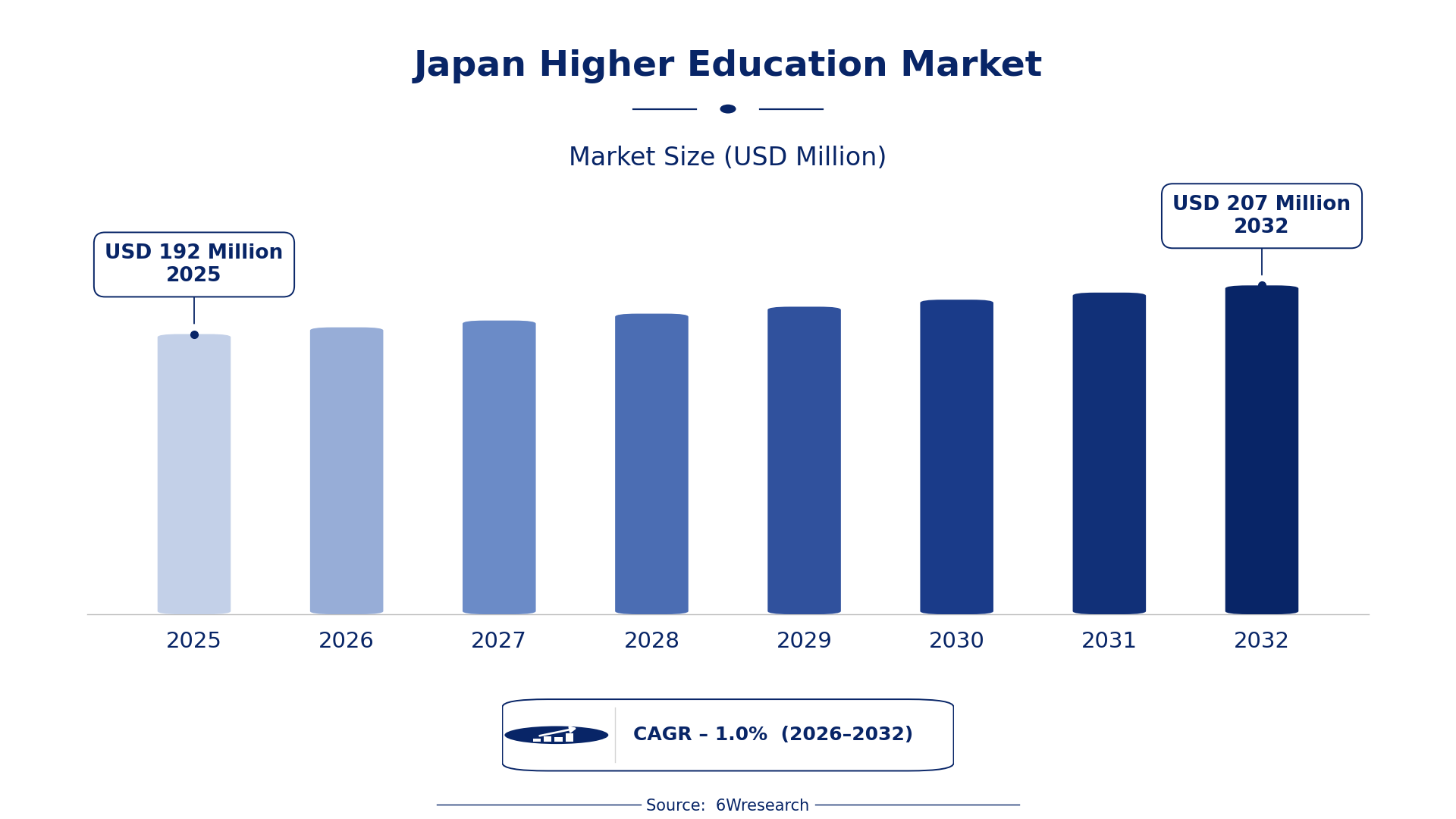
The Japan Higher Education Market was estimated at USD 192 Million in 2025 and is projected to reach USD 207 Million by 2032, growing at a CAGR of 1.0% from 2026 to 2032.
Japan Higher Education Market Synopsis
A strong push towards internationalization is currently shaping the Japan Higher Education Market. Universities across the nation are actively forging partnerships with foreign institutions, enhancing their global footprint while attracting diverse student demographics.
At the same time, technological advancements and the shift towards online learning models are redefining the educational experience. This transformation is not just a response to external pressures; it reflects an evolving demand for flexible and accessible education options in a competitive global environment.
Japan Higher Education Market Year-wise Growth Rate and Key Drivers
This graph illustrates the annual growth rates of the Japan Higher Education Market from 2021 to 2032, highlighting a steady upward trajectory and projected expansion over the forecast period.
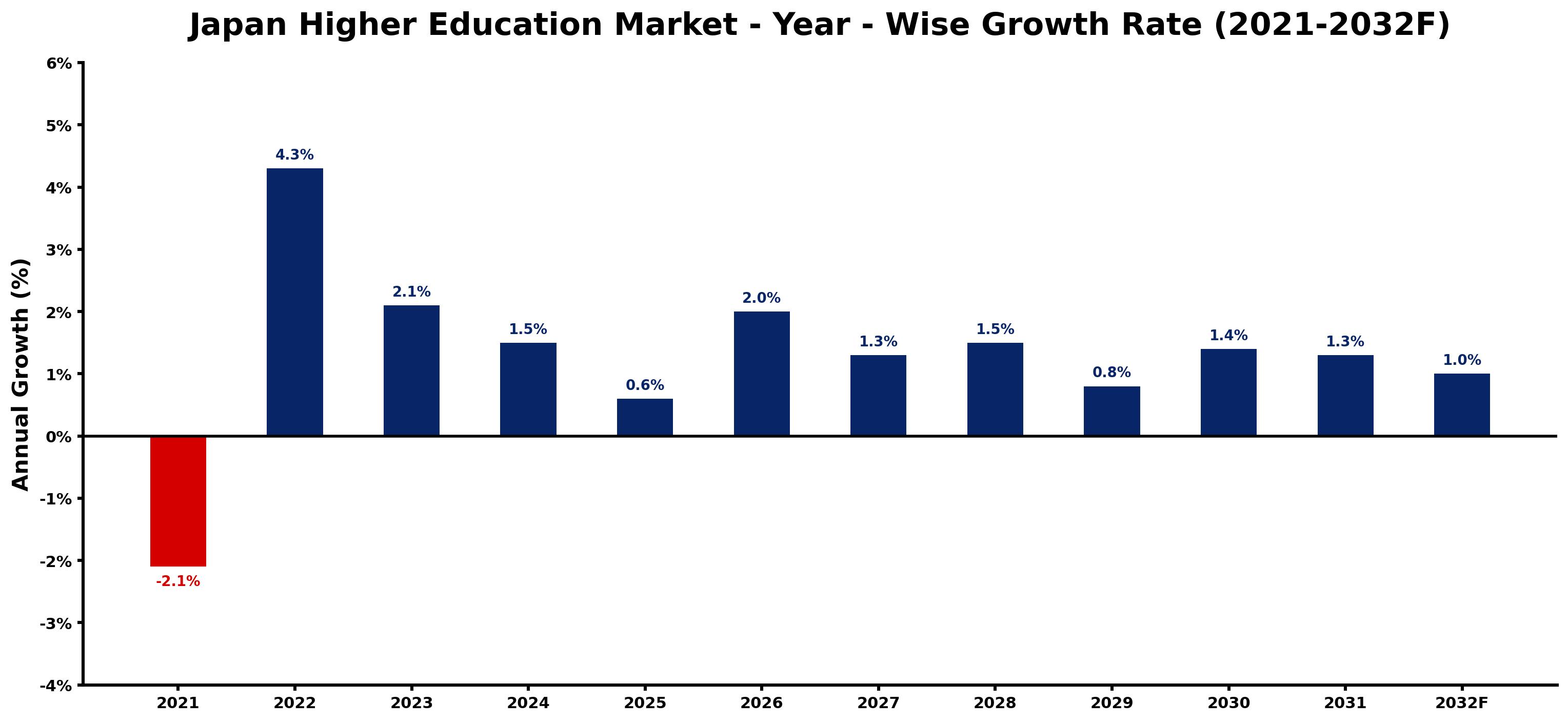
The table below presents the year‑wise growth rates along with the key drivers influencing the market
| Year | Growth Rate | Major Drivers |
| 2021 | -2.1% | Declining international student enrollment amid pandemic restrictions. |
| 2022 | 4.3% | Strategic government funding for research universities boost enrollments. |
| 2023 | 2.1% | Increased international student recruitment initiatives by Japanese institutions. |
| 2024 | 1.5% | Growth in digital learning platforms enhances access to education. |
| 2025 | 0.6% | Collaborations with tech firms improve vocational training offerings. |
| 2026 | 2.0% | New regulations promote hybrid learning models in higher education. |
| 2027 | 1.3% | Declining birthrate increases competition for student enrollment. |
| 2028 | 1.5% | Government incentives support STEM education growth initiatives. |
| 2029 | 0.8% | Rise in adult learners pursuing higher education qualifications. |
| 2030 | 1.4% | Partnerships with global universities enhance academic program diversity. |
| 2031 | 1.3% | Focus on research sustainability boosts funding for innovation. |
| 2032 | 1.0% | Cultural emphasis on lifelong learning drives enrollment increases. |
Note: Market size estimations and growth projections presented in this report are based on 6Wresearch's proprietary forecasting methodology, utilizing the latest available industry data, government publications, and primary research inputs.
Japan Higher Education Market Key Takeaways
Below are some of the specific key takeaways from the market, including:
- International partnerships are increasingly vital for enhancing global competitiveness among Japanese universities.
- The adoption of digital learning tools has surged, catalyzed by the COVID-19 pandemic.
- There is a notable demand for education focused on practical skills to meet the workforce requirements.
- Diversity and inclusion initiatives are gaining momentum within educational institutions.
- Government policies are actively supporting internationalization and research collaboration initiatives.
Evaluation of Restraints in Japan Higher Education Market
The Japan Higher Education Market faces several restraints that hinder its growth. A declining population, particularly among the youth demographic, poses challenges in student enrollment numbers. This demographic shift is exacerbated by a rigid educational system that struggles to adapt swiftly to modern demands and technological changes. Limited financial resources for research and development further restrict universities from competing on a global scale. The market must address these issues head-on to foster an environment conducive to growth and innovation.
Japan Higher Education Market Trends
Several key trends are currently influencing the Japan Higher Education Market. The emphasis on internationalization continues to rise, with many universities offering more English-taught programs to attract global students. The trend towards online and hybrid learning models is also increasing, accelerated by the pandemic and a greater focus on digital infrastructure. on top of that, there is a growing partnership between universities and industries, aimed at delivering education that aligns with practical workforce skills. Efforts towards increasing campus diversity and inclusivity are gaining traction, ensuring a more representative educational environment.
Japan Higher Education Market Opportunities
Investment opportunities abound in the Japan Higher Education Market. Collaborations between universities and industry partners can drive innovation in research and curriculum development. The rise of edtech presents a significant avenue for investment, particularly in platforms that enhance online learning experiences. Additionally, with a focus on attracting international students, there is potential for developing tailored programs and services. Lifelong learning initiatives are also on the rise, creating opportunities for specialized training and professional development offerings.
Government Initiatives in the Japan Higher Education Market
Government policy is a fundamental driver in shaping the Japan Higher Education Market. The Japanese government is committed to enhancing the global competitiveness of its universities, focusing on international collaborations and educational reforms. These initiatives are critical in addressing demographic challenges and ensuring that higher education remains relevant in the modern economy.
- The "Top Global University Project" launched to enhance international collaboration and competitiveness.
- A "Super Global Universities" initiative currently underway to support selected institutions in elevating their global standing.
- The "University Reform Plan," aimed at revitalizing higher education and addressing declining student enrollment, is being implemented.
- Ongoing funding programs designed to enhance research capabilities in universities.
- A planned initiative to improve digital learning infrastructure, expected to be rolled out by 2027.
Future Insights of the Japan Higher Education Market
Looking ahead to 2026-2032, the Japan Higher Education Market is set for transformation. The government's focus on internationalization and digitalization will likely spur growth, making education more accessible and relevant. As universities increasingly adopt online platforms and emphasize research partnerships with industries, the educational landscape will shift towards meeting the demands of a rapidly changing job market. This evolution presents unique opportunities for stakeholders invested in the future of education in Japan.
Japan Higher Education Market Latest Developments
In the past year, the Japan Higher Education Market has witnessed several noteworthy developments. Institutions are increasingly prioritizing innovation and collaboration, reflecting a shift towards a more integrated educational ecosystem. This momentum is driven by a combination of government initiatives and institutional responses to emerging global trends.
- A new partnership initiative was launched in early 2025 between leading Japanese universities and foreign institutions to enhance research collaboration.
- An ongoing project, started in mid-2025, focuses on upgrading digital infrastructure across multiple campuses nationwide.
- A recent curriculum reform effort, aimed at integrating practical skills training, has been implemented in several universities.
- By 2026, a nationwide campaign promoting lifelong learning and professional development programs is expected to roll out.
- A public-private partnership is currently underway to develop advanced student accommodation facilities by late 2026.
Japan Higher Education Market - Key Attractiveness of the Report
- 10 Years of Market Numbers
- Historical Data Starting from 2022 to 2025
- Base Year: 2025
- Forecast Data until 2032
- Key Performance Indicators Impacting the Market
- Major Upcoming Developments and Projects
Key Highlights of the Report:
- Japan Higher Education Market Outlook
- Market Size of Japan Higher Education Market, 2025
- Forecast of Japan Higher Education Market, 2032
- Historical Data and Forecast of Japan Higher Education Revenues & Volume for the Period 2022-2032F
- Japan Higher Education Market Trend Evolution
- Japan Higher Education Market Drivers and Challenges
- Japan Higher Education Price Trends
- Japan Higher Education Porter's Five Forces
- Japan Higher Education Industry Life Cycle
- Historical Data and Forecast of Japan Higher Education Market Revenues & Volume By Component for the Period 2022-2032F
- Historical Data and Forecast of Japan Higher Education Market Revenues & Volume By Solutions for the Period 2022-2032F
- Historical Data and Forecast of Japan Higher Education Market Revenues & Volume By Services for the Period 2022-2032F
- Historical Data and Forecast of Japan Higher Education Market Revenues & Volume By Deployment Type for the Period 2022-2032F
- Historical Data and Forecast of Japan Higher Education Market Revenues & Volume By On-premises for the Period 2022-2032F
- Historical Data and Forecast of Japan Higher Education Market Revenues & Volume By Cloud for the Period 2022-2032F
- Historical Data and Forecast of Japan Higher Education Market Revenues & Volume By Vertical for the Period 2022-2032F
- Historical Data and Forecast of Japan Higher Education Market Revenues & Volume By State Universities for the Period 2022-2032F
- Historical Data and Forecast of Japan Higher Education Market Revenues & Volume By Community Colleges for the Period 2022-2032F
- Historical Data and Forecast of Japan Higher Education Market Revenues & Volume By Private Colleges for the Period 2022-2032F
- Japan Higher Education Import Export Trade Statistics
- Market Opportunity Assessment By Component
- Market Opportunity Assessment By Deployment Type
- Market Opportunity Assessment By Vertical
- Japan Higher Education Top Companies Market Share
- Japan Higher Education Competitive Benchmarking By Technical and Operational Parameters
- Japan Higher Education Company Profiles
- Japan Higher Education Key Strategic Recommendations






































