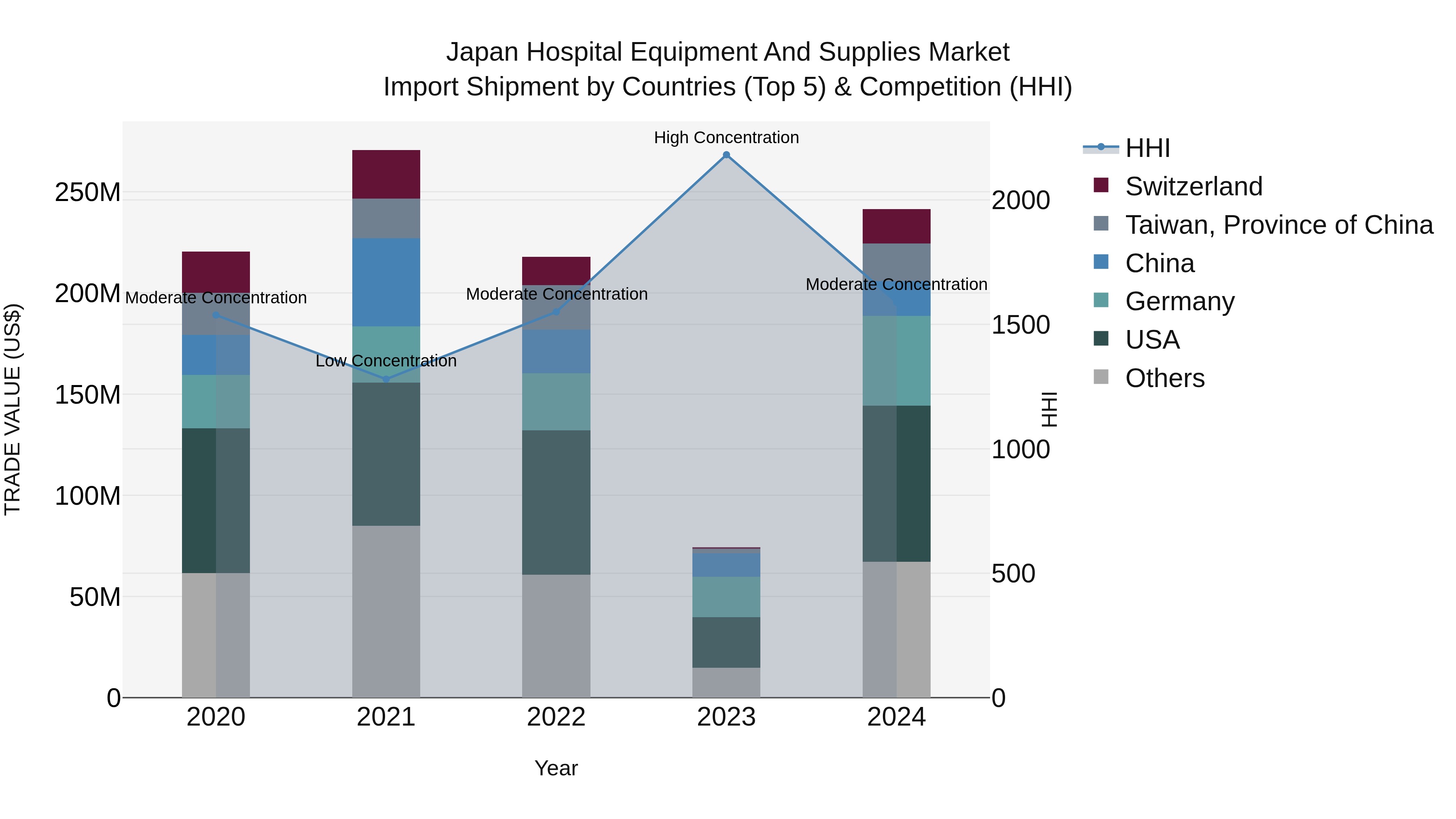
Japan Hospital Equipment And Supplies Market Import Shipment by Countries (Top 5) & Competition (HHI)
Japan's hospital equipment and supplies import shipments in 2024 continued to be dominated by key exporters such as the USA, Germany, Taiwan, China, and Switzerland. The market saw a shift from high concentration in 2023 to moderate concentration in 2024, indicating a more diversified import landscape. With a steady Compound Annual Growth Rate (CAGR) of 2.3% from 2020 to 2024, the sector experienced a remarkable growth rate of 224.48% from 2023 to 2024. This trend suggests a growing demand for high-quality medical equipment and supplies in Japan, driven by advancements in healthcare technology and infrastructure.
Japan Hospital Equipment And Supplies Market Synopsis
The Japan Hospital Equipment and Supplies market is a dynamic and rapidly evolving sector driven by technological advancements, increasing healthcare expenditure, and a growing aging population. The market encompasses a wide range of products including diagnostic equipment, surgical instruments, medical consumables, and patient monitoring devices. Key trends in the market include the adoption of digital health technologies, increasing demand for minimally invasive surgical procedures, and a focus on infection control and patient safety. Major players in the market include domestic companies such as Terumo Corporation and Hitachi, as well as international players like Siemens Healthineers and GE Healthcare. With a strong emphasis on innovation and quality, the Japan Hospital Equipment and Supplies market is poised for continued growth and expansion in the coming years.
Japan Hospital Equipment And Supplies Market Trends
The Japan Hospital Equipment and Supplies Market is experiencing several notable trends. One key trend is the increasing adoption of advanced technology and digitalization in healthcare facilities, driving the demand for innovative and high-tech medical equipment and supplies. Additionally, there is a growing focus on infection control and patient safety, leading to the demand for sterilization equipment, disposable supplies, and personal protective gear. Another trend is the emphasis on sustainability and eco-friendly products, prompting hospitals to seek out environmentally conscious equipment and supplies. Furthermore, the rise in aging population and chronic diseases is creating a higher demand for specialized equipment and supplies tailored to geriatric care. Overall, these trends are shaping the Japan Hospital Equipment and Supplies Market towards more efficient, safe, and sustainable healthcare practices.
Japan Hospital Equipment And Supplies Market Challenges
In the Japan Hospital Equipment and Supplies Market, some key challenges include stringent regulatory requirements for medical devices, high competition among local and international suppliers, and the need for advanced technology and innovation to meet the evolving healthcare demands. Additionally, the aging population in Japan is driving the demand for healthcare services and equipment, putting pressure on hospitals to invest in modern equipment while facing budget constraints. Ensuring compliance with quality standards and maintaining cost-effectiveness in procurement processes are also significant challenges faced by hospitals in Japan. Overall, navigating these complexities requires market players to continuously adapt and innovate to stay competitive and provide high-quality healthcare services in the dynamic Japanese healthcare landscape.
Japan Hospital Equipment And Supplies Market Investment Opportunities
The Japan Hospital Equipment and Supplies Market offers promising investment opportunities due to the country`s advanced healthcare infrastructure and increasing demand for high-quality medical equipment. Key areas for investment include advanced imaging technologies such as MRI and CT scanners, surgical equipment, and diagnostic tools. With Japan`s aging population driving the need for innovative healthcare solutions, there is a growing market for state-of-the-art medical devices and supplies. Additionally, the government`s focus on promoting healthcare advancements and research further enhances the investment potential in this sector. Investing in companies that provide cutting-edge hospital equipment and supplies in Japan can offer long-term growth potential and opportunities for innovation in the healthcare industry.
Japan Hospital Equipment And Supplies Market Future Outlook
The Japan Hospital Equipment And Supplies Market is expected to witness steady growth in the coming years due to factors such as an aging population, increasing healthcare expenditure, and advancements in medical technology. The market is likely to be driven by the growing demand for sophisticated medical devices and equipment to cater to the rising healthcare needs of the population. Additionally, the government`s initiatives to improve healthcare infrastructure and services are expected to further boost the market. Key players in the market are focusing on expanding their product portfolios and investing in research and development to introduce innovative solutions. Overall, the Japan Hospital Equipment And Supplies Market is anticipated to experience sustained growth opportunities and technological advancements in the foreseeable future.
Key Highlights of the Report:
- Japan Hospital Equipment And Supplies Market Outlook
- Market Size of Japan Hospital Equipment And Supplies Market, 2024
- Forecast of Japan Hospital Equipment And Supplies Market, 2031
- Historical Data and Forecast of Japan Hospital Equipment And Supplies Revenues & Volume for the Period 2021-2031
- Japan Hospital Equipment And Supplies Market Trend Evolution
- Japan Hospital Equipment And Supplies Market Drivers and Challenges
- Japan Hospital Equipment And Supplies Price Trends
- Japan Hospital Equipment And Supplies Porter's Five Forces
- Japan Hospital Equipment And Supplies Industry Life Cycle
- Historical Data and Forecast of Japan Hospital Equipment And Supplies Market Revenues & Volume By Product for the Period 2021-2031
- Historical Data and Forecast of Japan Hospital Equipment And Supplies Market Revenues & Volume By Sterilization And Disinfectant Equipment for the Period 2021-2031
- Historical Data and Forecast of Japan Hospital Equipment And Supplies Market Revenues & Volume By Disposable Hospital Supplies Patient Examination Devices for the Period 2021-2031
- Historical Data and Forecast of Japan Hospital Equipment And Supplies Market Revenues & Volume By Syringes And Needles for the Period 2021-2031
- Historical Data and Forecast of Japan Hospital Equipment And Supplies Market Revenues & Volume By Application for the Period 2021-2031
- Historical Data and Forecast of Japan Hospital Equipment And Supplies Market Revenues & Volume By OEMs for the Period 2021-2031
- Historical Data and Forecast of Japan Hospital Equipment And Supplies Market Revenues & Volume By Aftermarket for the Period 2021-2031
- Japan Hospital Equipment And Supplies Import Export Trade Statistics
- Market Opportunity Assessment By Product
- Market Opportunity Assessment By Application
- Japan Hospital Equipment And Supplies Top Companies Market Share
- Japan Hospital Equipment And Supplies Competitive Benchmarking By Technical and Operational Parameters
- Japan Hospital Equipment And Supplies Company Profiles
- Japan Hospital Equipment And Supplies Key Strategic Recommendations






































