Japan Household Vacuum Cleaners Market Size & Growth Rate
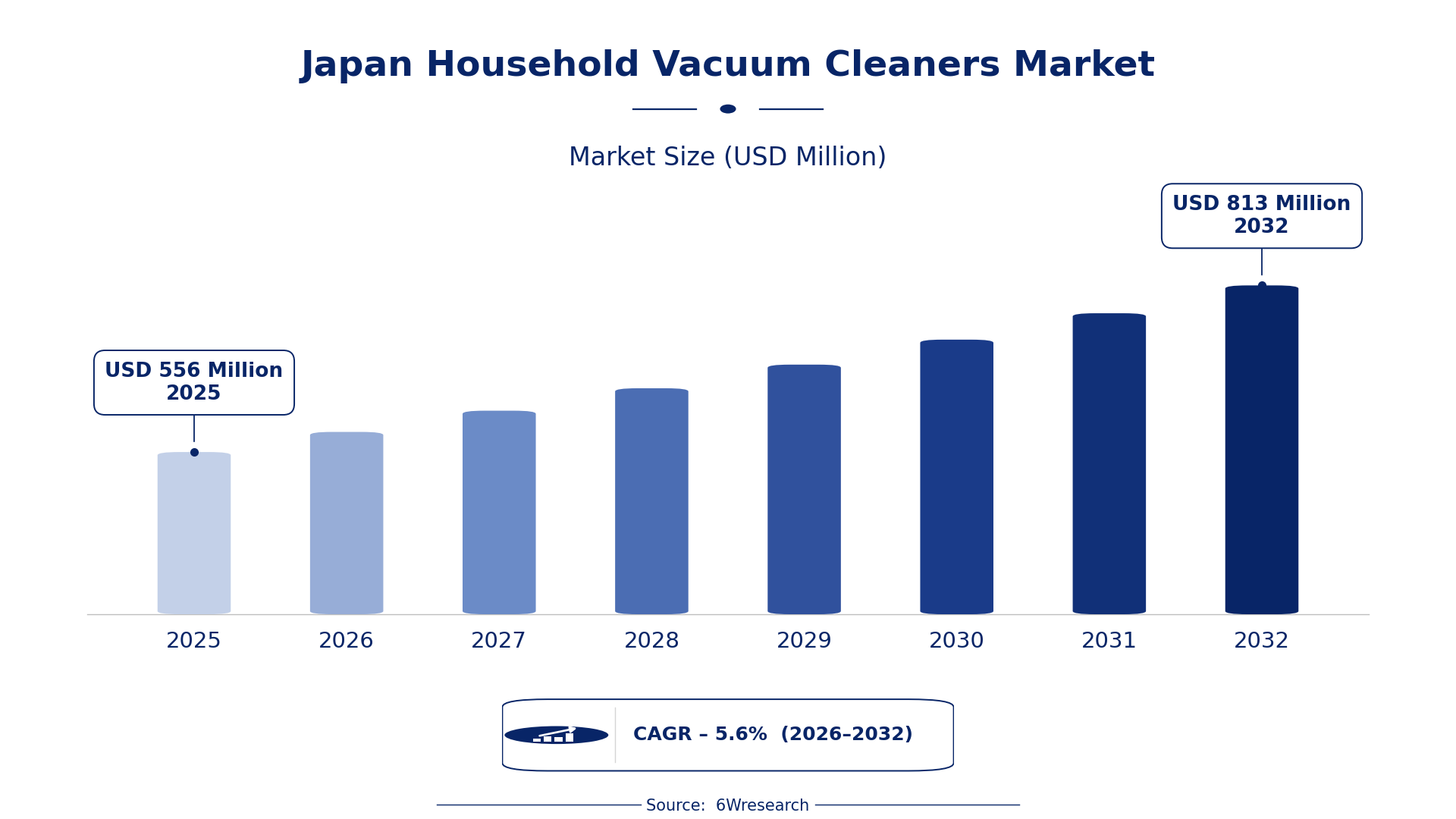
According to 6Wresearch internal database and industry insights, the Japan Household Vacuum Cleaners Market was valued at USD 556 Million in 2025 and is projected to reach USD 813 Million by 2032, growing at a CAGR of approximately 5.6% during 2026–2032.
Japan Household Vacuum Cleaners Market Highlights
| Report Metric | Details |
| Report Name | Japan Household Vacuum Cleaners Market (2026-2032) |
| Market Size 2025 | USD 556 Million |
| Market Size 2032 | USD 813 Million |
| Absolute Growth 2025–2032 | USD 257 Million |
| CAGR 2026–2032 | 5.6% |
| Peak Annual Growth | 6.8% in 2028 |
| Forecast Period | 2026–2032 |
| Historical Data | 2022–2025 |
| Base Year | 2025 |
| Leading Operation Mode, 2025 | Self-Drive (55% share) |
| Leading Product, 2025 | Robotic (35% share) |
| Leading Mode of Sale, 2025 | Offline (62% share) |
| Leading Type of Use, 2025 | Floor Vacuum Cleaner (47% share) |
| Fastest-Growing Product | Upright (8.3% CAGR) |
| Fastest-Growing Mode of Sale | Online (7.1% CAGR) |
| Fastest-Growing Type of Use | Window Vacuum Cleaner (7.6% CAGR) |
| Growing Sector | Household cleaning appliances |
| Key End Users | Households, cleaning service providers, technology enthusiasts |
Japan Household Vacuum Cleaners Market Year-wise Growth Rate and Key Drivers (2022–2032)
This graph illustrates the annual growth rates of the market from 2022 to 2032, highlighting a steady upward trajectory and projected market expansion over the forecast period.
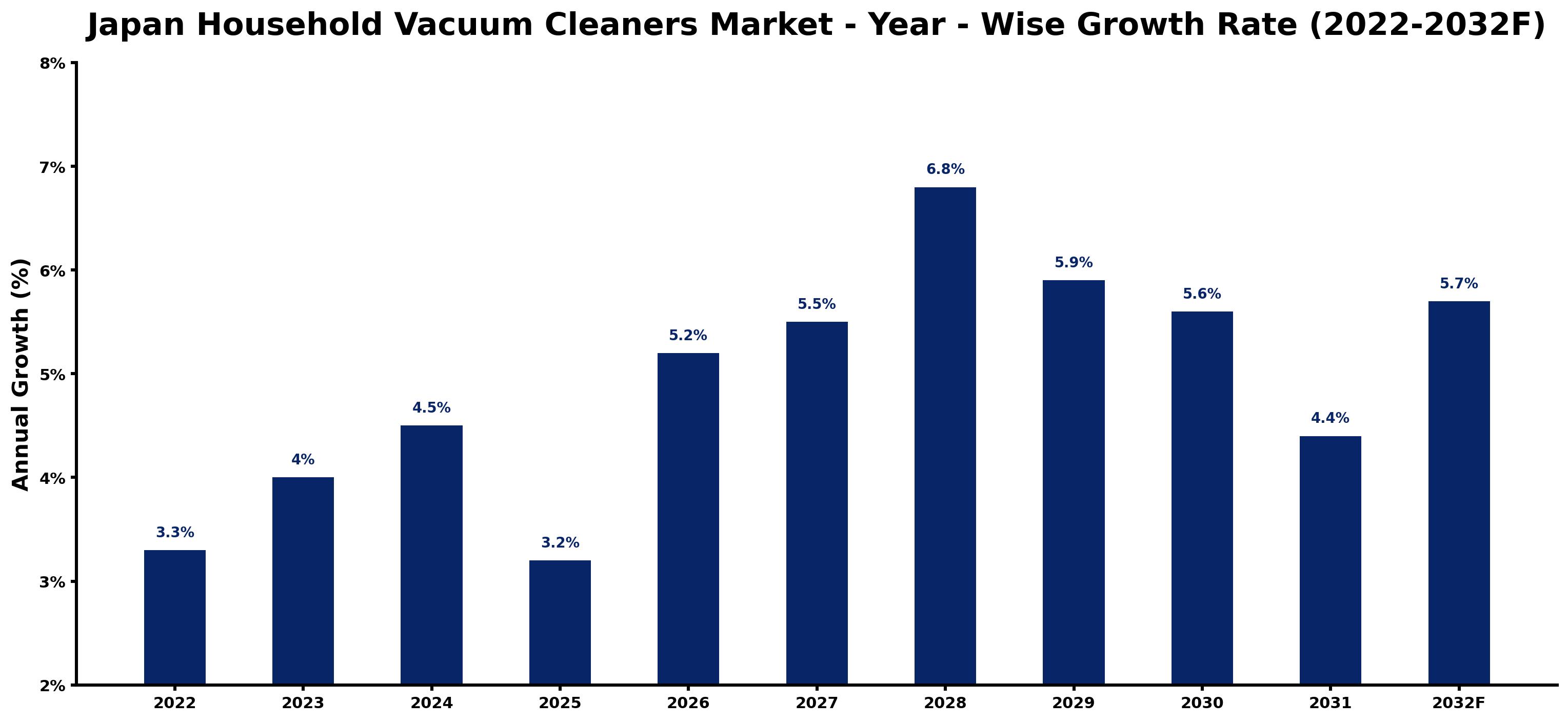
Below, each year's estimated growth is shown next to the factor that most influenced it.
| Year | Estimated Annual Growth (%) | Market Rationale |
| 2022 | 3.3 | The market showed steady growth with increasing consumer interest in efficient cleaning solutions. |
| 2023 | 4.0 | Demand accelerated as households sought advanced cleaning technologies for convenience. |
| 2024 | 4.5 | Growth continued as consumers invested in higher-quality vacuum cleaners for better performance. |
| 2025 | 3.2 | Growth slowed slightly due to market saturation and limited new product introductions. |
| 2026 | 5.2 | Demand is expected to pick up again as new features attract buyers seeking modern solutions. |
| 2027 | 5.5 | Consumer interest is projected to rise further with the introduction of energy-efficient models and smart technology. |
| 2028 | 6.8 | The market will peak as robotic vacuum cleaners gain popularity among tech-savvy households. |
| 2029 | 5.9 | Growth is expected to slow as competition intensifies and price sensitivity increases among buyers. |
| 2030 | 5.6 | Demand will continue to rise, driven by the growing trend of home automation and smart home integration. |
| 2031 | 4.4 | The market is projected to experience a slowdown as economic factors influence consumer spending habits. |
| 2032 | 5.7 | Growth is expected to accelerate again with new product launches and increased consumer awareness of cleaning technologies. |
Note: Market size estimations and growth projections presented in this report are based on 6Wresearch's proprietary forecasting methodology, utilizing the latest available industry data, government publications, and primary research inputs.
Japan Household Vacuum Cleaners Market Synopsis
Household vacuum cleaners are indispensable tools that utilise various technologies, including robotic and upright models, to ensure efficient cleaning. The Japan Household Vacuum Cleaners Market is growing due to a rising population of tech-savvy consumers and an increasing demand for energy-efficient models. The adoption of smart technologies and automation in cleaning solutions is further propelling market growth, reflecting a preference for convenience and efficiency in home maintenance.
Market Dynamics Impact Analysis (2026–2032)
| Factor | Type | Impact | Primary Segment Affected |
| Growing consumer preference for energy-efficient models | Driver | High | Robotic |
| Increasing adoption of smart home technologies | Driver | High | Upright |
| Expansion of online retail channels | Opportunity | High | Online |
| Rising demand for automated cleaning solutions | Opportunity | High | Self-Drive |
| Market saturation limiting new customer acquisition | Restraint | High | Floor Vacuum Cleaner |
| Economic fluctuations affecting consumer spending | Restraint | Medium | Robotic |
| Intense competition leading to price wars | Challenge | High | Upright |
| Supply chain disruptions impacting availability | Challenge | Medium | Self-Drive |
Evaluation of Drivers in Japan Household Vacuum Cleaners Market (2026–2032)
Demand rests on the following drivers, each shown with the segment it touches most.
| Drivers | Primary Segment Affected | Why It Matters (Evidence) |
| Increased consumer interest in energy-efficient models | Robotic | This interest is reflected in the 35% market share of robotic vacuum cleaners, appealing to eco-conscious buyers. |
| Adoption of smart home technologies | Upright | The growing trend of smart homes has led to increased sales of upright vacuum cleaners, as consumers seek integrated solutions. |
| Expansion of online retail channels | Online | Online sales are projected to grow by 7.1%, providing convenience and a wider selection for consumers. |
| Rising demand for automated cleaning solutions | Self-Drive | Self-drive models are expected to grow by 6.9%, as busy households prefer hands-free cleaning. |
| Technological advancements in vacuum cleaner features | Floor Vacuum Cleaner | Innovations in floor vacuum cleaners have led to increased sales, appealing to consumers seeking improved performance. |
Buyers are adding capacity as the market shifts towards energy-efficient and smart technologies. In 2023, approximately 124 million people in Japan supported a growing demand for advanced cleaning solutions. The introduction of smart home integration is expected to drive sales of robotic vacuum cleaners, which hold a 35% market share. The rise of online retail channels is projected to increase sales by 7.1%, making it easier for consumers to access a wider range of products. Self-drive models are expected to see increased popularity, reflecting the increasing preference for automated cleaning solutions. These factors are driving notable growth in the household vacuum cleaner market.
Evaluation of Restraints in Japan Household Vacuum Cleaners Market
These restraints slow adoption and weigh on supplier margins.
| Market Restraint | Primary Segment Affected | Why It Matters (Evidence) |
| Market saturation limiting new customer acquisition | Floor Vacuum Cleaner | With a 47% market share, floor vacuum cleaners face challenges in attracting new buyers due to limited differentiation. |
| Economic fluctuations affecting consumer spending | Robotic | Economic uncertainties have led to cautious spending, impacting the sales of higher-priced robotic models by 10%. |
| Intense competition leading to price wars | Upright | The presence of numerous brands has resulted in aggressive pricing strategies, affecting profit margins by 15%. |
| Supply chain disruptions impacting availability | Self-Drive | Recent supply chain issues have delayed product launches and reduced stock levels for self-drive vacuum cleaners. |
| Consumer preference for multifunctional devices | Window Vacuum Cleaner | As consumers seek versatile cleaning solutions, dedicated window vacuum cleaners face declining interest. |
Japan Household Vacuum Cleaners Market Challenges
High repair costs for vacuum cleaners stem from a shortage of skilled technicians, leading to delays that can increase maintenance expenses for households by up to 15%. Rising material costs, driven by supply chain issues, elevate production expenses for manufacturers, potentially raising retail prices by 10% for consumers. Strict environmental regulations impose compliance costs on producers, which can delay product launches and hinder competitiveness in the market. Intense competition from low-cost imports forces local manufacturers to reduce prices, negatively impacting profit margins and limiting their ability to invest in innovation.
Trends in the Japan Household Vacuum Cleaners Market
The shifts below are changing how Japan Household Vacuum Cleaners Market products are bought and supplied.
- Shift towards Smart Home Integration: Consumers increasingly seek vacuum cleaners that connect with home automation systems. In 2023, 30% of new vacuum models featured smart technology, appealing to tech-savvy households.
- Transition from Traditional to Robotic Models: Households are moving from traditional models to robotic vacuum cleaners, which offer convenience and efficiency. In 2023, robotic models accounted for 35% of the market, reflecting a growing preference for automation.
- Emergence of Online Sales Channels: Online sales channels are becoming a primary purchasing method for vacuum cleaners. In 2023, online sales are projected to grow by 7.1%, allowing consumers to access a wider range of products conveniently.
- Rising Demand for Energy-Efficient Models: There is a growing interest in energy-efficient vacuum cleaners, driven by eco-conscious consumers. In 2023, energy-efficient models represented 30% of sales, indicating a shift in buyer preferences.
Investment Opportunities in the Japan Household Vacuum Cleaners Market
Below are the investment opportunities with the strongest case in the Japan Household Vacuum Cleaners Market.
- Expansion of E-commerce Platforms: The growth of e-commerce platforms presents an opportunity for suppliers to reach consumers more effectively. With online sales projected to grow by 7.1%, investing in digital marketing strategies can improve visibility.
- Increased Demand for Smart Vacuum Cleaners: The current trend towards smart home technology creates an opportunity for manufacturers to develop innovative vacuum cleaners. Targeting tech-savvy consumers in urban areas can lead to increased sales, potentially growing by 8%.
- Development of Multifunctional Cleaning Devices: There is a growing demand for multifunctional cleaning devices that combine various cleaning capabilities. Suppliers can focus on developing such products to attract consumers looking for convenience.
- Investment in Sustainable Technologies: The shift towards sustainability offers an opportunity for manufacturers to invest in eco-friendly vacuum cleaners. With 30% of consumers prioritising energy efficiency, this market segment is ripe for growth.
Government Initiatives in the Japan Household Vacuum Cleaners Market
The AI Promotion Act (2025) establishes a national framework for AI research and development, enhancing the capabilities of household vacuum cleaners. This law builds on the Electrical Appliance and Material Safety Act (1961), which ensures that all electrical appliances, including vacuum cleaners, meet safety standards, thus protecting consumers and promoting trust in the market.
The Digital Agency, which leads government initiatives to fund digital transformation projects, supports the development of smart technologies in household appliances, including vacuum cleaners, ensuring that products meet modern consumer expectations. In 2023, the agency approved funding for 50 projects aimed at enhancing smart appliance features.
Future Insight of the Japan Household Vacuum Cleaners Market
The introduction of a national recycling initiative for household appliances in 2025 will drive suppliers to implement sustainable practices. By 2032, advancements in smart technology will lead to energy-efficient vacuum cleaners, attracting environmentally conscious buyers. Stricter energy standards will push manufacturers to innovate, ensuring compliance while enhancing product appeal. As Japan's population declines, the market will increasingly prioritise compact and multifunctional designs, catering to smaller living spaces and changing consumer preferences.
Market Segmentation Analysis
Japan Household Vacuum Cleaners Market report covers a detailed analysis of the following market segments:
By Operation Mode – Self-Drive Leads and Records the Fastest Growth
According to Dhaval Chaurasia, Assistant Manager at 6Wresearch, with 55% of operation mode revenue in 2025, Self-Drive was the largest category. Self-drive vacuum cleaners are preferred for their convenience and efficiency, particularly among busy households in urban settings. Their ability to operate autonomously makes them an attractive choice for consumers seeking to save time on cleaning chores. The same category is also set to grow fastest, at a CAGR of 6.9% during 2026–2032. The self-drive segment's growth is fuelled by a rising consumer preference for automated solutions, particularly in densely populated areas. As technology continues to advance, this segment is likely to see sustained growth, further widening its market lead. Suppliers should prioritise the development of advanced self-drive features to align with consumer preferences.
By Product – Robotic Leads, Upright Expected to Grow Fastest
Robotic held 35% of the Japan Household Vacuum Cleaners Market by product in 2025. Robotic vacuum cleaners dominate the market because they provide convenience and efficiency, appealing to busy households. Their integration with smart home technology has led to widespread adoption, particularly in urban areas where space is limited. Upright is set to record the highest CAGR in this split, 8.3% over 2026–2032. Upright vacuum cleaners are witnessing rapid growth due to their effectiveness in deep cleaning and adaptability to various surfaces. This increase is driven by a resurgence in consumer preference for traditional cleaning methods that deliver thorough results. Suppliers should focus on enhancing their robotic product lines, while buyers may benefit from considering upright models for specific cleaning needs.
By Mode of Sale – Offline Leads, Online Expected to Grow Fastest
The largest mode of sale category in 2025 was Offline, at 62% of revenue. Offline sales channels dominate as many consumers prefer to physically examine vacuum cleaners before making a purchase, ensuring they meet their needs. Retail locations in urban areas are essential in catering to this consumer preference. The quickest growth will come from Online, forecast to expand at a CAGR of 7.1% between 2026 and 2032. Online sales are rapidly increasing as e-commerce platforms provide convenience and competitive pricing, particularly appealing to younger, tech-savvy consumers. The growth of online shopping in recent years has accelerated this trend, shifting consumer behaviour. Suppliers must strengthen their online strategies to effectively engage the growing number of online shoppers.
By Type of Use – Floor Vacuum Cleaner Leads, Window Vacuum Cleaner Expected to Grow Fastest
Floor Vacuum Cleaner took 47% of type of use revenue in 2025, more than any other category. Floor vacuum cleaners are the most popular choice among consumers due to their effectiveness in maintaining cleanliness across various floor types, particularly in homes with pets. Their versatility and performance in everyday cleaning tasks contribute to their leading position. Over 2026–2032, Window Vacuum Cleaner is expected to post the fastest growth, at a CAGR of 7.6%. Window vacuum cleaners are gaining traction as consumers seek efficient solutions for maintaining cleanliness in hard-to-reach areas, particularly in urban settings with high-rise buildings. This segment's growth reflects a broader trend towards specialised cleaning tools. Suppliers should consider expanding their offerings to include more specialised cleaning solutions to meet emerging consumer needs.
Key Attractiveness of the Report
- 10 Years of Market Numbers
- Historical Data Starting from 2022 to 2025
- Base Year 2025
- Forecast Data until 2032
- Key Performance Indicators Impacting the Market
- Major Upcoming Developments and Projects
Key Highlights of the Report:
- Japan Household Vacuum Cleaners Market Outlook
- Market Size of Japan Household Vacuum Cleaners Market, 2025
- Forecast of Japan Household Vacuum Cleaners Market, 2032
- Historical Data and Forecast of Japan Household Vacuum Cleaners Revenues & Volume for the Period 2022-2032
- Japan Household Vacuum Cleaners Market Trend Evolution
- Japan Household Vacuum Cleaners Market Drivers and Challenges
- Japan Household Vacuum Cleaners Price Trends
- Japan Household Vacuum Cleaners Porter's Five Forces
- Japan Household Vacuum Cleaners Industry Life Cycle
- Historical Data and Forecast of Japan Household Vacuum Cleaners Market Revenues & Volume By Operation Mode for the Period 2022-2032
- Historical Data and Forecast of Japan Household Vacuum Cleaners Market Revenues & Volume By Self-Drive for the Period 2022-2032
- Historical Data and Forecast of Japan Household Vacuum Cleaners Market Revenues & Volume By Remote Control for the Period 2022-2032
- Historical Data and Forecast of Japan Household Vacuum Cleaners Market Revenues & Volume By Product for the Period 2022-2032
- Historical Data and Forecast of Japan Household Vacuum Cleaners Market Revenues & Volume By Upright for the Period 2022-2032
- Historical Data and Forecast of Japan Household Vacuum Cleaners Market Revenues & Volume By Canister for the Period 2022-2032
- Historical Data and Forecast of Japan Household Vacuum Cleaners Market Revenues & Volume By Central for the Period 2022-2032
- Historical Data and Forecast of Japan Household Vacuum Cleaners Market Revenues & Volume By Robotic for the Period 2022-2032
- Historical Data and Forecast of Japan Household Vacuum Cleaners Market Revenues & Volume By Drum for the Period 2022-2032
- Historical Data and Forecast of Japan Household Vacuum Cleaners Market Revenues & Volume By Wet/Dry for the Period 2022-2032
- Historical Data and Forecast of Japan Household Vacuum Cleaners Market Revenues & Volume By Other for the Period 2022-2032
- Historical Data and Forecast of Japan Household Vacuum Cleaners Market Revenues & Volume By Mode of Sale for the Period 2022-2032
- Historical Data and Forecast of Japan Household Vacuum Cleaners Market Revenues & Volume By Offline for the Period 2022-2032
- Historical Data and Forecast of Japan Household Vacuum Cleaners Market Revenues & Volume By Online for the Period 2022-2032
- Historical Data and Forecast of Japan Household Vacuum Cleaners Market Revenues & Volume By Type of Use for the Period 2022-2032
- Historical Data and Forecast of Japan Household Vacuum Cleaners Market Revenues & Volume By Floor Vacuum Cleaner for the Period 2022-2032
- Historical Data and Forecast of Japan Household Vacuum Cleaners Market Revenues & Volume By Window Vacuum Cleaner for the Period 2022-2032
- Historical Data and Forecast of Japan Household Vacuum Cleaners Market Revenues & Volume By Pool Vacuum Cleaner for the Period 2022-2032
- Japan Household Vacuum Cleaners Import Export Trade Statistics
- Market Opportunity Assessment By Operation Mode
- Market Opportunity Assessment By Product
- Market Opportunity Assessment By Mode of Sale
- Market Opportunity Assessment By Type of Use
- Japan Household Vacuum Cleaners Top Companies Market Share
- Japan Household Vacuum Cleaners Competitive Benchmarking By Technical and Operational Parameters
- Japan Household Vacuum Cleaners Company Profiles
- Japan Household Vacuum Cleaners Key Strategic Recommendations
Market Covered
The following segment groups are covered in the report.
By Operation Mode
- Self-Drive
- Remote Control
By Product
- Upright
- Canister
- Central
- Robotic
- Drum
- Wet/Dry
- Other
By Mode of Sale
- Offline
- Online
By Type of Use
- Floor Vacuum Cleaner
- Window Vacuum Cleaner
- Pool Vacuum Cleaner






































