Japan Hyperscale Data Center Market Size & Growth Rate (2026-2032)
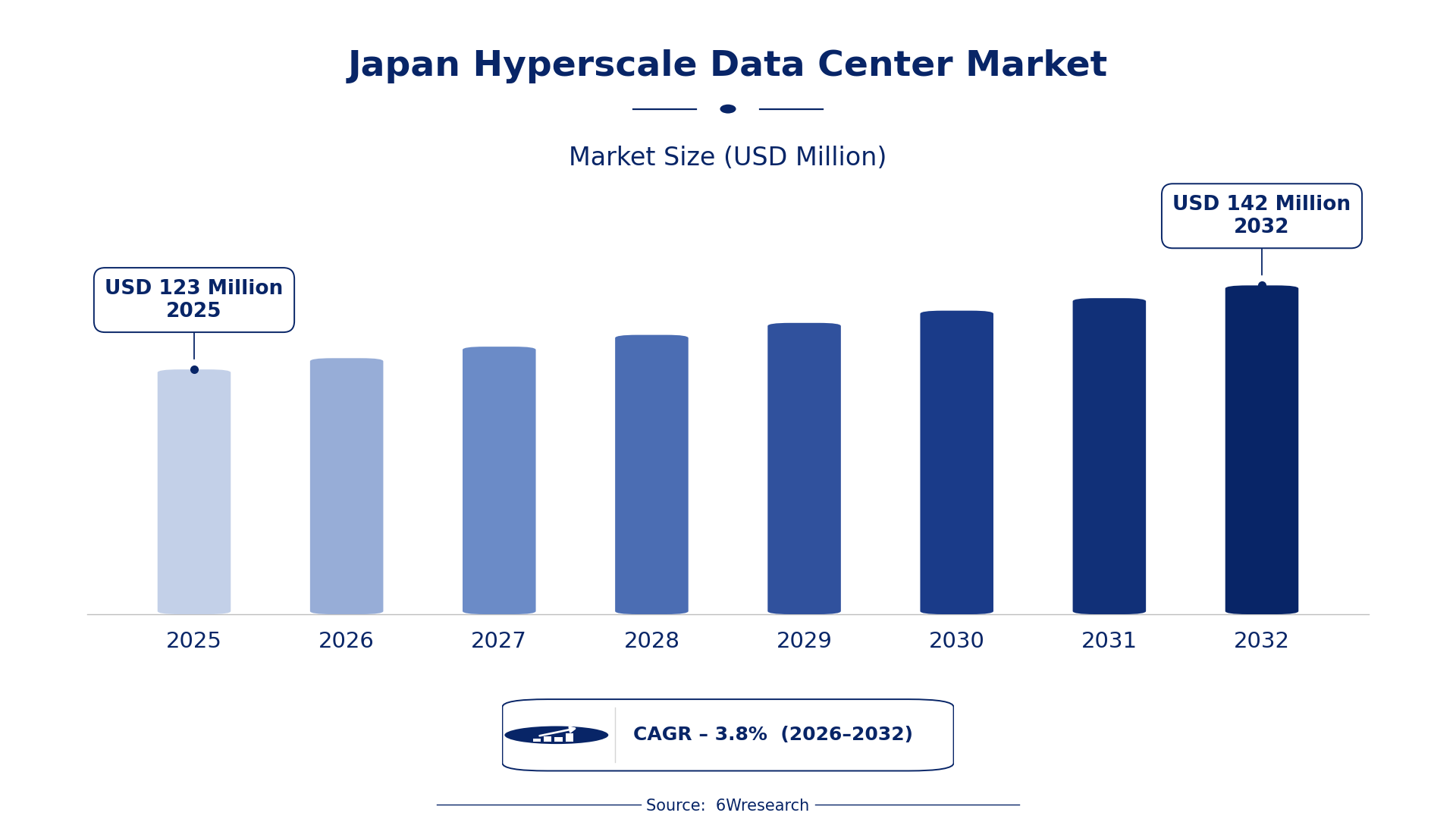
The Japan Hyperscale Data Center Market was estimated at USD 123 Million in 2025 and is projected to reach USD 142 Million by 2032, growing at a CAGR of 3.8% from 2026 to 2032.
Japan Hyperscale Data Center Market Synopsis
The demand for hyperscale data centers in Japan is surging, primarily fueled by the increasing reliance on cloud services and the rapid expansion of IoT technologies. Enterprises are recognizing the need for high-performance computing solutions that can keep pace with evolving data requirements.
Local businesses are transitioning towards advanced data storage and processing capabilities, driven by the necessity for Big Data analytics. The government's initiatives to promote digital transformation further bolster the growth of the hyperscale data center market in Japan.
Japan Hyperscale Data Center Market Year-wise Growth Rate and Key Drivers
This graph illustrates the annual growth rates of the Japan Hyperscale Data Center Market from 2021 to 2032, highlighting a steady upward trajectory and projected expansion over the forecast period.
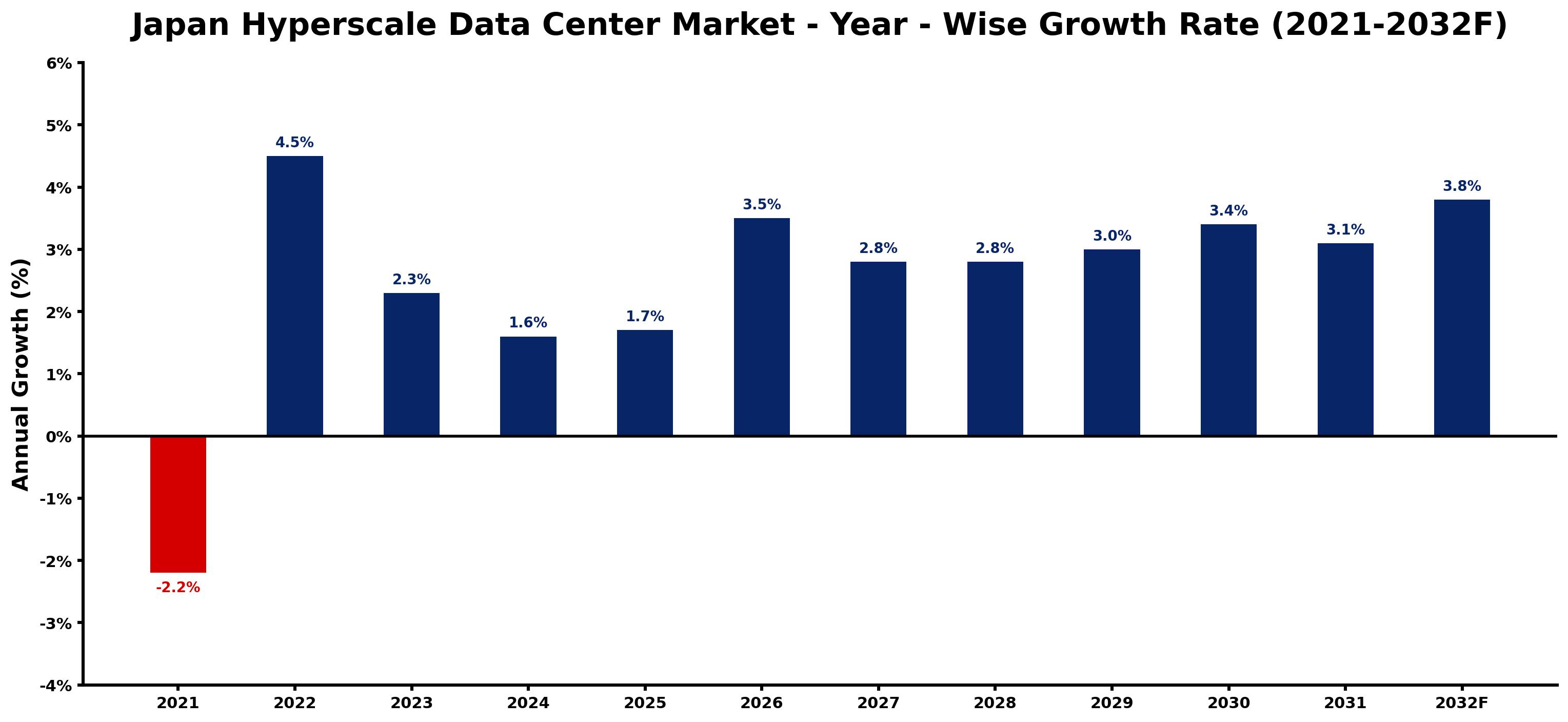
The table below presents the year‑wise growth rates along with the key drivers influencing the market
| Year | Growth Rate | Major Drivers |
| 2021 | -2.2% | Abe administration's digital economy initiatives lagging behind competitors. |
| 2022 | 4.5% | Increase in demand from Japan's 5G rollout initiatives. |
| 2023 | 2.3% | Growing adoption of cloud services in Japanese enterprises. |
| 2024 | 1.6% | Government incentives for data center energy efficiency projects. |
| 2025 | 1.7% | Rise of e-commerce boosting data processing requirements. |
| 2026 | 3.5% | Focus on sustainable data center practices by local firms. |
| 2027 | 2.8% | Emergence of AI applications driving infrastructure investments. |
| 2028 | 2.8% | Enhanced cybersecurity laws spurring data center resilience needs. |
| 2029 | 3.0% | Expanding digital entertainment sector requiring enhanced data storage. |
| 2030 | 3.4% | Increasing local investments in edge computing technologies. |
| 2031 | 3.1% | Proliferation of IoT devices necessitating larger data capacities. |
| 2032 | 3.8% | Regulatory support for data localization influencing data center expansions. |
Note: Market size estimations and growth projections presented in this report are based on 6Wresearch's proprietary forecasting methodology, utilizing the latest available industry data, government publications, and primary research inputs.
Japan Hyperscale Data Center Market Key Takeaways
Below are some of the specific key takeaways from the market, including:
- The market is expected to grow steadily, reaching USD 142 million by 2032.
- Energy efficiency and sustainability are becoming central to new data center designs.
- Edge computing is gaining traction as organizations seek to minimize latency.
- Government policies are actively supporting infrastructure investment in this sector.
- Challenges related to land availability and construction costs remain significant.
Evaluation of Restraints in Japan Hyperscale Data Center Market
The Japan hyperscale data center market faces several pressing constraints, notably the limited availability of land suitable for large-scale development. High population density in urban areas complicates site selection, leading to inflated construction costs. on top of that, stringent regulations surrounding energy usage and environmental impact add layers of complexity to the development process. These hurdles necessitate innovative solutions and close collaboration with local authorities to ensure sustainable growth.
Japan Hyperscale Data Center Market Trends
Current trends in the Japan hyperscale data center market point towards a growing emphasis on energy efficiency. Companies are increasingly adopting advanced cooling technologies to mitigate operational costs and reduce environmental footprints. Additionally, there is a marked shift towards modular data center solutions that allow for scalability and flexibility to adapt to changing demands.
The rise of edge computing is also notable, driven by the need for low-latency applications across various sectors. As businesses continue to embrace digital transformation, the demand for cloud-based services will likely intensify, propelling further investment into the hyperscale data center market.
Japan Hyperscale Data Center Market Opportunities
Investment opportunities abound in the Japan hyperscale data center market, particularly due to the growing need for cloud services and IoT applications. The country's established infrastructure and skilled workforce present a compelling case for long-term investments. With digital transformation at the forefront, companies that focus on scalable and energy-efficient solutions are well-positioned to capitalize on emerging trends.
Government initiatives aimed at promoting data security and infrastructure development further enhance the attractiveness of this market. Investors should pay close attention to the evolving regulatory landscape, which can offer incentives for entering the sector.
Government Initiatives in the Japan Hyperscale Data Center Market
The Japanese government plays a crucial role in shaping the hyperscale data center market through various policy initiatives. By focusing on attracting foreign investments and enhancing digital infrastructure, the government aims to position Japan as a competitive player in the global market. Public sector priorities, including energy efficiency and data security, are critical in guiding investment decisions.
- A recently completed initiative under the Japan Revitalization Strategy has attracted significant foreign investments in the data center sector.
- Current efforts include a national digital infrastructure upgrade program that emphasizes the development of energy-efficient data centers.
- A planned regulatory framework aimed at enhancing data center security is expected to roll out by 2026, mandating compliance with industry standards.
- Ongoing discussions around tax incentives for data center construction are expected to continue through 2025.
- Future initiatives targeting sustainable energy practices for data centers are anticipated to be introduced by the end of 2026.
Future Insights of the Japan Hyperscale Data Center Market
Looking ahead to 2026-2032, the Japan hyperscale data center market is set for notable advancements. Increased cloud adoption and the demand for efficient data storage will likely drive further investment. The integration of 5G technology is expected to enhance connectivity, providing new avenues for data center expansion. As competition intensifies, innovations in energy efficiency and sustainability practices will become essential for companies aiming to thrive.
Japan Hyperscale Data Center Market Latest Developments
Recent activity in the Japan hyperscale data center market reflects a strong commitment to innovation and efficiency. Over the past year, several initiatives have been launched, focusing on enhancing infrastructure and meeting growing data demands. Companies are increasingly prioritizing the development of energy-efficient solutions to align with evolving regulations and consumer expectations.
- A major technology vendor announced plans for a new data center focused on energy efficiency, expected to break ground in early 2026.
- An ongoing initiative aimed at integrating AI-driven cooling systems into existing data centers is currently in the testing phase.
- A leading regional operator is expanding its footprint by retrofitting older facilities with sustainable technologies, a project that began in late 2025 and remains underway.
- Plans for a joint venture focused on modular data center development are slated for launch in mid-2026.
- A recent partnership between government agencies and private firms aims to enhance cybersecurity measures across data centers, with implementation expected by late 2025.
Japan Hyperscale Data Center Market - Key Attractiveness of the Report
- 10 Years of Market Numbers
- Historical Data Starting from 2022 to 2025
- Base Year: 2025
- Forecast Data until 2032
- Key Performance Indicators Impacting the Market
- Major Upcoming Developments and Projects
Key Highlights of the Report:
- Japan Hyperscale Data Center Market Outlook
- Market Size of Japan Hyperscale Data Center Market, 2025
- Forecast of Japan Hyperscale Data Center Market, 2032
- Historical Data and Forecast of Japan Hyperscale Data Center Revenues & Volume for the Period 2022-2032F
- Japan Hyperscale Data Center Market Trend Evolution
- Japan Hyperscale Data Center Market Drivers and Challenges
- Japan Hyperscale Data Center Price Trends
- Japan Hyperscale Data Center Porter's Five Forces
- Japan Hyperscale Data Center Industry Life Cycle
- Historical Data and Forecast of Japan Hyperscale Data Center Market Revenues & Volume By Solution for the Period 2022-2032F
- Historical Data and Forecast of Japan Hyperscale Data Center Market Revenues & Volume By Server for the Period 2022-2032F
- Historical Data and Forecast of Japan Hyperscale Data Center Market Revenues & Volume By Storage for the Period 2022-2032F
- Historical Data and Forecast of Japan Hyperscale Data Center Market Revenues & Volume By Networking for the Period 2022-2032F
- Historical Data and Forecast of Japan Hyperscale Data Center Market Revenues & Volume By Software for the Period 2022-2032F
- Historical Data and Forecast of Japan Hyperscale Data Center Market Revenues & Volume By Service for the Period 2022-2032F
- Historical Data and Forecast of Japan Hyperscale Data Center Market Revenues & Volume By Consulting for the Period 2022-2032F
- Historical Data and Forecast of Japan Hyperscale Data Center Market Revenues & Volume By Installation and deployment for the Period 2022-2032F
- Historical Data and Forecast of Japan Hyperscale Data Center Market Revenues & Volume By Maintenance and support for the Period 2022-2032F
- Historical Data and Forecast of Japan Hyperscale Data Center Market Revenues & Volume By End-User for the Period 2022-2032F
- Historical Data and Forecast of Japan Hyperscale Data Center Market Revenues & Volume By Cloud providers for the Period 2022-2032F
- Historical Data and Forecast of Japan Hyperscale Data Center Market Revenues & Volume By Colocation providers for the Period 2022-2032F
- Historical Data and Forecast of Japan Hyperscale Data Center Market Revenues & Volume By Enterprises for the Period 2022-2032F
- Historical Data and Forecast of Japan Hyperscale Data Center Market Revenues & Volume By Data Center Size for the Period 2022-2032F
- Historical Data and Forecast of Japan Hyperscale Data Center Market Revenues & Volume By Small and medium-sized data centers for the Period 2022-2032F
- Historical Data and Forecast of Japan Hyperscale Data Center Market Revenues & Volume By Large data centers for the Period 2022-2032F
- Historical Data and Forecast of Japan Hyperscale Data Center Market Revenues & Volume By Industry for the Period 2022-2032F
- Historical Data and Forecast of Japan Hyperscale Data Center Market Revenues & Volume By Banking, Financial Services, and Insurance (BFSI) for the Period 2022-2032F
- Historical Data and Forecast of Japan Hyperscale Data Center Market Revenues & Volume By IT and telecom for the Period 2022-2032F
- Historical Data and Forecast of Japan Hyperscale Data Center Market Revenues & Volume By Research and academics for the Period 2022-2032F
- Historical Data and Forecast of Japan Hyperscale Data Center Market Revenues & Volume By Government and defense for the Period 2022-2032F
- Historical Data and Forecast of Japan Hyperscale Data Center Market Revenues & Volume By Retail for the Period 2022-2032F
- Historical Data and Forecast of Japan Hyperscale Data Center Market Revenues & Volume By Manufacturing for the Period 2022-2032F
- Historical Data and Forecast of Japan Hyperscale Data Center Market Revenues & Volume By Healthcare for the Period 2022-2032F
- Historical Data and Forecast of Japan Hyperscale Data Center Market Revenues & Volume By Media and entertainment for the Period 2022-2032F
- Japan Hyperscale Data Center Import Export Trade Statistics
- Market Opportunity Assessment By Solution
- Market Opportunity Assessment By Service
- Market Opportunity Assessment By End-User
- Market Opportunity Assessment By Data Center Size
- Market Opportunity Assessment By Industry
- Japan Hyperscale Data Center Top Companies Market Share
- Japan Hyperscale Data Center Competitive Benchmarking By Technical and Operational Parameters
- Japan Hyperscale Data Center Company Profiles
- Japan Hyperscale Data Center Key Strategic Recommendations






































