Japan Industrial Analytics Market Size & Growth Rate (2026-2032)
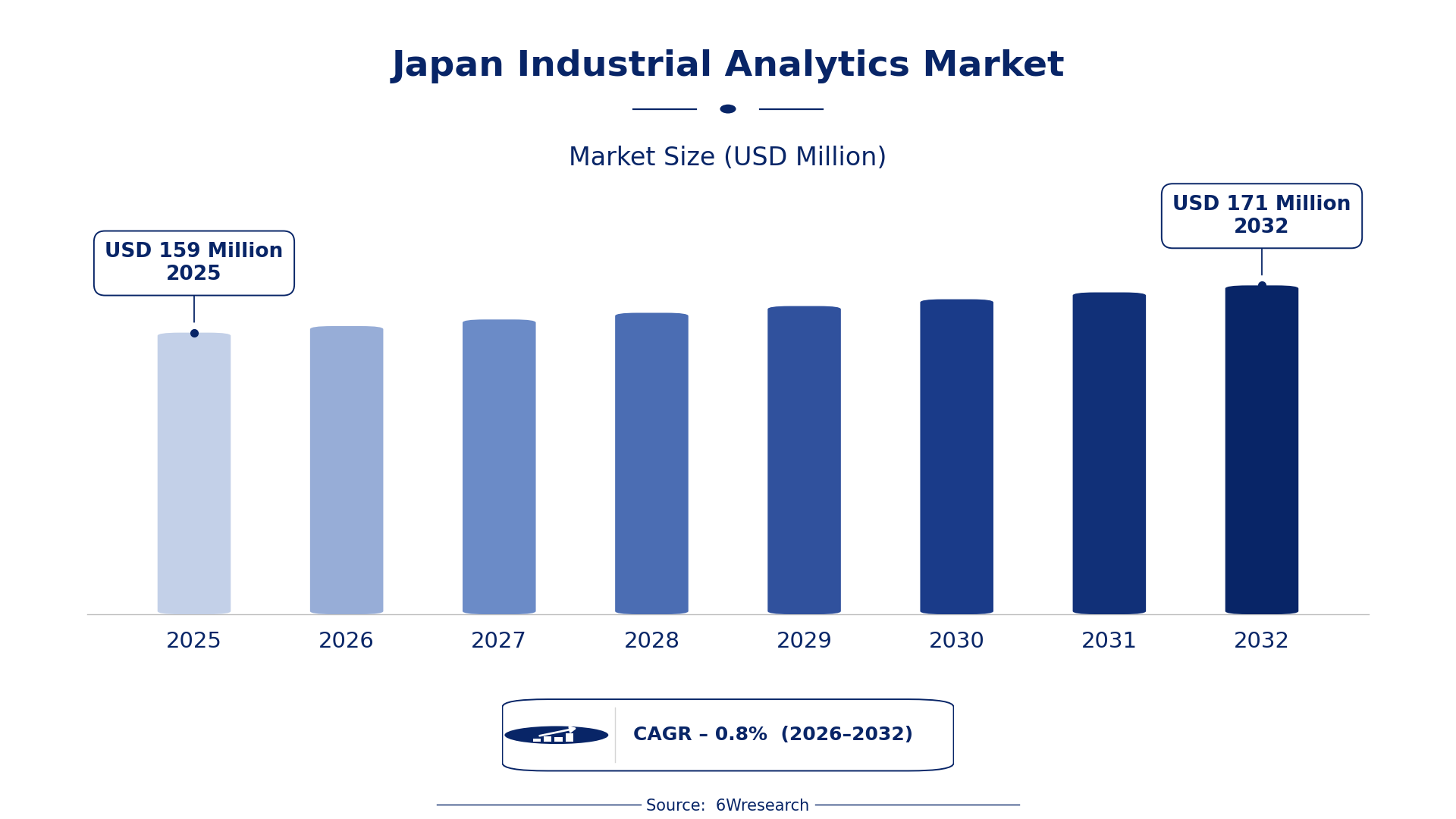
The Japan Industrial Analytics Market was estimated at USD 159 Million in 2025 and is projected to reach USD 171 Million by 2032, growing at a CAGR of 0.8% from 2026 to 2032.
Japan Industrial Analytics Market Synopsis
The Japan Industrial Analytics Market has witnessed substantial momentum, driven by technological advancements and a commitment to efficiency. As industries increasingly adopt big data analytics, AI, and machine learning, the demand for industrial analytics solutions is set to rise sharply, particularly in sectors like manufacturing and healthcare.
Looking ahead, the market is shifting towards more tailored analytics solutions that cater to specific industry needs. The push for smart manufacturing and Industry 4.0 initiatives is not merely a trend; it's a fundamental shift that will define the future of industrial operations in Japan.
Japan Industrial Analytics Market Year-wise Growth Rate and Key Drivers
This graph illustrates the annual growth rates of the Japan Industrial Analytics Market from 2021 to 2032, highlighting a steady upward trajectory and projected expansion over the forecast period.
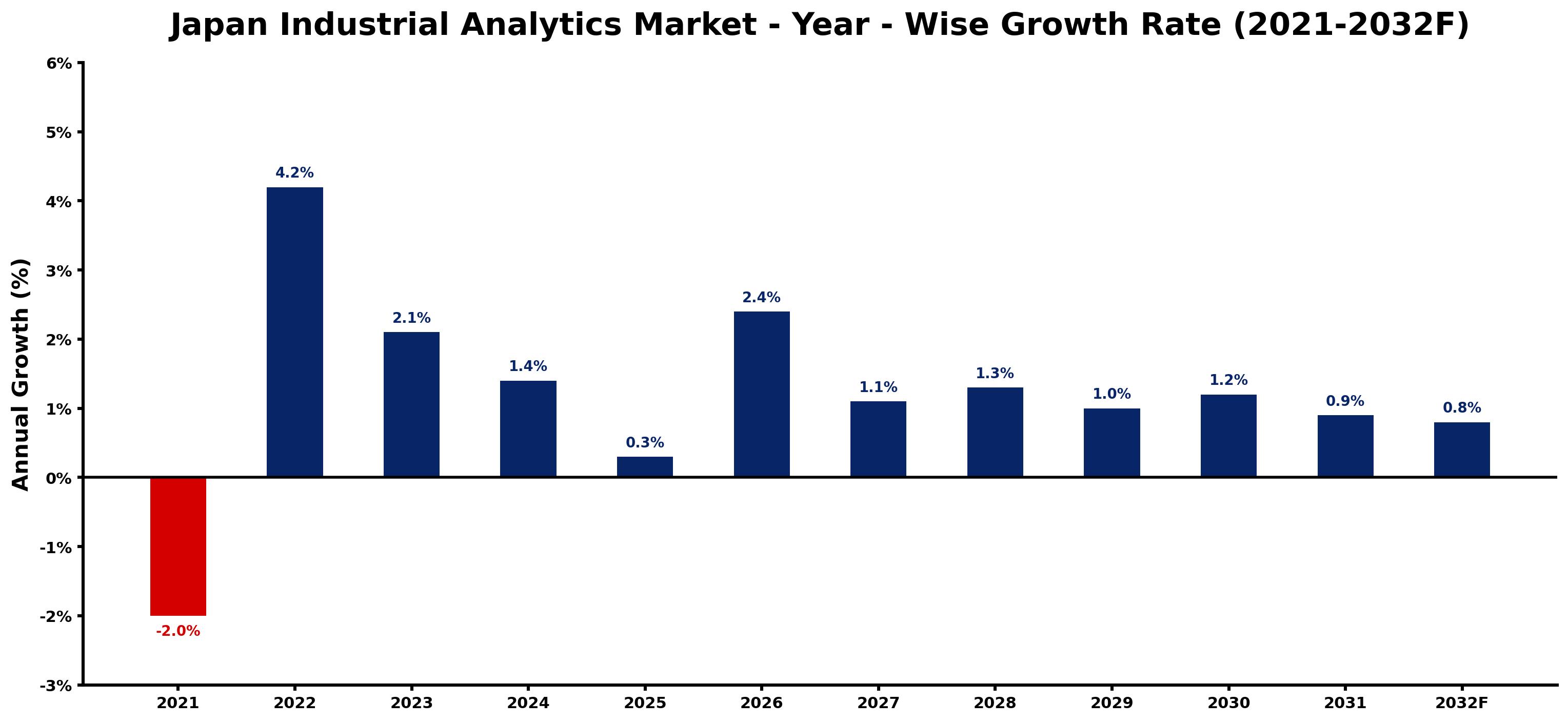
The table below presents the year‑wise growth rates along with the key drivers influencing the market
| Year | Growth Rate | Major Drivers |
| 2021 | -2.0% | Tokyo Stock Exchange volatility impacting corporate spending decisions. |
| 2022 | 4.2% | Government's Society 5.0 initiative drives digital transformation. |
| 2023 | 2.1% | Increased demand for predictive maintenance in manufacturing sectors. |
| 2024 | 1.4% | Aging workforce spurs automation and analytics adoption. |
| 2025 | 0.3% | Diverse industrial sectors seek efficiency through data insights. |
| 2026 | 2.4% | Digital twin technology adoption expands in manufacturing. |
| 2027 | 1.1% | Emergence of IoT applications enhances data collection capabilities. |
| 2028 | 1.3% | Investment in R&D bolsters analytics-driven decision-making. |
| 2029 | 1.0% | Increased focus on sustainable manufacturing fuels analytics growth. |
| 2030 | 1.2% | Growing interest in risk management analytics among businesses. |
| 2031 | 0.9% | Regulatory pressures prompt enhanced operational efficiency measures. |
| 2032 | 0.8% | Integration of AI technology elevates analytical capabilities. |
Note: Market size estimations and growth projections presented in this report are based on 6Wresearch's proprietary forecasting methodology, utilizing the latest available industry data, government publications, and primary research inputs.
Japan Industrial Analytics Market Key Takeaways
Below are some of the specific key takeaways from the market, including:
- The market is witnessing a growing reliance on predictive maintenance solutions to enhance operational performance.
- Real-time data collection via IoT devices is becoming a standard practice across industries.
- Cloud-based analytics platforms are on the rise, offering scalability and flexibility to businesses.
- Investment in talent and skills development is critical to address the shortage of qualified data professionals.
- Government initiatives aimed at promoting advanced technologies are significantly influencing market dynamics.
Evaluation of Restraints in Japan Industrial Analytics Market
Despite the promising growth trajectory, the Japan Industrial Analytics Market faces several hurdles. A critical issue is the shortage of skilled professionals who can effectively utilize advanced analytics tools. This talent gap hampers the ability of organizations to fully exploit data-driven insights. on top of that, integrating legacy systems with modern analytics platforms remains a daunting challenge, often leading to inefficiencies in real-time data capture and analysis. Coupled with rising data security concerns, particularly in regulated sectors, these factors could slow down the market’s advancement.
Japan Industrial Analytics Market Trends
Several key trends are shaping the Japan Industrial Analytics Market. The swift adoption of IoT devices enables real-time data collection, which is crucial for effective decision-making. Companies are increasingly utilizing advanced machine learning algorithms for predictive maintenance and quality control, resulting in reduced operational downtime. on top of that, the integration of AI-driven solutions is optimizing production workflows and enhancing productivity. As businesses seek to personalize their analytics solutions, a shift towards customized platforms is becoming apparent, reflecting the unique demands of various sectors.
Japan Industrial Analytics Market Opportunities
The potential for growth and investment in the Japan Industrial Analytics Market is substantial, particularly within the manufacturing sector. Companies are eager to adopt analytics solutions to refine production processes, enhance efficiency, and cut operational costs. There's a noteworthy opportunity for providers of predictive maintenance solutions, real-time monitoring systems, and AI-driven optimization tools. Additionally, analytics solutions that address specific challenges—such as quality control, energy management, and supply chain optimization—are in high demand, presenting further avenues for investment.
Government Initiatives in the Japan Industrial Analytics Market
The Japanese government has been instrumental in shaping the Industrial Analytics Market through various policies and initiatives. Recently, the Society 5.0 vision was launched, emphasizing the integration of IoT, big data, and AI across industries. Currently, the government is actively promoting the "Connected Industries" strategy, which encourages collaboration among businesses to foster innovation. Looking ahead, plans for the Moonshot R&D initiative aim to support cutting-edge technologies in industrial analytics, ensuring Japan remains competitive on the global stage.
Future Insights of the Japan Industrial Analytics Market
The outlook for the Japan Industrial Analytics Market from 2026 to 2032 is optimistic. Increasing adoption of IoT, big data analytics, and AI will drive demand for industrial analytics solutions that enhance operational efficiency and productivity. With a strong emphasis on predictive maintenance and quality control, businesses will seek to implement analytics strategies that improve their competitive edge. As government initiatives continue to promote smart manufacturing and Industry 4.0 practices, the market is expected to expand steadily, offering lucrative opportunities for technology providers.
Japan Industrial Analytics Market Latest Developments
In the past year, the Japan Industrial Analytics Market has seen notable developments. A leading technology vendor launched a new predictive maintenance platform in early 2025, which was completed by late 2025, allowing manufacturers to optimize their operations. Currently, another major operator is rolling out a comprehensive real-time monitoring system, aimed at enhancing data-driven decision-making, and this initiative began in mid-2025 and remains underway. Additionally, plans for an upcoming AI-driven optimization tool, expected to begin in the second half of 2026, are generating considerable interest among industry stakeholders.
Japan Industrial Analytics Market - Key Attractiveness of the Report
- 10 Years of Market Numbers
- Historical Data Starting from 2022 to 2025
- Base Year: 2025
- Forecast Data until 2032
- Key Performance Indicators Impacting the Market
- Major Upcoming Developments and Projects
Key Highlights of the Report:
- Japan Industrial Analytics Market Outlook
- Market Size of Japan Industrial Analytics Market, 2025
- Forecast of Japan Industrial Analytics Market, 2032
- Historical Data and Forecast of Japan Industrial Analytics Revenues & Volume for the Period 2022-2032F
- Japan Industrial Analytics Market Trend Evolution
- Japan Industrial Analytics Market Drivers and Challenges
- Japan Industrial Analytics Price Trends
- Japan Industrial Analytics Porter's Five Forces
- Japan Industrial Analytics Industry Life Cycle
- Historical Data and Forecast of Japan Industrial Analytics Market Revenues & Volume By Component for the Period 2022-2032F
- Historical Data and Forecast of Japan Industrial Analytics Market Revenues & Volume By Software for the Period 2022-2032F
- Historical Data and Forecast of Japan Industrial Analytics Market Revenues & Volume By Service for the Period 2022-2032F
- Historical Data and Forecast of Japan Industrial Analytics Market Revenues & Volume By Software for the Period 2022-2032F
- Historical Data and Forecast of Japan Industrial Analytics Market Revenues & Volume By Operational analytics for the Period 2022-2032F
- Historical Data and Forecast of Japan Industrial Analytics Market Revenues & Volume By Risk analytics for the Period 2022-2032F
- Historical Data and Forecast of Japan Industrial Analytics Market Revenues & Volume By Financial analytics for the Period 2022-2032F
- Historical Data and Forecast of Japan Industrial Analytics Market Revenues & Volume By Marketing analytics for the Period 2022-2032F
- Historical Data and Forecast of Japan Industrial Analytics Market Revenues & Volume By Customer analytics for the Period 2022-2032F
- Historical Data and Forecast of Japan Industrial Analytics Market Revenues & Volume By Workforce analytics for the Period 2022-2032F
- Historical Data and Forecast of Japan Industrial Analytics Market Revenues & Volume By Service for the Period 2022-2032F
- Historical Data and Forecast of Japan Industrial Analytics Market Revenues & Volume By Managed services for the Period 2022-2032F
- Historical Data and Forecast of Japan Industrial Analytics Market Revenues & Volume By Professional services for the Period 2022-2032F
- Historical Data and Forecast of Japan Industrial Analytics Market Revenues & Volume By Analytics Type for the Period 2022-2032F
- Historical Data and Forecast of Japan Industrial Analytics Market Revenues & Volume By Descriptive for the Period 2022-2032F
- Historical Data and Forecast of Japan Industrial Analytics Market Revenues & Volume By Diagnostic for the Period 2022-2032F
- Historical Data and Forecast of Japan Industrial Analytics Market Revenues & Volume By Predictive for the Period 2022-2032F
- Historical Data and Forecast of Japan Industrial Analytics Market Revenues & Volume By Prescriptive for the Period 2022-2032F
- Historical Data and Forecast of Japan Industrial Analytics Market Revenues & Volume By Organization size for the Period 2022-2032F
- Historical Data and Forecast of Japan Industrial Analytics Market Revenues & Volume By Large enterprises for the Period 2022-2032F
- Historical Data and Forecast of Japan Industrial Analytics Market Revenues & Volume By Small and medium-sized enterprises for the Period 2022-2032F
- Japan Industrial Analytics Import Export Trade Statistics
- Market Opportunity Assessment By Component
- Market Opportunity Assessment By Software
- Market Opportunity Assessment By Service
- Market Opportunity Assessment By Analytics Type
- Market Opportunity Assessment By Organization size
- Japan Industrial Analytics Top Companies Market Share
- Japan Industrial Analytics Competitive Benchmarking By Technical and Operational Parameters
- Japan Industrial Analytics Company Profiles
- Japan Industrial Analytics Key Strategic Recommendations






































