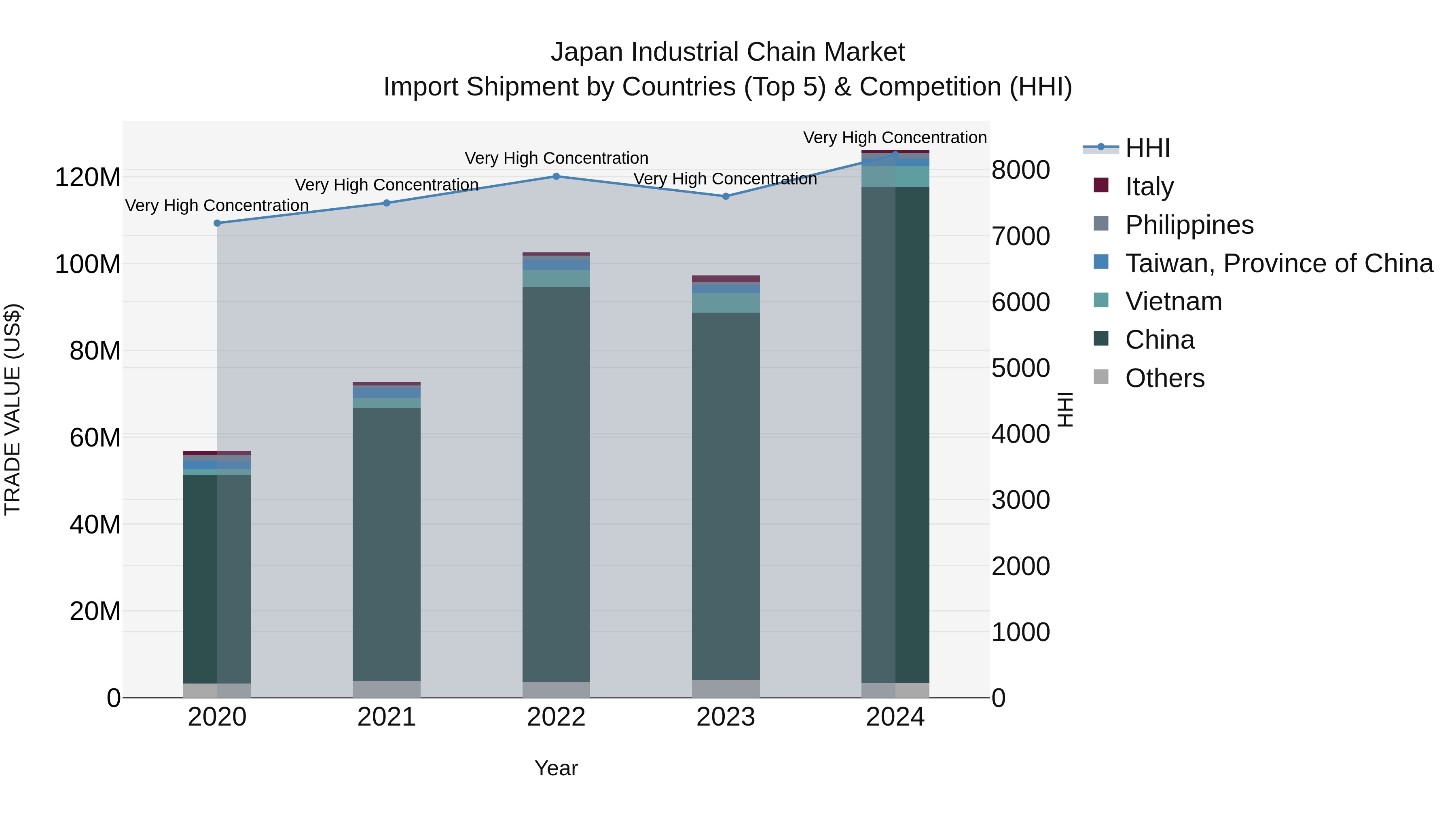
Japan Industrial Chain Market Import Shipment by Countries (Top 5) & Competition (HHI)
Japan's industrial chain import shipments in 2024 continue to be dominated by key Asian exporters, with China, Vietnam, Taiwan, Province of China, Philippines, and South Korea leading the pack. The high Herfindahl-Hirschman Index (HHI) indicates a concentrated market, while the impressive Compound Annual Growth Rate (CAGR) of 22.07% from 2020 to 2024 demonstrates strong sustained growth. Furthermore, the growth rate of 29.72% from 2023 to 2024 highlights the rapid expansion of import volumes in the industry, showcasing the ongoing importance of these key trading partners to Japan's industrial supply chain.
Japan Industrial Chain Market Market Overview
The Japan industrial chain market is a robust and highly competitive sector characterized by a diverse range of players including manufacturers, distributors, and suppliers. The market is driven by the country`s strong industrial base across various sectors such as automotive, electronics, and machinery. Japanese industrial chains are known for their high quality, reliability, and advanced technology, making them sought after both domestically and internationally. Key players in the market include Tsubakimoto Chain Co., Hitachi Metals, and Daido Kogyo Co., among others. The market is witnessing steady growth due to increasing industrialization and automation in Japan, as well as the growing demand for efficient and durable chain solutions across different industries. Continuous innovation and technological advancements are key factors shaping the future growth of the Japan industrial chain market.
Japan Industrial Chain Market Trends
In the Japan industrial chain market, a key trend is the increasing focus on automation and digitization to enhance efficiency and productivity. Companies are investing in advanced technologies such as robotics, Internet of Things (IoT), and artificial intelligence to streamline manufacturing processes and minimize downtime. Another notable trend is the shift towards sustainable practices, with a growing emphasis on eco-friendly materials and energy-efficient production methods. Additionally, there is a rising demand for customized industrial chains to meet specific requirements across various sectors such as automotive, electronics, and healthcare. Overall, the Japan industrial chain market is witnessing a transformation towards smart, sustainable, and flexible solutions to meet the evolving needs of industries in the country.
Japan Industrial Chain Market Challenges
In the Japan industrial chain market, several challenges are prevalent. One major challenge is the increasing competition from other countries in the region, which puts pressure on Japanese manufacturers to innovate and improve efficiency to remain competitive. Additionally, the aging workforce in Japan poses a challenge in terms of skilled labor availability and knowledge transfer to the younger generation. Another significant challenge is the impact of global economic fluctuations and trade tensions on the market, affecting demand and supply chains. Moreover, the need to adhere to strict regulatory standards and environmental regulations adds complexity and cost to the industrial chain operations in Japan. Overall, addressing these challenges requires strategic planning, investment in technology and workforce development, and collaboration with international partners to stay resilient in the evolving market landscape.
Japan Industrial Chain Market Investment Opportunities
In the Japan industrial chain market, there are several investment opportunities worth considering. One area of interest is advanced manufacturing technologies, such as robotics and automation, which are increasingly being adopted by Japanese companies to improve efficiency and competitiveness. Another promising opportunity lies in the development of eco-friendly industrial solutions, including renewable energy systems and sustainable manufacturing practices, as Japan aims to reduce its environmental impact and achieve carbon neutrality. Additionally, investments in supply chain management software and logistics solutions are crucial for optimizing operations in the complex and interconnected industrial chain network of Japan. Overall, the Japan industrial chain market offers diverse investment prospects for those looking to capitalize on technological advancements and sustainability initiatives in the industry.
Japan Industrial Chain Market Government Policy
The Japanese government has implemented several policies to support the industrial chain market, including the Promotion of Science and Technology Innovation policy to encourage research and development activities, the Industrial Structure Vision 2050 to promote sustainable growth and innovation in key industries, and the Regional Revitalization Strategy to support the development of local industries. Additionally, the government has introduced measures to enhance industrial competitiveness, such as the Japan Revitalization Strategy and the New Growth Strategy. These policies aim to strengthen the industrial chain market by fostering innovation, supporting small and medium-sized enterprises, and promoting collaboration between industry and academia. Overall, the government`s initiatives seek to drive economic growth, enhance productivity, and ensure the long-term sustainability of the industrial chain market in Japan.
Japan Industrial Chain Market Future Outlook
The future outlook for the Japan industrial chain market appears positive, driven by factors such as increasing industrial automation, technological advancements, and the growing adoption of smart manufacturing practices. These trends are expected to fuel the demand for high-quality industrial chains that are essential components in various machinery and equipment used across industries such as automotive, manufacturing, and transportation. Additionally, the focus on improving operational efficiency and reducing maintenance costs is likely to drive the market growth further. However, challenges such as the impact of the COVID-19 pandemic on supply chains and economic uncertainties remain potential obstacles. Overall, the Japan industrial chain market is poised for steady growth in the coming years, with opportunities for innovation and expansion in both domestic and international markets.
Key Highlights of the Report:
- Japan Industrial Chain Market Outlook
- Market Size of Japan Industrial Chain Market,2024
- Forecast of Japan Industrial Chain Market, 2031
- Historical Data and Forecast of Japan Industrial Chain Revenues & Volume for the Period 2021-2031
- Japan Industrial Chain Market Trend Evolution
- Japan Industrial Chain Market Drivers and Challenges
- Japan Industrial Chain Price Trends
- Japan Industrial Chain Porter's Five Forces
- Japan Industrial Chain Industry Life Cycle
- Historical Data and Forecast of Japan Industrial Chain Market Revenues & Volume By Chain Type for the Period 2021-2031
- Historical Data and Forecast of Japan Industrial Chain Market Revenues & Volume By Roller Chains for the Period 2021-2031
- Historical Data and Forecast of Japan Industrial Chain Market Revenues & Volume By Leaf Chains for the Period 2021-2031
- Historical Data and Forecast of Japan Industrial Chain Market Revenues & Volume By Silent Chains for the Period 2021-2031
- Historical Data and Forecast of Japan Industrial Chain Market Revenues & Volume By Engineered Chains for the Period 2021-2031
- Historical Data and Forecast of Japan Industrial Chain Market Revenues & Volume By Material Used for the Period 2021-2031
- Historical Data and Forecast of Japan Industrial Chain Market Revenues & Volume By Stainless Steel for the Period 2021-2031
- Historical Data and Forecast of Japan Industrial Chain Market Revenues & Volume By Carbon Steel for the Period 2021-2031
- Historical Data and Forecast of Japan Industrial Chain Market Revenues & Volume By Alloy Steel for the Period 2021-2031
- Historical Data and Forecast of Japan Industrial Chain Market Revenues & Volume By Nickel-Plated Steel for the Period 2021-2031
- Historical Data and Forecast of Japan Industrial Chain Market Revenues & Volume By Application for the Period 2021-2031
- Historical Data and Forecast of Japan Industrial Chain Market Revenues & Volume By Conveyor Systems for the Period 2021-2031
- Historical Data and Forecast of Japan Industrial Chain Market Revenues & Volume By Power Transmission for the Period 2021-2031
- Historical Data and Forecast of Japan Industrial Chain Market Revenues & Volume By Lifting Applications for the Period 2021-2031
- Historical Data and Forecast of Japan Industrial Chain Market Revenues & Volume By Mining & Drilling for the Period 2021-2031
- Historical Data and Forecast of Japan Industrial Chain Market Revenues & Volume By End User for the Period 2021-2031
- Historical Data and Forecast of Japan Industrial Chain Market Revenues & Volume By Manufacturing for the Period 2021-2031
- Historical Data and Forecast of Japan Industrial Chain Market Revenues & Volume By Automotive for the Period 2021-2031
- Historical Data and Forecast of Japan Industrial Chain Market Revenues & Volume By Construction for the Period 2021-2031
- Historical Data and Forecast of Japan Industrial Chain Market Revenues & Volume By Oil & Gas for the Period 2021-2031
- Historical Data and Forecast of Japan Industrial Chain Market Revenues & Volume By Sales Model for the Period 2021-2031
- Historical Data and Forecast of Japan Industrial Chain Market Revenues & Volume By Direct Sales for the Period 2021-2031
- Historical Data and Forecast of Japan Industrial Chain Market Revenues & Volume By Distributors for the Period 2021-2031
- Historical Data and Forecast of Japan Industrial Chain Market Revenues & Volume By Online Suppliers for the Period 2021-2031
- Historical Data and Forecast of Japan Industrial Chain Market Revenues & Volume By Industrial Suppliers for the Period 2021 - 2029
- Japan Industrial Chain Import Export Trade Statistics
- Market Opportunity Assessment By Chain Type
- Market Opportunity Assessment By Material Used
- Market Opportunity Assessment By Application
- Market Opportunity Assessment By End User
- Market Opportunity Assessment By Sales Model
- Japan Industrial Chain Top Companies Market Share
- Japan Industrial Chain Competitive Benchmarking By Technical and Operational Parameters
- Japan Industrial Chain Company Profiles
- Japan Industrial Chain Key Strategic Recommendations






































