Japan Industrial Computers Market Summary
The japan industrial computers market was estimated at USD 185 Million in 2025 and is projected to reach USD 198 Million by 2032, growing at a CAGR of 2.1% from 2026 to 2032.
Japan Industrial Computers Market Year-wise Growth Rate and Key Drivers
This graph highlights how the Japan Industrial Computers Market has steadily grown over the past five years, supported by major growth factors.
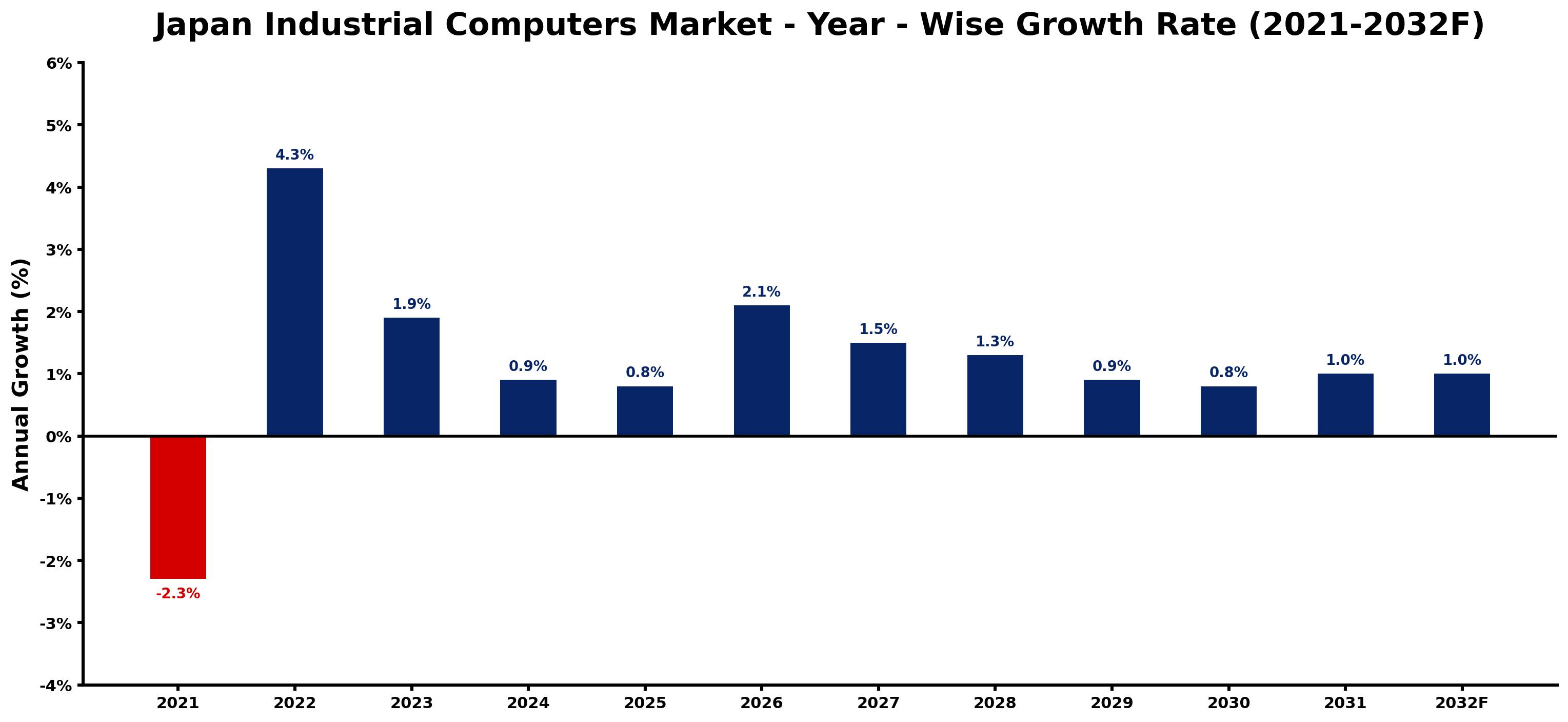
The table below presents the year wise growth rates along with the key drivers influencing the market
| Year | Growth Rate | Major Drivers |
| 2021 | -2.3% | Supply chain disruptions hindered timely delivery of industrial computer components, stifling production capabilities and sales. |
| 2022 | 4.3% | Supply chain disruptions prompted businesses to invest in more resilient computing solutions. |
| 2023 | 1.9% | Sustainability concerns encouraged firms to explore energy-efficient industrial computing platforms. |
| 2024 | 0.9% | Technological upgrades became essential for maintaining competitive production capabilities across sectors. |
| 2025 | 0.8% | The increased complexity of manufacturing processes necessitated advanced software-driven computing solutions. |
| 2026 | 2.1% | Cybersecurity threats highlighted the need for robust, secure industrial computer systems. |
| 2027 | 1.5% | Urban industrial development drove demand for localized computing solutions in Japan's cities. |
| 2028 | 1.3% | The shift toward smart factories required integration of IoT technologies with industrial computing. |
| 2029 | 0.9% | Rising competition in the global market urged companies to enhance operational efficiencies. |
| 2030 | 0.8% | Evolving consumer expectations pushed industries to adopt real-time data processing capabilities. |
| 2031 | 1.0% | Integration of AI technologies in manufacturing reshaped traditional approaches to industrial computing. |
| 2032 | 1.0% | Cross-industry collaborations fostered innovation in specialized industrial computer applications. |
Note - Market size estimations and growth projections presented in this report are based on 6Wresearch's advanced forecasting approach, validated with industry datasets as of June 2026.
Japan Industrial Computers Market Synopsis
The Japan Industrial Computers Market is projected to reach 2.1% and witness significant growth during the forecast period (2026-2032). This market is characterized by rapid advancements in technology and a robust demand for automation solutions across multiple industries including manufacturing, automotive, and healthcare. Industrial computers are integral to processes such as monitoring, data acquisition, and machine vision applications, thereby playing a crucial role in driving operational efficiencies and productivity. The growth trajectory of this market is closely linked to Japan's commitment to innovation and the ongoing digital transformation shaping its industrial landscape.
Japan Industrial Computers Market Growth Drivers
Several factors are propelling the growth of the Japan Industrial Computers Market. Firstly, the increasing adoption of Industry 4.0 technologies is a notable driver, fostering the integration of IoT and artificial intelligence in industrial applications. Secondly, the need for rugged and reliable computers that can operate effectively in harsh environments is elevating demand, particularly within sectors predisposed to extreme conditions. Thirdly, the surge in automation initiatives across various industries contributes to the push for advanced industrial computing solutions. Additionally, evolving customer expectations for tailored solutions necessitate adaptability and innovation from manufacturers. Finally, Japan's emphasis on smart factory initiatives creates a fertile environment for the proliferation of industrial computing technology.
Japan Industrial Computers Market Trends and Opportunities
The Japan Industrial Computers Market is witnessing compelling trends that suggest a bright future for investment and growth. The proliferation of IoT technology across multiple sectors is fostering a shift towards industrial computers equipped with advanced connectivity that supports real-time data exchange. Further, there is a marked increase in the demand for compact and energy-efficient industrial computers, which are essential for optimizing space and reducing energy costs in production environments. The trend of incorporating AI capabilities into industrial computers is becoming more pronounced, opening doors to new applications in machine learning and predictive maintenance. Moreover, the ongoing push for digitization and automation continues to drive interest in sophisticated industrial computing solutions capable of enhancing operational capabilities.
Japan Industrial Computers Market Challenges and Restraints
While the Japan Industrial Computers Market shows promising growth, it is not without its challenges. Intense competition from global manufacturers places significant pressure on local firms to innovate and remain price competitive. Rapid technological advancements necessitate constant investment in research and development, compelling companies to adapt swiftly to changing market dynamics. Furthermore, the stringent regulatory landscape and quality standards in Japan can impede the efficient development and deployment of new products. Finally, catering to the increasing customer demand for customizable solutions can strain production capabilities, requiring manufacturers to achieve a finer balance between mass production and bespoke offerings.
Japan Industrial Computers Market Investment Opportunities
Investment opportunities within the Japan Industrial Computers Market are robust due to the nation's advanced technological ecosystem and manufacturing expertise. Key areas for investment include rugged industrial PCs, embedded systems, and panel PCs tailored for critical applications in factory automation, robotics, and automotive industries. The push for smart factories and the integration of IoT technologies position the market as an attractive prospect for investors seeking high-quality, high-performance computing solutions. Additionally, the rise of emerging firms specializing in AI-integrated systems and enhanced cybersecurity measures presents unique opportunities for investment. Collectively, these factors contribute to a dynamic and evolving investment landscape in the realm of industrial computing.
Japan Industrial Computers Market Government Investment and Initiatives
The Japanese government has implemented various policies aimed at enhancing the country's industrial computing sector. Initiatives such as the "Society 5.0" vision emphasize the integration of advanced digital technologies across industries, promoting innovation while ensuring cybersecurity. Furthermore, the government provides incentives and subsidies to encourage companies to invest in automation and digital transformation projects. Regulatory frameworks are continuously updated to improve the security and reliability of industrial control systems, which is crucial for protecting critical infrastructure. These government-led initiatives function as catalysts for growth, fostering a competitive environment that underscores Japan's commitment to remaining a leader in industrial technology advancements.
Japan Industrial Computers Market Latest Developments (May 2025 - June 2026)
In the period from May 2025 to June 2026, the Japan Industrial Computers Market has undergone significant developments characterized by increased investment in research and development activities. Companies are focusing on enhancing the functionality of industrial computers, infusing them with advanced AI capabilities to facilitate autonomous operations. There is also a discernible trend towards the adoption of more sustainable production practices within the sector, propelling the need for energy-efficient computing solutions. Collaborations among industry stakeholders to develop next-generation ruggedized computers that can withstand extreme environmental conditions have become more common. Moreover, initiatives aimed at bolstering the cybersecurity framework for industrial systems have gained importance as companies look to safeguard critical operations against emerging threats.
Japan Industrial Computers Market - Key Attractiveness of the Report
- 10 Years of Market Numbers
- Historical Data Starting from 2022 to 2025
- Base Year: 2025
- Forecast Data until 2032
- Key Performance Indicators Impacting the Market
- Major Upcoming Developments and Projects
Key Highlights of the Report:
- Japan Industrial Computers Market Outlook
- Market Size of Japan Industrial Computers Market, 2025
- Forecast of Japan Industrial Computers Market, 2032F
- Historical Data and Forecast of Japan Industrial Computers Revenues & Volume for the Period 2022-2032F
- Japan Industrial Computers Market Trend Evolution
- Japan Industrial Computers Market Drivers and Challenges
- Japan Industrial Computers Price Trends
- Japan Industrial Computers Porter's Five Forces
- Japan Industrial Computers Industry Life Cycle
- Historical Data and Forecast of Japan Industrial Computers Market Revenues & Volume By Type for the Period 2022-2032F
- Historical Data and Forecast of Japan Industrial Computers Market Revenues & Volume By Panel for the Period 2022-2032F
- Historical Data and Forecast of Japan Industrial Computers Market Revenues & Volume By Box for the Period 2022-2032F
- Historical Data and Forecast of Japan Industrial Computers Market Revenues & Volume By Embedded for the Period 2022-2032F
- Historical Data and Forecast of Japan Industrial Computers Market Revenues & Volume By Din Rail for the Period 2022-2032F
- Historical Data and Forecast of Japan Industrial Computers Market Revenues & Volume By Rack Mount for the Period 2022-2032F
- Historical Data and Forecast of Japan Industrial Computers Market Revenues & Volume By Thin Client for the Period 2022-2032F
- Historical Data and Forecast of Japan Industrial Computers Market Revenues & Volume By Technology for the Period 2022-2032F
- Historical Data and Forecast of Japan Industrial Computers Market Revenues & Volume By Resistive for the Period 2022-2032F
- Historical Data and Forecast of Japan Industrial Computers Market Revenues & Volume By Capacitive for the Period 2022-2032F
- Historical Data and Forecast of Japan Industrial Computers Market Revenues & Volume By Others for the Period 2022-2032F
- Historical Data and Forecast of Japan Industrial Computers Market Revenues & Volume By ?End Use for the Period 2022-2032F
- Historical Data and Forecast of Japan Industrial Computers Market Revenues & Volume By Automotive for the Period 2022-2032F
- Historical Data and Forecast of Japan Industrial Computers Market Revenues & Volume By Chemicals for the Period 2022-2032F
- Historical Data and Forecast of Japan Industrial Computers Market Revenues & Volume By Electronics for the Period 2022-2032F
- Historical Data and Forecast of Japan Industrial Computers Market Revenues & Volume By Oil & Gas for the Period 2022-2032F
- Historical Data and Forecast of Japan Industrial Computers Market Revenues & Volume By Food & Beverages for the Period 2022-2032F
- Historical Data and Forecast of Japan Industrial Computers Market Revenues & Volume By Pharmaceuticals for the Period 2022-2032F
- Historical Data and Forecast of Japan Industrial Computers Market Revenues & Volume By Others for the Period 2022-2032F
- Japan Industrial Computers Import Export Trade Statistics
- Market Opportunity Assessment By Type
- Market Opportunity Assessment By Technology
- Market Opportunity Assessment By ?End Use
- Japan Industrial Computers Top Companies Market Share
- Japan Industrial Computers Competitive Benchmarking By Technical and Operational Parameters
- Japan Industrial Computers Company Profiles
- Japan Industrial Computers Key Strategic Recommendations






































