Japan Industrial Evaporators Market Import Shipment by Countries (Top 5) & Competition (HHI)
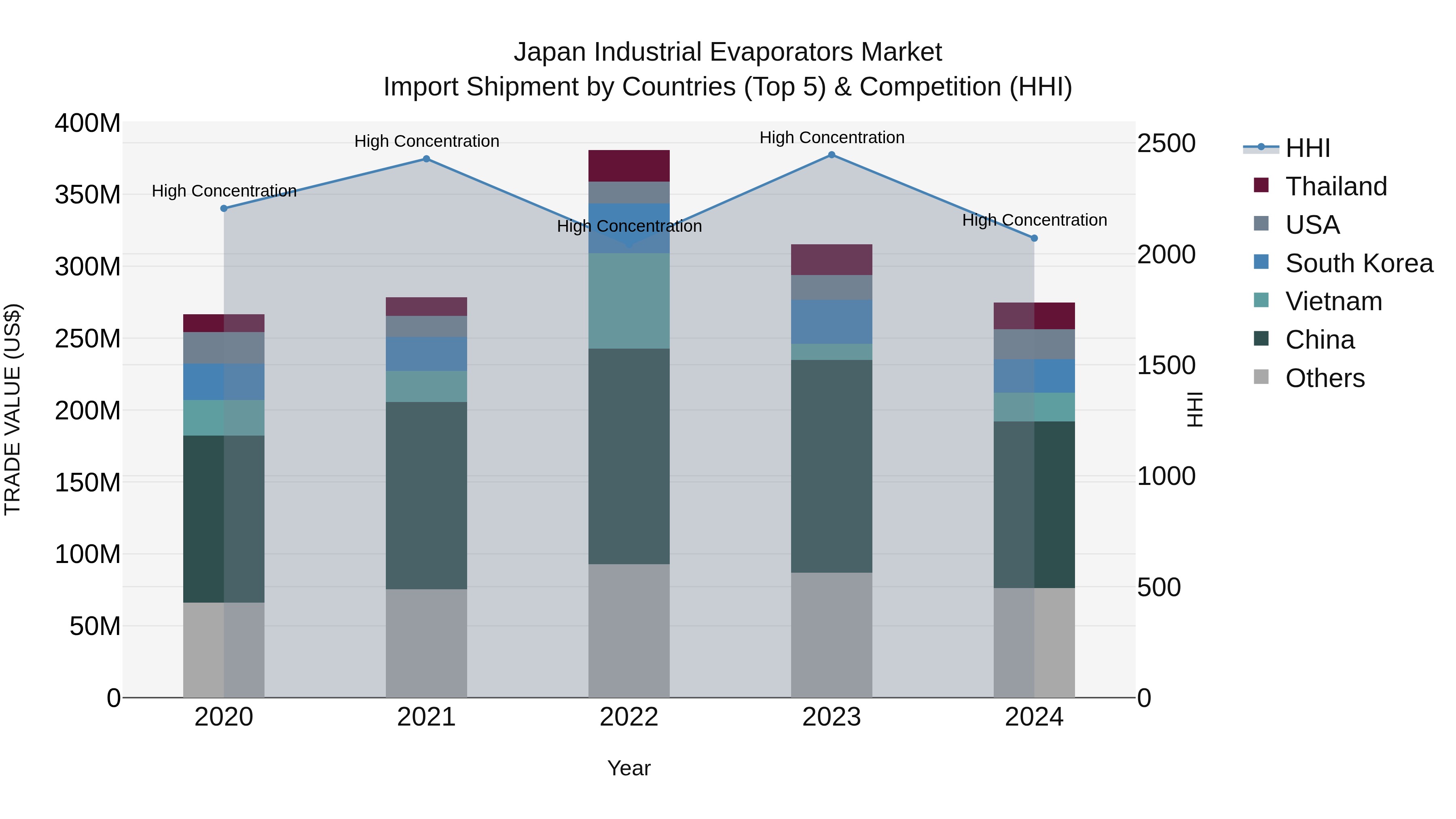
Japan continues to heavily rely on industrial evaporator imports, with key suppliers like China, South Korea, USA, Vietnam, and Thailand dominating the market in 2024. Despite a slight growth in market concentration, the Compound Annual Growth Rate (CAGR) from 2020 to 2024 was moderate at 0.78%. However, the negative growth rate of -12.83% from 2023 to 2024 raises concerns about potential challenges faced by the industry. It will be crucial for stakeholders to closely monitor market dynamics and adapt strategies to navigate the evolving landscape effectively.
Japan Industrial Evaporators Market Overview
The Japan Industrial Evaporators Market is experiencing steady growth driven by factors such as increasing demand for evaporators in industries like food and beverage, pharmaceuticals, and chemical processing. The market is characterized by the presence of key players offering a wide range of evaporator technologies, including falling film, rising film, and forced circulation evaporators. Technological advancements in energy-efficient evaporators and the emphasis on sustainability are also influencing market growth. Additionally, stringent regulations regarding wastewater treatment and environmental protection are driving the adoption of industrial evaporators in Japan. The market is anticipated to witness further expansion due to the growing focus on water and waste management practices in the industrial sector, along with the increasing emphasis on resource efficiency and cost savings.
Japan Industrial Evaporators Market Trends and Opportunities
The Japan Industrial Evaporators Market is experiencing a growing demand due to the increasing focus on sustainability and environmental regulations in the country. Key trends in the market include the adoption of energy-efficient evaporator systems, integration of advanced technologies such as IoT and automation for better control and monitoring, and the development of hybrid evaporator systems. Opportunities in the market lie in the food and beverage industry, where evaporators are used for concentration and drying processes, as well as in the wastewater treatment sector for zero liquid discharge systems. Additionally, the pharmaceutical and chemical industries are also driving the demand for industrial evaporators in Japan. Overall, the market is poised for growth as companies seek innovative solutions to improve efficiency and reduce environmental impact.
Japan Industrial Evaporators Market Challenges
In the Japan Industrial Evaporators Market, some of the key challenges faced include increasing competition from foreign manufacturers offering lower-priced alternatives, stringent regulatory requirements and compliance standards, rising energy costs impacting operational expenses, and a limited pool of skilled workforce leading to higher labor costs. Additionally, rapid technological advancements necessitate continuous innovation and upgrades to stay competitive, which can strain resources and hinder smaller companies in the market. Moreover, fluctuations in raw material prices and economic uncertainties can further impact profit margins and overall market growth. To navigate these challenges successfully, companies in the Japan Industrial Evaporators Market need to focus on product differentiation, cost optimization strategies, regulatory compliance, and talent development to ensure sustainable growth and profitability.
Japan Industrial Evaporators Market Drivers
The Japan Industrial Evaporators Market is primarily driven by the increasing demand for energy-efficient and eco-friendly solutions in industries such as food and beverage, chemical, and pharmaceutical. The stringent government regulations regarding environmental protection and sustainability are pushing companies to invest in advanced evaporator technologies to reduce their carbon footprint and operating costs. Additionally, the growing focus on water and waste management in Japan is driving the adoption of industrial evaporators to efficiently treat and recycle industrial wastewater. The trend towards automation and digitization in manufacturing processes is also contributing to the market growth, as modern evaporator systems offer enhanced control, monitoring, and optimization capabilities to improve overall efficiency and productivity in industrial operations.
Japan Industrial Evaporators Market Government Policy
In Japan, government policies related to the industrial evaporators market focus on promoting energy efficiency and environmental sustainability. The government has implemented regulations and incentives to encourage industries to adopt eco-friendly evaporator technologies that reduce energy consumption and emissions. Additionally, there are stringent standards in place to ensure the safe and proper disposal of evaporator waste products to minimize environmental impact. The government also supports research and development efforts to drive innovation in the sector and enhance the overall competitiveness of Japanese industrial evaporator manufacturers. Overall, the policies aim to balance economic development with environmental protection by promoting sustainable practices within the industrial evaporators market in Japan.
Japan Industrial Evaporators Market Future Outlook
The Japan Industrial Evaporators Market is poised for steady growth in the coming years, driven by factors such as increasing demand for processed foods, pharmaceuticals, and chemicals. Technological advancements in evaporator systems, such as energy-efficient designs and automation capabilities, are also expected to fuel market expansion. Additionally, stringent environmental regulations pushing for sustainable manufacturing practices are anticipated to boost the adoption of eco-friendly evaporator solutions in industries across Japan. With a focus on improving production efficiency and reducing operational costs, the Japan Industrial Evaporators Market is likely to witness sustained growth and innovation in the foreseeable future.
Key Highlights of the Report:
- Japan Industrial Evaporators Market Outlook
- Market Size of Japan Industrial Evaporators Market, 2024
- Forecast of Japan Industrial Evaporators Market, 2031
- Historical Data and Forecast of Japan Industrial Evaporators Revenues & Volume for the Period 2021-2031
- Japan Industrial Evaporators Market Trend Evolution
- Japan Industrial Evaporators Market Drivers and Challenges
- Japan Industrial Evaporators Price Trends
- Japan Industrial Evaporators Porter's Five Forces
- Japan Industrial Evaporators Industry Life Cycle
- Historical Data and Forecast of Japan Industrial Evaporators Market Revenues & Volume By Construction Type for the Period 2021-2031
- Historical Data and Forecast of Japan Industrial Evaporators Market Revenues & Volume By Shell & Tube for the Period 2021-2031
- Historical Data and Forecast of Japan Industrial Evaporators Market Revenues & Volume By Plate for the Period 2021-2031
- Historical Data and Forecast of Japan Industrial Evaporators Market Revenues & Volume By End Use Industry for the Period 2021-2031
- Historical Data and Forecast of Japan Industrial Evaporators Market Revenues & Volume By Food & Beverage for the Period 2021-2031
- Historical Data and Forecast of Japan Industrial Evaporators Market Revenues & Volume By Pharmaceutical for the Period 2021-2031
- Historical Data and Forecast of Japan Industrial Evaporators Market Revenues & Volume By Chemical & Petrochemical for the Period 2021-2031
- Historical Data and Forecast of Japan Industrial Evaporators Market Revenues & Volume By Automotive for the Period 2021-2031
- Historical Data and Forecast of Japan Industrial Evaporators Market Revenues & Volume By Functionality for the Period 2021-2031
- Historical Data and Forecast of Japan Industrial Evaporators Market Revenues & Volume By Falling Film for the Period 2021-2031
- Historical Data and Forecast of Japan Industrial Evaporators Market Revenues & Volume By Rising Film for the Period 2021-2031
- Japan Industrial Evaporators Import Export Trade Statistics
- Market Opportunity Assessment By Construction Type
- Market Opportunity Assessment By End Use Industry
- Market Opportunity Assessment By Functionality
- Japan Industrial Evaporators Top Companies Market Share
- Japan Industrial Evaporators Competitive Benchmarking By Technical and Operational Parameters
- Japan Industrial Evaporators Company Profiles
- Japan Industrial Evaporators Key Strategic Recommendations






































