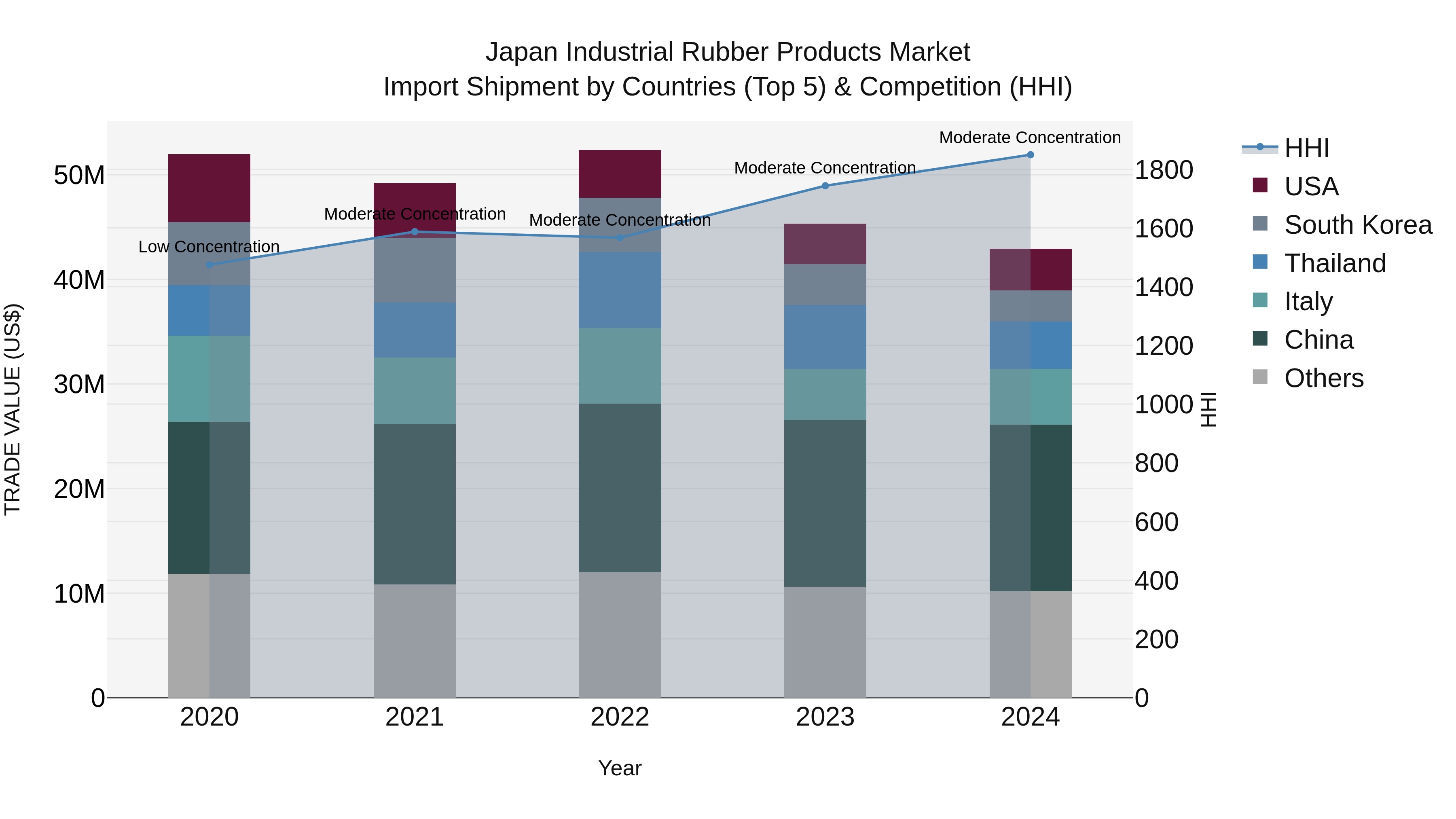
Japan Industrial Rubber Products Market Import Shipment by Countries (Top 5) & Competition (HHI)
Japan's industrial rubber products import market in 2024 saw major contributions from top exporting countries such as China, Italy, Thailand, USA, and South Korea. Despite a moderate concentration level measured by the Herfindahl-Hirschman Index, the market experienced a negative compound annual growth rate of -4.67% from 2020 to 2024. The growth rate in 2024 declined further by -5.27%, indicating challenges in the sector. This data suggests a need for market players to strategize and adapt to the evolving dynamics of the industrial rubber products import market in Japan.
Japan Industrial Rubber Products Market Overview
The Japan Industrial Rubber Products Market is a thriving sector characterized by the production and distribution of a wide range of rubber-based products such as tires, hoses, belts, seals, and gaskets. With a strong emphasis on quality, innovation, and technological advancement, Japanese companies in this market segment are known for their high-quality products that meet stringent industry standards. The market is driven by factors such as the robust manufacturing sector, increasing demand for automobiles, and infrastructure development projects. Key players in the industry include Bridgestone Corporation, Sumitomo Rubber Industries, Yokohama Rubber Co., and Toyo Tire Corporation. The market is also witnessing a growing focus on sustainability and eco-friendly practices, leading to the development of green rubber products and recycling initiatives.
Japan Industrial Rubber Products Market Trends
The Japan Industrial Rubber Products Market is experiencing several key trends. Firstly, there is a growing demand for eco-friendly and sustainable rubber products, driven by increasing environmental awareness and regulations. Companies are focusing on developing products with reduced carbon footprint and recyclable materials. Secondly, the market is witnessing a shift towards advanced materials and technologies, such as synthetic rubbers and composite materials, to improve product performance and durability. Thirdly, there is a rising emphasis on innovation and product customization to meet the specific requirements of different industries, such as automotive, construction, and electronics. Additionally, the market is also seeing an integration of digital technologies like IoT and automation to enhance production processes and efficiency. Overall, these trends are shaping the Japan Industrial Rubber Products Market towards a more sustainable, innovative, and technologically advanced future.
Japan Industrial Rubber Products Market Challenges
In the Japan Industrial Rubber Products Market, some key challenges include intense competition from both domestic and international manufacturers, rising raw material costs, and increasing environmental regulations. The market is highly competitive, with a large number of players vying for market share, leading to pressure on pricing and margins. Additionally, fluctuating prices of raw materials such as natural rubber and synthetic rubber can impact profitability for manufacturers. Moreover, as environmental concerns continue to grow, regulations regarding the disposal and recycling of rubber products are becoming more stringent, requiring companies to invest in sustainable practices and technologies. Adapting to these challenges will be crucial for companies in the Japan Industrial Rubber Products Market to maintain their competitive edge and ensure long-term sustainability.
Japan Industrial Rubber Products Market Investment Opportunities
The Japan Industrial Rubber Products Market offers various investment opportunities across different segments such as automotive, construction, electronics, and healthcare industries. With a strong emphasis on technological advancements and product innovation, investing in companies that specialize in manufacturing high-performance rubber products for these sectors could be lucrative. Additionally, there is a growing demand for eco-friendly and sustainable rubber products, presenting opportunities for investments in companies focusing on green technologies and sustainable practices. Moreover, with Japan being a major hub for research and development in the rubber industry, investing in companies that are at the forefront of technological advancements and product diversification could offer long-term growth potential in the market.
Japan Industrial Rubber Products Market Government Policy
The Japanese government has implemented various policies to support the industrial rubber products market, focusing on promoting innovation, sustainability, and global competitiveness. Initiatives include funding research and development projects to encourage technological advancements in rubber manufacturing, fostering partnerships between industry and academia to drive innovation, and promoting eco-friendly practices to enhance sustainability. Additionally, the government has introduced measures to support small and medium-sized enterprises in the industry, such as providing financial assistance and access to international markets through trade agreements. Overall, these policies aim to strengthen the industrial rubber products sector in Japan by fostering innovation, sustainability, and competitiveness both domestically and globally.
Japan Industrial Rubber Products Market Future Outlook
The Japan Industrial Rubber Products Market is expected to show steady growth in the coming years, driven by factors such as increasing demand from industries like automotive, construction, and electronics. With a focus on innovation and technological advancements, manufacturers in the market are likely to introduce new products with improved performance and sustainability features. Additionally, the growing emphasis on environmental regulations and sustainability practices is expected to drive the adoption of eco-friendly rubber products in the market. Overall, the Japan Industrial Rubber Products Market is projected to witness moderate growth in the future as companies continue to invest in research and development to meet the evolving needs of various industries while also addressing environmental concerns.
Key Highlights of the Report:
- Japan Industrial Rubber Products Market Outlook
- Market Size of Japan Industrial Rubber Products Market, 2024
- Forecast of Japan Industrial Rubber Products Market, 2031
- Historical Data and Forecast of Japan Industrial Rubber Products Revenues & Volume for the Period 2021-2031
- Japan Industrial Rubber Products Market Trend Evolution
- Japan Industrial Rubber Products Market Drivers and Challenges
- Japan Industrial Rubber Products Price Trends
- Japan Industrial Rubber Products Porter's Five Forces
- Japan Industrial Rubber Products Industry Life Cycle
- Historical Data and Forecast of Japan Industrial Rubber Products Market Revenues & Volume By Rubber Type for the Period 2021-2031
- Historical Data and Forecast of Japan Industrial Rubber Products Market Revenues & Volume By Natural Rubber for the Period 2021-2031
- Historical Data and Forecast of Japan Industrial Rubber Products Market Revenues & Volume By Styrene Butadiene Rubber for the Period 2021-2031
- Historical Data and Forecast of Japan Industrial Rubber Products Market Revenues & Volume By Polybutadiene for the Period 2021-2031
- Historical Data and Forecast of Japan Industrial Rubber Products Market Revenues & Volume By Ethylene-propylene for the Period 2021-2031
- Historical Data and Forecast of Japan Industrial Rubber Products Market Revenues & Volume By Nitrile Butadiene Rubber for the Period 2021-2031
- Historical Data and Forecast of Japan Industrial Rubber Products Market Revenues & Volume By Others for the Period 2021-2031
- Historical Data and Forecast of Japan Industrial Rubber Products Market Revenues & Volume By Process for the Period 2021-2031
- Historical Data and Forecast of Japan Industrial Rubber Products Market Revenues & Volume By Molded for the Period 2021-2031
- Historical Data and Forecast of Japan Industrial Rubber Products Market Revenues & Volume By Extruded for the Period 2021-2031
- Historical Data and Forecast of Japan Industrial Rubber Products Market Revenues & Volume By Fabricated for the Period 2021-2031
- Historical Data and Forecast of Japan Industrial Rubber Products Market Revenues & Volume By Latex-Based for the Period 2021-2031
- Historical Data and Forecast of Japan Industrial Rubber Products Market Revenues & Volume By Others for the Period 2021-2031
- Historical Data and Forecast of Japan Industrial Rubber Products Market Revenues & Volume By Product for the Period 2021-2031
- Historical Data and Forecast of Japan Industrial Rubber Products Market Revenues & Volume By Mechanical Rubber Products for the Period 2021-2031
- Historical Data and Forecast of Japan Industrial Rubber Products Market Revenues & Volume By Rubber Hoses for the Period 2021-2031
- Historical Data and Forecast of Japan Industrial Rubber Products Market Revenues & Volume By Rubber Belts for the Period 2021-2031
- Historical Data and Forecast of Japan Industrial Rubber Products Market Revenues & Volume By Rubber Roofing for the Period 2021-2031
- Historical Data and Forecast of Japan Industrial Rubber Products Market Revenues & Volume By Others for the Period 2021-2031
- Historical Data and Forecast of Japan Industrial Rubber Products Market Revenues & Volume By End-use for the Period 2021-2031
- Historical Data and Forecast of Japan Industrial Rubber Products Market Revenues & Volume By Construction & Infrastructure for the Period 2021-2031
- Historical Data and Forecast of Japan Industrial Rubber Products Market Revenues & Volume By Automotive for the Period 2021-2031
- Historical Data and Forecast of Japan Industrial Rubber Products Market Revenues & Volume By Aerospace for the Period 2021-2031
- Historical Data and Forecast of Japan Industrial Rubber Products Market Revenues & Volume By Energy for the Period 2021-2031
- Historical Data and Forecast of Japan Industrial Rubber Products Market Revenues & Volume By Others for the Period 2021-2031
- Japan Industrial Rubber Products Import Export Trade Statistics
- Market Opportunity Assessment By Rubber Type
- Market Opportunity Assessment By Process
- Market Opportunity Assessment By Product
- Market Opportunity Assessment By End-use
- Japan Industrial Rubber Products Top Companies Market Share
- Japan Industrial Rubber Products Competitive Benchmarking By Technical and Operational Parameters
- Japan Industrial Rubber Products Company Profiles
- Japan Industrial Rubber Products Key Strategic Recommendations






































