Japan Industrial Vacuum Cleaner Market Import Shipment by Countries (Top 5) & Competition (HHI)
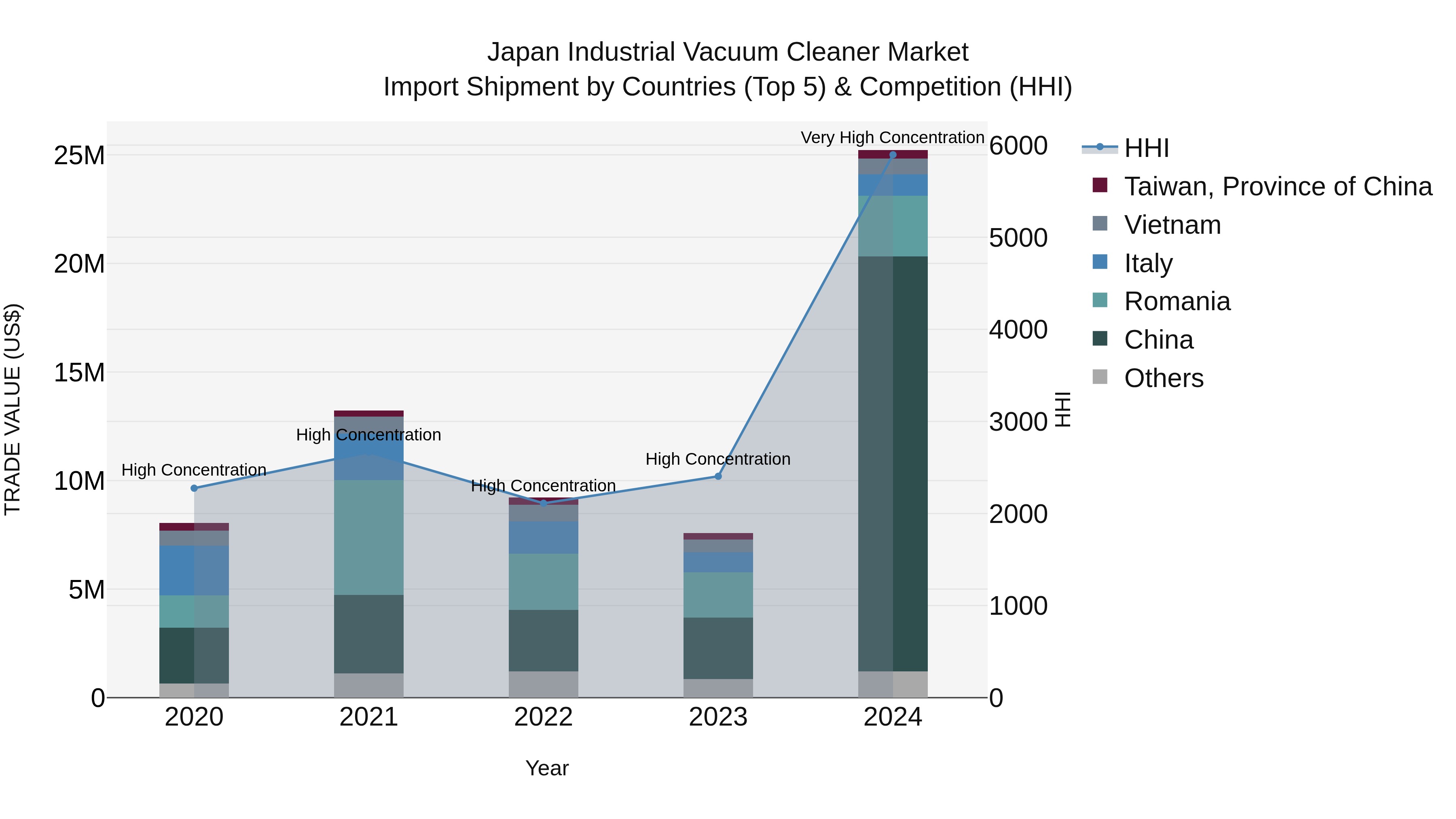
The industrial vacuum cleaner import market in Japan saw significant growth in 2024, with top exporting countries being China, Romania, Italy, Vietnam, and Germany. The market concentration, as measured by the HHI, increased from high to very high in 2024, indicating a more consolidated market. The impressive CAGR of 33.07% from 2020 to 2024 highlights the strong demand for industrial vacuum cleaners in Japan. Moreover, the remarkable growth rate of 232.89% from 2023 to 2024 suggests a surge in import shipments, signaling opportunities for both domestic and foreign suppliers to capitalize on this expanding market.
Japan Industrial Vacuum Cleaner Market Overview
The Japan Industrial Vacuum Cleaner Market is characterized by a strong demand from various industries such as manufacturing, automotive, electronics, and healthcare. The market is driven by the stringent regulations regarding workplace safety and cleanliness, leading to the adoption of industrial vacuum cleaners to maintain high standards of hygiene. Key players in the market offer a wide range of products with advanced features such as high suction power, HEPA filters, and portability, catering to the diverse needs of industrial customers. Growing awareness about the importance of maintaining clean and dust-free work environments is expected to further drive market growth in the coming years. Additionally, technological advancements such as IoT integration and robotic vacuum cleaners are anticipated to revolutionize the Japan Industrial Vacuum Cleaner Market.
Japan Industrial Vacuum Cleaner Market Trends
The Japan Industrial Vacuum Cleaner Market is experiencing a shift towards more compact and lightweight models that offer increased portability and maneuverability. There is a growing demand for industrial vacuum cleaners with higher efficiency in dust and debris collection, as well as enhanced filtration systems to maintain clean air quality in industrial settings. Additionally, there is a noticeable trend towards the adoption of smart features such as IoT connectivity and remote monitoring capabilities to improve operational efficiency and maintenance scheduling. Manufacturers are also focusing on developing eco-friendly models with reduced energy consumption and noise levels to align with sustainability goals. Overall, the market is witnessing a convergence of technological advancements and sustainability initiatives to meet the evolving needs of industrial users in Japan.
Japan Industrial Vacuum Cleaner Market Challenges
In the Japan Industrial Vacuum Cleaner Market, several challenges are faced, including intense competition from both domestic and international manufacturers, rapidly changing technological advancements leading to the need for constant innovation and product development, stringent regulations and standards governing industrial equipment, and the impact of economic fluctuations on consumer spending and industrial activities. Additionally, the market is influenced by factors such as rising raw material costs, labor shortages, and increasing environmental concerns regarding energy efficiency and sustainability. To succeed in this competitive landscape, companies must focus on quality, reliability, and performance of their products, as well as invest in research and development to stay ahead of the competition and meet the evolving needs of customers in the industrial sector.
Japan Industrial Vacuum Cleaner Market Investment Opportunities
The Japan Industrial Vacuum Cleaner Market offers promising investment opportunities due to the increasing demand for efficient and reliable cleaning solutions across various industries such as manufacturing, automotive, and electronics. With a growing focus on maintaining clean and safe work environments, companies are increasingly investing in industrial vacuum cleaners to improve productivity and compliance with stringent regulations. This market is also witnessing technological advancements, including the development of smart and energy-efficient vacuum cleaners, which further enhances the appeal for investors. Additionally, the Japanese government`s initiatives to promote sustainability and environmental protection are driving the adoption of eco-friendly cleaning equipment, presenting a lucrative opportunity for investors looking to capitalize on the growing demand for industrial vacuum cleaners in Japan.
Japan Industrial Vacuum Cleaner Market Government Policy
The Japanese government has implemented several policies to regulate the industrial vacuum cleaner market. These policies primarily focus on promoting energy efficiency and environmental sustainability. The Energy Efficiency Act sets energy efficiency standards for industrial vacuum cleaners to reduce electricity consumption and carbon emissions. Additionally, the Waste Management Act mandates proper disposal and recycling of industrial vacuum cleaner components to minimize environmental impact. The government also offers incentives and subsidies to encourage manufacturers to produce eco-friendly and efficient industrial vacuum cleaners. Overall, these policies aim to drive technological innovation, improve product quality, and create a more sustainable industrial vacuum cleaner market in Japan.
Japan Industrial Vacuum Cleaner Market Future Outlook
The Japan Industrial Vacuum Cleaner Market is expected to witness steady growth in the coming years. Factors driving this growth include increasing adoption of industrial cleaning equipment in manufacturing facilities, warehouses, and other industrial spaces to maintain hygiene and compliance with regulatory standards. Additionally, the shift towards automated and efficient cleaning solutions is expected to fuel the demand for industrial vacuum cleaners in Japan. The market is also likely to benefit from technological advancements such as IoT integration for remote monitoring and control, enhancing the overall efficiency and productivity of cleaning operations. As sustainability and energy efficiency become more important considerations for industries, the demand for eco-friendly and energy-efficient industrial vacuum cleaners is expected to rise, further driving market growth in Japan.
Key Highlights of the Report:
- Japan Industrial Vacuum Cleaner Market Outlook
- Market Size of Japan Industrial Vacuum Cleaner Market, 2024
- Forecast of Japan Industrial Vacuum Cleaner Market, 2031
- Historical Data and Forecast of Japan Industrial Vacuum Cleaner Revenues & Volume for the Period 2021-2031
- Japan Industrial Vacuum Cleaner Market Trend Evolution
- Japan Industrial Vacuum Cleaner Market Drivers and Challenges
- Japan Industrial Vacuum Cleaner Price Trends
- Japan Industrial Vacuum Cleaner Porter's Five Forces
- Japan Industrial Vacuum Cleaner Industry Life Cycle
- Historical Data and Forecast of Japan Industrial Vacuum Cleaner Market Revenues & Volume By Type for the Period 2021-2031
- Historical Data and Forecast of Japan Industrial Vacuum Cleaner Market Revenues & Volume By Dry for the Period 2021-2031
- Historical Data and Forecast of Japan Industrial Vacuum Cleaner Market Revenues & Volume By Wet & Dry for the Period 2021-2031
- Historical Data and Forecast of Japan Industrial Vacuum Cleaner Market Revenues & Volume By Power Source for the Period 2021-2031
- Historical Data and Forecast of Japan Industrial Vacuum Cleaner Market Revenues & Volume By Electric for the Period 2021-2031
- Historical Data and Forecast of Japan Industrial Vacuum Cleaner Market Revenues & Volume By Pneumatic for the Period 2021-2031
- Historical Data and Forecast of Japan Industrial Vacuum Cleaner Market Revenues & Volume By Industry for the Period 2021-2031
- Historical Data and Forecast of Japan Industrial Vacuum Cleaner Market Revenues & Volume By Food & Beverages for the Period 2021-2031
- Historical Data and Forecast of Japan Industrial Vacuum Cleaner Market Revenues & Volume By Metalworking for the Period 2021-2031
- Historical Data and Forecast of Japan Industrial Vacuum Cleaner Market Revenues & Volume By Pharmaceuticals for the Period 2021-2031
- Historical Data and Forecast of Japan Industrial Vacuum Cleaner Market Revenues & Volume By Manufacturing for the Period 2021-2031
- Historical Data and Forecast of Japan Industrial Vacuum Cleaner Market Revenues & Volume By Building & Construction for the Period 2021-2031
- Historical Data and Forecast of Japan Industrial Vacuum Cleaner Market Revenues & Volume By Others for the Period 2021-2031
- Japan Industrial Vacuum Cleaner Import Export Trade Statistics
- Market Opportunity Assessment By Type
- Market Opportunity Assessment By Power Source
- Market Opportunity Assessment By Industry
- Japan Industrial Vacuum Cleaner Top Companies Market Share
- Japan Industrial Vacuum Cleaner Competitive Benchmarking By Technical and Operational Parameters
- Japan Industrial Vacuum Cleaner Company Profiles
- Japan Industrial Vacuum Cleaner Key Strategic Recommendations






































