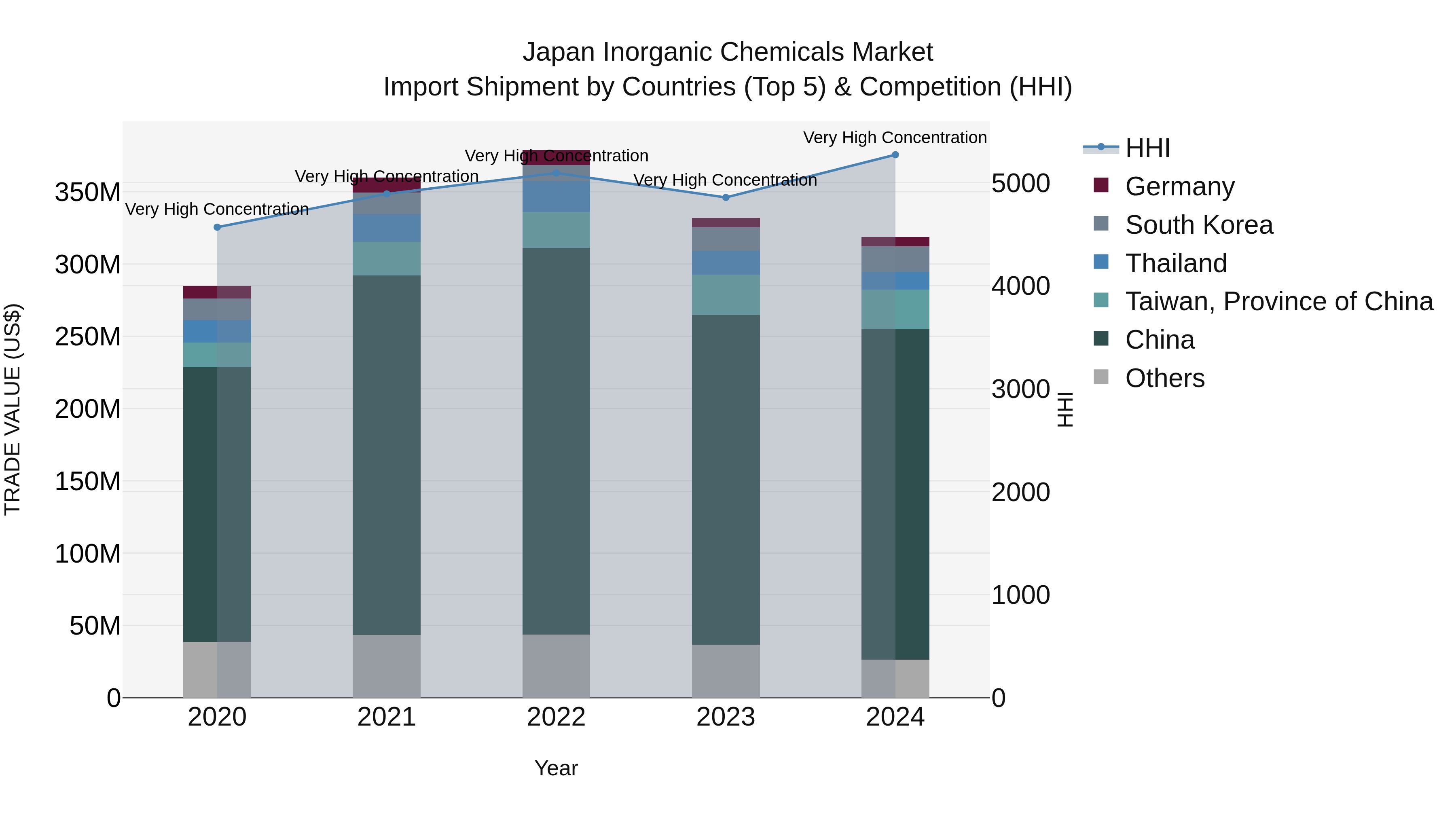
Japan Inorganic Chemicals Market Import Shipment by Countries (Top 5) & Competition (HHI)
In 2024, Japan's inorganic chemicals import market continued to be dominated by key players such as China, Taiwan, South Korea, Thailand, and Germany. Despite a slight decline in growth rate from the previous year, the high Herfindahl-Hirschman Index (HHI) suggests a market with strong concentration levels. With a steady Compound Annual Growth Rate (CAGR) of 2.84% over the period of 2020-2024, Japan remains a significant destination for inorganic chemical imports, indicating sustained demand and opportunities for international exporters in the sector.
Key Highlights of the Report:
- Japan Inorganic Chemicals Market Outlook
- Market Size of Japan Inorganic Chemicals Market, 2024
- Forecast of Japan Inorganic Chemicals Market, 2031
- Historical Data and Forecast of Japan Inorganic Chemicals Revenues & Volume for the Period 2021 - 2031
- Japan Inorganic Chemicals Market Trend Evolution
- Japan Inorganic Chemicals Market Drivers and Challenges
- Japan Inorganic Chemicals Price Trends
- Japan Inorganic Chemicals Porter's Five Forces
- Japan Inorganic Chemicals Industry Life Cycle
- Historical Data and Forecast of Japan Inorganic Chemicals Market Revenues & Volume By Type for the Period 2021 - 2031
- Historical Data and Forecast of Japan Inorganic Chemicals Market Revenues & Volume By Ammonia for the Period 2021 - 2031
- Historical Data and Forecast of Japan Inorganic Chemicals Market Revenues & Volume By Chlor alkali for the Period 2021 - 2031
- Historical Data and Forecast of Japan Inorganic Chemicals Market Revenues & Volume By Ammonium nitrate for the Period 2021 - 2031
- Historical Data and Forecast of Japan Inorganic Chemicals Market Revenues & Volume By Ammonium sulfate for the Period 2021 - 2031
- Historical Data and Forecast of Japan Inorganic Chemicals Market Revenues & Volume By Inorganic acid for the Period 2021 - 2031
- Historical Data and Forecast of Japan Inorganic Chemicals Market Revenues & Volume By Sodium hydroxide for the Period 2021 - 2031
- Historical Data and Forecast of Japan Inorganic Chemicals Market Revenues & Volume By Hydrogen peroxide for the Period 2021 - 2031
- Historical Data and Forecast of Japan Ammonia Inorganic Chemicals Market Revenues & Volume By Oxygen for the Period 2021 - 2031
- Japan Inorganic Chemicals Import Export Trade Statistics
- Market Opportunity Assessment By Type
- Japan Inorganic Chemicals Top Companies Market Share
- Japan Inorganic Chemicals Competitive Benchmarking By Technical and Operational Parameters
- Japan Inorganic Chemicals Company Profiles
- Japan Inorganic Chemicals Key Strategic Recommendations






































