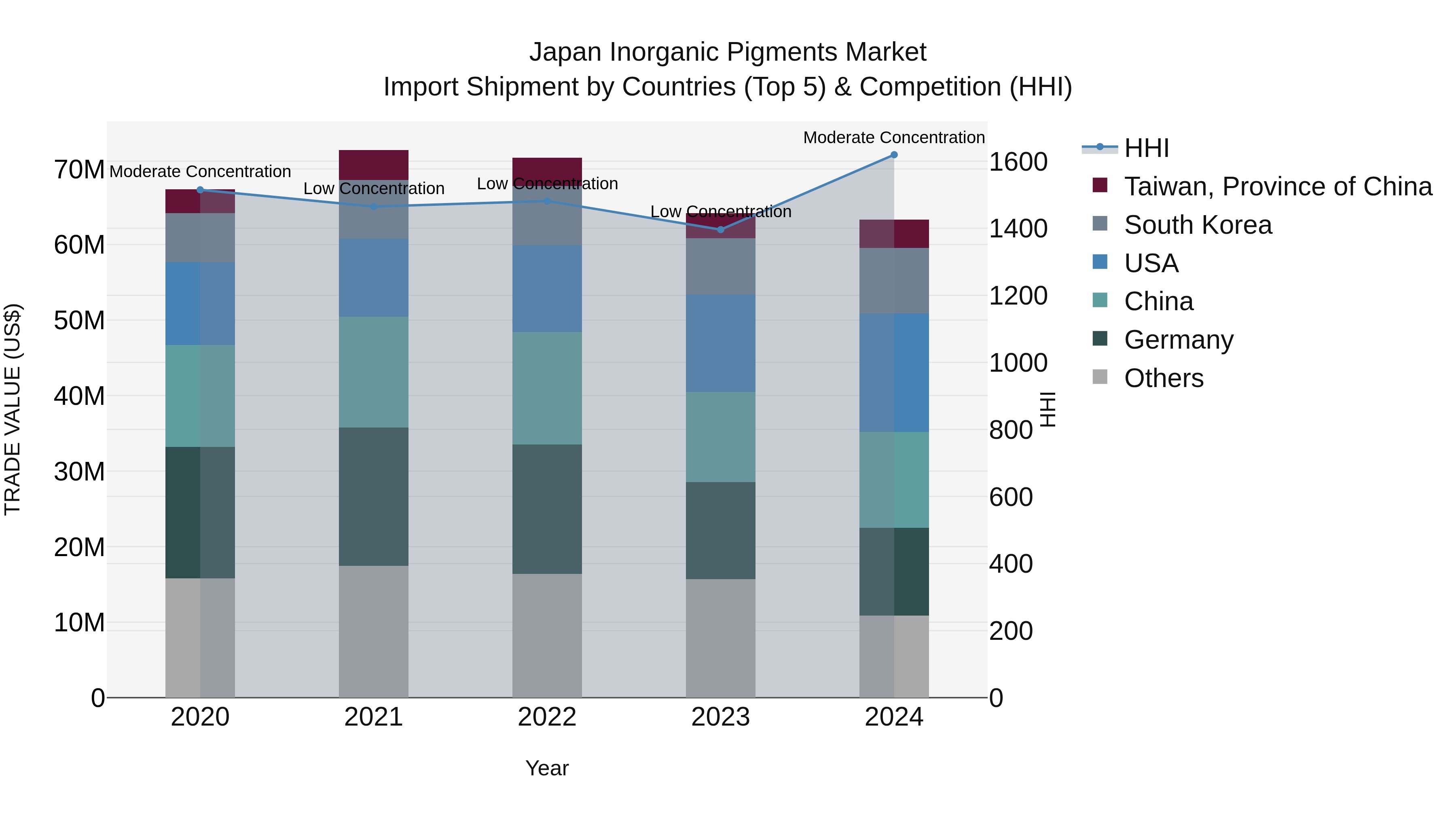
Japan Inorganic Pigments Market Import Shipment by Countries (Top 5) & Competition (HHI)
Japan's inorganic pigments import market saw a shift in concentration levels from low to moderate in 2024, with top exporting countries being the USA, China, Germany, South Korea, and Taiwan. Despite a negative CAGR of -1.52% from 2020 to 2024, the growth rate improved slightly in 2024 with a -1.3% change from the previous year. This indicates a stable but slightly declining market, highlighting the importance of monitoring global trends and competition dynamics to capitalize on potential opportunities in the industry.
Japan Inorganic Pigments Market Overview
The Japan Inorganic Pigments Market is characterized by a growing demand driven by various end-use industries such as paints and coatings, plastics, and construction. The market is witnessing a shift towards eco-friendly and high-performance pigments to meet stringent regulatory standards. Key players in the market are focusing on product innovation and development of advanced pigment technologies to cater to evolving consumer preferences. Titanium dioxide, iron oxide, and carbon black are among the prominent inorganic pigments widely used in the market. Increasing investments in research and development activities, along with expanding applications in automotive and electronics sectors, are expected to drive market growth. However, challenges related to raw material procurement and volatile prices may impact market dynamics in the near future.
Japan Inorganic Pigments Market Trends
In the Japan Inorganic Pigments Market, there is a growing demand for high-performance pigments with enhanced properties such as weather and light fastness, chemical resistance, and durability. Manufacturers are focusing on developing innovative products that meet the stringent environmental regulations in the region. There is also a rising interest in eco-friendly inorganic pigments made from sustainable sources and with reduced environmental impact. The market is witnessing an increasing adoption of inorganic pigments in various applications such as coatings, plastics, ceramics, and construction materials. Additionally, collaborations and partnerships between key players in the industry are driving research and development efforts to introduce advanced inorganic pigments that offer superior performance and color stability, catering to the evolving needs of customers in Japan.
Japan Inorganic Pigments Market Challenges
The Japan Inorganic Pigments Market faces several challenges, including intense competition from domestic and international manufacturers, stringent environmental regulations regarding the use of certain pigments, and fluctuating raw material prices. Additionally, the market is witnessing a shift towards organic pigments due to increasing awareness about eco-friendly products, posing a threat to traditional inorganic pigment producers. Furthermore, the economic slowdown in certain industries that are major consumers of inorganic pigments, such as construction and automotive, has impacted market growth. To stay competitive, companies in the Japan Inorganic Pigments Market must focus on innovation, product differentiation, and sustainable practices to address these challenges and adapt to changing market dynamics.
Japan Inorganic Pigments Market Investment Opportunities
The Japan inorganic pigments market presents various investment opportunities due to its steady growth driven by the expanding automotive, construction, and packaging industries in the country. With increasing demand for high-quality pigments offering durability, color stability, and heat resistance, investing in manufacturers specializing in inorganic pigments such as titanium dioxide, iron oxide, and chromium oxide could be lucrative. Additionally, the growing trend towards environmentally friendly and sustainable pigments provides opportunities for companies investing in research and development of eco-friendly inorganic pigments. Collaborating with local distributors and forming strategic partnerships with end-user industries can also enhance market penetration and profitability in the Japan inorganic pigments market.
Japan Inorganic Pigments Market Government Policy
In Japan, government policies related to the inorganic pigments market focus on ensuring product safety, environmental sustainability, and competitiveness in the global market. The government has implemented regulations such as the Chemical Substance Control Law and the Industrial Safety and Health Law to monitor and control the use of inorganic pigments to protect human health and the environment. Additionally, initiatives promoting research and development in eco-friendly pigments and incentivizing companies to adopt sustainable practices are encouraged to enhance the market`s competitiveness. The government also supports the industry through trade policies to facilitate exports and maintain a strong position in the global market. Overall, Japan`s government policies aim to balance economic growth with environmental protection and safety in the inorganic pigments market.
Japan Inorganic Pigments Market Future Outlook
The Japan inorganic pigments market is poised for steady growth in the coming years, driven by increasing demand from industries such as construction, automotive, and packaging. The market is expected to benefit from the country`s focus on infrastructure development and the growing trend of eco-friendly products. Additionally, advancements in technology leading to the development of high-performance pigments and the shift towards sustainable practices are likely to fuel market growth. With a strong emphasis on quality and innovation, key players in the Japanese inorganic pigments market are expected to invest in research and development to introduce new products and cater to evolving consumer preferences. Overall, the market is anticipated to witness a positive trajectory in the foreseeable future.
Key Highlights of the Report:
- Japan Inorganic Pigments Market Outlook
- Market Size of Japan Inorganic Pigments Market, 2024
- Forecast of Japan Inorganic Pigments Market, 2031
- Historical Data and Forecast of Japan Inorganic Pigments Revenues & Volume for the Period 2021-2031
- Japan Inorganic Pigments Market Trend Evolution
- Japan Inorganic Pigments Market Drivers and Challenges
- Japan Inorganic Pigments Price Trends
- Japan Inorganic Pigments Porter's Five Forces
- Japan Inorganic Pigments Industry Life Cycle
- Historical Data and Forecast of Japan Inorganic Pigments Market Revenues & Volume By Type for the Period 2021-2031
- Historical Data and Forecast of Japan Inorganic Pigments Market Revenues & Volume By Titanium Dioxide for the Period 2021-2031
- Historical Data and Forecast of Japan Inorganic Pigments Market Revenues & Volume By Iron Oxide, Cadmium for the Period 2021-2031
- Historical Data and Forecast of Japan Inorganic Pigments Market Revenues & Volume By Carbon Blank for the Period 2021-2031
- Historical Data and Forecast of Japan Inorganic Pigments Market Revenues & Volume By Lead Chromate for the Period 2021-2031
- Historical Data and Forecast of Japan Inorganic Pigments Market Revenues & Volume By Chromium Oxide for the Period 2021-2031
- Historical Data and Forecast of Japan Inorganic Pigments Market Revenues & Volume By Others for the Period 2021-2031
- Historical Data and Forecast of Japan Inorganic Pigments Market Revenues & Volume By Colour for the Period 2021-2031
- Historical Data and Forecast of Japan Inorganic Pigments Market Revenues & Volume By Red for the Period 2021-2031
- Historical Data and Forecast of Japan Inorganic Pigments Market Revenues & Volume By Yellow for the Period 2021-2031
- Historical Data and Forecast of Japan Inorganic Pigments Market Revenues & Volume By Orange for the Period 2021-2031
- Historical Data and Forecast of Japan Inorganic Pigments Market Revenues & Volume By Green for the Period 2021-2031
- Historical Data and Forecast of Japan Inorganic Pigments Market Revenues & Volume By Blue for the Period 2021-2031
- Historical Data and Forecast of Japan Inorganic Pigments Market Revenues & Volume By Black for the Period 2021-2031
- Historical Data and Forecast of Japan Inorganic Pigments Market Revenues & Volume By White for the Period 2021-2031
- Historical Data and Forecast of Japan Inorganic Pigments Market Revenues & Volume By Others for the Period 2021-2031
- Historical Data and Forecast of Japan Inorganic Pigments Market Revenues & Volume By Chemistry for the Period 2021-2031
- Historical Data and Forecast of Japan Inorganic Pigments Market Revenues & Volume By Oxide for the Period 2021-2031
- Historical Data and Forecast of Japan Inorganic Pigments Market Revenues & Volume By Silicate for the Period 2021-2031
- Historical Data and Forecast of Japan Inorganic Pigments Market Revenues & Volume By Carbonate for the Period 2021-2031
- Historical Data and Forecast of Japan Inorganic Pigments Market Revenues & Volume By Sulphate for the Period 2021-2031
- Historical Data and Forecast of Japan Inorganic Pigments Market Revenues & Volume By Sulphide for the Period 2021-2031
- Historical Data and Forecast of Japan Inorganic Pigments Market Revenues & Volume By Others for the Period 2021-2031
- Historical Data and Forecast of Japan Inorganic Pigments Market Revenues & Volume By Grade for the Period 2021-2031
- Historical Data and Forecast of Japan Inorganic Pigments Market Revenues & Volume By Food Grade for the Period 2021-2031
- Historical Data and Forecast of Japan Inorganic Pigments Market Revenues & Volume By Pharmaceutical Grade for the Period 2021-2031
- Historical Data and Forecast of Japan Inorganic Pigments Market Revenues & Volume By Industrial Grade for the Period 2021-2031
- Historical Data and Forecast of Japan Inorganic Pigments Market Revenues & Volume By Others for the Period 2021-2031
- Historical Data and Forecast of Japan Inorganic Pigments Market Revenues & Volume By Form for the Period 2021-2031
- Historical Data and Forecast of Japan Inorganic Pigments Market Revenues & Volume By Powder for the Period 2021-2031
- Historical Data and Forecast of Japan Inorganic Pigments Market Revenues & Volume By Liquid for the Period 2021-2031
- Historical Data and Forecast of Japan Inorganic Pigments Market Revenues & Volume By Application for the Period 2021-2031
- Historical Data and Forecast of Japan Inorganic Pigments Market Revenues & Volume By Plastics for the Period 2021-2031
- Historical Data and Forecast of Japan Inorganic Pigments Market Revenues & Volume By Paints & Coatings for the Period 2021-2031
- Historical Data and Forecast of Japan Inorganic Pigments Market Revenues & Volume By Printing Inks for the Period 2021-2031
- Historical Data and Forecast of Japan Inorganic Pigments Market Revenues & Volume By Glass & Ceramics for the Period 2021-2031
- Historical Data and Forecast of Japan Inorganic Pigments Market Revenues & Volume By Cosmetics for the Period 2021-2031
- Historical Data and Forecast of Japan Inorganic Pigments Market Revenues & Volume By Paper Industry for the Period 2021-2031
- Historical Data and Forecast of Japan Inorganic Pigments Market Revenues & Volume By Food Industry for the Period 2021-2031
- Historical Data and Forecast of Japan Inorganic Pigments Market Revenues & Volume By Others for the Period 2021-2031
- Japan Inorganic Pigments Import Export Trade Statistics
- Market Opportunity Assessment By Type
- Market Opportunity Assessment By Colour
- Market Opportunity Assessment By Chemistry
- Market Opportunity Assessment By Grade
- Market Opportunity Assessment By Form
- Market Opportunity Assessment By Application
- Japan Inorganic Pigments Top Companies Market Share
- Japan Inorganic Pigments Competitive Benchmarking By Technical and Operational Parameters
- Japan Inorganic Pigments Company Profiles
- Japan Inorganic Pigments Key Strategic Recommendations






































