Japan Insurance Telematics Market Size & Growth Rate (2026-2032)
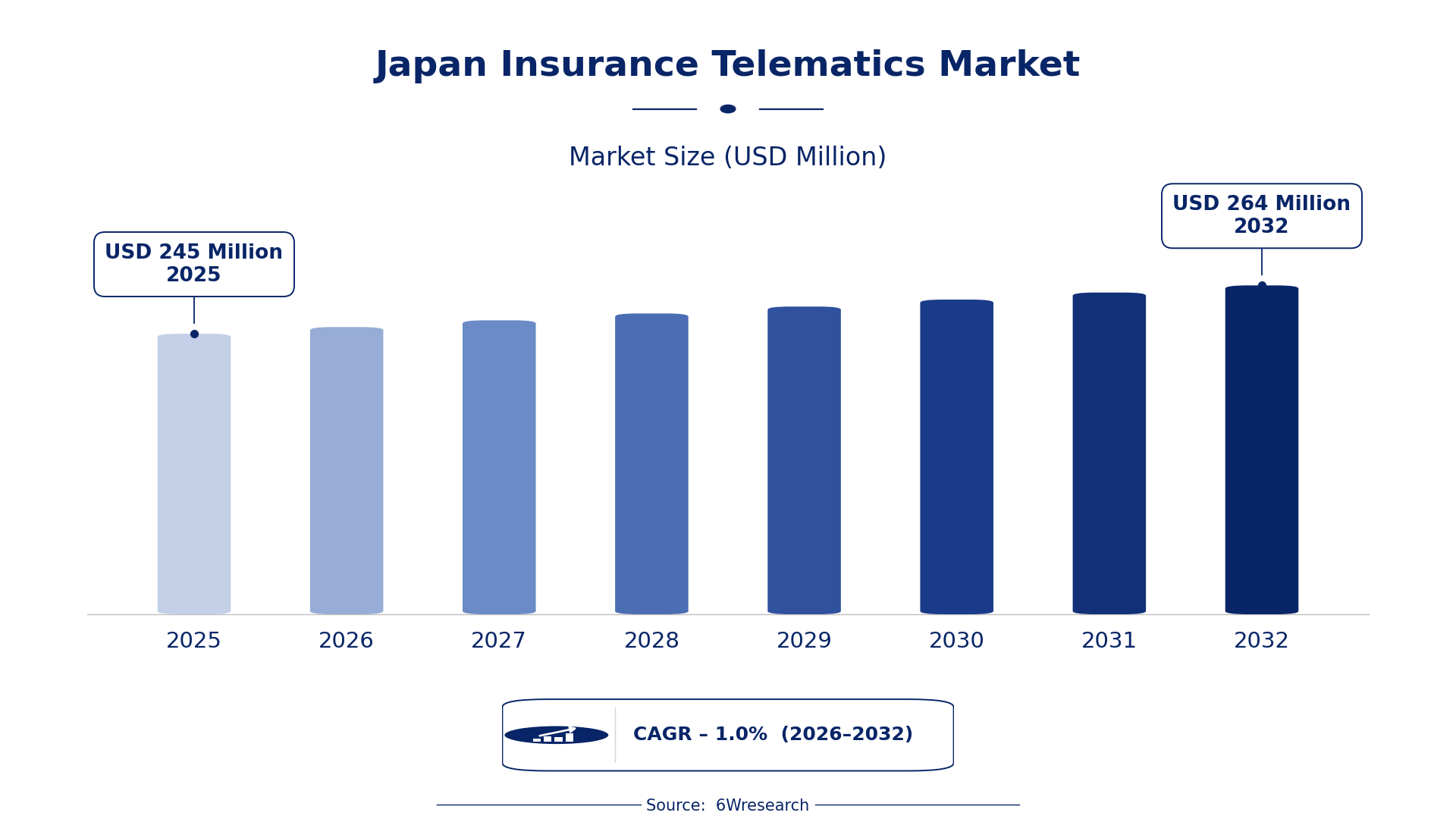
The Japan Insurance Telematics Market was estimated at USD 245 Million in 2025 and is projected to reach USD 264 Million by 2032, growing at a CAGR of 1.0% from 2026 to 2032.
Japan Insurance Telematics Market Synopsis
The integration of telematics technology in the Japanese insurance sector is gaining traction, largely due to the demand for more personalized insurance solutions. As insurers increasingly utilize real-time data from telematics devices, they can enhance risk assessment and tailor policies to individual driving behaviors.
This shift is not merely about improving profitability; it's also about engaging customers more effectively. By offering usage-based insurance models, companies can incentivize safer driving practices, creating a win-win situation for both insurers and policyholders.
Japan Insurance Telematics Market Year-wise Growth Rate and Key Drivers
This graph illustrates the annual growth rates of the Japan Insurance Telematics Market from 2021 to 2032, highlighting a steady upward trajectory and projected expansion over the forecast period.
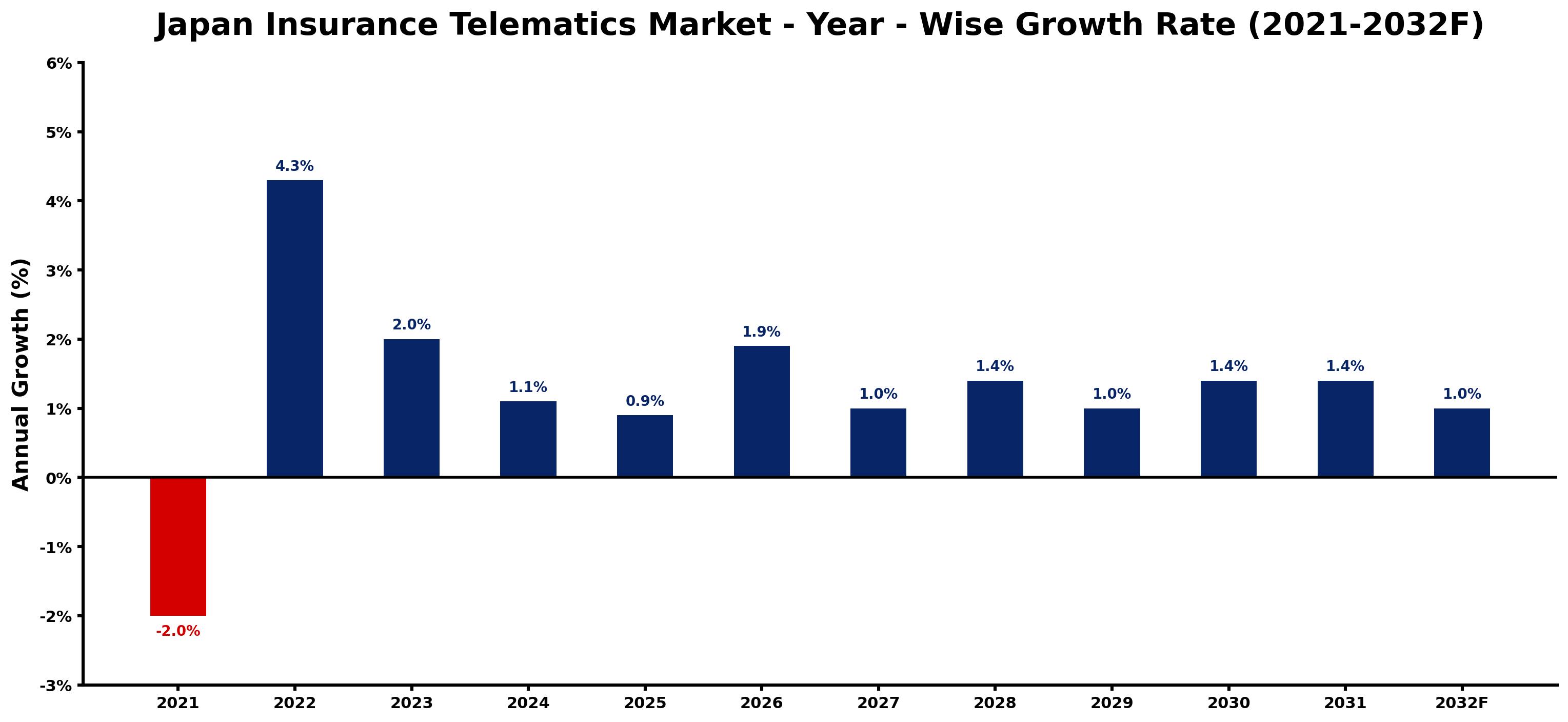
The table below presents the year‑wise growth rates along with the key drivers influencing the market
| Year | Growth Rate | Major Drivers |
| 2021 | -2.0% | Government regulations limiting telematics data usage. |
| 2022 | 4.3% | Government's push for smart mobility initiatives. |
| 2023 | 2.0% | Increased consumer demand for personalized insurance services. |
| 2024 | 1.1% | Growing awareness of driver safety and behavior tracking. |
| 2025 | 0.9% | Rise in telematics adoption among fleet operators. |
| 2026 | 1.9% | Enhanced regulatory focus on driver data privacy. |
| 2027 | 1.0% | Insurance premium discounts tied to telematics usage. |
| 2028 | 1.4% | Partnerships with automotive manufacturers for integrated systems. |
| 2029 | 1.0% | Increased smartphone penetration boosting telematics applications. |
| 2030 | 1.4% | Shift in consumer expectations towards data-driven policies. |
| 2031 | 1.4% | Advancements in vehicle connectivity improving real-time data. |
| 2032 | 1.0% | Regulatory incentives encouraging telematics for risk assessment. |
Note: Market size estimations and growth projections presented in this report are based on 6Wresearch's proprietary forecasting methodology, utilizing the latest available industry data, government publications, and primary research inputs.
Japan Insurance Telematics Market Key Takeaways
Below are some of the specific key takeaways from the market, including:
- The market is driven by the increasing adoption of usage-based insurance (UBI) policies.
- Technological advancements in data analytics are refining risk assessment capabilities.
- Partnerships between insurance providers and telematics solution companies are on the rise.
- Government initiatives are fostering a supportive environment for telematics adoption.
- Consumer demand for personalized insurance products is reshaping market dynamics.
Evaluation of Restraints in Japan Insurance Telematics Market
Despite the promising growth trajectory, several constraints hinder the Japan Insurance Telematics Market. Data privacy concerns remain a significant barrier, as potential customers may hesitate to share sensitive information. The financial burden associated with implementing telematics systems can also deter smaller insurance companies from entering the market. on top of that, the lack of standardized regulations governing telematics data usage can create uncertainty, complicating the decision-making processes for insurers and consumers alike.
Japan Insurance Telematics Market Trends
Current trends indicate a strong shift toward integrating telematics solutions with mobile technology and IoT devices. This integration allows for real-time monitoring of driving behavior, enabling insurers to offer dynamic and personalized premium models. Additionally, there is an increasing emphasis on customer engagement through services like driver coaching and vehicle maintenance alerts, which further enhance the value proposition of telematics-based insurance.
Japan Insurance Telematics Market Opportunities
The Japan Insurance Telematics Market is ripe with investment opportunities, particularly in technology development and data analytics sectors. Companies that specialize in telematics solutions can expect growing demand as insurers seek to enhance their offerings. on top of that, collaborations between automotive manufacturers and insurance providers may open new avenues for growth, particularly in connected vehicle technologies.
Government Initiatives in the Japan Insurance Telematics Market
The Japanese government plays a crucial role in promoting telematics technology within the insurance sector. Its focus on road safety and efficiency drives policy initiatives aimed at encouraging the adoption of usage-based insurance programs. By establishing regulatory frameworks that protect consumer data and foster innovation, the government is helping to create a favorable environment for market growth.
- A recently completed initiative includes the introduction of a national framework for usage-based insurance programs that incentivize safer driving.
- Ongoing projects focus on enhancing data privacy regulations, ensuring the secure transmission of telematics data.
- Upcoming initiatives aim to establish a public-private partnership to promote the integration of telematics into new vehicle models by 2027.
- Current efforts are underway to develop educational campaigns that raise consumer awareness about the benefits of telematics in insurance.
- The government has announced plans for a regulatory review process in 2026 to evaluate and update existing telematics standards.
Future Insights of the Japan Insurance Telematics Market
Looking ahead to 2026-2032, the Japan Insurance Telematics Market is expected to evolve significantly. The adoption of connected car technologies will likely streamline operations and enhance customer experiences. Insurers will increasingly leverage telematics data for precise risk assessment, allowing for more competitive premium pricing. As consumer awareness of telematics grows, demand for personalized insurance offerings will continue to drive market expansion.
Japan Insurance Telematics Market Latest Developments
In the past year, activity in the Japan Insurance Telematics Market has ramped up considerably. Various insurance providers and technology firms have launched initiatives to enhance telematics capabilities, driven by both consumer demand and regulatory encouragement.
- A major technology vendor launched a new telematics platform in early 2025, designed to integrate with existing insurance systems and improve data analytics capabilities.
- In mid-2025, a leading regional insurance provider began a pilot program to test new usage-based insurance products, collecting consumer feedback for future enhancements.
- By late 2025, an ongoing collaboration between telematics firms and automotive manufacturers focused on developing integrated telematics solutions for new vehicle models.
- Upcoming in 2026 is a planned rollout of a government-backed initiative aimed at expanding telematics infrastructure in urban areas.
- A partnership announced in early 2025 between insurers and consumer advocacy groups aims to improve transparency in telematics data usage.
Japan Insurance Telematics Market - Key Attractiveness of the Report
- 10 Years of Market Numbers
- Historical Data Starting from 2022 to 2025
- Base Year: 2025
- Forecast Data until 2032
- Key Performance Indicators Impacting the Market
- Major Upcoming Developments and Projects
Key Highlights of the Report:
- Japan Insurance Telematics Market Outlook
- Market Size of Japan Insurance Telematics Market, 2025
- Forecast of Japan Insurance Telematics Market, 2032
- Historical Data and Forecast of Japan Insurance Telematics Revenues & Volume for the Period 2022-2032F
- Japan Insurance Telematics Market Trend Evolution
- Japan Insurance Telematics Market Drivers and Challenges
- Japan Insurance Telematics Price Trends
- Japan Insurance Telematics Porter's Five Forces
- Japan Insurance Telematics Industry Life Cycle
- Historical Data and Forecast of Japan Insurance Telematics Market Revenues & Volume By End User for the Period 2022-2032F
- Historical Data and Forecast of Japan Insurance Telematics Market Revenues & Volume By Small for the Period 2022-2032F
- Historical Data and Forecast of Japan Insurance Telematics Market Revenues & Volume By Medium Enterprises for the Period 2022-2032F
- Historical Data and Forecast of Japan Insurance Telematics Market Revenues & Volume By Large Enterprises for the Period 2022-2032F
- Historical Data and Forecast of Japan Insurance Telematics Market Revenues & Volume By Deployment Type for the Period 2022-2032F
- Historical Data and Forecast of Japan Insurance Telematics Market Revenues & Volume By Cloud for the Period 2022-2032F
- Historical Data and Forecast of Japan Insurance Telematics Market Revenues & Volume By On-Premises for the Period 2022-2032F
- Historical Data and Forecast of Japan Insurance Telematics Market Revenues & Volume By Organization Size for the Period 2022-2032F
- Historical Data and Forecast of Japan Insurance Telematics Market Revenues & Volume By Small and Medium Enterprises (SMEs) for the Period 2022-2032F
- Historical Data and Forecast of Japan Insurance Telematics Market Revenues & Volume By Large Enterprises for the Period 2022-2032F
- Japan Insurance Telematics Import Export Trade Statistics
- Market Opportunity Assessment By End User
- Market Opportunity Assessment By Deployment Type
- Market Opportunity Assessment By Organization Size
- Japan Insurance Telematics Top Companies Market Share
- Japan Insurance Telematics Competitive Benchmarking By Technical and Operational Parameters
- Japan Insurance Telematics Company Profiles
- Japan Insurance Telematics Key Strategic Recommendations






































