Japan Intelligent Document Processing Market Size & Growth Rate (2026-2032)
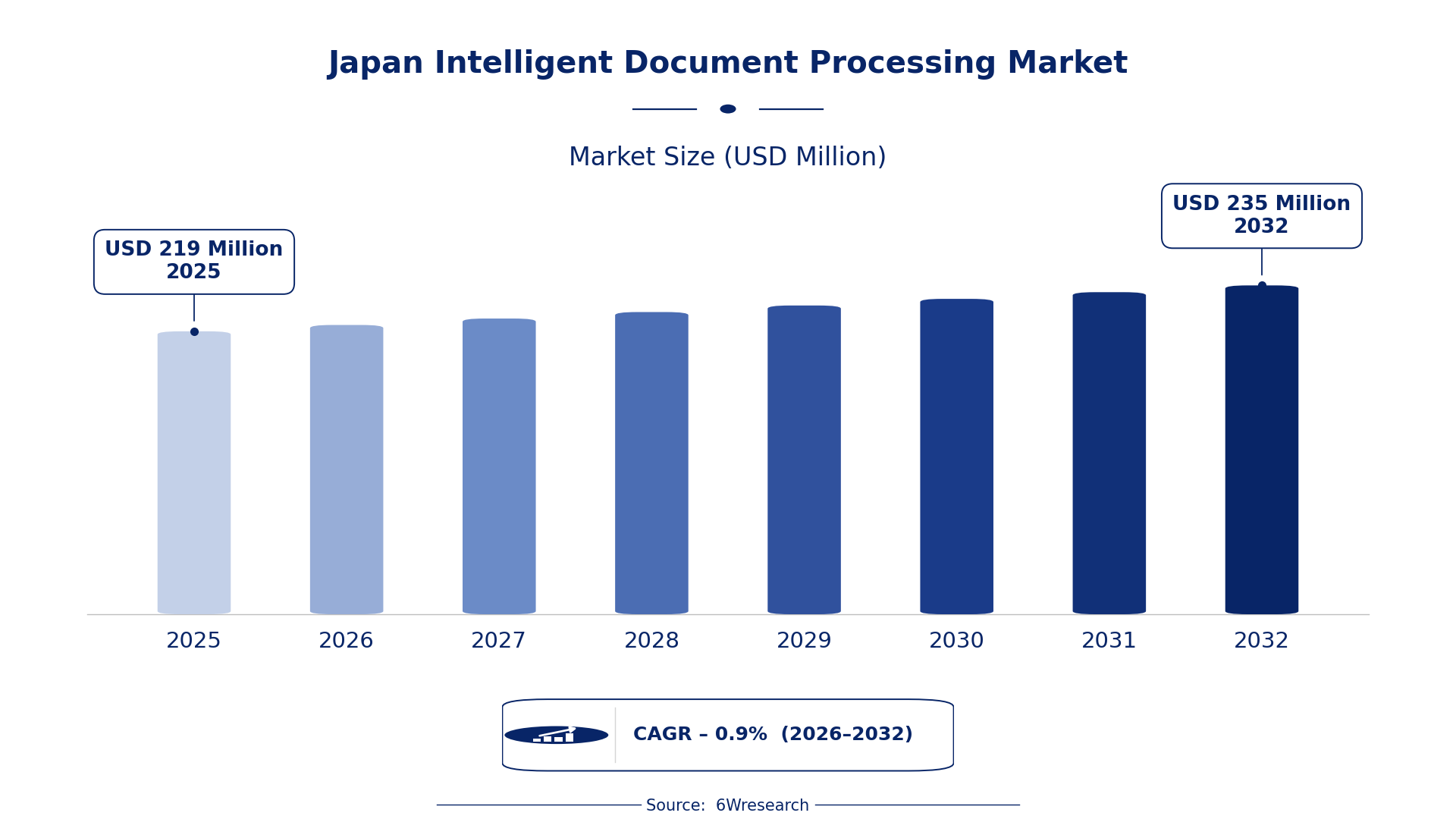
The Japan Intelligent Document Processing Market was estimated at USD 219 Million in 2025 and is projected to reach USD 235 Million by 2032, growing at a CAGR of 0.9% from 2026 to 2032.
Japan Intelligent Document Processing Market Synopsis
The primary force shaping the Japan Intelligent Document Processing Market is the escalating demand for automation across industries. Businesses are increasingly recognizing the value of technology in enhancing document handling efficiency and accuracy, particularly in sectors like finance, healthcare, and legal services.
As organizations strive for operational excellence, Intelligent Document Processing (IDP) solutions are becoming indispensable. The need for precise data extraction and regulatory compliance is pushing companies to adopt advanced technologies, making the IDP market a critical area for investment and innovation.
Japan Intelligent Document Processing Market Year-wise Growth Rate and Key Drivers
This graph illustrates the annual growth rates of the Japan Intelligent Document Processing Market from 2021 to 2032, highlighting a steady upward trajectory and projected expansion over the forecast period.
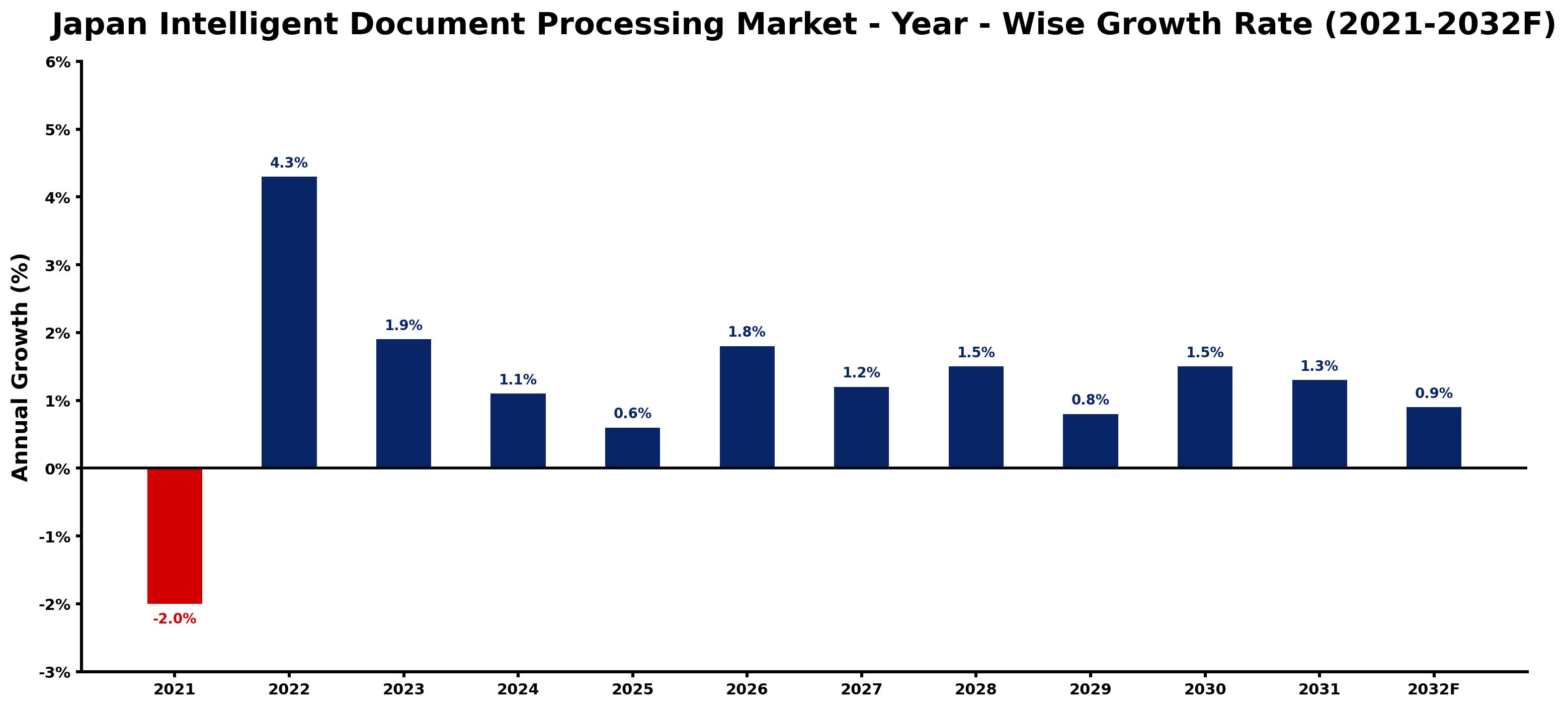
The table below presents the year‑wise growth rates along with the key drivers influencing the market
| Year | Growth Rate | Major Drivers |
| 2021 | -2.0% | Delayed adoption of AI by Japanese enterprises. |
| 2022 | 4.3% | Rise in robotic process automation adoption by enterprises |
| 2023 | 1.9% | Increased need for AI-powered data extraction solutions |
| 2024 | 1.1% | Growing regulations on data privacy and security compliance |
| 2025 | 0.6% | Surge in digitalization of financial services industry |
| 2026 | 1.8% | Increasing investment in cloud-based document management systems |
| 2027 | 1.2% | Demand for improved customer experience in banking sector |
| 2028 | 1.5% | Integration of machine learning in document processing tools |
| 2029 | 0.8% | Focus on efficiency in government document handling processes |
| 2030 | 1.5% | Continuing digital literacy enhancement programs in universities |
| 2031 | 1.3% | Rising competition among fintech firms driving innovation |
| 2032 | 0.9% | Emergence of startups specializing in intelligent document solutions |
Note: Market size estimations and growth projections presented in this report are based on 6Wresearch's proprietary forecasting methodology, utilizing the latest available industry data, government publications, and primary research inputs.
Japan Intelligent Document Processing Market Key Takeaways
Below are some of the specific key takeaways from the market, including:
- The increasing adoption of AI and machine learning is enhancing document processing capabilities.
- Cloud-based solutions are gaining traction for their accessibility and scalability benefits.
- Integration with existing business applications is becoming a standard requirement.
- Compliance and security measures are critical focus areas for businesses implementing IDP solutions.
- The market is characterized by intense competition, with ongoing investments in R&D for innovative solutions.
Evaluation of Restraints in Japan Intelligent Document Processing Market
Despite the promising outlook, several restraints are hindering market growth. A significant barrier is the reluctance of organizations to shift from traditional document processing methods to intelligent solutions. Concerns about data security and compliance with stringent regulations remain prevalent. on top of that, the complexity of integrating new technologies into existing workflows adds another layer of hesitation. The shortage of skilled professionals capable of managing IDP solutions further complicates the landscape, as does the cultural inclination towards manual processes. Addressing these challenges will require a multi-faceted approach, including robust training programs and effective change management strategies.
Japan Intelligent Document Processing Market Trends
The IDP market in Japan is seeing several transformative trends. Chief among these is the rapid adoption of AI and machine learning technologies to improve accuracy in data extraction and classification. There is also a noticeable shift towards cloud-based solutions, which enhance operational scalability. on top of that, the integration of IDP with enterprise resource planning (ERP) systems and customer relationship management (CRM) platforms is becoming increasingly common, facilitating streamlined workflows. As businesses prioritize compliance and security, the demand for advanced protection measures within IDP solutions is also on the rise.
Japan Intelligent Document Processing Market Opportunities
The growing adoption of automation technologies presents substantial investment opportunities within the Japan Intelligent Document Processing Market. Companies that specialize in cutting-edge document processing solutions, particularly those utilizing optical character recognition (OCR), natural language processing (NLP), and machine learning, are well-positioned for growth. As digital transformation initiatives accelerate across industries, there is a pressing need for solutions that enhance workflow efficiency and productivity. Collaborations with local firms and strategic partnerships can further facilitate market entry and expansion, allowing investors to tap into this dynamic sector.
Government Initiatives in the Japan Intelligent Document Processing Market
The Japanese government is actively promoting Intelligent Document Processing technologies to drive digital transformation. Initiatives such as the "Digital Transformation Strategy" and "Society 5.0" highlight the importance of leveraging IDP for increased efficiency and productivity. With incentives and funding programs in place, the government aims to support organizations in adopting these solutions, reinforcing its commitment to fostering a digital and data-driven economy.
- A recent initiative launched in 2025 focuses on funding for small and medium-sized enterprises to implement IDP technologies.
- A currently ongoing program aims to enhance digital literacy and training for professionals in IDP technologies.
- A planned initiative set for 2026 intends to establish a framework for data security standards specifically for IDP processes.
- The government is also working on public-private partnerships to develop a national digital infrastructure upgrade, expected to enhance access to IDP technologies.
Future Insights of the Japan Intelligent Document Processing Market
Looking ahead to 2026-2032, the Japan Intelligent Document Processing Market is set for steady growth. The increasing demand for efficient document management solutions will drive organizations to invest in advanced IDP technologies. Factors such as heightened data accuracy requirements and ongoing digital transformation efforts will further propel market expansion. Additionally, government initiatives to support technological adoption are expected to create a favorable environment for IDP solutions, making this market a focal point for innovation and development.
Japan Intelligent Document Processing Market Latest Developments
Recent activity in the Japan Intelligent Document Processing Market has been marked by significant technological advancements and strategic initiatives. Over the past year, companies have been focusing on enhancing their IDP offerings to meet the growing demands for efficiency and security.
- A major technology vendor launched a new AI-driven IDP solution in Q1 2025, aimed at improving data extraction accuracy for financial institutions.
- An initiative that began in early 2025 is currently underway, involving a collaborative project between several industry players to develop standardized IDP protocols.
- A planned rollout in late 2026 aims to introduce cloud-based IDP services tailored for the healthcare sector, emphasizing patient data security.
- A leading regional operator is expanding its IDP capabilities through a strategic partnership formed in mid-2025, focusing on integrating machine learning algorithms.
Japan Intelligent Document Processing Market - Key Attractiveness of the Report
- 10 Years of Market Numbers
- Historical Data Starting from 2022 to 2025
- Base Year: 2025
- Forecast Data until 2032
- Key Performance Indicators Impacting the Market
- Major Upcoming Developments and Projects
Key Highlights of the Report:
- Japan Intelligent Document Processing Market Outlook
- Market Size of Japan Intelligent Document Processing Market, 2025
- Forecast of Japan Intelligent Document Processing Market, 2032
- Historical Data and Forecast of Japan Intelligent Document Processing Revenues & Volume for the Period 2022-2032F
- Japan Intelligent Document Processing Market Trend Evolution
- Japan Intelligent Document Processing Market Drivers and Challenges
- Japan Intelligent Document Processing Price Trends
- Japan Intelligent Document Processing Porter's Five Forces
- Japan Intelligent Document Processing Industry Life Cycle
- Historical Data and Forecast of Japan Intelligent Document Processing Market Revenues & Volume By Component for the Period 2022-2032F
- Historical Data and Forecast of Japan Intelligent Document Processing Market Revenues & Volume By Solutions for the Period 2022-2032F
- Historical Data and Forecast of Japan Intelligent Document Processing Market Revenues & Volume By Services for the Period 2022-2032F
- Historical Data and Forecast of Japan Intelligent Document Processing Market Revenues & Volume By Vertical for the Period 2022-2032F
- Historical Data and Forecast of Japan Intelligent Document Processing Market Revenues & Volume By BFSI for the Period 2022-2032F
- Historical Data and Forecast of Japan Intelligent Document Processing Market Revenues & Volume By Government for the Period 2022-2032F
- Historical Data and Forecast of Japan Intelligent Document Processing Market Revenues & Volume By Healthcare and Life Sciences for the Period 2022-2032F
- Historical Data and Forecast of Japan Intelligent Document Processing Market Revenues & Volume By Retail and eCommerce for the Period 2022-2032F
- Historical Data and Forecast of Japan Intelligent Document Processing Market Revenues & Volume By Manufacturing for the Period 2022-2032F
- Historical Data and Forecast of Japan Intelligent Document Processing Market Revenues & Volume By Transportation & Logistics for the Period 2022-2032F
- Historical Data and Forecast of Japan Intelligent Document Processing Market Revenues & Volume By Other Verticals (ITeS, telecom, HR, CRM, sales, education, and energy and utilities) for the Period 2022-2032F
- Historical Data and Forecast of Japan Intelligent Document Processing Market Revenues & Volume By Deployment Mode for the Period 2022-2032F
- Historical Data and Forecast of Japan Intelligent Document Processing Market Revenues & Volume By Cloud for the Period 2022-2032F
- Historical Data and Forecast of Japan Intelligent Document Processing Market Revenues & Volume By On-Premises for the Period 2022-2032F
- Historical Data and Forecast of Japan Intelligent Document Processing Market Revenues & Volume By Organization Size for the Period 2022-2032F
- Historical Data and Forecast of Japan Intelligent Document Processing Market Revenues & Volume By SMEs for the Period 2022-2032F
- Historical Data and Forecast of Japan Intelligent Document Processing Market Revenues & Volume By Large Enterprises for the Period 2022-2032F
- Historical Data and Forecast of Japan Intelligent Document Processing Market Revenues & Volume By Technology for the Period 2022-2032F
- Historical Data and Forecast of Japan Intelligent Document Processing Market Revenues & Volume By Natural Language Processing (NLP) for the Period 2022-2032F
- Historical Data and Forecast of Japan Intelligent Document Processing Market Revenues & Volume By Optical Character Recognition (OCR) for the Period 2022-2032F
- Historical Data and Forecast of Japan Intelligent Document Processing Market Revenues & Volume By Machine Learning (ML) for the Period 2022-2032F
- Historical Data and Forecast of Japan Intelligent Document Processing Market Revenues & Volume By Artificial Intelligence (AI) for the Period 2022-2032F
- Historical Data and Forecast of Japan Intelligent Document Processing Market Revenues & Volume By Robotic Process Automation (RPA) for the Period 2022-2032F
- Historical Data and Forecast of Japan Intelligent Document Processing Market Revenues & Volume By Google Vision for the Period 2022-2032F
- Historical Data and Forecast of Japan Intelligent Document Processing Market Revenues & Volume By Deep Learning (DL) for the Period 2022-2032F
- Historical Data and Forecast of Japan Intelligent Document Processing Market Revenues & Volume By Vision API for the Period 2022-2032F
- Japan Intelligent Document Processing Import Export Trade Statistics
- Market Opportunity Assessment By Component
- Market Opportunity Assessment By Vertical
- Market Opportunity Assessment By Deployment Mode
- Market Opportunity Assessment By Organization Size
- Market Opportunity Assessment By Technology
- Japan Intelligent Document Processing Top Companies Market Share
- Japan Intelligent Document Processing Competitive Benchmarking By Technical and Operational Parameters
- Japan Intelligent Document Processing Company Profiles
- Japan Intelligent Document Processing Key Strategic Recommendations






































